Writing is the correct spelling, while writeing is a common misspelling. If you’ve come across the words “writing” and “writeing” and wondered which one is correct, the difference comes down to how the verb write changes when the -ing ending is added. This spelling rule is closely connected to English spelling patterns, verb forms, suffixes, present participles, and common spelling mistakes.
The writing vs writeing difference is simple: writing is the standard and correct form of the verb write, while writeing is incorrect in standard English. When -ing is added to write, the final silent e is dropped, producing writing, not writeing. Similar spelling changes occur in words such as making, taking, and coming.
In this guide, you’ll learn why “writing” is correct, why “writeing” is incorrect, how the spelling rule works, and how to use “writing” correctly in sentences. You’ll also see clear examples and comparisons with similar -ing forms to make the rule easy to remember.
By the end, you’ll know exactly when to use writing instead of writeing and why dropping the final e is necessary when forming the present participle of write.
Writing vs Writeing: Quick Answer
The correct spelling is writing.
Writeing is a misspelling. It is not an alternative British or American spelling, and it should not be used in formal or standard written English.
| Spelling | Correct? | Explanation |
| Writing | ✅ Yes | Correct form of write + -ing |
| Writeing | ❌ No | Incorrectly keeps the final e |
| Write | ✅ Yes | Base form of the verb |
| Wrote | ✅ Yes | Simple past tense |
| Written | ✅ Yes | Past participle |
| Writting | ❌ No | Another common misspelling, but different from writeing |
The basic transformation is:
WRITE − E + ING = WRITING
The important point is that the final e is removed before -ing is added. Cambridge’s spelling guidance specifically lists write → writing under the rule for dropping a final e before an -ing suffix.
Is Writing or Writeing Correct?
Writing Is the Correct Spelling
Writing is the standard spelling of the present participle of write. It can also function as a gerund or noun, depending on the sentence.
For example:
- I am writing an email.
- She is writing a novel.
- Writing takes practice.
- His writing has improved considerably.
Major dictionaries list writing as the present participle of write. Collins, for example, gives the verb forms as writes, writing, wrote, and written.
Writeing Is a Misspelling
Writeing incorrectly preserves the final e from write.
The error usually happens because someone sees:
write + ing
and assumes that the two parts can simply be joined.
English spelling does not work that way in this case. The final e is removed first:
write → writ → writing
So this is correct:
She is writing a letter.
This is incorrect:
She is writeing a letter.
The second version may still be understandable because the intended word is obvious, but it does not follow standard English spelling.
Why Is Writing Spelled Without an E?
The Silent E Rule
The main reason is the silent-e spelling rule.
Many English words end in a final e that is not pronounced. When a suffix beginning with a vowel is added, that final e is often removed.
For example:
| Base word | Add | Correct form |
| hope | -ing | hoping |
| make | -ing | making |
| take | -ing | taking |
| drive | -ing | driving |
| smile | -ing | smiling |
| use | -ing | using |
| write | -ing | writing |
Cambridge Dictionary describes this as a general pattern: a final -e is often dropped when a suffix beginning with a vowel is added. It specifically gives write → writing as an example.
How Write Becomes Writing
You can break the spelling into three simple steps:
Step 1: Start with write.
Step 2: Remove the final e.
write → writ
Step 3: Add -ing.
writ + ing → writing
Therefore:
write + ing = writing
Not:
write + ing = writeing
This is why the spelling writeing should be avoided.
Why the Final E Is Dropped
The final e in write is part of the base word, but it is not retained when -ing is attached.
The same pattern occurs with many common verbs:
- make → making
- bake → baking
- take → taking
- give → giving
- drive → driving
- save → saving
- close → closing
- dance → dancing
- write → writing
The rule is not limited to write. It is part of a broader English spelling pattern involving suffixes.
Writing Meaning and Definition
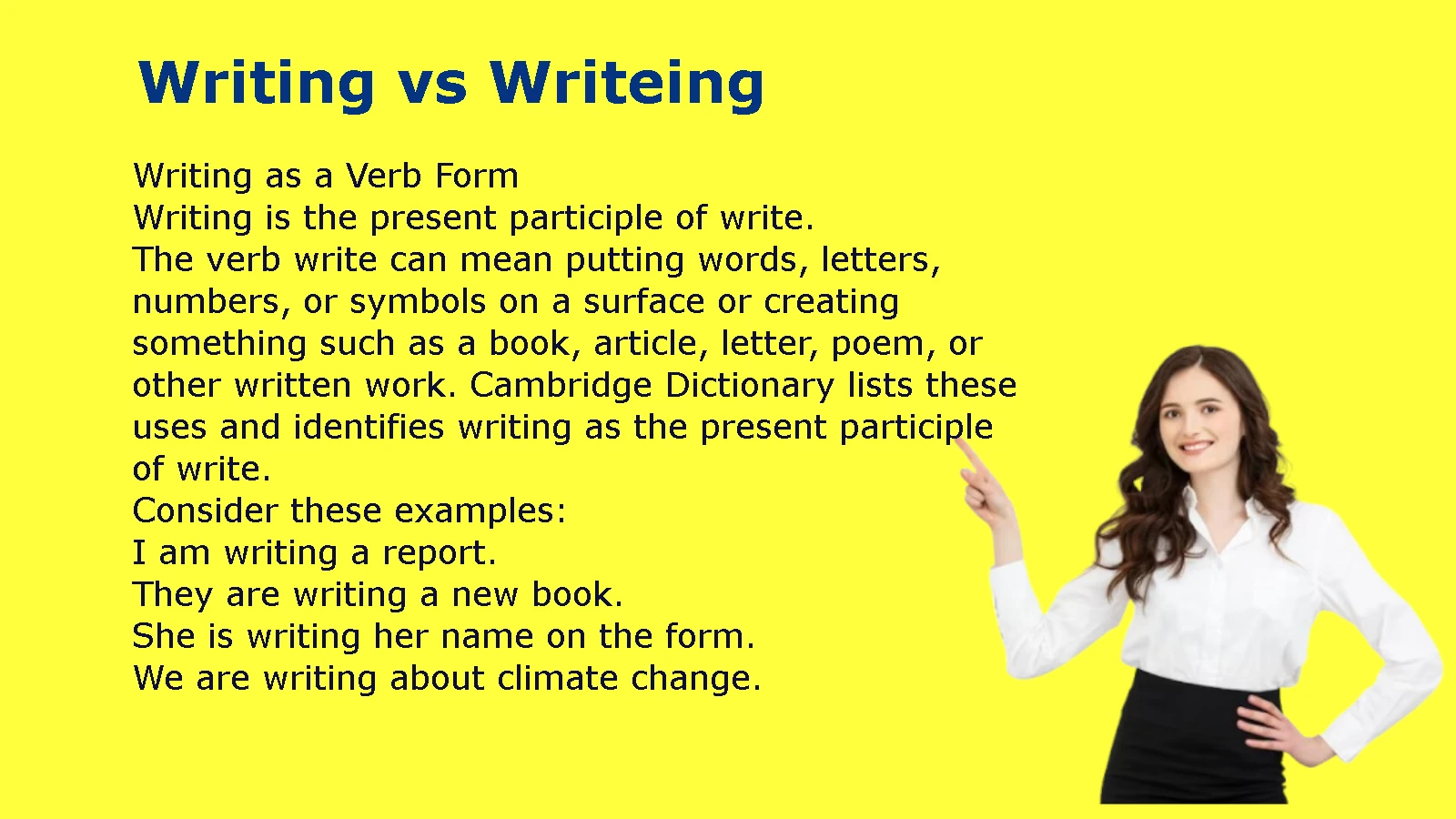
The verb write can mean putting words, letters, numbers, or symbols on a surface or creating something such as a book, article, letter, poem, or other written work. Cambridge Dictionary lists these uses and identifies writing as the present participle of write.
Consider these examples:
- I am writing a report.
- They are writing a new book.
- She is writing her name on the form.
- We are writing about climate change.
In these sentences, writing describes an action that is happening.
The verb can refer to handwriting, typing, composing, or producing written material. You can therefore write with a pen, keyboard, or another method of producing text.
Writing as a Noun
Writing can also function as a noun.
For example:
Writing requires patience and practice.
Here, writing is not describing what someone is doing at that exact moment. It refers to the activity or skill of producing written material.
The noun writing can also refer to written material itself:
- Her writing is easy to understand.
- I enjoyed his writing.
- The writing on the wall was difficult to read.
- Academic writing requires careful organization.
Dictionary.com lists several noun meanings for writing, including the act of writing, written material, a literary composition, and the profession or practice of writing.
Writing vs Writeing Examples
Seeing the two spellings side by side makes the difference easier to remember.
Correct Examples With Writing
Here are several correct examples:
- I am writing a message to my friend.
- She is writing an article about grammar.
- They were writing their answers when the bell rang.
- He enjoys writing short stories.
- We are writing a report for the client.
- The students are writing essays.
- I spent the morning writing emails.
- She has been writing since breakfast.
- Writing clearly takes practice.
- His writing style is concise and direct.
Notice that writing always appears without the e after the t.
Incorrect Examples With Writeing
These examples contain the common spelling error:
- ❌ I am writeing an email.
- ❌ She is writeing a report.
- ❌ They were writeing notes.
- ❌ He enjoys writeing stories.
- ❌ We are writeing a proposal.
The corrected versions are:
- ✅ I am writing an email.
- ✅ She is writing a report.
- ✅ They were writing notes.
- ✅ He enjoys writing stories.
- ✅ We are writing a proposal.
The mistake is always the same: the writer has retained the final e from write.
Writing in Different Grammar Contexts
Writing as the Present Participle
A present participle is the -ing form of a verb. With write, that form is writing.
For example:
She is writing a novel.
The verb phrase is writing uses the present participle.
Other examples include:
- I am writing.
- You are writing.
- He is writing.
- We are writing.
- They are writing.
The form remains writing regardless of the subject.
Writing in the Present Progressive
The present progressive, also called the present continuous, uses a form of be followed by a present participle.
Therefore:
am/is/are + writing
Examples:
- I am writing a letter.
- She is writing a story.
- He is writing an email.
- We are writing a report.
- They are writing an assignment.
The spelling does not change to writeing.
Writing as a Gerund
An -ing form can also function as a gerund, meaning it acts as a noun in a sentence.
For example:
Writing improves communication skills.
Here, writing is the subject of the sentence.
Another example is:
She enjoys writing.
In this sentence, writing functions as the object of the verb enjoys.
You can therefore see writing in several grammatical roles:
| Use | Example |
| Present participle | She is writing a letter. |
| Gerund | Writing takes practice. |
| Noun | His writing is clear. |
| Part of a verb phrase | They were writing notes. |
The spelling remains the same in each case.
Write, Wrote, Written, and Writing Compared
One reason people make mistakes with writing is that write has several irregular forms.
| Word | Grammatical form | Example |
| write | Base form | I write every day. |
| writes | Third-person singular present | She writes every morning. |
| writing | Present participle / -ing form | She is writing now. |
| wrote | Simple past | She wrote yesterday. |
| written | Past participle | She has written three pages. |
Collins and Cambridge both identify writing, wrote, and written as forms of write.
Consider this sequence:
Today I write.
Yesterday I wrote.
Right now I am writing.
I have written three pages.
These forms are related, but they cannot be substituted freely.
Write vs Writing
Write is the base form.
I want to write a book.
Writing is the -ing form.
I am writing a book.
The difference is grammatical rather than simply a spelling difference.
Writing vs Written
Writing usually describes an ongoing action or functions as a noun.
She is writing a report.
Written is the past participle.
She has written a report.
Therefore, these sentences have different meanings:
- She is writing the report. — The action is in progress.
- She has written the report. — The report has been completed.
Common Words That Follow the Same Spelling Pattern
The spelling pattern behind writing vs writeing appears in many familiar verbs.
Make → Making
The final e disappears:
make → making
Not:
makeing
Example:
She is making dinner.
Take → Taking
The final e is dropped:
take → taking
Example:
He is taking notes.
Come → Coming
The same pattern applies:
come → coming
Example:
They are coming home.
Use → Using
The final e disappears:
use → using
Example:
We are using a new system.
Give → Giving
The transformation is:
give → giving
Example:
She is giving a presentation.
These examples show why write → writing is not unusual. It follows a well-established spelling pattern.
Common Mistakes With Writing
Adding the E Before -ing
The most direct error is:
❌ writeing
The writer has simply attached -ing to the unchanged base word.
Correct it by removing the final e:
write → writing
A useful mental formula is:
WRITE − E + ING = WRITING
Confusing Writing With Written
Because writing and written are both forms of write, learners sometimes use the wrong one.
Compare:
She is writing a book.
with:
She has written a book.
The first sentence describes an ongoing activity. The second uses the past participle and indicates a completed action in the present perfect construction.
Confusing Writing With Wrote
The simple past of write is wrote, not writing.
Incorrect:
❌ Yesterday, I writing a letter.
Correct:
✅ Yesterday, I wrote a letter.
For an ongoing action in the past, use was/were writing:
Yesterday at noon, I was writing a letter.
That distinction is grammatical, not merely orthographic.
Writing vs Writting: What Is the Difference?
Although the target spelling error here is writeing, another frequent mistake is writting.
The correct form is:
writing
Neither writeing nor writting is the standard spelling.
The two errors arise from different mistakes.
| Incorrect form | Likely mistake | Correct form |
| writeing | Keeping the final e | writing |
| writting | Doubling the t | writing |
The spelling writting may look plausible because English does double consonants in words such as running and sitting. However, write does not follow that pattern.
The correct transformation is simply:
write → writing
There is no second t.
Why Doesn’t the T Double in Writing?
Consonant doubling is a separate spelling pattern.
Compare:
- run → running
- sit → sitting
- stop → stopping
Those verbs have spelling patterns that can trigger consonant doubling before -ing.
Write is different. It ends in a silent e, so the relevant change is the removal of that final e.
Therefore:
write → writing
not:
write → writting
The key is not to apply multiple spelling rules at the same time. Once the silent-e rule gives you writ, you simply add -ing.
Writing vs Writeing: Comparison Table
| Feature | Writing | Writeing |
| Standard English | ✅ Yes | ❌ No |
| Dictionary form | ✅ Yes | ❌ No |
| Comes from write | ✅ Yes | Intended to, but incorrectly formed |
| Uses the suffix -ing | ✅ Yes | Yes, but incorrectly attached |
| Final e retained | ❌ No | ✅ Incorrectly retained |
| Suitable for formal writing | ✅ Yes | ❌ No |
| Suitable for academic work | ✅ Yes | ❌ No |
| Correct in British English | ✅ Yes | ❌ No |
| Correct in American English | ✅ Yes | ❌ No |
There is no British-versus-American spelling difference here. Both varieties use writing.
Writing vs Writeing in American and British English
Some English spellings vary between American and British English.
For example:
| British English | American English |
| colour | color |
| centre | center |
| analyse | analyze |
| programme | program |
| travelling | traveling |
However, writing is not one of those differences.
Both British and American English use:
writing
and not:
writeing
Cambridge’s guidance distinguishes genuine British-American spelling differences while treating the spelling rules for forms such as write → writing separately.
That means changing your regional English setting will not make writeing correct.
A Simple Way to Remember Writing
If you regularly hesitate between writing vs writeing, return to the base word.
Start with:
WRITE
Then ask:
What happens when I add -ing?
Remove the final e:
WRIT
Add ING:
WRITING
The entire process can be remembered as:
WRITE − E + ING = WRITING
This works especially well because the same idea applies to many other words:
- make → making
- take → taking
- drive → driving
- hope → hoping
- smile → smiling
- use → using
- write → writing
Cambridge and several educational spelling guides describe this final-e pattern directly.
When Should You Keep the Final E?
The rule is useful, but it is important not to turn it into an absolute rule for every English word.
A final e is often dropped before a suffix beginning with a vowel, such as -ing. However, English has exceptions.
For example:
- see → seeing
- agree → agreeing
- dye → dyeing
- singe → singeing
Cambridge specifically notes that final e is retained in forms such as dyeing and singeing, partly to distinguish them from dying and singing.
That is why the safest approach is to learn the general pattern while recognizing that English spelling has exceptions.
For write, however, there is no such exception:
write → writing
A Closer Look at the Silent E in Write
The e in write is not pronounced as a separate sound at the end of the word.
The word is pronounced approximately:
/raɪt/
The final e therefore does not create an additional spoken syllable.
Its spelling role is important, though. The written e is part of the traditional spelling of write and helps distinguish it from forms such as writ.
When -ing is added, the spelling changes:
write → writing
The pronunciation also changes in a predictable way:
write → /raɪt/
writing → /ˈraɪtɪŋ/
The final e is no longer present in the spelling.
Why Writeing Looks Tempting
The spelling writeing seems logical if you treat suffix addition as a simple process of attaching letters.
Someone might reason:
write + ing = writeing
That reasoning would work for some words in which no spelling change is required, but it does not work here.
English spelling frequently modifies a base word when an ending is attached. The important lesson is that suffixes can trigger spelling changes.
Compare:
- hope + ing → hoping
- love + ing → loving
- take + ing → taking
- write + ing → writing
Educational spelling references use this exact type of example to teach the dropping-final-e rule.
Common Sentences With Writing
Here are practical examples showing how writing works in everyday English.
Everyday Communication
- I am writing you a quick message.
- She is writing an email to her manager.
- He spends his evenings writing.
- We are writing down the instructions.
Academic English
- Writing clearly is important in academic work.
- The students are writing their final essays.
- She is writing a research paper.
- Good academic writing requires organization and evidence.
Professional English
- I am writing to confirm our meeting.
- He is writing a report for the client.
- The team is writing a new policy document.
- She has experience writing technical documentation.
Creative Writing
- She is writing a novel.
- He enjoys writing short stories.
- They are writing a screenplay.
- The author has been writing for more than a decade.
In every example, writing retains its standard spelling.
A Practical Editing Test for Writing
When proofreading, use this quick three-step test.
Check the Base Word
Ask:
What is the base verb?
For writing, the answer is write.
Check the Ending
Ask:
Am I adding -ing?
If yes, check whether the base word ends in a final e.
Apply the Spelling Change
If the word follows the normal silent-e pattern, remove the e.
So:
write + ing → writing
This simple check can catch the error before it appears in an email, essay, article, résumé, report, or assignment.
Case Study: Correcting a Common Sentence
Consider this sentence:
❌ I am writeing an article for my website.
The intended verb is write, and the sentence uses the present progressive construction am + -ing form.
Start with the base:
write
Add the required -ing ending:
write + ing
Apply the final-e rule:
writ + ing
Final result:
✅ I am writing an article for my website.
The correction requires only one change: remove the unnecessary e.
This example also shows why understanding the rule is more useful than memorizing isolated spellings. Once you know how write behaves before -ing, the correct form becomes predictable.
Frequently Asked Questions About Writing vs Writeing
Is writing or writeing correct?
Writing is correct. Writeing is a misspelling.
The word comes from the verb write. When -ing is added, the final e is dropped:
write → writing
Why is writing spelled without an e?
Because English commonly drops the final e from a word when a suffix beginning with a vowel is added. Since -ing begins with a vowel, write becomes writing.
Is writeing ever correct?
No. Writeing is not the standard spelling of the -ing form of write. Use writing instead.
What is the correct spelling of writing in British English?
The correct British English spelling is writing.
What is the correct spelling of writing in American English?
The correct American English spelling is also writing.
There is no regional spelling variation between writing and writeing.
What is the difference between writing and written?
Writing is the present participle and can also function as a gerund or noun.
She is writing a report.
Written is the past participle.
She has written a report.
The two forms have different grammatical functions.
What is the difference between writing and wrote?
Wrote is the simple past form of write.
She wrote a letter yesterday.
Writing is the -ing form.
She is writing a letter now.
Why isn’t it writting?
The correct spelling is writing, not writting.
The word write follows the final-e rule. Remove the e and add -ing:
write → writing
You do not double the t.
What is the spelling rule for words ending in silent e?
A common rule is to drop the final e when adding a suffix beginning with a vowel, including -ing.
Examples include:
- hope → hoping
- make → making
- drive → driving
- write → writing
There are exceptions, so the rule should be treated as a general spelling pattern rather than an absolute formula.
How do you spell writing correctly?
Spell it:
W-R-I-T-I-N-G
The correct word contains one t and no e after the t.
Is writing a verb or a noun?
It can be both, depending on the sentence.
As a verb:
She is writing a report.
As a noun:
Writing takes practice.
It can also refer to written material:
His writing is clear and concise.
Dictionary sources recognize these different uses of writing.
Key Takeaway
When choosing between writing vs writeing, use writing.
The correct spelling follows a standard English spelling pattern:
WRITE − E + ING = WRITING
The final e in write is dropped before -ing is added. The resulting word has one t, no e, and ends in -ing.
Remember these forms together:
| Correct form | Use |
| write | Base verb |
| writes | Third-person singular present |
| writing | Present participle / gerund |
| wrote | Simple past |
| written | Past participle |
The easiest memory trick is simple: write loses its final e before -ing.
So if you are ever unsure, don’t write writeing. Go back to the base word, remove the final e, and add -ing:
write → writing
That rule gives you the correct spelling every time in this case.