Planned vs planed is a common spelling confusion, especially because both words are pronounced similarly but have completely different meanings. If you’ve come across “planned” and “planed” and wondered which spelling is correct, the difference becomes much clearer once you understand how each word is used. Planned is related to making arrangements or deciding what you intend to do, while planed usually refers to smoothing or shaping something with a plane.
The planned vs planed distinction depends on the meaning and context of the sentence. Planned is the past tense and past participle of plan, and it means arranged, intended, or prepared in advance. Planed is the past tense and past participle of plane, a verb that means to smooth or shape a surface with a woodworking tool called a plane. Related terms include plan, planning, planned, plane, woodworking, arranged, scheduled, prepared, and intended.
In this guide, you’ll learn the difference between planned and planed, what each word means, when to use planned or planed, and why these two words are often confused. You’ll also see clear examples, simple explanations, and practical sentence comparisons to help you remember the correct spelling.
By the end, you’ll know exactly when to use “planned” and “planed” and how to avoid this common spelling mistake in your writing.
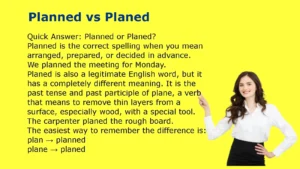
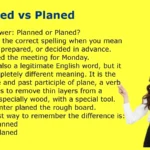
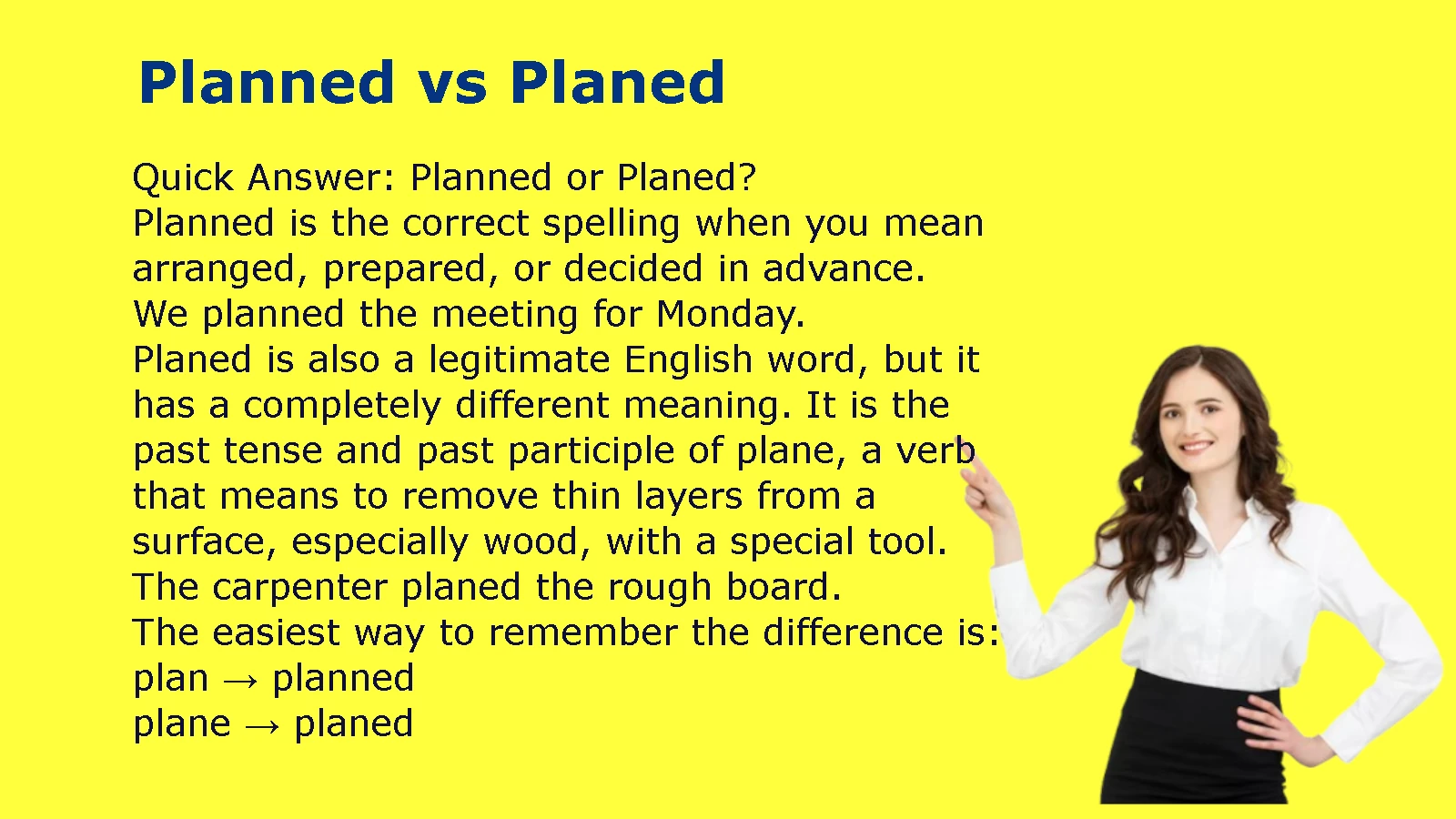
Quick Answer: Planned or Planed?
Planned is the correct spelling when you mean arranged, prepared, or decided in advance.
We planned the meeting for Monday.
Planed is also a legitimate English word, but it has a completely different meaning. It is the past tense and past participle of plane, a verb that means to remove thin layers from a surface, especially wood, with a special tool.
The carpenter planed the rough board.
The easiest way to remember the difference is:
plan → planned
plane → planed
The extra n in planned isn’t optional. It’s part of the standard spelling of the past tense and past participle of plan. Cambridge lists planned as both the past simple and past participle of plan.
What Does Planned Mean?
Planned is the past tense and past participle of the verb plan.
The verb plan means to think about something in advance and decide what you’re going to do or how you’re going to do it. It can describe anything from a simple weekend activity to a large business project.
For example:
- We planned a family vacation.
- She planned the entire event.
- They planned to leave early.
- The company planned a major expansion.
- He carefully planned his presentation.
In each sentence, planned refers to an action or decision that someone arranged or considered beforehand.
Planned as a Verb
As a verb, planned tells you that someone made arrangements or formed an intention in the past.
Consider this sentence:
Maria planned the meeting for Friday.
Maria didn’t simply attend the meeting. She made the decision and arrangements for it to happen on Friday.
You can also use planned with to + verb:
- I planned to call you.
- She planned to study abroad.
- They planned to move next year.
- We planned to arrive before noon.
You can also use it with on + -ing:
- She planned on staying for another week.
- They planned on visiting the museum.
The exact construction can vary depending on the sentence, but the spelling of the past tense remains planned.
Planned as an Adjective
Planned can also work as an adjective when it describes something that was arranged or intended.
For example:
- a planned event
- a planned meeting
- a planned shutdown
- a planned renovation
- a planned expansion
- a planned response
In these expressions, planned tells you that something was deliberate rather than accidental.
For example:
The hospital announced a planned maintenance shutdown.
The shutdown wasn’t an unexpected failure. Someone arranged it in advance.
Cambridge’s thesaurus groups planned with words such as intentional, intended, designed, deliberate, and thought out, depending on context.
What Does Planed Mean?
Planed is a real word, but it doesn’t mean arranged in advance.
It is the past tense and past participle of plane when plane functions as a verb.
To plane something means to remove thin layers from a surface with a special tool. The word commonly appears in woodworking and carpentry. Cambridge defines plane as removing small strips of wood from a surface with a special tool.
For example:
The carpenter planed the rough board until it was smooth.
Here, planed has nothing to do with making a schedule or deciding what to do.
It describes physical work performed on a material.
Examples of Planed
Here are several natural examples:
- The carpenter planed the wooden board.
- He planed the door because it was sticking.
- The rough timber was planed before it was painted.
- She planed the surface until it was smooth.
- The craftsman planed a thin layer from the wood.
The context usually makes the meaning obvious. Words such as wood, board, timber, surface, carpenter, and smooth often signal that planed comes from plane.
Planned vs Planed: What’s the Difference?
The difference is easier to understand when you look at the words they come from.
Planned comes from plan.
Planed comes from plane.
Those base words have different meanings:
- plan = decide or arrange what you intend to do
- plane = remove thin layers from a surface using a plane
That produces two completely different words.
| Word | Base Word | Past Tense | Main Meaning |
| plan | plan | planned | Arranged or decided beforehand |
| plane | plane | planed | Smoothed or shaped with a plane |
Compare these sentences:
We planned the renovation.
The carpenter planed the wooden door.
The first sentence concerns preparation. The second concerns woodworking.
Planned
Use planned when you’re talking about:
- arranging an event
- deciding what to do
- preparing a project
- intending to do something
- organizing a trip
- scheduling an activity
- designing an approach
- preparing for a future event
Planed
Use planed when you’re talking about:
- smoothing wood
- removing thin layers from wood
- shaping a wooden surface
- preparing timber
- using a woodworking plane
That’s why you can’t substitute one word for the other.
Incorrect: We planed the meeting for Friday.
Correct: We planned the meeting for Friday.
And:
Incorrect: The carpenter planned the rough board smooth.
Correct: The carpenter planed the rough board smooth.
The spelling isn’t merely a matter of style. The words carry different meanings.
Why Is Planned Spelled With Two Ns?
The spelling planned follows a standard English spelling pattern involving the doubling of a final consonant.
The base word is:
plan
When you add -ed, the final n doubles:
plan + ed = planned
The same thing happens when you add -ing:
plan + ing = planning
Cambridge’s spelling guidance explains that English often doubles a final consonant when a suffix beginning with a vowel is added. It gives examples such as hop → hopped, rub → rubbed, and sit → sitting. It specifically identifies plan → planned and plan → planning as examples of this pattern.
The Basic Pattern
For a short word such as plan, the pattern can be represented as:
short vowel + single final consonant
In plan:
- p = first consonant
- a = short vowel
- n = final consonant
When -ed is added, the final consonant doubles:
plan → planned
When -ing is added:
plan → planning
This is why planed is not the normal past-tense spelling of plan.
Why “Planed” Is Wrong When You Mean “Planned”
If you write:
I planed the vacation.
you have technically used a real English word, but you’ve changed the meaning.
The reader could interpret planed as the past tense of plane. That’s a woodworking verb, not the verb plan.
The intended sentence is:
I planned the vacation.
The extra n preserves the connection to the base word plan.
Planned vs Planed: Plan + Ed vs Plane + Ed
This is the most useful spelling comparison in the entire topic.
Plan → Planned
The base word is plan.
Add -ed:
plan + ed → planned
The final n doubles.
Plane → Planed
The base word is plane.
Add -ed:
plane + ed → planed
The final e is removed:
plane + d → planed
That’s why the two forms look so similar while following different spelling patterns.
| Base Word | Suffix | Result |
| plan | -ed | planned |
| plan | -ing | planning |
| plane | -ed | planed |
| plane | -ing | planing |
This four-word comparison is worth remembering because it prevents several common spelling errors at once.
Why Is Planed Spelled With One N?
The answer becomes straightforward once you identify its base word.
Planed comes from plane, not plan.
The verb plane ends in a silent e. When you form its past tense with -ed, the final e is removed and -d is added:
plane → planed
The result contains only one n because the base word itself contains only one n.
So:
- plan → planned
- plane → planed
Don’t try to choose between them based on how they look. Start with the meaning and identify the base word.
Planned vs Planed in Sentences
Seeing the words in context makes the difference much easier to remember.
Examples With Planned
We planned the wedding six months in advance.
She planned a surprise birthday party.
They planned to arrive before sunset.
The team planned the project carefully.
I had planned to call you yesterday.
The company planned a major product launch.
Each example involves intention, preparation, organization, or arrangements.
Examples With Planed
The carpenter planed the board.
He planed the door to make it fit the frame.
The craftsman planed the timber before assembling the cabinet.
She planed the rough surface until it was smooth.
The board was planed on both sides.
These examples involve removing material from a surface.
Planned vs Planed: A Simple Context Test
When you’re unsure which spelling to use, ask one question:
Am I talking about making arrangements or smoothing a surface?
If you’re making arrangements, choose planned.
If you’re smoothing or shaping something with a plane, choose planed.
For example:
We planned the construction project.
You’re discussing preparation.
We planed the construction material.
You’re discussing woodworking.
The surrounding noun often provides a useful clue. Words such as meeting, trip, event, project, vacation, schedule, and strategy strongly suggest planned.
Words such as wood, board, timber, door, surface, and carpenter can point toward planed.
Common Mistakes With Planned and Planed
The biggest mistake is using planed when you mean planned.
Mistake: Planed Instead of Planned
Incorrect: We planed the conference for next month.
Correct: We planned the conference for next month.
The conference wasn’t smoothed with a woodworking tool. It was arranged.
Mistake: Planned Instead of Planed
The reverse mistake is less common but still possible.
Incorrect: The carpenter planned the board smooth.
Correct: The carpenter planed the board smooth.
Here, the verb describes the physical removal of material from the board.
Mistake: Planing Instead of Planning
This is another important distinction.
Planning = arranging or preparing
Planing = smoothing or shaping with a plane
For example:
We are planning the project.
The carpenter is planing the board.
Cambridge identifies planning as the present participle of plan and planing as the present participle of plane.
Planned vs Planed vs Planning vs Planing
These four forms are easy to confuse because they share most of their letters.
| Word | Base Verb | Form | Meaning |
| planned | plan | Past tense/past participle | Arranged beforehand |
| planning | plan | Present participle | Arranging or preparing |
| planed | plane | Past tense/past participle | Smoothed with a plane |
| planing | plane | Present participle | Smoothing with a plane |
Consider these examples:
We are planning a trip.
We planned the trip last week.
The carpenter is planing the board.
The carpenter planed the board yesterday.
Once you connect each word to its base verb, the spelling becomes much easier.
The Spelling Rule Behind Planned
The spelling of planned isn’t random. It reflects a common English doubling pattern.
When a short word ends in a single consonant after a short vowel, adding a suffix that begins with a vowel often causes that final consonant to double.
Examples include:
- stop → stopped
- shop → shopped
- rub → rubbed
- sit → sitting
- plan → planned
- plan → planning
Cambridge’s grammar guidance describes this consonant-doubling pattern and notes that the vowel before the final consonant is typically short in these examples.
Why This Matters
Knowing the pattern is more useful than memorizing planned as an isolated spelling.
If you understand why plan becomes planned, you can also recognize why planning has two Ns.
That gives you a practical spelling family:
plan → planned → planning
You don’t have to guess each form separately.
Planned in American and British English
Planned is spelled the same way in American and British English.
There is no American spelling such as planed that replaces planned when the meaning is “arranged beforehand.”
Likewise, planed remains the correct form when you’re talking about the woodworking verb plane.
| Meaning | American English | British English |
| Arranged beforehand | planned | planned |
| Arranging or preparing | planning | planning |
| Smoothed with a plane | planed | planed |
| Smoothing with a plane | planing | planing |
So if you’re writing for a US audience, use planned exactly as you would for a British audience when discussing arrangements.
This isn’t one of those spelling differences where American and British English use different forms.
How to Use Planned Correctly
Planned works in many common grammatical structures.
Planned + Noun
Use planned directly before a noun when describing something arranged or intended.
Examples:
- a planned event
- a planned meeting
- a planned trip
- a planned expansion
- a planned shutdown
- a planned project
- a planned response
For example:
The company announced a planned expansion.
The expansion has been arranged or intended rather than happening unexpectedly.
Planned to + Verb
You can use planned to before a base-form verb.
Examples:
- She planned to travel in June.
- We planned to meet at noon.
- They planned to move next year.
- I planned to finish the report before Friday.
The structure is:
planned + to + base verb
Planned on + -ing
In contexts where plan on is used, follow it with a gerund.
Examples:
- We planned on staying for another night.
- She planned on applying for the position.
- They planned on visiting the museum.
Cambridge lists plan on doing something as a standard construction.
Was/Were Planned
Use was planned or were planned when something was arranged in advance.
Examples:
The meeting was planned for Tuesday.
Several changes were planned for the new version.
This construction often appears in professional and academic writing.
Has/Have Planned
Use has planned or have planned when the planning happened at some point before now and remains relevant.
Examples:
She has planned everything carefully.
They have planned the next stage of the project.
Had Planned
Use had planned when the planning occurred before another past event.
For example:
We had planned to leave early, but the storm delayed us.
The planning happened first. The delay happened later.
Common Phrases With Planned
The word planned appears in many common expressions.
Carefully Planned
It was a carefully planned campaign.
This emphasizes preparation and deliberate decision-making.
Well Planned
The event was well planned from start to finish.
This means the organizers handled the arrangements effectively.
Poorly Planned
The project failed because it was poorly planned.
This means the preparation or organization was inadequate.
Planned in Advance
The visit was planned in advance.
The phrase reinforces the idea of prior preparation.
Planned Ahead
We planned ahead to avoid last-minute problems.
This expression emphasizes preparing before something happens.
As Planned
Everything went as planned.
This means an event happened according to the intended arrangement.
The expression as planned is especially common in everyday, professional, and technical writing. Cambridge also gives examples of go ahead as planned and longer than planned.
Common Phrases With Planed
Because planed has a specialized meaning, its common combinations tend to appear in woodworking and construction contexts.
Examples include:
- planed wood
- planed timber
- planed board
- planed surface
- planed smooth
- planed door
- planed lumber
For example:
The cabinet was made from carefully planed wood.
The adjective-like use of planed tells you that the wood has undergone the planing process.
A Practical Case Study: Choosing the Correct Word
Imagine you’re writing this sentence:
The team ___ the conference six months ago.
You have two options:
- planed
- planned
Start with the meaning.
Did the team use a woodworking plane on the conference?
Obviously not.
Did the team arrange the conference six months ago?
Yes.
Therefore:
The team planned the conference six months ago.
Now change the sentence:
The carpenter ___ the board six months ago.
This time, you’re dealing with wood and a woodworking process.
Therefore:
The carpenter planed the board six months ago.
What the Case Study Shows
The correct spelling doesn’t depend on which word “looks right.”
Instead, identify the base verb.
Conference → plan → planned
Board → plane → planed
That approach works much better than trying to memorize isolated spellings.
How to Remember the Spelling of Planned
Use this simple memory trick:
If you mean a plan, keep the N: planned.
Think of the word family:
plan → planned → planning
All three forms clearly connect to plan.
For the other word:
plane → planed → planing
These forms connect to plane, the tool or process.
Another quick way to remember it is to focus on the meanings:
Planned = prepared.
Planed = smoothed.
If you’re talking about a schedule, intention, decision, or arrangement, planned is your word.
If you’re talking about removing material from wood with a plane, planed is the right choice.
A Quick Spelling Test
Choose planned or planed in each sentence.
- We ___ the meeting for Thursday.
- The carpenter ___ the board.
- She ___ to study abroad.
- The door was ___ until it fit the frame.
- They ___ the entire project in advance.
- He ___ the rough timber smooth.
Answers
- planned
- planed
- planned
- planed
- planned
- planed
The pattern should now be clear.
If the sentence concerns arrangements or intentions, choose planned.
If it concerns woodworking or smoothing a surface, choose planed.
Why People Commonly Write Planed Instead of Planned
The error usually comes from the fact that planed looks like a logical past-tense form of plan.
Many learners see:
plan + ed
and instinctively produce:
planed
That pattern works for some verbs. However, plan belongs to a group of short verbs that double the final consonant when forming the past tense or present participle.
So:
plan → planned
not:
plan → planed
The spelling can feel counterintuitive until you compare it with familiar examples such as:
- stop → stopped
- drop → dropped
- shop → shopped
- rub → rubbed
- plan → planned
English spelling contains plenty of patterns like this. Learning the pattern makes the word easier to remember than relying on pronunciation alone.
Planned vs Planed in Formal Writing
In professional, academic, and business writing, the distinction matters because spelling errors can change the meaning of a sentence.
Consider:
The research team planned the experiment carefully.
This means the team prepared the experiment.
Now compare:
The research team planed the experiment carefully.
The second sentence is incorrect if planed was intended to mean arranged. It suggests the unusual idea of using a plane on the experiment itself.
A single letter can therefore create an obvious semantic error.
Where Correct Spelling Matters Most
Pay particular attention to the distinction in:
- resumes and cover letters
- academic assignments
- research papers
- business reports
- presentations
- professional emails
- website content
- technical documentation
- marketing copy
A spelling mistake in a casual text may go unnoticed. In formal writing, however, the wrong form can undermine clarity and credibility.
Planned vs Similar Words
it can overlap in meaning with several other words, but they’re not always interchangeable.
Planned vs Intended
Intended emphasizes what someone meant or expected to happen.
The intended result was different.
Planned emphasizes preparation or arrangement.
The event was planned months ago.
Planned vs Scheduled
Scheduled usually means assigned to a particular time or date.
The meeting is scheduled for 3 p.m.
Planned can be broader.
We planned the meeting weeks ago.
Something can be planned without having a fixed schedule.
Planned vs Deliberate
Deliberate often emphasizes that something was intentional rather than accidental.
It was a deliberate decision.
Planned often emphasizes preparation or advance organization.
It was a planned operation.
These words can overlap, but context determines the best choice.
Planned vs Planed: Frequently Asked Questions
Is planned the correct spelling?
Yes. Planned is the correct spelling when the verb plan means to arrange, prepare, or decide something in advance.
We planned the trip carefully.
Is planed a correct word?
Yes. Planed is a legitimate word, but it comes from plane, not plan. It refers to smoothing or shaping a surface with a plane.
The carpenter planed the board.
What is the difference between planned and planed?
Planned means arranged or decided beforehand. Planed means smoothed or shaped with a plane.
We planned the project.
He planed the wood.
Why does planned have two Ns?
The base word plan ends in a single consonant after a short vowel. When -ed is added, the final consonant doubles:
plan + ed → planned
The same pattern gives:
plan + ing → planning
Cambridge specifically identifies plan → planned and plan → planning as examples of consonant doubling.
Is planed ever the correct spelling?
Yes. Planed is correct when it is the past tense or past participle of plane.
The carpenter planed the board.
Is planned spelled differently in British English?
No. Planned has the same spelling in American and British English.
What is the past tense of plan?
The past tense of plan is planned.
I planned the event last week.
What is the past tense of plane?
The past tense of plane is planed.
He planed the board yesterday.
Is planning spelled with two Ns?
Yes. The correct form is planning.
We are planning a vacation.
The double n comes from the same consonant-doubling pattern that produces planned.
What is the difference between planning and planing?
Planning means arranging or preparing something.
Planing means smoothing or shaping something with a plane.
We are planning the event.
The carpenter is planing the wood.
Can planned and planed be used interchangeably?
No. They have different meanings and come from different verbs.
Use planned for arrangements and intentions.
Use planed for the woodworking process.
Planned vs Planed: Facts to Remember
Keep these points in mind whenever you’re unsure about the spelling:
- Planned is the past tense and past participle of plan.
- Planed is the past tense and past participle of plane.
- Planned means arranged, prepared, or decided beforehand.
- Planed means smoothed or shaped with a plane.
- Plan becomes planned with a double n.
- Plane becomes planed with one n.
- Planning has two Ns.
- Planing has one N.
- Planned is spelled the same in American and British English.
- Planed is a real word, but it has a specialized meaning.
Here’s the entire distinction in one table:
| If you mean… | Use this word |
| Arranged an event | planned |
| Decided what to do | planned |
| Prepared a project | planned |
| Intended something to happen | planned |
| Organized a trip | planned |
| Smoothed wood | planed |
| Removed a thin layer from a board | planed |
| Shaped a wooden surface with a plane | planed |
Conclusion: Planned vs Planed
The difference between planned and planed becomes simple once you look at their base words.
Planned comes from plan. It means arranged, prepared, or decided beforehand.
Planed comes from plane. It means smoothed or shaped with a plane, especially in woodworking.
The spelling difference follows the same distinction:
plan → planned → planning
plane → planed → planing
So if you’re writing about a meeting, vacation, project, event, schedule, or future intention, use planned.
If you’re writing about a carpenter smoothing a board, use planed.
Remember the base word and the spelling takes care of itself: plan = planned, plane = planed.