Dropped vs Droped is a common spelling question that comes up when you’re writing in English, especially because the word drop changes its spelling when you add the -ed ending. If you’ve wondered whether “dropped” or “droped” is correct, the answer is straightforward: dropped is the correct spelling, while droped is a misspelling.
The dropped vs droped difference comes down to a basic English spelling rule. When a one-syllable verb ends in a single vowel followed by a single consonant, the final consonant is usually doubled before adding -ed. That’s why drop becomes dropped, not droped. Related forms include dropping, drops, and drop.
In this guide, you’ll learn whether “dropped” or “droped” is correct, why the final “p” is doubled, what “dropped” means, and how to use it correctly in sentences. You’ll also see clear examples and a simple explanation of the spelling rule to help you remember the correct form.
By the end, you’ll know exactly why dropped is correct and why droped is incorrect, so you can use the word confidently in your writing.
Dropped vs Droped: Quick Answer
Here’s the short version:
| Spelling | Correct? | Example |
| dropped | ✅ Correct | She dropped her keys. |
| droped | ❌ Incorrect | She droped her keys. |
Dropped is the standard past tense and past participle of drop. Major English dictionaries list dropped as the correct form. Cambridge Dictionary
The spelling rule
The base verb is:
drop
Add -ed:
drop + ed → dropped
Add -ing:
drop + ing → dropping
The final p doubles before the suffix.
By contrast:
❌ drop + ed → droped
doesn’t follow the standard spelling pattern.
Quick memory tip: If you remember drop → dropped → dropping, you’ll avoid both droped and droping.
Why Is “Dropped” Spelled With Two Ps?
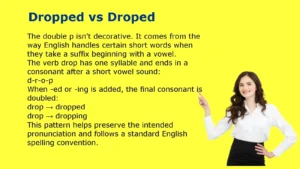
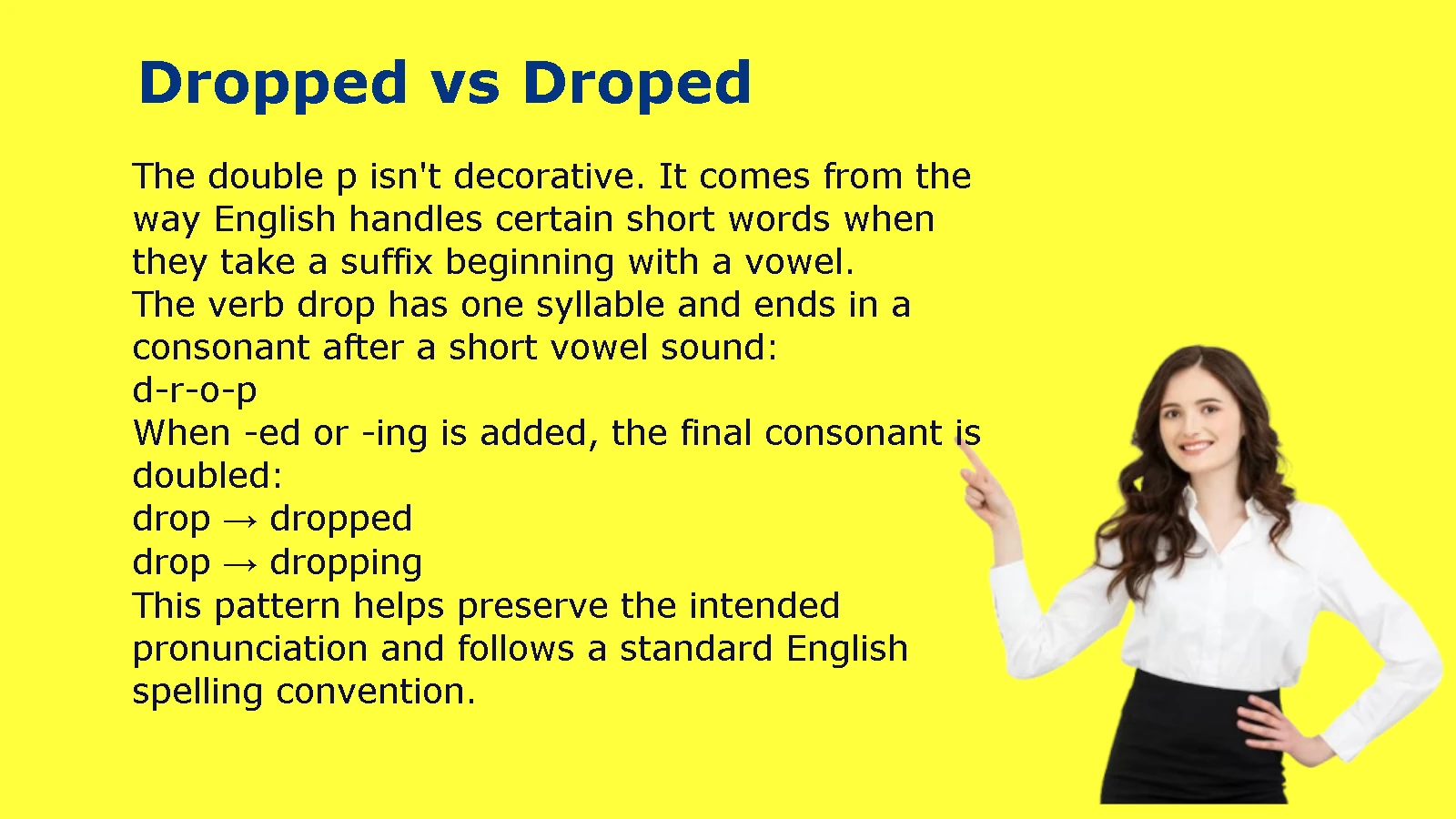
The double p isn’t decorative. It comes from the way English handles certain short words when they take a suffix beginning with a vowel.
The verb drop has one syllable and ends in a consonant after a short vowel sound:
d-r-o-p
When -ed or -ing is added, the final consonant is doubled:
drop → dropped
drop → dropping
This pattern helps preserve the intended pronunciation and follows a standard English spelling convention.
The Short-Vowel + Consonant Rule
A useful version of the rule is this:
When a one-syllable word ends in a single consonant immediately after a single short vowel, the final consonant is often doubled before a suffix such as -ed or -ing.
Consider these examples:
| Base word | Past tense | -ing form |
| drop | dropped | dropping |
| stop | stopped | stopping |
| shop | shopped | shopping |
| plan | planned | planning |
| rub | rubbed | rubbing |
| slip | slipped | slipping |
The pattern becomes easier to recognize when you see several examples together.
The important point is that the rule isn’t simply “double every final consonant.” English spelling has several conditions and exceptions. For drop, however, the doubled p is standard.
Why “Droped” Is Incorrect
If you mechanically attach -ed to drop, you might get:
drop + ed = droped
That looks logical at first glance. English spelling, however, doesn’t always work by simply joining letters together.
The correct spelling doubles the final p:
drop + ed = dropped
That’s why droped looks plausible but remains incorrect in standard English.
What Does “Dropped” Mean?
Dropped is the past tense and past participle of the verb drop. It can describe several different actions or changes depending on the sentence. Cambridge Dictionary
The most basic meaning involves letting something fall.
She dropped her phone.
Here, the person had the phone and accidentally or intentionally allowed it to fall.
But dropped can also describe a decrease, stopping an activity, removing something from consideration, taking someone somewhere, and several other situations.
Dropped Can Mean “Let Something Fall”
This is probably the meaning you learned first.
- He dropped the glass.
- I dropped my keys.
- She dropped the book.
- The child dropped the toy.
The subject can either accidentally or intentionally cause something to fall.
Dropped Can Mean “Became Lower”
Dropped can also describe a decrease in a number, amount, price, temperature, or level.
- The temperature dropped overnight.
- The price dropped by 15%.
- Sales dropped sharply in January.
- The water level dropped after the storm.
Cambridge lists this sense of drop as moving to a lower level or causing something to move to a lower level. Cambridge Dictionary
Dropped Can Mean “Stopped”
You can also drop an activity, plan, subject, idea, or other undertaking.
- She dropped the course.
- The company dropped the proposal.
- They dropped the project.
- He dropped the idea after discussing it with his team.
In this sense, dropped means something was abandoned or discontinued. Cambridge Dictionary
Dropped Can Mean “Taken Somewhere”
In informal English, drop can mean taking someone somewhere and leaving them there.
- Dad dropped me at school.
- She dropped him off at the airport.
- I dropped my sister at work.
This meaning is particularly common in expressions such as dropped off. Cambridge Dictionary
“Dropped” as the Past Tense of “Drop”
The simple past form of drop is dropped.
| Present | Past |
| I drop | I dropped |
| You drop | You dropped |
| He drops | He dropped |
| She drops | She dropped |
| We drop | We dropped |
| They drop | They dropped |
For example:
- I dropped my wallet.
- She dropped the package.
- We dropped our plans.
- They dropped the price.
- The temperature dropped overnight.
Notice something important: the base form drop doesn’t have a double p, but the past tense dropped does.
That’s because the spelling changes when -ed is added.
“Dropped” as the Past Participle of “Drop”
Dropped also functions as the past participle of drop. Cambridge identifies dropped as both the past simple and past participle form. Cambridge Dictionary
The past participle appears with auxiliary verbs such as has, have, had, and forms of be.
Present Perfect
Use has dropped or have dropped.
- The temperature has dropped significantly.
- Sales have dropped since last quarter.
- The water level has dropped by several inches.
The present perfect connects a past change to the present situation.
Past Perfect
Use had dropped when the action happened before another past event.
- The temperature had dropped below freezing before sunrise.
- Sales had dropped considerably before the company changed its strategy.
- The price had dropped by the time we arrived.
Future Perfect
The form will have dropped describes something that will be complete by a future point.
- By tomorrow morning, the temperature will have dropped considerably.
- By the end of the month, prices will have dropped further if demand remains weak.
Passive Constructions
Because dropped is also a past participle, you can use it in passive constructions.
- The package was dropped at the front desk.
- The charges were dropped after the investigation.
- The player was dropped from the team.
- The proposal was dropped after further review.
The meaning depends heavily on context. For example, the package was dropped can describe a physical object falling or being delivered to a particular location.
Dropped in Different Contexts
One reason dropped appears so frequently is that drop has many meanings. The spelling stays the same even when the meaning changes.
Physical Objects
The most literal use involves something falling.
- She dropped her phone.
- He dropped the plate.
- I dropped my keys on the floor.
- The glass dropped from his hand.
Here, dropped describes movement from a higher position to a lower one.
Prices, Numbers, and Levels
The word also commonly describes decreases.
- The stock price dropped 8%.
- The temperature dropped below freezing.
- The company’s revenue dropped last quarter.
- The number of applicants dropped sharply.
This use is common in business, economics, science, weather reports, and everyday conversation. Cambridge specifically gives examples of drop for decreases in prices, temperatures, and other measurable quantities. Cambridge Dictionary
Communication and Conversation
In informal English, drop can mean to send or mention something casually.
- She dropped me a message.
- He dropped a quick note before leaving.
- The manager dropped a hint about the upcoming changes.
These expressions don’t involve physically dropping anything.
Plans, Classes, or Activities
Dropped can mean discontinued.
- He dropped the course.
- They dropped the project.
- The company dropped the proposal.
- She dropped the idea.
Cambridge gives drop this meaning for stopping an activity or plan. Cambridge Dictionary
Sports and Competition
The word can also appear in sports contexts.
- The team dropped two points.
- The player dropped a catch.
- The club dropped out of the tournament.
The exact meaning changes with the sport and sentence.
Dropped vs Droped in a Sentence
The easiest way to see the difference is to put the two spellings side by side.
| Incorrect | Correct |
| She droped her phone. | She dropped her phone. |
| He droped the ball. | He dropped the ball. |
| The price droped suddenly. | The price dropped suddenly. |
| They droped the plan. | They dropped the plan. |
| The temperature droped overnight. | The temperature dropped overnight. |
| She droped the class. | She dropped the class. |
In every case, droped should be replaced with dropped.
Everyday Examples
Here are some natural examples you’ll encounter in ordinary writing:
- I dropped my keys in the hallway.
- She dropped her bag beside the chair.
- The glass dropped onto the floor.
- He dropped his phone while running.
- The temperature dropped overnight.
- The price dropped after the sale started.
Professional Examples
In professional writing, dropped often describes numbers, plans, prices, or decisions.
- Revenue dropped by 6% during the quarter.
- The company dropped the proposed expansion.
- Customer complaints dropped after the update.
- The manufacturer dropped the product from its lineup.
Academic Examples
Academic writing frequently uses dropped to describe measurable changes.
- The average score dropped after the second assessment.
- The response rate dropped during the final phase.
- The measured concentration dropped after treatment.
Scientific Examples
Scientific writing also uses the word for changes in measurements.
- The temperature dropped below 0°C.
- Pressure dropped rapidly after the valve opened.
- The concentration dropped as the reaction progressed.
The spelling remains dropped regardless of the field.
Dropped vs Dropping
A closely related spelling mistake is droping.
If droped looks tempting, droping can cause the same problem. Both forms incorrectly leave the final p undoubled.
The correct forms are:
drop → dropped → dropping
Examples:
- She dropped the glass.
- She is dropping the glass.
The same spelling pattern appears in:
- stop → stopped → stopping
- shop → shopped → shopping
- plan → planned → planning
- slip → slipped → slipping
Why Does “Dropping” Also Have Two Ps?
The same general doubling principle applies before -ing.
Without doubling:
drop + ing → droping ❌
With the correct spelling:
drop + ing → dropping ✅
So if you remember one pattern, remember all three forms together:
drop — dropped — dropping
Drop, Dropped, and Dropping: Word Forms
Understanding the complete word family makes the spelling easier to remember.
| Word form | Grammatical function | Example |
| drop | Base form | Don’t drop the glass. |
| drops | Third-person singular present | The temperature drops at night. |
| dropped | Simple past | She dropped her keys. |
| dropped | Past participle | He has dropped the package. |
| dropping | Present participle | The temperature is dropping. |
| dropping | Gerund | Dropping the course was difficult. |
This table also shows why dropped has more than one grammatical job. It’s both the simple past and past participle of drop. Cambridge Dictionary
Why Do People Spell “Dropped” as “Droped”?
The mistake is understandable. English spelling contains many patterns that aren’t obvious from pronunciation alone.
Forgetting the Consonant-Doubling Rule
Someone may know that the past tense usually takes -ed and simply write:
drop + ed = droped
The problem is that this ignores the spelling change required when the suffix is added.
Treating Every Verb the Same Way
English verbs don’t all form their past tense by following one identical visual pattern.
For example:
- clean → cleaned
- rain → rained
- look → looked
But:
- drop → dropped
- stop → stopped
- plan → planned
The difference comes from the structure of the base word.
Typing Too Quickly
Sometimes droped is simply a typo. Because the pronunciation doesn’t clearly announce the second p, it’s easy to miss while typing.
That’s particularly common when you’re writing quickly and relying on memory rather than spell-checking.
Confusing Spelling With Pronunciation
The pronunciation of dropped doesn’t sound like someone is saying two separate p sounds.
That’s important.
The doubled letter is primarily a spelling convention. You shouldn’t try to pronounce an exaggerated double p. Write the word correctly and pronounce it naturally.
Is “Droped” Ever Correct?
In standard modern English, droped is not the correct spelling of the past tense or past participle of drop.
The standard form is:
dropped
You should therefore write:
- dropped the ball
- dropped the price
- dropped the class
- dropped the charges
- dropped below zero
Not:
- ❌ droped the ball
- ❌ droped the price
- ❌ droped the class
- ❌ droped the charges
- ❌ droped below zero
If a spell-checker flags droped, accept the correction to dropped unless you’re reproducing a specific historical document or quotation where the original spelling itself matters.
Is “Dropped” Spelled Differently in British English?
No.
Dropped is the standard spelling in both American English and British English.
| Variety | Correct spelling |
| American English | dropped |
| British English | dropped |
| Incorrect form | droped |
The spelling doesn’t change based on the variety of English.
There are plenty of words where American and British spelling differs. Dropped isn’t one of them.
Cambridge’s American and British dictionary entries both use dropped as the past form of drop. Cambridge Dictionary
So there’s no American-versus-British debate here.
Dropped is correct everywhere standard English is used.
Common Words That Follow the Same Spelling Pattern
Learning related words can make the rule much easier to remember.
Words With a Doubled Final Consonant
| Base word | Past tense | -ing form |
| drop | dropped | dropping |
| stop | stopped | stopping |
| shop | shopped | shopping |
| plan | planned | planning |
| slip | slipped | slipping |
| rub | rubbed | rubbing |
| admit | admitted | admitting |
| prefer | preferred | preferring |
These examples demonstrate the broader consonant-doubling pattern.
Words That Don’t Double the Final Consonant
Now compare them with:
| Base word | Past tense | -ing form |
| look | looked | looking |
| clean | cleaned | cleaning |
| rain | rained | raining |
| jump | jumped | jumping |
| help | helped | helping |
Why don’t these words behave exactly like drop?
Because the spelling pattern depends on factors such as the number of syllables, the vowel sound, the final consonant, and the word’s structure. The rule has limits and exceptions, so it’s better to learn it as a useful pattern rather than a mechanical instruction that applies to every English verb.
Common Mistakes With “Dropped”
Droped vs Dropped
This is the central spelling mistake.
❌ She droped her phone.
✅ She dropped her phone.
Droping vs Dropping
The same error can appear with -ing.
❌ He is droping the ball.
✅ He is dropping the ball.
Dropped vs Drop
These aren’t interchangeable.
Use drop as the base form:
Don’t drop the glass.
Use dropped for the past:
She dropped the glass.
Use dropped after an auxiliary in perfect constructions:
She has dropped the glass.
Use dropping for the progressive form:
She is dropping the glass.
Dropped vs Fell
These words overlap in some contexts, but they don’t always mean the same thing.
Compare:
The glass fell.
This tells you that the glass moved downward.
She dropped the glass.
This tells you that she caused or allowed the glass to fall.
The distinction is useful because fall is generally intransitive when used in this physical sense, while drop can be transitive or intransitive.
How to Remember the Spelling of “Dropped”
The easiest trick is to learn the three forms as a single sequence:
drop → dropped → dropping
Don’t memorize dropped as an isolated word. Connect it to drop and dropping.
Another useful reminder is:
Short vowel + final consonant → double the consonant before -ed or -ing in the relevant spelling pattern.
So:
drop + ed = dropped
and:
drop + ing = dropping
A Simple Visual Memory Trick
Think of the word this way:
DRO + PP + ED
The two Ps sit together in the middle:
dropped
If you see droped, the missing p should stand out.
Quick Spelling Test
Test yourself before checking the answers.
Choose the correct spelling
She ___ her keys on the kitchen counter.
- A. droped
- B. dropped
The temperature ___ sharply overnight.
- A. dropped
- B. droped
He is ___ the ball repeatedly.
- A. droping
- B. dropping
The company ___ the proposal.
- A. dropped
- B. droped
Sales have ___ since January.
- A. droped
- B. dropped
Answers
- dropped
- dropped
- dropping
- dropped
- dropped
The pattern should now look familiar:
drop → dropped → dropping
A Simple Case Study: Correcting a Common Spelling Error
Imagine you’re writing a report about product sales.
You write:
“Sales droped by 12% during the second quarter.”
The meaning is perfectly understandable. However, the spelling is incorrect.
The corrected sentence is:
“Sales dropped by 12% during the second quarter.”
Nothing about the meaning changed. Only the spelling did.
Now consider the same error in a formal email:
“The temperature droped below freezing last night.”
Again, the reader will probably understand what you mean. Yet droped can make the writing look careless, especially in academic, professional, or published material.
The correct version is:
“The temperature dropped below freezing last night.”
This small spelling detail illustrates an important point: a word can be easy to understand and still be incorrect.
How “Dropped” Works in Formal Writing
Dropped is completely appropriate in formal writing when the context calls for it.
You might see it in:
- research papers
- financial reports
- business articles
- news reports
- technical documentation
- academic essays
- government reports
- laboratory reports
For example:
“The measured pressure dropped significantly after the valve was opened.”
Or:
“The company’s operating costs dropped by 4.2% during the reporting period.”
There’s no need to replace dropped with a more complicated word simply because the writing is formal.
Depending on context, alternatives such as decreased, declined, fell, or was reduced may work. However, dropped is perfectly standard when it expresses the intended meaning.
When to Use “Dropped” Correctly
Dropped + Noun
Use dropped directly before or with an object when drop has a transitive meaning.
- She dropped the phone.
- He dropped the package.
- They dropped the proposal.
- The company dropped the price.
Was/Were Dropped
Use was dropped or were dropped in passive constructions.
- The charges were dropped.
- The proposal was dropped.
- The package was dropped at the entrance.
Has/Have Been Dropped
Use this form when describing an action completed before now with present relevance.
- The charges have been dropped.
- The prices have been dropped to attract buyers.
- Several requirements have been dropped from the application.
Had Been Dropped
Use had been dropped when the action happened before another event in the past.
- The proposal had been dropped before the meeting began.
- The charges had been dropped before the case went to trial.
Dropped By
Dropped by can have several meanings depending on context.
It can describe something being lowered by a particular amount:
The company dropped the price by 10%.
It can also appear in passive constructions:
The player was dropped by the coach.
Or it can refer to a brief visit in the phrase dropped by:
She dropped by after work.
Context does the heavy lifting.
Dropped Through
Dropped through is less common as a general fixed phrase. It usually describes something physically moving through an opening or space.
For example:
The ball dropped through the net.
Don’t treat dropped through as a universal substitute for dropped. The surrounding sentence determines whether it makes sense.
Other Useful Forms of “Drop”
Once you understand dropped, the rest of the verb family becomes much easier.
Drop
Base form:
Please drop the package here.
Drops
Third-person singular present:
The temperature drops quickly after sunset.
Dropped
Past tense and past participle:
She dropped her keys.
She has dropped her keys.
Dropping
Present participle and gerund:
She is dropping the keys.
Dropping the course was a difficult decision.
Cambridge identifies dropping as the present participle and dropped as both the past tense and past participle. Cambridge Dictionary
Interesting Uses of “Dropped”
The versatility of drop is one reason the word appears so often in everyday English.
Dropped Out
Dropped out means stopped participating in something before completing it, especially school or a course.
He dropped out of college.
The spelling remains dropped, even though the phrase is a phrasal verb. Cambridge Dictionary
Dropped Off
Dropped off can mean taking someone or something somewhere and leaving them there.
She dropped me off at the station.
It can also describe something decreasing:
Sales dropped off toward the end of the year.
Dropped From
This construction often means someone was removed from a team, list, group, or activity.
He was dropped from the team.
Dropped Charges
In legal contexts, charges were dropped means the prosecution discontinued the charges. It does not mean someone physically dropped anything.
The charges were dropped after further investigation.
The Cambridge dictionary gives this as one of the established uses of drop. Cambridge Dictionary
Dropped vs Droped: Key Facts to Remember
If you only have a few seconds to remember the answer, keep these facts in mind:
- Dropped is correct.
- Droped is incorrect.
- Dropped is the past tense of drop.
- Dropped is also the past participle of drop.
- The final p doubles before -ed.
- The final p also doubles before -ing.
- Dropping is correct.
- Droping is incorrect.
- Dropped is spelled the same in American and British English.
- The word can describe falling, decreasing, stopping something, transporting someone, and other actions depending on context.
The most useful sequence to memorize is:
drop → dropped → dropping
Frequently Asked Questions About Dropped vs Droped
Is “dropped” the correct spelling?
Yes. Dropped is the correct spelling. It is the simple past and past participle of drop. Cambridge Dictionary
Is “droped” a word?
Droped is not the standard spelling of the past tense or past participle of drop. In ordinary modern English writing, use dropped.
Why does “dropped” have two Ps?
The final p doubles when drop takes -ed or -ing because it follows the relevant consonant-doubling spelling pattern.
Thus:
drop → dropped
and:
drop → dropping
What is the past tense of “drop”?
The past tense is dropped.
She dropped the glass.
What is the past participle of “drop”?
The past participle is also dropped.
She has dropped the glass.
Is “droping” correct?
No. The correct form is dropping with two ps.
❌ droping
✅ dropping
Is “dropped” spelled differently in British English?
No. Dropped is standard in both American and British English.
What is the difference between “dropped” and “dropping”?
Dropped is the past tense and past participle:
He dropped the ball.
Dropping is the present participle or gerund:
He is dropping the ball.
What is the correct spelling: droped or dropped?
Dropped is correct.
✅ dropped
❌ droped
Final Answer: Dropped Is Correct
When choosing between dropped vs droped, there’s no real contest: dropped is the correct spelling.
Droped is a misspelling. The correct form doubles the final p before -ed:
drop + ed = dropped
The same pattern applies to the -ing form:
drop + ing = dropping
You can use dropped as both the simple past and past participle of drop:
- She dropped her phone.
- The temperature dropped overnight.
- He has dropped the course.
- The charges were dropped.
- Sales have dropped by 10%.
The simplest way to remember everything is to keep the three forms together:
drop → dropped → dropping
Once that pattern sticks, droped and droping should be easy to spot and avoid.