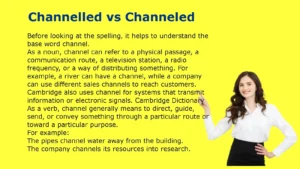
Channelled vs channeled is a common spelling question, especially when you’re writing for an American or British English audience. Both forms are correct, but the spelling you should use depends largely on the variety of English you’re following. If you’ve seen “channelled” and “channeled” and wondered which one is correct, the difference comes from how British and American English form the past tense and past participle of channel.
The channelled vs channeled difference is mainly a matter of spelling rather than meaning. Channelled is the standard spelling in British English and other varieties that generally follow British spelling conventions, while channeled is the preferred spelling in American English. Both forms mean the same thing and can refer to directing, guiding, or conveying something through a particular channel.
In this guide, you’ll learn whether to use channelled or channeled, which spelling is correct in American and British English, why the extra “l” appears in channelled, and how to use both forms correctly in sentences. You’ll also see clear examples to help you remember the difference.
By the end, you’ll know exactly when to use “channelled” and “channeled” and which spelling is the best choice for your writing.
Permitted vs Permited: What Is the Difference?
The difference between permitted and permited is simply spelling.
| Word | Correct? | Meaning |
| permitted | ✅ Yes | Allowed or authorized |
| permited | ❌ No | Incorrect spelling |
Permitted is the standard spelling in American and British English. Permited isn’t an alternative regional spelling.
For example:
- Students are permitted to use calculators during the exam.
- Employees aren’t permitted to share confidential information.
- The law permitted residents to appeal the decision.
- The museum permitted visitors to take photographs.
In every case, the word contains two Ts.
If you write permited, the reader will generally recognize what you mean. However, the spelling is still incorrect and should be changed to permitted, especially in academic, professional, legal, or formal writing.
What Does Permitted Mean?
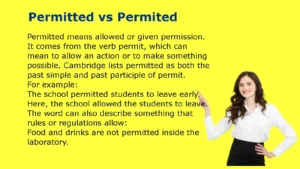
Permitted means allowed or given permission.
It comes from the verb permit, which can mean to allow an action or to make something possible. Cambridge lists permitted as both the past simple and past participle of permit.
For example:
The school permitted students to leave early.
Here, the school allowed the students to leave.
The word can also describe something that rules or regulations allow:
Food and drinks are not permitted inside the laboratory.
In this sentence, permitted means “allowed.”
Permitted Can Mean Allowed by a Rule
You will often see permitted when discussing rules, policies, laws, regulations, or official instructions.
Examples include:
- Smoking is not permitted inside the building.
- Only authorized personnel are permitted to enter.
- Parking is permitted after 6 p.m.
- The regulations specify the maximum permitted noise level.
- Visitors are not permitted beyond this point.
This is one reason the word appears frequently in formal notices and official writing.
Oxford gives examples such as visitors being permitted to take photographs and references to permitted levels of noise pollution.
Permitted as the Past Tense of Permit
Permitted is the simple past tense of permit.
The basic pattern is:
permit → permitted
For example:
- The manager permits flexible hours.
- The manager permitted flexible hours last year.
The first sentence uses the present tense. The second uses the past tense.
Why Not “Permited”?
Because permit ends in a stressed syllable containing a short vowel followed by a single consonant.
When you add -ed, the final consonant doubles:
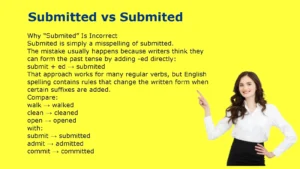
permit + ed → permitted
The same spelling pattern appears in several other verbs:
- admit → admitted
- commit → committed
- submit → submitted
- omit → omitted
- refer → referred
This isn’t an arbitrary exception. English spelling uses consonant doubling in certain situations before suffixes such as -ed and -ing.
So the spelling isn’t:
permit + ed = permited
Instead:
permit + t + ed = permitted
That extra t matters.
Permitted as the Past Participle
Permitted also functions as the past participle of permit.
Cambridge and Oxford both identify permitted as the past participle.
The past participle commonly appears with auxiliary verbs such as has, have, and had.
Present Perfect
Use has/have permitted when talking about an action that occurred in the past and has a connection to the present.
Examples:
- The new policy has permitted greater flexibility.
- The changes have permitted employees to work remotely.
- The system has permitted users to access additional features.
Past Perfect
Use had permitted when one past action happened before another past event.
Examples:
- The director had permitted the change before the board objected.
- The previous policy had permitted visitors to enter after hours.
- The manager had permitted employees to work from home before the policy changed.
Passive Voice
Permitted also appears frequently in passive constructions.
For example:
Visitors are permitted to enter through the main entrance.
The structure is:
be + permitted + to + verb
More examples include:
- Employees are permitted to work remotely.
- Children aren’t permitted to use the equipment.
- Guests were permitted to enter after security checks.
- Researchers were permitted to access the database.
Oxford specifically lists be permitted, be permitted to do something, and related constructions among the standard uses of permit.
Why Is Permitted Spelled With Two Ts?
The double t in permitted results from the consonant-doubling pattern used when certain verbs ending in a single consonant take a suffix beginning with a vowel.
The base word is:
permit
When -ed is added, the final t doubles:
permit → permitted
The same thing happens with -ing:
permit → permitting
That’s why both forms contain two Ts.
| Base verb | Past tense | -ing form |
| permit | permitted | permitting |
| admit | admitted | admitting |
| commit | committed | committing |
| submit | submitted | submitting |
| omit | omitted | omitting |
This gives you a useful spelling pattern rather than a rule you have to memorize word by word.
The Stress Pattern Matters
In permit as a verb, the stress falls on the second syllable:
per-MIT
That helps explain why the final consonant doubles when the word takes -ed or -ing.
The noun permit behaves differently in pronunciation. The noun normally has first-syllable stress, while the verb has second-syllable stress. Oxford lists the verb as permit and gives its past forms as permitted and permitting.
You don’t need to memorize the pronunciation to spell the word correctly. Still, understanding the pattern makes the spelling less mysterious.
Why Is “Permited” Incorrect?
Permited is incorrect because it leaves out one of the two required t letters.
The correct formation is:
permit + ted = permitted
Not:
permit + ed = permited
Compare these examples:
❌ The students were permited to leave.
✅ The students were permitted to leave.
The incorrect form often appears because writers treat permit like a verb that simply takes -ed without doubling its final consonant.
That shortcut doesn’t work here.
The same problem occurs with the present participle:
❌ The system is permiting access.
✅ The system is permitting access.
Learning permitted and permitting together can prevent both errors.
Permitted in American and British English
The correct spelling is permitted in both American and British English.
There is no American spelling permited and no British spelling permited.
Both varieties use:
- permit
- permits
- permitting
- permitted
Oxford’s American English dictionary gives permitted as the past form and permitting as the -ing form.
So if you’re writing for a US audience, use permitted. If you’re writing for a British audience, use permitted as well.
This is not one of those spelling differences like color/colour or center/centre.
Is Permitted a British or American Spelling?
It’s both.
The spelling doesn’t change based on the variety of English.
| English variety | Correct spelling |
| American English | permitted |
| British English | permitted |
| Canadian English | permitted |
| Australian English | permitted |
The form permited should be avoided in all standard varieties of English.
Permitted in a Sentence
Seeing permitted in different contexts makes its usage much easier to understand.
Everyday Examples
- Pets aren’t permitted inside the restaurant.
- Are we permitted to park here?
- Guests are permitted to use the pool until 9 p.m.
- My parents permitted me to stay out late.
- The rules don’t permit visitors to enter this area.
Notice that permitted often appears with to + verb when the sentence describes an allowed action.
Visitors are permitted to enter.
Employees are permitted to work remotely.
Students are permitted to use calculators.
Professional Examples
In workplaces, permitted commonly describes company policies, access rules, and authorized activities.
- Employees are not permitted to disclose customer information.
- Staff members are permitted to work flexible hours.
- The company permitted employees to use personal devices.
- Only authorized personnel are permitted inside the server room.
- The policy specifies the maximum permitted file size.
The word works particularly well in formal writing because it clearly communicates that a rule or authority allows something.
Academic Examples
Academic writing often uses permitted when describing research conditions, procedures, or institutional rules.
- The study permitted researchers to examine long-term trends.
- Participants were permitted to withdraw from the study.
- The methodology permitted a more detailed analysis.
- Students are not permitted to use unauthorized materials during the examination.
Cambridge’s examples also show permitted in research and scientific contexts where a particular method or condition makes something possible.
Scientific Examples
In scientific writing, permit can mean either “allow” or “make possible.”
For example:
The instrument’s design permitted researchers to measure the sample accurately.
Here, the instrument didn’t give permission in the human sense. Instead, its design made the measurement possible.
Oxford identifies both meanings of permit: allowing something and making something possible.
Common Phrases With Permitted
Certain combinations appear repeatedly in everyday, professional, and formal English.
Permitted To
Permitted to means allowed to do something.
Examples:
- You are permitted to enter.
- Employees are permitted to work from home.
- Visitors aren’t permitted to take photographs.
- Students were permitted to leave early.
This is one of the most common structures involving permitted.
Not Permitted
Not permitted means prohibited or not allowed.
Examples:
- Smoking is not permitted.
- Outside food is not permitted.
- Personal devices are not permitted during the test.
- Entry is not permitted without identification.
Official signs often use this concise construction because it communicates a restriction clearly.
Permitted By
Use permitted by when identifying the rule, authority, law, or person that allows something.
Examples:
- The activity is permitted by law.
- The procedure is permitted by company policy.
- The exception is permitted by the regulations.
Permitted Use
Permitted use refers to an allowed or authorized use.
For example:
The agreement defines the permitted use of the software.
You may encounter this phrase in contracts, licenses, policies, and terms of service.
Permitted Activities
This phrase refers to activities that rules or authorities allow.
Examples include:
- permitted activities on public land
- permitted activities during school hours
- permitted activities under the agreement
Common Spelling Mistakes Related to Permit
The main error is permited, but it isn’t the only spelling mistake associated with this verb.
Permited vs Permitted
This is the core distinction:
❌ permited
✅ permitted
Always use the double t.
Permiting vs Permitting
The same doubling rule applies before -ing.
❌ permiting
✅ permitting
For example:
The new system is permitting users to access additional features.
Cambridge identifies permitting as the present participle of permit.
Permit vs Permitted
These forms serve different grammatical roles.
Permit is the base form:
The rules permit visitors to enter.
Permitted is the past form:
The rules permitted visitors to enter.
The meaning remains related, but the tense changes.
Permission vs Permitted
Don’t confuse permission, the noun, with permitted, the past form or past participle.
We received permission to enter.
We were permitted to enter.
Both sentences communicate the same basic situation from different grammatical angles.
Cambridge defines permission as the act of allowing someone to do something.
The Complete Word Family of Permit
Understanding the word family helps you recognize which form belongs in a sentence.
| Word | Part of speech | Example |
| permit | Verb | The rules permit visitors to enter. |
| permits | Verb | The law permits this activity. |
| permitted | Verb/adjective | Visitors are permitted to enter. |
| permitting | Verb/adjective | The new system is permitting access. |
| permit | Noun | You need a parking permit. |
| permission | Noun | We received permission to enter. |
| permissible | Adjective | The activity is legally permissible. |
| permissive | Adjective | The policy is relatively permissive. |
The spelling of permitted makes more sense when you see it as part of this larger family.
Permit as a Verb vs Permit as a Noun
One interesting feature of permit is that it functions as both a verb and a noun.
As a verb, permit means to allow something or make something possible:
The rules permit visitors to enter.
As a noun, permit means an official document that gives someone permission to do something.
You need a parking permit.
Oxford defines the noun as an official document that gives someone the right to do something, often for a limited period.
The pronunciation also differs in standard English. The verb has stress on the second syllable, while the noun has stress on the first.
That distinction can be useful when speaking even though the spelling remains the same.
Permitted vs Similar Words
Permitted vs Allowed
Both are often interchangeable.
Visitors are permitted to enter.
Visitors are allowed to enter.
Both sentences mean that visitors have permission to enter.
However, permitted often sounds more formal. It appears frequently in regulations, official notices, policies, and legal writing.
Allowed is more common in casual conversation.
My parents allowed me to stay up late.
That sounds more natural in everyday speech than:
My parents permitted me to stay up late.
Cambridge describes allow and permit as verbs with closely related meanings and notes that permit commonly appears in official public notices.
Permitted vs Authorized
Authorized usually emphasizes official authority or approval.
Only authorized employees are permitted to access the records.
Here, authorized describes the employees’ status, while permitted describes what they are allowed to do.
The two words can overlap, but they aren’t always interchangeable.
Permitted vs Approved
Approved generally means accepted or officially agreed to.
Permitted means allowed.
Compare:
The manager approved the proposal.
The manager permitted the team to proceed.
The first sentence focuses on acceptance of the proposal. The second focuses on permission to take an action.
Permitted vs Legal
Legal means allowed under the law.
Permitted has a broader range.
Something can be permitted by a school, employer, property owner, event organizer, or other authority without the word necessarily involving law.
For example:
Employees are permitted to work remotely on Fridays.
That is a workplace rule. It doesn’t necessarily have anything to do with legality.
Permitted vs Permissible
These words are closely related, but their grammar and emphasis differ.
Permitted means something is allowed.
Permissible means something is acceptable or allowed under a particular rule, standard, or system.
Compare:
Photography is permitted inside the museum.
Photography is permissible under the museum’s current policy.
The first sounds like a direct statement about permission. The second has a more formal and evaluative tone.
Cambridge defines permissible as “allowed” and labels it as a formal adjective.
A Useful Rule
Use permitted when you’re describing what someone or something allows.
Use permissible when you’re describing whether an action is acceptable or allowed under a rule or standard.
How to Use Permitted Correctly
The most common grammatical patterns are easy to recognize once you see them.
Permitted + To + Verb
This construction describes an allowed action.
Pattern:
subject + be + permitted + to + verb
Examples:
- You are permitted to enter.
- Students are permitted to use calculators.
- Visitors were permitted to take photographs.
- Employees aren’t permitted to share passwords.
Oxford lists this structure as a standard use of permit.
Was/Were Permitted
Use was permitted with a singular subject and were permitted with a plural subject.
Examples:
- The visitor was permitted to enter.
- The visitors were permitted to enter.
- She was permitted to leave early.
- They were permitted to leave early.
Has/Have Been Permitted
Use has been permitted with a singular subject and have been permitted with a plural subject.
Examples:
- The request has been permitted under the new policy.
- Several exceptions have been permitted this year.
Had Been Permitted
Use had been permitted when describing something that was allowed before another past event.
The project had been permitted to continue before officials introduced new restrictions.
Permitted By
This structure identifies the authority or rule behind the permission.
Examples:
- The activity is permitted by law.
- The exception is permitted by the policy.
- The procedure was permitted by the agreement.
Permitted Through
Permitted through can describe something made possible through a particular method, system, or arrangement.
For example:
The agreement permitted access through a separate entrance.
However, don’t force this construction when a simpler phrase works. In many cases, permitted by, permitted to, or permitted under will sound more natural.
A Simple Case Study: Correcting “Permited”
Consider this sentence:
❌ Employees are permited to work remotely on Fridays.
At first glance, the sentence looks fine. The meaning is obvious. The spelling isn’t.
The correction is:
✅ Employees are permitted to work remotely on Fridays.
Why?
The base verb is permit. When the past participle permitted is formed, the final t doubles.
This same pattern helps with:
permit → permitted
and:
permit → permitting
A quick proofreading trick is to look for the base word permit before adding the suffix. Once you recognize the verb, the double t becomes much easier to remember.
Why People Commonly Write “Permited”
The mistake is understandable because many English verbs form their past tense simply by adding -ed.
For example:
- walk → walked
- clean → cleaned
- open → opened
- help → helped
A writer may therefore see permit and instinctively produce:
permit + ed = permited
But English spelling doesn’t always work that mechanically.
Some verbs double their final consonant before a suffix:
- stop → stopped
- plan → planned
- admit → admitted
- commit → committed
- permit → permitted
The pronunciation can also make the mistake less noticeable. In normal speech, the double t isn’t heard as two separate, exaggerated consonants.
That’s why this is primarily a spelling problem rather than a pronunciation problem.
A Quick Spelling Test
Choose the correct form in each sentence.
Question One
The rules have ______ visitors from entering after 10 p.m.
- A. permited
- B. permitted
Answer: B. permitted
Question Two
Students are not ______ to use phones during the examination.
- A. permitted
- B. permited
Answer: A. permitted
Question Three
The new system is ______ users to access the database remotely.
- A. permiting
- B. permitting
Answer: B. permitting
Question Four
The manager ______ the employee to leave early.
- A. permitted
- B. permited
Answer: A. permitted
Question Five
The activity is not ______ under the current regulations.
- A. permited
- B. permitted
Answer: B. permitted
If you remember permit → permitted → permitting, you’ll avoid the most common spelling errors.
Permitted vs Permited in Formal Writing
Correct spelling matters most when your writing represents you in a professional or academic setting.
A single typo won’t usually make a sentence impossible to understand. Still, repeated spelling mistakes can make otherwise strong writing look careless.
The correct form is especially important in:
- Academic papers
- Business reports
- Resumes and cover letters
- Legal documents
- Government forms
- Company policies
- Research papers
- Technical documentation
- Formal emails
- Applications
Consider these two versions:
❌ Employees are not permited to disclose confidential information.
✅ Employees are not permitted to disclose confidential information.
The second version looks polished and professional. The first contains an obvious spelling error.
In formal writing, there is little reason to take the risk when the correct spelling is easy to remember.
Is Permitted the Correct Spelling?
Yes. Permitted is the correct spelling.
It is the past tense and past participle of permit. Cambridge explicitly identifies permitted as both forms, while Oxford lists permitted as the past simple and past participle.
Correct: The company permitted employees to work remotely.
Is Permited a Word?
Permited is not the standard spelling of the English word.
If you intend to write the past tense or past participle of permit, use permitted.
The correct forms are:
- permit
- permits
- permitting
- permitted
There is no standard form permited.
What Is the Past Tense of Permit?
The past tense of permit is permitted.
Present: The rules permit visitors to enter.
Past: The rules permitted visitors to enter.
The spelling contains two t letters.
What Is the Past Participle of Permit?
The past participle is also permitted.
Examples:
- The change has been permitted.
- The company had permitted the activity.
- Visitors were permitted to enter.
- The system has permitted broader access.
Cambridge and Oxford both list permitted as the past participle.
Is “Controling” or “Permiting” Correct?
Neither controling nor permiting is the standard spelling when you mean the present participle of the relevant verb.
For permit, the correct form is:
permitting
The final t doubles before -ing.
❌ The software is permiting access.
✅ The software is permitting access.
Cambridge identifies permitting as the present participle of permit.
This gives you a useful three-form memory pattern:
permit → permitted → permitting
Is Permitted Spelled the Same in American and British English?
Yes.
Permitted is correct in both American and British English.
Unlike words such as color/colour, this verb doesn’t have a standard US/UK spelling difference.
| Variety | Correct form |
| American English | permitted |
| British English | permitted |
| Canadian English | permitted |
| Australian English | permitted |
So changing the spelling to permited won’t make your writing more British or more American. It will simply make it incorrect.
Permitted Synonyms
Depending on the context, you can replace permitted with several related words.
| Synonym | Best used when… | Example |
| allowed | Talking about general permission | Visitors are allowed inside. |
| authorized | Official authority matters | Only authorized staff may enter. |
| approved | Someone formally accepts something | The request was approved. |
| acceptable | Something meets a standard | The method is acceptable. |
| legal | The law allows something | The activity is legal. |
| licensed | Formal permission requires a license | The company is licensed to operate. |
These aren’t perfect substitutes in every sentence.
For example, permitted and allowed are often interchangeable:
Photography is permitted.
Photography is allowed.
However, licensed has a much narrower meaning. A person or business may have a license to perform an activity, while something can be permitted without requiring a license.
Choosing the right synonym depends on what kind of permission you’re describing.
Common Questions About Permitted vs Permited
Is permitted the correct spelling?
Yes. Permitted is the correct spelling.
Is permited a word?
No. Permited is an incorrect spelling of permitted.
Why does permitted have two Ts?
The final t in permit doubles when the verb takes -ed or -ing:
permit → permitted
permit → permitting
What is the past tense of permit?
The past tense is permitted.
The manager permitted the change.
What is the past participle of permit?
The past participle is also permitted.
The manager has permitted the change.
Is permitting spelled with two Ts?
Yes. The correct spelling is permitting.
❌ permiting
✅ permitting
Is permitted spelled differently in British English?
No. Permitted is the standard spelling in both American and British English.
What is the difference between permitted and allowed?
Both can mean “given permission.” Permitted tends to sound more formal and frequently appears in rules, policies, regulations, and official notices. Allowed is more common in everyday conversation.
What is the difference between permitted and permissible?
Permitted describes something that is allowed. Permissible is a formal adjective meaning allowed or acceptable under a particular rule or standard.
What is the difference between permit and permission?
As a verb, permit means to allow something. As a noun, permit means an official document that gives someone permission. Permission refers to the act or state of being allowed to do something.
For example:
You need a permit to park here.
You need permission to park here.
The first refers to an official document. The second refers to authorization.
Permitted vs Permited: Facts to Remember
The entire spelling issue comes down to a few facts.
- Permitted is correct.
- Permited is incorrect.
- Permit is the base verb.
- Permitted is both the past tense and past participle.
- Permitting is the present participle.
- The final t doubles before -ed and -ing.
- Permitted is used in both American and British English.
- Permitted to is a common structure meaning “allowed to.”
- Not permitted means “not allowed.”
- Permitted by identifies the rule, law, person, or authority that allows something.
- Permissible is a related but distinct adjective.
- Allowed is a common, less formal alternative to permitted.
The easiest memory trick
Think of the word as a three-part family:
permit → permitted → permitting
All three forms keep the double t once the suffix is added.
Final Takeaway: Permitted Is the Correct Spelling
When you’re choosing between permitted vs permited, choose permitted every time.
Permitted ✅
Permited ❌
The correct word is the past tense and past participle of permit, meaning allowed or made possible. The spelling uses a double t because the final consonant of permit doubles before -ed and -ing in these forms.
Correct: Visitors are permitted to enter the building.
Incorrect: Visitors are permited to enter the building.
The same spelling pattern gives you permitting, so remembering the pair permitted / permitting can help prevent both common mistakes.
When in doubt, return to the base word:
permit → permitted
That extra t is the key.