Have you ever wondered whether “Real vs. Authentic” actually means the same thing or if there is a deeper difference hidden in everyday English usage? This is a common point of confusion in both casual conversation and formal writing, especially when people use these words to describe people, products, experiences, or even emotions.
In simple terms, real usually refers to something that actually exists or is not fake, imaginary, or artificial. It is often used in everyday contexts like real money, real friendship, or real events. On the other hand, authentic goes a step further—it not only means something is genuine, but also that it is original, trustworthy, and true to its origin or identity. This word is often used in more refined or formal contexts such as authentic food, authentic documents, or authentic experiences.
Because both words are closely related in meaning, learners often confuse them in writing and speech. You might see searches like “real meaning,” “authentic meaning,” or “difference between real and authentic,” especially among English learners trying to improve vocabulary precision and communication clarity.
Understanding Real vs. Authentic helps you choose the right word depending on context, tone, and intention—making your English more accurate, natural, and expressive.
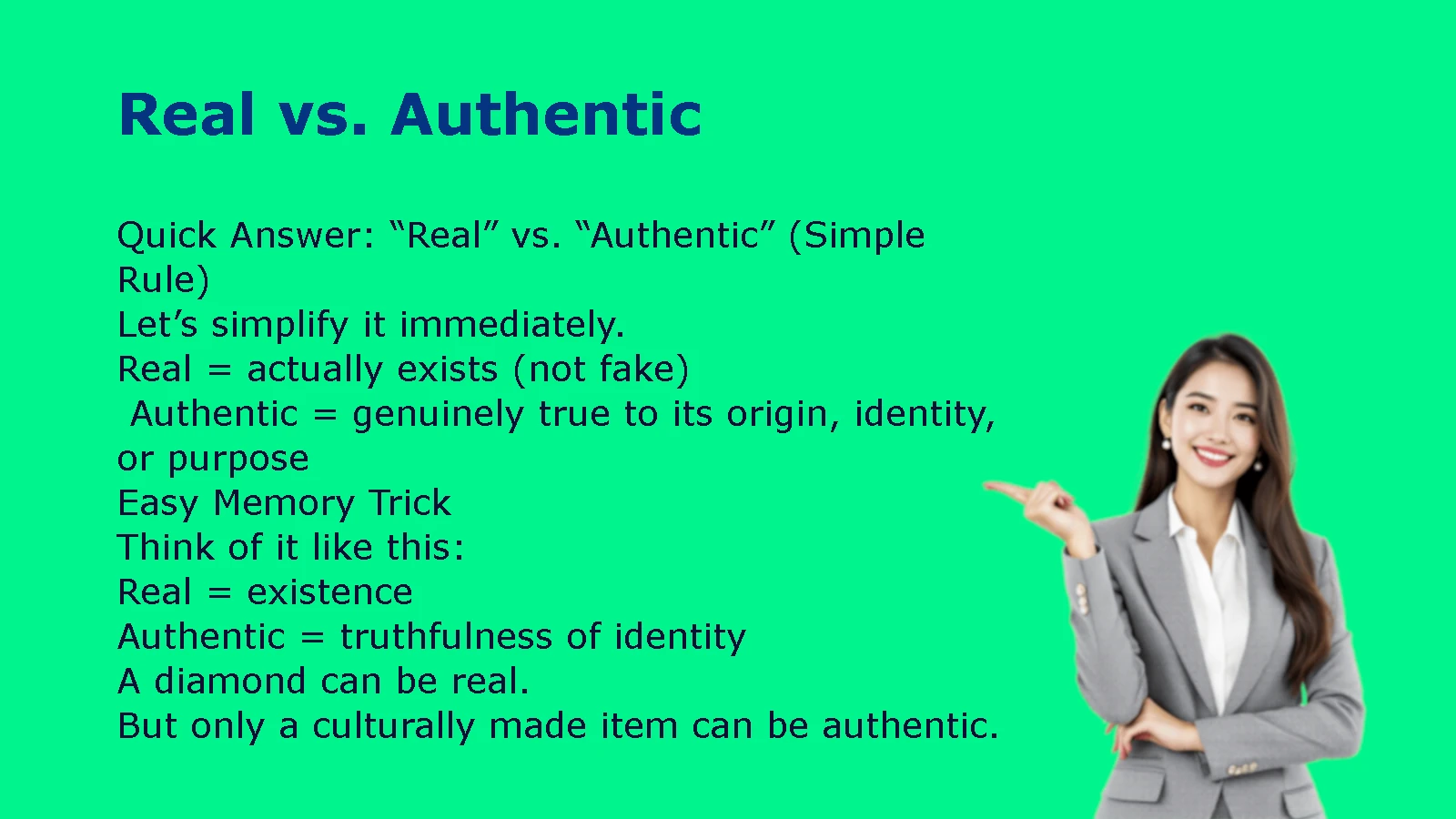
Quick Answer: “Real” vs. “Authentic” (Simple Rule)
Let’s simplify it immediately.
Real = actually exists (not fake)
Authentic = genuinely true to its origin, identity, or purpose
Easy Memory Trick
Think of it like this:
- Real = existence
- Authentic = truthfulness of identity
A diamond can be real.
But only a culturally made item can be authentic.
How People Actually Use “Real” and “Authentic”
Here’s where things get interesting—people don’t always use these words strictly.
In Casual Conversation
- “That looks real” often just means “not fake”
- “That feels authentic” often means “natural or genuine vibe”
In Marketing & Branding
- “Real” focuses on physical truth
- “Authentic” focuses on emotional trust and originality
Why Confusion Happens
- Both words overlap in meaning
- Both are used for “truth”
- Context decides everything
The Core Logic Behind “Real” vs. “Authentic”
To fully understand the difference, think in this simple framework:
REAL = Physical Existence
Something is real if it exists in reality.
Examples:
- Real money (not fake)
- Real person (not AI or imitation)
- Real food (not plastic model)
AUTHENTIC = True to Origin or Identity
Something is authentic if it is true to its source or original form.
Examples:
- Authentic Italian pizza (made in traditional way)
- Authentic voice (not forced or fake behavior)
- Authentic artwork (original or faithfully created style)
“Real” Explained Clearly (With Edge Cases)
At its core, real means something is not imaginary or fake.
Standard Meaning
- Real diamond = not fake
- Real account = not bot-generated
- Real emotion = genuinely felt
Edge Case: Digital World
In today’s world:
- AI images can look real
- Virtual influencers feel real
But technically:
- They may look real but not be real
Key Insight
Real is about existence, not quality.
“Authentic” Explained Clearly (With Edge Cases)
Now let’s break down authentic, the more complex one.
Standard Meaning
- Authentic document = original, verified
- Authentic culture = true to traditions
- Authentic behavior = not fake or performed
Edge Case: Social Media
A person can be real but not authentic online:
- Real person posting fake lifestyle
- Real influencer copying trends
Key Insight
Authentic is about truth of identity, not just existence.
The Biggest Mistake People Make
Here’s the real confusion point:
People assume real = good and authentic = better version of real.
But that’s not correct.
What Goes Wrong
- “Real leather” is physical truth
- “Authentic leather bag” refers to origin and craftsmanship
They are not interchangeable.
Simple Truth
- Real = factual existence
- Authentic = meaningful truth
Side-by-Side Comparison Table
| Word | Meaning | Focus | Example |
| Real | Exists in reality | Physical truth | Real diamond |
| Authentic | True to origin or identity | Cultural/emotional | Authentic Italian recipe |
Real-Life Examples of “Real”
Let’s ground it in everyday language:
- “Is this real gold or fake?”
- “That story is real, it actually happened.”
- “I want real feedback, not sugarcoated advice.”
Meaning
Always tied to truth of existence
Real-Life Examples of “Authentic”
Now compare:
- “This is authentic Thai food.”
- “Her reaction felt authentic.”
- “We want an authentic brand voice.”
Meaning
Always tied to truth of identity or origin
Case Study: Real vs Authentic in Branding
A clothing brand advertises:
Claim A: “Real leather jackets”
Means:
- The material is actually leather
Claim B: “Authentic leather craftsmanship”
Means:
- Made using traditional methods
- True to heritage style
Outcome
Both are correct—but they communicate different trust signals.
Regional and Usage Differences
In American English
- “Real” = factual existence
- “Authentic” = emotional + cultural truth
In British English
- Slightly more flexible use of “authentic”
- Often used for food, culture, and behavior
Global Marketing
- “Real” builds trust
- “Authentic” builds emotional connection
How to Avoid Confusion Every Time
Use this simple checklist:
- Is it about existence? → Use real
- Is it about identity or origin? → Use authentic
- Still unsure? → Use both carefully in context
What to Say Instead (Clear Alternatives)
Instead of “real”
- Genuine
- Actual
- True
- Physical
Instead of “authentic”
- Original
- Traditional
- Genuine in spirit
- Faithful to origin
Quick Decision Guide
When in doubt:
- Exists in reality → Real
- True to source or identity → Authentic
- Marketing or branding context → Both may apply
FAQ: “Real” vs. “Authentic”
Is authentic better than real?
No. They serve different purposes. One is not superior.
Can something be real but not authentic?
Yes. Example: Real product, fake branding.
Can something be authentic but not real?
No. Authentic still requires existence—it just focuses on truth of identity.
Key Facts You Should Remember
- Real = existence
- Authentic = identity truth
- Context decides usage
- They are not synonyms in strict meaning
Final Takeaway: The One Rule That Never Fails
Here’s the simplest way to remember it:
If you can touch it or verify it physically → it’s real.
If it stays true to its origin or identity → it’s authentic.
A thing can be real without being meaningful.
A thing can be authentic without being obvious.
That’s the difference.
And once you see it this way, you’ll never mix “real” vs. “authentic” again.