Have you ever wondered whether Credibility vs Authenticity is just another pair of similar-sounding terms or two completely different ideas shaping how we trust information, people, and messages in today’s world? In everyday communication, marketing, storytelling, and even social media, these two concepts often overlap, yet they carry distinct meanings that are essential for clear understanding.
In simple terms, Credibility (Credibility) refers to how believable, trustworthy, and reliable a person, source, or message appears to others. It is often built through expertise, evidence, consistency, and reputation. On the other hand, Authenticity (Authenticity) is about being genuine, real, and true to one’s identity, values, or voice without imitation or artificiality.
This distinction is especially important in writing, branding, digital content, and communication skills, where audiences constantly evaluate whether something is both trustworthy and real. Many learners and creators often confuse these terms while exploring topics like credibility meaning, authenticity definition, and the difference between credibility and authenticity.
If you’ve ever questioned whether a message feels believable but not genuine, or real but not fully trustworthy, you’re already touching on the core difference between these two powerful concepts. In this guide, you’ll clearly understand how credibility and authenticity differ, where they overlap, and how to use them effectively in communication.
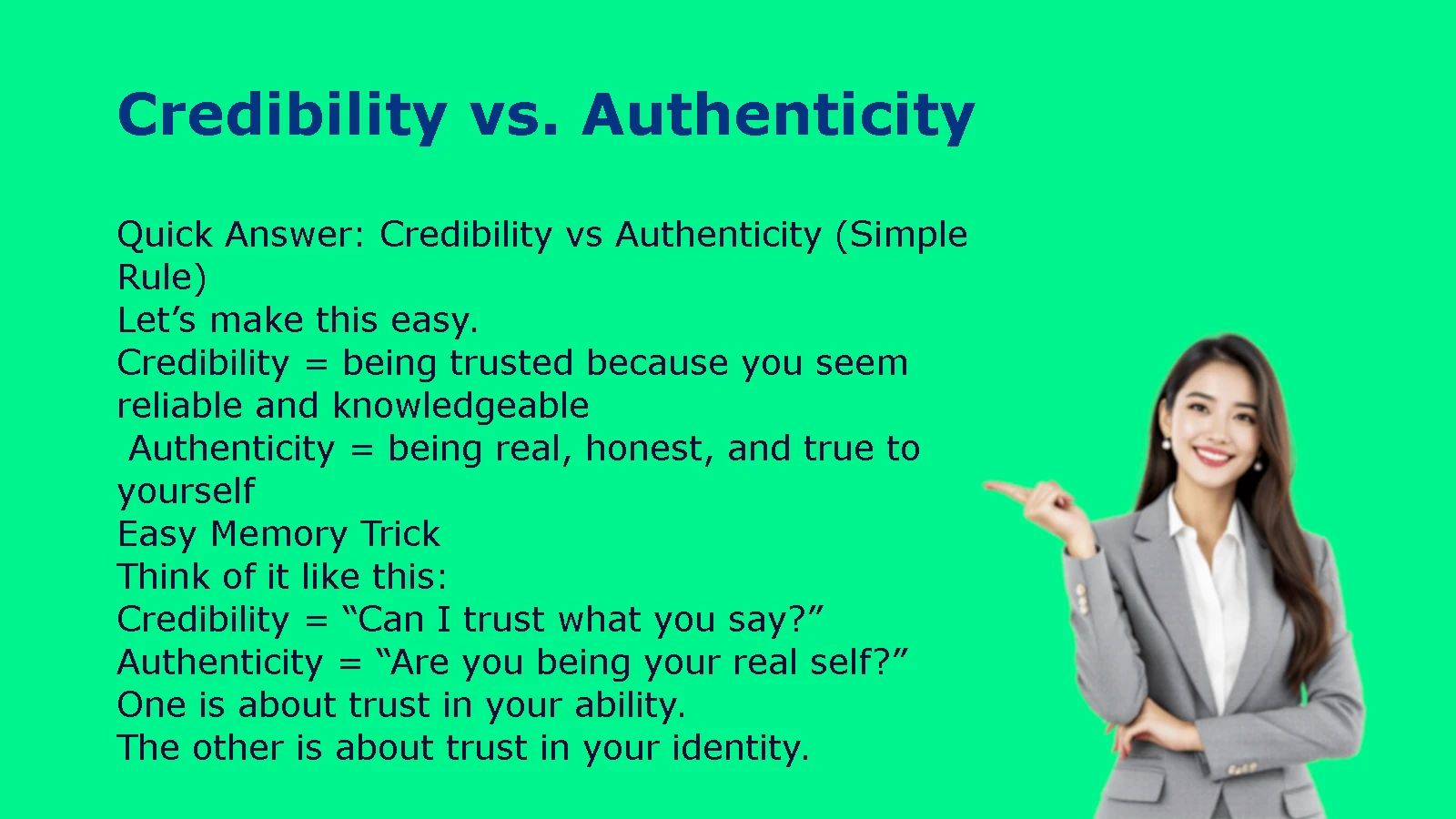
Quick Answer: Credibility vs Authenticity (Simple Rule)
Let’s make this easy.
Credibility = being trusted because you seem reliable and knowledgeable
Authenticity = being real, honest, and true to yourself
Easy Memory Trick
Think of it like this:
- Credibility = “Can I trust what you say?”
- Authenticity = “Are you being your real self?”
One is about trust in your ability.
The other is about trust in your identity.
Why People Confuse Credibility and Authenticity
At first glance, they overlap. Someone who is authentic often feels credible. Someone credible often seems authentic.
But here’s the problem: they don’t always come together.
In Social Media
- A polished influencer may look credible but not feel authentic
- A raw, unfiltered creator may feel authentic but not fully credible
In Work or Communication
- A professional report builds credibility
- A personal story builds authenticity
Why This Happens
- Both build trust, but in different ways
- People judge tone, style, and delivery differently
- One is external perception, the other is internal truth
The Core Difference Behind Credibility vs Authenticity
Let’s break it down simply.
Think in Two Questions
- Credibility asks: “Do you know what you’re talking about?”
- Authenticity asks: “Are you being true to who you are?”
Key Insight
Credibility is about competence
Authenticity is about character
One comes from proof and performance
The other comes from honesty and consistency
Credibility Explained Clearly (With Real-Life Meaning)
At its core, credibility is how much people trust your knowledge, skills, or authority.
What Builds Credibility
- Experience and expertise
- Evidence and facts
- Clear, structured communication
- Consistency in results
Real Examples
- A doctor giving medical advice
- A research paper with data
- A journalist citing verified sources
Mini Scenario
Imagine someone giving financial advice:
- If they show data, experience, and results → credible
- If they speak vaguely without proof → not credible
Key Takeaway
Credibility is earned through what you can prove
Authenticity Explained Clearly (With Real-Life Meaning)
Now let’s look at authenticity.
It’s about being genuine, transparent, and aligned with your true self.
What Builds Authenticity
- Honest expression
- Personal storytelling
- Consistent values
- Natural tone (not forced or scripted)
Real Examples
- A content creator sharing real struggles
- A brand showing behind-the-scenes moments
- A speaker admitting mistakes openly
Mini Scenario
A motivational speaker says:
- “I failed many times before success” → feels authentic
- “I’ve always been perfect” → feels inauthentic
Key Takeaway
Authenticity is earned through what feels real
Side-by-Side Comparison Table
| Aspect | Credibility | Authenticity |
| Core Meaning | Trust in expertise | Trust in genuineness |
| Focus | Skills, facts, results | Identity, honesty, values |
| Built Through | Evidence, experience | Transparency, expression |
| Question It Answers | “Can I trust your knowledge?” | “Are you real and honest?” |
| Risk if Missing | Not believed | Not relatable |
How Credibility and Authenticity Work Together
Here’s the most important part: they are not enemies.
In fact, the strongest communication blends both.
Example in Real Life
A great teacher:
- Explains concepts clearly (credibility)
- Shares personal learning struggles (authenticity)
A strong brand:
- Uses data and results (credibility)
- Shows human stories and values (authenticity)
Key Insight
Credibility earns respect.
Authenticity earns connection.
Together, they build trust.
Where People Go Wrong
This is where confusion turns into mistakes.
Mistake 1: Being Credible but Not Authentic
- Overly polished
- Too formal
- Feels robotic
Result: People trust your knowledge but don’t connect with you
Mistake 2: Being Authentic but Not Credible
- Very real and emotional
- But lacks structure or proof
Result: People relate to you but don’t fully trust your expertise
Real-Life Case Study
A fitness coach posts online:
Version A
- Scientific terms
- Training certifications
- No personal story
→ High credibility, low authenticity
Version B
- Shares weight loss journey
- Talks about failures
- No structured guidance
→ High authenticity, low credibility
Best Version
- Shares personal transformation
- Adds science-backed methods
→ High credibility + high authenticity
How to Build Both at the Same Time
If you want to master both, use this simple approach:
Build Credibility By
- Using facts and data
- Showing experience
- Staying consistent
Build Authenticity By
- Sharing real experiences
- Admitting mistakes
- Using a natural tone
Simple Formula
Proof + Personality = Trust
Quick Decision Guide
When in doubt, ask:
- Need trust in knowledge? → Focus on credibility
- Need emotional connection? → Focus on authenticity
- Need strong impact? → Use both together
FAQ: Credibility vs Authenticity
Are credibility and authenticity the same?
No. Credibility is about trust in expertise, while authenticity is about being real and honest.
Can you have one without the other?
Yes. You can be credible but not authentic, and vice versa.
Which is more important?
Neither alone. The strongest communication combines both.
Do brands need both?
Yes. Credibility builds trust, authenticity builds loyalty.
Final Takeaway: The One Rule That Never Fails
Here’s the simplest way to remember it.
Credibility tells people you know what you’re doing.
Authenticity tells people you’re being real while doing it.
One builds confidence in your message.
The other builds connection with your audience.
And when both work together, your words stop being just information—they become influence.
Because in the end, credibility vs authenticity isn’t a competition. It’s a balance.