Flied vs Flew
Flied and flew are both past-tense forms of fly, but they are used in different contexts. Flew is the standard past tense when talking about flying through the air, while flied is mainly used in baseball to describe hitting a fly ball.
Examples:
- The bird flew across the lake.
- The batter flied out to center field.
In this guide, you’ll learn the difference between Costed vs Cost, discover when to use costed, when to use cost, and understand why cost is usually the correct past tense of cost, while costed has a specific meaning in accounting and project management. You’ll also find cost vs costed examples, learn how to use cost in a sentence, and avoid one of the most common grammar mistakes involving this verb.
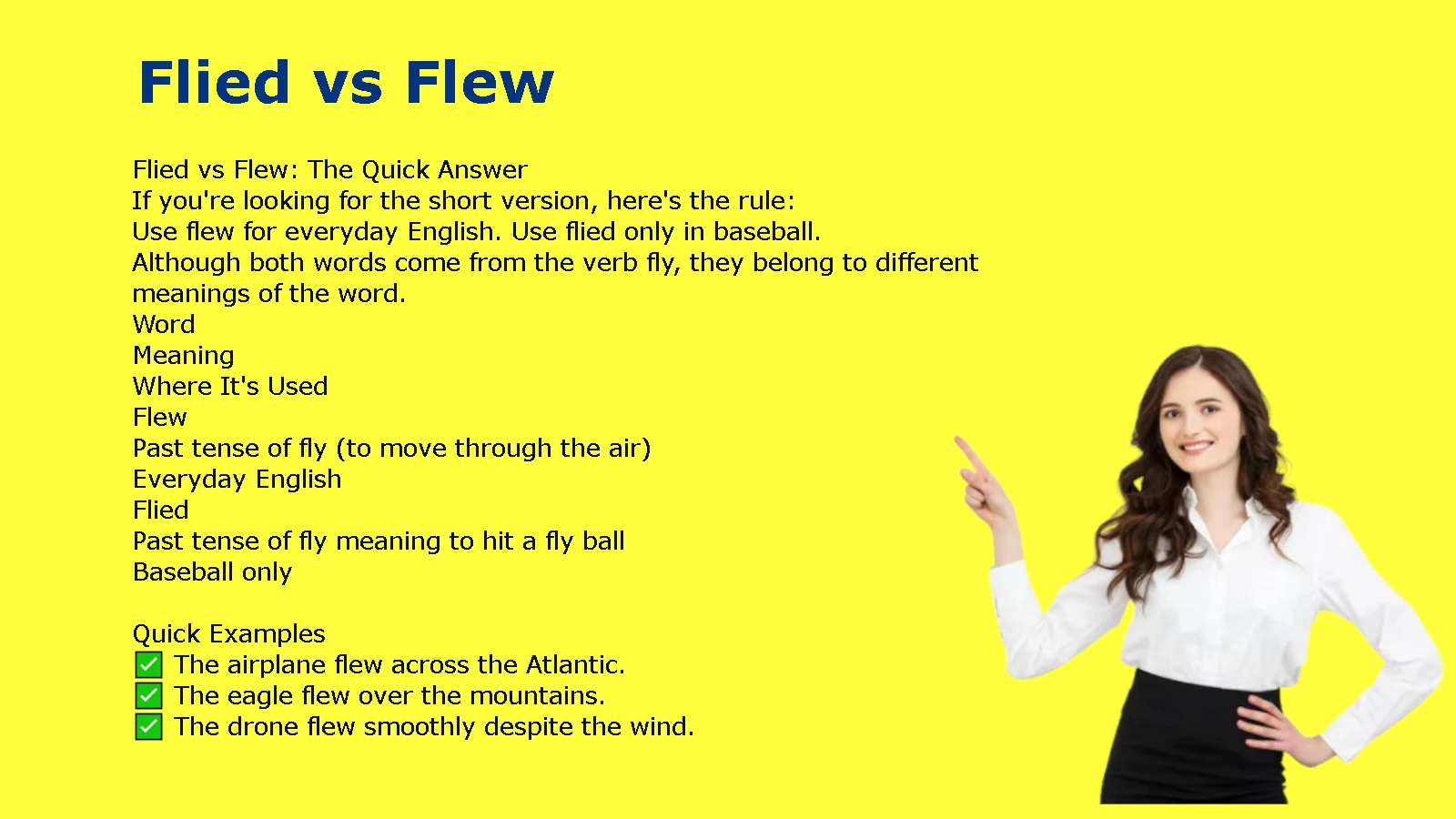
Flied vs Flew: The Quick Answer
If you’re looking for the short version, here’s the rule:
Use flew for everyday English. Use flied only in baseball.
Although both words come from the verb fly, they belong to different meanings of the word.
| Word | Meaning | Where It’s Used |
| Flew | Past tense of fly (to move through the air) | Everyday English |
| Flied | Past tense of fly meaning to hit a fly ball | Baseball only |
Quick Examples
✅ The airplane flew across the Atlantic.
✅ The eagle flew over the mountains.
❌ He flied to New York.
❌ The butterfly flied around the garden.
Key Takeaways
- Flew is the standard past tense of fly.
- Flied is a specialized baseball term.
- Never replace flew with flied in normal conversation.
- If the sentence has nothing to do with baseball, flew is almost always the correct choice.
What Does Flew Mean?
Flew is the simple past tense of the irregular verb fly, meaning to move through the air or to travel by aircraft.
Unlike regular verbs that simply add -ed, the verb fly changes its spelling in the past tense.
| Verb Form | Word |
| Base Form | Fly |
| Past Tense | Flew |
| Past Participle | Flown |
Because fly is an irregular verb, flew has become the accepted past tense in modern English.
When to Use Flew
You’ll use flew whenever the action involves movement through the air or travel by plane.
Common situations include:
- Air travel
- Birds flying
- Insects flying
- Kites
- Drones
- Helicopters
- Balloons
- Fictional characters
- Figurative expressions
Air Travel
One of the most common uses of flew relates to transportation.
Examples:
- We flew to Chicago for a business conference.
- She flew home after graduation.
- They flew first class for the first time.
- My grandparents flew overseas last summer.
Notice that flew works whether you’re talking about a commercial flight or a private aircraft.
Birds and Animals
Birds naturally provide some of the earliest examples children learn.
Examples:
- The owl flew silently through the forest.
- A flock of geese flew south for the winter.
- The hummingbird flew from flower to flower.
- The hawk flew high above the valley.
The same rule applies to insects.
Examples:
- The bee flew into the garden.
- Several butterflies flew around the flowers.
Aircraft and Technology
Modern technology gives us many additional examples.
Examples:
- The drone flew over the construction site.
- The rescue helicopter flew through heavy rain.
- The military aircraft flew at low altitude.
- The space probe flew past the asteroid.
Fiction and Entertainment
Stories often feature characters who can fly.
Examples:
- Superman flew over the city.
- The dragon flew above the castle.
- The fairy flew into the glowing forest.
- The wizard flew across the mountains on his broomstick.
Figurative Uses
English also uses flew in many figurative expressions.
Examples:
- Time flew during the vacation.
- The hours flew by.
- News of the victory flew across social media.
- Her imagination flew as she read the novel.
Here, nothing literally moves through the air. Instead, flew expresses speed or rapid movement.
Example Sentences Using Flew
Here are more examples that demonstrate correct usage.
- The airplane flew through thick clouds.
- Our kite flew higher than expected.
- The pilot flew safely despite the storm.
- A paper airplane flew across the classroom.
- Sparks flew from the fireworks display.
- The baseball flew over the fence after being hit.
- She flew to London for an international conference.
- The eagle flew effortlessly above the canyon.
- Leaves flew across the street during the storm.
- Excitement flew through the crowd after the announcement.
Each sentence describes movement, speed, or travel—not baseball terminology.
What Does Flied Mean?
Unlike flew, the word flied has a very narrow meaning.
In baseball, flied is the past tense of fly, where fly means to hit a fly ball into the air.
This surprises many English learners because they expect every use of fly to become flew. Baseball developed its own specialized vocabulary over many decades, and flied became the accepted past-tense form for this specific action.
Because of this unique usage, dictionaries recognize flied as a legitimate word even though it rarely appears outside baseball writing.
Baseball Definition
A batter flies out when they hit a fly ball that a defensive player catches before it touches the ground.
When describing that action in the past tense, baseball writers say the batter flied out.
For example:
- The cleanup hitter flied out to left field.
- He flied to center in the seventh inning.
- The rookie flied out with runners on base.
These are standard baseball expressions.
What Is a Fly Ball?
To understand flied, you first need to know what a fly ball is.
A fly ball is:
- A ball hit high into the air.
- Not a line drive.
- Not a ground ball.
- Catchable before it lands.
If a fielder catches it before it hits the ground, the batter is out.
That’s why baseball reports often contain sentences like:
- The batter flied out to right field.
- Smith flied to deep center.
- Jones flied out with two runners aboard.
Examples of Flied
Correct examples include:
- Aaron Judge flied out to left.
- The leadoff hitter flied to center field.
- The batter flied out to end the inning.
- He flied to right on the first pitch.
- The rookie flied deep enough for the runner to tag up.
Notice that every example belongs to a baseball setting.
Incorrect Uses of Flied
Many people mistakenly apply flied outside sports.
These examples are incorrect:
❌ She flied to California.
❌ We flied home yesterday.
Each sentence should use flew instead.
Correct versions:
- She flew to California.
- The bird flew away.
- We flew home yesterday.
- The airplane flew over the mountains.
Why Does Baseball Use Flied Instead of Flew?
This question confuses almost everyone encountering baseball terminology for the first time.
If fly normally becomes flew, why doesn’t baseball follow the same rule?
The answer lies in how specialized language evolves.
In baseball, the word fly doesn’t primarily describe movement through the air. Instead, it refers to a specific type of hit. Over time, players, coaches, sportswriters, and official scorers treated fly as a distinct baseball verb rather than the ordinary verb meaning “to move through the air.”
As a result, they formed its past tense the same way they would for many regular verbs—by adding -ed.
That convention eventually became standard across professional baseball.
Today, official game summaries, scorebooks, broadcasters, journalists, and baseball organizations consistently use flied.
For example:
- The batter flied out to short right field.
- Rodriguez flied to center in the fifth inning.
- The designated hitter flied out with two outs.
Although flew out occasionally appears in informal conversation, professional baseball writing overwhelmingly favors flied out because it distinguishes the baseball action from the ordinary verb flew.
Grammar Insight: In baseball, flied isn’t replacing the irregular past tense of fly. Instead, it’s the accepted past tense of a specialized sports verb that developed its own grammatical convention.
Why Is It Flew in General English but Flied in Baseball?
The difference becomes much easier to understand when you recognize that English often gives specialized fields their own vocabulary.
Medicine, law, technology, music, and sports all contain words that follow conventions unfamiliar to everyday speakers.
Baseball is no exception.
Think of fly as having two distinct meanings:
| Meaning of Fly | Correct Past Tense | Example |
| To move through the air | Flew | The pilot flew to Seattle. |
| To hit a fly ball (baseball) | Flied | The batter flied out to center field. |
Although both meanings share the same spelling, they belong to different contexts.
Using flew for air travel keeps English consistent with its irregular verb pattern:
- fly
- flew
- flown
Meanwhile, using flied in baseball helps preserve a long-standing sports convention that clearly identifies a particular type of play.
This distinction also prevents confusion. Imagine reading the sentence:
The batter flew to center field.
Without context, it almost sounds as if the player himself took flight. Saying:
The batter flied out to center field.
immediately tells baseball fans that the hitter produced a catchable fly ball.
That clarity is one reason the specialized form has remained in use for well over a century.
Flied vs Flew: Side-by-Side Comparison
The following table summarizes the key differences between these two words.
| Feature | Flew | Flied |
| Meaning | Past tense of fly (move through the air) | Past tense of fly meaning to hit a fly ball |
| Grammar Type | Irregular verb | Specialized baseball verb |
| Everyday English | Yes | No |
| Air travel | ✅ | ❌ |
| Birds and insects | ✅ | ❌ |
| Airplanes | ✅ | ❌ |
| Baseball | Rarely used | Standard usage |
| Dictionaries recognize it | ✅ | ✅ |
| Appropriate in formal writing | Yes | Only in baseball contexts |
Flied vs Flew in Different Contexts
The easiest way to choose between flied and flew is to think about what’s happening in the sentence. Is someone or something moving through the air? Or are you describing a baseball play?
If it’s about flying, traveling, or airborne movement, flew is correct. If it’s about a batter hitting a fly ball in baseball, use flied.
The table below summarizes the most common situations.
| Situation | Correct Word | Example |
| Airplane travel | Flew | We flew to Boston last weekend. |
| Birds | Flew | The eagle flew over the canyon. |
| Insects | Flew | A butterfly flew into the garden. |
| Drones | Flew | The drone flew above the stadium. |
| Helicopters | Flew | The helicopter flew over the wildfire. |
| Kites | Flew | Our kite flew surprisingly high. |
| Superheroes | Flew | Iron Man flew across the skyline. |
| Baseball fly ball | Flied | The batter flied out to left field. |
| Baseball game recap | Flied | He flied to center in the eighth inning. |
| Baseball scorebook | Flied | Smith flied out with two runners on. |
Everyday English Uses Flew
Whenever you’re talking about movement through the air, the irregular verb flew is the only correct choice.
Examples include:
- Commercial flights
- Birds migrating
- Bees pollinating flowers
- Balloons floating away
- Helicopters rescuing people
- Fictional flying creatures
- Drones capturing aerial footage
Here are a few examples:
- The rescue plane flew through dangerous weather.
- Hundreds of birds flew south before winter arrived.
- My cousin flew from Miami to Seattle for work.
- The balloon flew out of the child’s hands.
Baseball Uses Flied
Baseball has its own vocabulary, and flied belongs to it.
Sports commentators, official scorers, and journalists consistently use flied when describing a batter hitting a fly ball.
Examples include:
- The rookie flied out to center field.
- Harper flied to right on the first pitch.
- The cleanup hitter flied out to end the inning.
- The batter flied deep enough for the runner to score.
Outside baseball, however, this form sounds incorrect.
Common Mistakes People Make
Because fly is an irregular verb, people often assume every past-tense use should be flew. Others see flied in baseball articles and begin using it everywhere.
Both mistakes are common.
Let’s clear them up.
Mistake 1: Using Flied for Air Travel
❌ We flied to New York.
✅ We flew to New York.
Travel always takes flew.
Mistake 2: Using Flied for Birds
❌ The eagle flied over the lake.
✅ The eagle flew over the lake.
Animals don’t flied.
Mistake 3: Assuming Flied Is Always Wrong
Many people believe flied isn’t a real word.
It absolutely is.
Major dictionaries recognize flied because baseball uses it as the accepted past tense of fly in the sense of hitting a fly ball.
Mistake 4: Using Flew Out Instead of Flied Out
Some casual conversations include sentences like:
The batter flew out to center.
Although many fans understand the meaning, professional baseball writing overwhelmingly favors:
The batter flied out to center.
Sports journalists, broadcasters, official scorers, and statistical databases generally follow this convention.
Mistake 5: Confusing Flew and Flown
Many learners also mix these forms.
Incorrect:
❌ I have flew to Canada before.
Correct:
✅ I have flown to Canada before.
Remember:
- Flew = simple past
- Flown = past participle
Quick Correction Table
| Incorrect | Correct |
| She flied to Paris. | She flew to Paris. |
| The hawk flied away. | The hawk flew away. |
| I have flew before. | I have flown before. |
| The batter flew out to center. (acceptable informally but not standard baseball style) | The batter flied out to center. |
Flew vs Flied vs Flown
One of the biggest reasons learners struggle with flied vs flew is that another form—flown—also enters the picture.
These three words each have a different job.
| Word | Grammar Function | Example |
| Fly | Base verb | Birds fly south every winter. |
| Flew | Simple past tense | The birds flew south yesterday. |
| Flown | Past participle | The birds have flown south. |
| Flied | Baseball past tense | The batter flied out to left field. |
Think of It This Way
Normal English follows this pattern:
- Fly
- Flew
- Flown
Baseball creates a separate branch:
- Fly (hit a fly ball)
- Flied
- Flied
That distinction keeps baseball terminology precise while preserving the irregular verb pattern used everywhere else.
Sentence Comparison
| Sentence | Correct? |
| I flew to California yesterday. | ✅ |
| I have flown to California three times. | ✅ |
| The batter flied out in the ninth inning. | ✅ |
| The eagle flied over the canyon. | ❌ |
| We have flew there before. | ❌ |
Idioms and Expressions That Use Flew
English contains many expressions using flew that have nothing to do with literal flying.
Learning these idioms helps you sound more natural in conversation and writing.
Time Flew
Meaning: Time passed very quickly.
Examples:
- Time flew during our vacation.
- The weekend flew by.
Flew Into a Rage
Meaning: Became angry very suddenly.
Examples:
- He flew into a rage after hearing the accusation.
- She flew into a panic when she lost her passport.
Flew Off the Handle
Meaning: Lost your temper.
Examples:
- He flew off the handle over a small mistake.
- Try not to fly off the handle before hearing the full story.
Flew Under the Radar
Meaning: Avoided attention.
Examples:
- The startup flew under the radar for several years.
- His quiet leadership style often flew under the radar.
Flew the Coop
Meaning: Left home or became independent.
Examples:
- Both children flew the coop after college.
- She finally flew the coop and started her own business.
Flew in the Face of
Meaning: Went completely against something.
Examples:
- The decision flew in the face of expert advice.
- His actions flew in the face of company policy.
Examples of Flew in Sentences
Below are examples covering different situations you’ll encounter in everyday English.
Travel
- We flew across the country in just five hours.
- My parents flew to Italy for their anniversary.
- She flew home after finishing the conference.
- They flew overnight to avoid delays.
Birds and Wildlife
- A bald eagle flew over the river.
- Hundreds of geese flew south before winter.
- The owl flew silently through the forest.
- A hummingbird flew between colorful flowers.
Technology
- The drone flew above the construction site.
- The helicopter flew close to the mountain.
- The experimental aircraft flew farther than expected.
Objects
- The baseball flew over the fence for a home run.
- Sparks flew from the welding machine.
- Leaves flew across the parking lot during the storm.
- The paper airplane flew across the classroom.
Figurative Uses
- Time flew while we talked.
- Rumors flew around the office.
- Ideas flew during the brainstorming session.
- His imagination flew as he read the novel.
Mixed Examples
- The rescue pilot flew through heavy rain.
- My hat flew off in the wind.
- The kite flew higher than anyone expected.
- The superhero flew above the city skyline.
Examples of Flied in Sentences
Every sentence below uses flied correctly in a baseball context.
- The batter flied out to right field.
- Jackson flied to center on the first pitch.
- The cleanup hitter flied out with runners on first and second.
- The rookie flied deep enough to score the runner.
- Martinez flied out to end the inning.
- The leadoff hitter flied to left.
- He flied to shallow center for the second out.
- The designated hitter flied to deep right field.
- The pinch hitter flied out in foul territory.
- Smith flied to the warning track.
- The catcher flied out after an eight-pitch at-bat.
- The batter flied to center to finish the game.
Notice that every example involves a baseball play rather than ordinary flying.
Case Study: Why One Word Changed the Meaning
Imagine two sports reporters covering different events on the same day.
Reporter A
The team flew to Chicago for an important playoff game.
This sentence describes travel.
The players boarded an airplane.
Reporter B
The cleanup hitter flied out to center field in the ninth inning.
This sentence describes baseball action.
No one actually flew through the air. Instead, the batter hit a fly ball that a fielder caught.
Although both reports use a form of fly, they describe completely different actions.
That’s why English preserves both flew and flied.
“Context determines correctness far more often than spelling alone.”
Flied vs Flew Quiz
Now that you’ve learned the difference between flied and flew, it’s time to test your knowledge. Choose the correct word in each sentence before checking the answers.
Multiple-Choice Questions
1. We ______ to Denver for our family vacation.
A. Flied
B. Flew
2. The batter ______ out to center field in the seventh inning.
A. Flew
B. Flied
3. Hundreds of birds ______ south before winter arrived.
A. Flew
B. Flied
4. The rookie ______ out with runners on first and second.
A. Flied
B. Flew
5. My grandparents ______ overseas last month.
A. Flew
B. Flied
6. The drone ______ above the construction site.
A. Flew
B. Flied
7. The cleanup hitter ______ to left field to end the game.
A. Flied
B. Flew
8. Time ______ by while we were talking.
A. Flied
B. Flew
9. The eagle ______ over the canyon.
A. Flew
B. Flied
10. The center fielder caught the ball after the batter ______ out.
A. Flew
B. Flied
Answer Key
| Question | Correct Answer |
| 1 | B. Flew |
| 2 | B. Flied |
| 3 | A. Flew |
| 4 | A. Flied |
| 5 | A. Flew |
| 6 | A. Flew |
| 7 | A. Flied |
| 8 | B. Flew |
| 9 | A. Flew |
| 10 | B. Flied |
If you answered 8–10 correctly, you’ve mastered the difference between these two words.
Memory Tricks to Remember the Difference
English grammar becomes much easier when you connect rules to simple mental shortcuts. These memory tricks can help you remember flied vs flew without looking up the rule every time.
Trick 1: Think About the Setting
Ask yourself one question:
Is this sentence about baseball?
- Yes → Use flied.
- No → Use flew.
This simple check solves almost every case.
Trick 2: Picture an Airplane
If someone travels by plane or something moves through the air, choose flew.
Examples:
- The airplane flew.
- The bird flew.
- The drone flew.
- The kite flew.
Trick 3: Think of a Baseball Diamond
If you can imagine a batter, pitcher, catcher, or outfielder, you’re almost certainly dealing with flied.
Examples:
- The batter flied out.
- The hitter flied to center.
- The rookie flied deep enough for a sacrifice fly.
Trick 4: Remember the Irregular Verb Pattern
The ordinary verb fly follows this pattern:
- Fly
- Flew
- Flown
The baseball verb follows a different pattern:
- Fly (hit a fly ball)
- Flied
- Flied
Keeping these two patterns separate prevents confusion.
Expert Grammar Notes
The distinction between flied and flew often raises questions about how English verbs evolve. Understanding a few grammar principles makes the difference much clearer.
English Allows Specialized Verb Forms
English isn’t completely uniform. Certain professions, sports, and technical fields develop vocabulary that differs from everyday language.
Examples include:
- Legal terms
- Medical terminology
- Military jargon
- Computing language
- Sports vocabulary
Baseball belongs to this group.
Although fly is normally an irregular verb, baseball treats fly meaning “to hit a fly ball” as a specialized verb with its own accepted past tense.
Why Dictionaries Include Both Words
Modern dictionaries list both flew and flied because each serves a legitimate purpose.
- Flew belongs to standard English.
- Flied belongs to baseball English.
Neither word is replacing the other. Instead, each applies to a different meaning of fly.
Language Changes Through Usage
One of the most important principles in linguistics is that language changes through consistent use.
For more than a century, baseball players, coaches, broadcasters, sportswriters, and official scorers have used flied. Because of that widespread and consistent usage, the term became part of standard baseball vocabulary.
This illustrates an important point:
Grammar doesn’t exist in isolation. Real-world usage shapes the language over time.
Flied vs Flew: Quick Reference Chart
If you only remember one table from this guide, make it this one.
| If You’re Talking About… | Use | Example |
| Airplane travel | Flew | We flew to Texas. |
| Birds | Flew | The hawk flew overhead. |
| Bees | Flew | A bee flew into the garden. |
| Drones | Flew | The drone flew across the field. |
| Superheroes | Flew | Superman flew away. |
| Baseball fly ball | Flied | The batter flied out. |
| Baseball recap | Flied | He flied to center. |
| Baseball statistics | Flied | Smith flied out twice. |
Frequently Asked Questions
Is flied a real word?
Yes. Flied is a real word recognized by major English dictionaries. It serves as the accepted past tense of fly when referring to hitting a fly ball in baseball.
Is flew the correct past tense of fly?
Yes. In everyday English, flew is the standard simple past tense of fly.
Examples include:
- She flew to Seattle.
- The eagle flew overhead.
- Time flew by.
Why doesn’t baseball use flew?
Baseball developed its own specialized vocabulary. In this context, fly refers to a particular type of hit rather than movement through the air. Over time, flied became the accepted past-tense form used by players, coaches, broadcasters, and official scorers.
Can I say, “He flied to New York”?
No.
The correct sentence is:
He flew to New York.
Travel always takes flew.
Is flied out grammatically correct?
Yes.
In baseball, flied out is the standard expression.
Examples:
- The batter flied out to right field.
- He flied out with two runners on base.
Is flew out ever correct in baseball?
You may hear flew out in casual conversation, especially among fans. However, professional baseball writing, official scorekeeping, and sports journalism generally prefer flied out because it’s the established term within the sport.
What’s the difference between flew and flown?
- Flew is the simple past tense.
- Flown is the past participle used with helping verbs such as has, have, or had.
Examples:
- We flew to Boston yesterday.
- We have flown to Boston several times.
Should English learners use flied?
Only if you’re discussing baseball.
For almost every other situation, you’ll use flew.
Is flied used outside baseball?
Rarely. Outside baseball, flied is generally considered incorrect because the ordinary past tense of fly is flew.
Key Takeaways
Here’s a quick recap of everything you’ve learned.
- Flew is the standard past tense of fly in everyday English.
- Flied is correct only when discussing baseball.
- Use flew for airplanes, birds, insects, drones, balloons, and figurative expressions.
- Use flied when a batter hits a fly ball.
- Flied is recognized by major dictionaries because it represents established baseball terminology.
- Flew follows the irregular verb pattern: fly → flew → flown.
- Context always determines which word is correct.
Conclusion
Understanding flied vs flew is easier than it first appears. Although both words come from the verb fly, they belong to different meanings and different contexts.
For everyday English, the rule is straightforward: use flew whenever someone or something moves through the air or travels by aircraft. Whether you’re describing a bird soaring above the trees, a drone capturing aerial footage, or a family vacation across the country, flew is the correct choice.
Flied, on the other hand, occupies a unique place in baseball. It refers specifically to a batter hitting a fly ball, and it has been the standard term in scorebooks, game recaps, broadcasts, and baseball journalism for generations.
The next time you hesitate between these two words, remember one simple question:
Is this sentence about baseball?
If the answer is yes, flied is probably correct.
If the answer is no, choose flew.
Keeping that distinction in mind will help you write with greater confidence, avoid common grammar mistakes, and use each word exactly as native speakers and professional writers do.