The em dash (—) is a punctuation mark that creates a strong break in a sentence, adds emphasis, or sets off extra information. Understanding em dash meaning, correct usage, and the difference between an em dash, en dash, and hyphen helps you write clearer sentences in emails, essays, articles, and everyday conversations. You can also learn how to type the em dash symbol on Windows, Mac, and mobile devices, and why people often associate em dashes with AI-generated writing.
An em dash gives a sentence more flexibility than a comma or period in certain situations. It can highlight an important detail, show an interruption, or introduce an explanation. However, it works best when you use it intentionally rather than inserting one into every sentence.
What Does an Em Dash Mean?
An em dash (—) is a long punctuation mark that separates parts of a sentence to create emphasis, indicate a sudden break, or add supplementary information. Writers use it to connect ideas, interrupt a thought, or draw attention to a detail. Its effect is usually stronger than a comma but less final than a period.
For example:
- I wanted to call you—but I lost your number.
- My favorite meal—homemade chicken soup—was waiting on the table.
In the first example, the em dash creates a pause before the unexpected explanation. In the second, a pair of em dashes encloses extra information
What Is the Em Dash Symbol?
The em dash symbol looks like this:
—
It is longer than a hyphen (-) and an en dash (–). Although these marks look similar, they serve different purposes.
| Punctuation mark | Symbol | Main purpose | Example |
| Em dash | — | Emphasis, interruption, or extra information | I called her—no answer. |
| En dash | – | Ranges or relationships | Pages 20–35 |
| Hyphen | – | Joining words or word parts | A well-known writer |
| Comma | , | Separating sentence elements | After lunch, we left. |
The em dash symbol does not have a fixed grammatical meaning on its own. Its function depends on the sentence. It may signal a pause, an interruption, a clarification, or a shift in thought.
Why Is It Called an Em Dash?
The name comes from traditional typography. An em dash was historically associated with a width roughly equal to the typeface’s capital letter M. An en dash was associated with a width roughly equal to the letter N.
Modern fonts do not always follow these proportions exactly, but the names remain standard.
The word em identifies the typographic unit; it does not mean that the punctuation mark belongs exclusively to a particular type of writing.
Em Dash vs. En Dash vs. Hyphen
These three marks are easy to confuse, especially when typing quickly.
- Em dash (—): Creates a break, adds emphasis, or sets off information.
- En dash (–): Commonly connects numbers in a range or expresses a relationship between two things.
- Hyphen (-): Joins words or parts of words, as in part-time job or well-written article.
Consider these examples:
- The meeting was delayed—again.
- The meeting runs from 2:00–3:00 p.m.
- We discussed a last-minute change.
Each mark has a different job. Replacing one with another can make a sentence look incorrect or change how readers interpret it.
What Is an Em Dash Used For?
An em dash serves several purposes in everyday writing. You can use it to emphasize a phrase, insert extra information, show interrupted speech, or introduce an explanation. The key is to choose it when you want a noticeable break in the sentence rather than an ordinary pause.
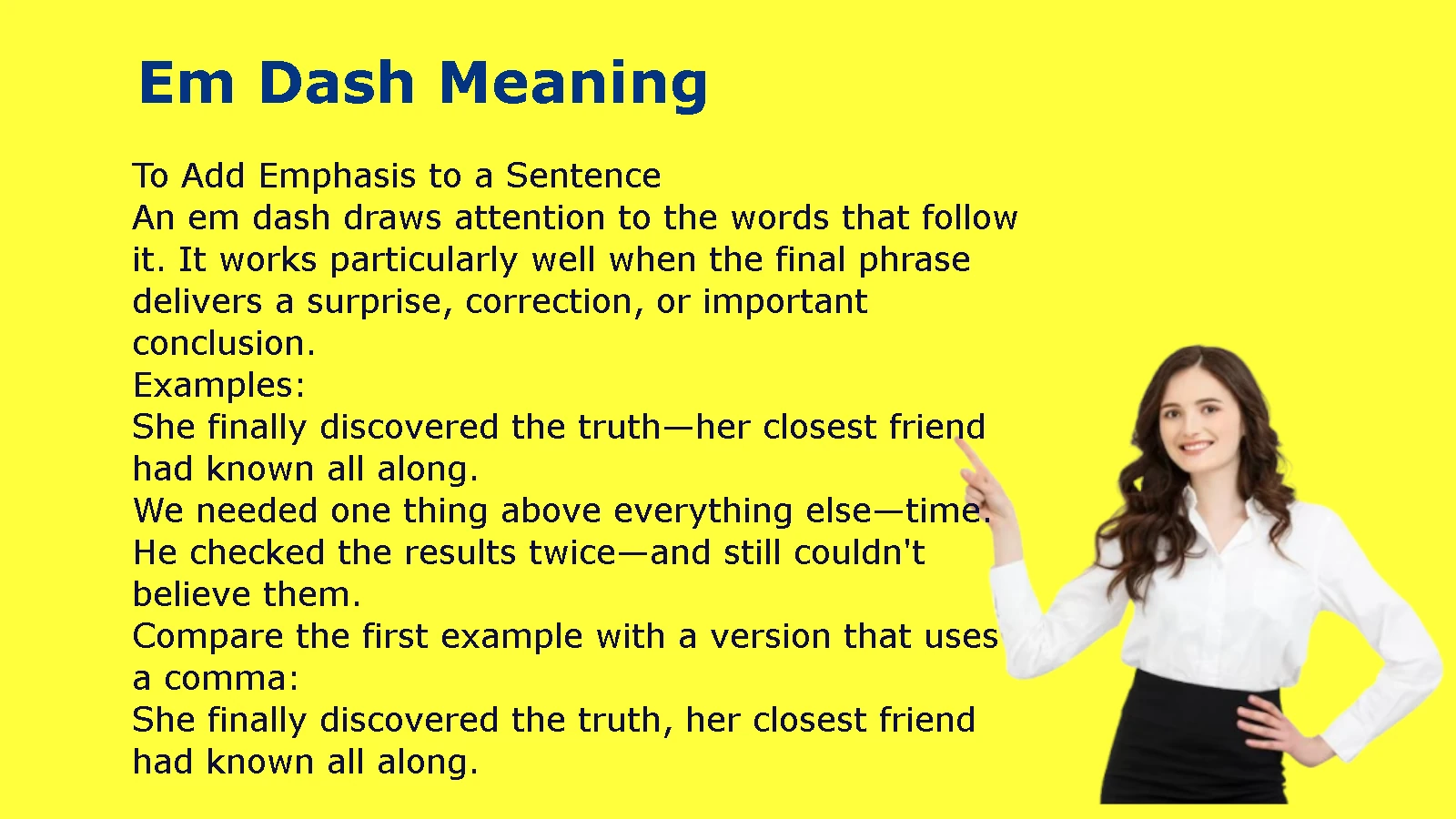
To Add Emphasis to a Sentence
An em dash draws attention to the words that follow it. It works particularly well when the final phrase delivers a surprise, correction, or important conclusion.
Examples:
- She finally discovered the truth—her closest friend had known all along.
- We needed one thing above everything else—time.
- He checked the results twice—and still couldn’t believe them.
Compare the first example with a version that uses a comma:
She finally discovered the truth, her closest friend had known all along.
The comma creates a grammatical problem because it joins two independent clauses without an appropriate conjunction or punctuation. The em dash gives the sentence a clear break and emphasizes the revelation.
Use this technique when the second part of a sentence deserves extra attention. Avoid adding a dash simply to make ordinary information look dramatic.
To Add Extra Information or an Explanation
You can use two em dashes to insert information into a sentence. The inserted phrase provides context but does not carry the main message.
Examples:
- My brother—who rarely arrives early—was the first person there.
- The restaurant—despite its small dining room—serves excellent food.
- Our final candidate—a former teacher with ten years of experience—accepted the offer.
In each example, the sentence remains understandable if you remove the words between the dashes.
For instance:
My brother was the first person there.
The extra phrase adds detail, while the main sentence carries the central idea.
You can also use commas or parentheses for the same general purpose. Em dashes create a stronger interruption, commas feel more integrated into the sentence, and parentheses make the extra information feel more like an aside.
To Show an Interruption or Sudden Change in Thought
An em dash can represent an interruption in dialogue or a speaker’s sudden change of direction.
Examples:
- “I thought you said the train would—”
- “Wait! Don’t open that door—”
- “I was going to explain, but—actually, never mind.”
In fiction, an em dash can show that another speaker cuts someone off. It can also indicate that a character stops speaking abruptly.
Compare an em dash with an ellipsis:
- Em dash: “I was just trying to—” She interrupted him.
- Ellipsis: “I thought we could have…” His voice faded away.
The em dash often suggests a sudden stop or interruption. An ellipsis commonly suggests hesitation, fading speech, or an unfinished thought that trails off.
These conventions can vary by publisher and style guide, but the distinction helps readers understand the intended delivery.
To Introduce an Explanation or Summary
An em dash can introduce a detail that explains or summarizes the preceding statement.
Examples:
- She had everything she needed—a laptop, a notebook, and a quiet room.
- The result was clear—our original plan would not work.
- He finally understood the problem—he had been looking at the wrong numbers.
A colon can also introduce an explanation or list. The difference lies mainly in tone and emphasis.
A colon often signals a formal explanation or structured list. An em dash tends to create a more conversational or dramatic transition.
For example:
- Colon: We needed three supplies: paper, pens, and folders.
- Em dash: We needed three supplies—paper, pens, and folders.
Both versions are correct. The colon presents the list more formally, while the em dash creates a stronger connection between the statement and the list.
To Replace a Colon or Parentheses
An em dash can sometimes replace a colon or parentheses, but the marks do not always produce the same effect.
Consider these sentences:
- Colon: She had one concern: the deadline.
- Em dash: She had one concern—the deadline.
- Parentheses: She had one concern (the deadline).
The colon introduces the concern directly. The em dash gives the concern more dramatic weight. The parentheses make the information feel quieter or more incidental.
Choose the punctuation mark based on the relationship between the ideas, the sentence’s tone, and your audience.
Em Dash Examples in Sentences
The easiest way to understand em dash usage is to examine complete sentences. The following examples show how the punctuation mark works in different contexts, from casual messages to professional writing.
Simple Em Dash Examples
Here are original examples of em dashes in everyday sentences:
- I finished the report—finally!
- The weather looked promising—but the forecast was wrong.
- Her answer was simple—she wasn’t interested.
- We searched everywhere—the keys were in the car.
- One thing mattered most—keeping everyone safe.
- The package arrived late—three days after the expected date.
- He promised to help—and he kept his word.
- My favorite book—an old mystery novel—was missing.
- The room was silent—nobody knew what to say.
- I had a backup plan—just in case.
Each sentence uses the dash to create a distinct break. Some examples emphasize the ending, while others add an explanation or insert a phrase.
Em Dash Examples at the Beginning, Middle, and End of Sentences
Em dashes usually appear within sentences rather than at the very beginning. Their position depends on what the writer wants to emphasize.
Em dash in the middle of a sentence
- The manager—who had reviewed every application—made the final decision.
- We planned to leave early—but the storm changed everything.
At the end of a sentence
- She had only one request—keep the information private.
- I knew exactly what had gone wrong—the file was missing.
Em dash at the beginning of a new thought
- “—And that is why we need a new plan,” she said.
This last construction can appear in dialogue or stylized writing, but it is not the most common use in ordinary prose. In many fiction styles, writers place an em dash at the end of interrupted speech or use a dialogue-specific convention.
For most everyday writing, focus on using em dashes within a sentence or to mark an interruption.
Using One Em Dash vs. Two Em Dashes
A single em dash often introduces a conclusion, explanation, or emphasized phrase. Two em dashes can enclose information within a sentence.
| Pattern | Example | Purpose |
| One dash before an emphasized ending | She finally understood—the answer was obvious. | Highlights the final idea |
| Two dashes around extra information | The answer—which seemed obvious at first—was wrong. | Inserts supplementary information |
| One dash for interruption | “I wanted to tell you—but never mind.” | Shows a break or change of thought |
| One dash introducing a list | Bring the essentials—water, food, and a map. | Introduces examples or details |
When using a pair of em dashes, make sure the sentence remains grammatically sound after you remove the inserted information.
For example:
The building—which opened last year—already needs repairs.
Remove the inserted phrase:
The building already needs repairs.
The main sentence still works.
Em Dash Examples in Dialogue and Fiction
Writers use em dashes to control dialogue, pace, and character voice.
Examples:
- “I didn’t take your phone—I swear!”
- “If you would just listen—”
- “Stop right there!”
- “I know what you’re going to say—but I disagree.”
In the second example, the dash signals interrupted speech when the surrounding narration makes the interruption clear.
Fiction writers can also use em dashes to reveal a character’s personality. A nervous character might interrupt themselves frequently, while an impatient character might cut other people off.
However, don’t use a dash every time a character pauses. Ordinary pauses may need no punctuation beyond the natural structure of the dialogue.
How to Type an Em Dash on a Keyboard
You can type an em dash using a keyboard shortcut, an automatic text substitution, a character menu, or copy and paste. The best method depends on your device and application. If you use the mark frequently, learning a shortcut can save time.
How to Type an Em Dash on Windows
On Windows, one common method uses the numeric keypad.
Numeric keypad method
- Turn on Num Lock if your keyboard requires it.
- Hold down the Alt key.
- Type 0151 on the numeric keypad.
- Release Alt.
The em dash should appear: —
This method works in many Windows applications, but behavior can vary by program and keyboard configuration. A laptop without a dedicated numeric keypad may require a different approach.
Microsoft Word method
In many Microsoft Word configurations, typing two hyphens between words and then continuing the sentence can trigger an automatic conversion to an em dash.
For example, typing:
The answer–after several delays–was finally available.
may automatically convert the paired hyphens into em dashes, depending on your AutoCorrect settings.
If the substitution doesn’t occur, check Word’s AutoCorrect options or use the application’s symbol menu.
How to Type an Em Dash on Mac
On macOS, the standard keyboard shortcut for an em dash is:
Option + Shift + Hyphen (-)
Press and hold Option and Shift, then press the hyphen key.
The result should be:
—
This shortcut works in many Mac applications. Some applications may override standard system shortcuts, so check the application’s menu if it behaves differently.
If you frequently write articles, emails, or documents, learning this shortcut is usually faster than opening the character viewer each time.
How to Type an Em Dash on iPhone and Android
Mobile keyboards usually provide the em dash through the punctuation layout or a symbol panel.
On iPhone
- Open the keyboard in a text field.
- Tap the number or symbol key.
- Look for the dash or punctuation options.
- Depending on your keyboard layout, press and hold a dash key to reveal additional characters.
On Android
- Open the keyboard.
- Switch to the symbols or punctuation layout.
- Look for the em dash.
- If it isn’t visible, press and hold the hyphen key or check the keyboard’s additional symbols.
The exact steps depend on your keyboard app, operating-system version, and language settings. If you cannot find the symbol, copying it from this page is a simple alternative: —
How to Insert an Em Dash in Microsoft Word and Google Docs
Microsoft Word and Google Docs offer several ways to insert special punctuation.
In Microsoft Word
- Use the Mac keyboard shortcut or Windows numeric keypad method.
- Check whether automatic punctuation replacement is enabled.
- Open the Insert or Symbol menu and locate the em dash.
In Google Docs
- Open the document.
- Select Insert, then Special characters.
- Search for “em dash.”
- Select the symbol to insert it.
Google Docs may also convert certain typed character combinations into an em dash automatically, depending on the application and settings.
Practical tip: If you edit long articles, check your automatic substitution settings before making a large revision. Automatic replacements can save time, but they may also change punctuation you intended to keep.
Copy and Paste the Em Dash Symbol
If you need the symbol only occasionally, copy it from here:
Em dash: —
For comparison:
- Em dash: —
- En dash: –
- Hyphen: –
You can paste the em dash into emails, content management systems, spreadsheets, social media posts, and word processors.
This approach is especially useful when working on a device that lacks a convenient keyboard shortcut.
Em Dash vs. Comma vs. Hyphen: What’s the Difference?
An em dash, comma, and hyphen may appear similar in a line of text, but they perform different grammatical jobs. The em dash creates a noticeable break, the comma separates sentence elements, and the hyphen joins words or word parts.
Em Dash vs. Comma
The main difference between an em dash and a comma is the strength of the interruption or emphasis.
A comma usually creates a lighter pause. An em dash creates a more noticeable break and can draw attention to the information that follows.
Compare these examples:
- Comma: My sister, who lives in Chicago, is visiting next week.
- Em dash: My sister—who lives in Chicago—is visiting next week.
Both versions are grammatically acceptable. The comma version integrates the extra information smoothly. The em dash version makes the inserted phrase stand out more.
Consider another example:
- Comma: I needed one thing, a little more time.
- Em dash: I needed one thing—a little more time.
The em dash makes the explanation clearer and more emphatic. In the comma version, the relationship between the clauses may feel less direct.
Use a comma when:
- You need a conventional grammatical separator.
- The extra information should flow naturally.
- The sentence already contains enough emphasis.
Use an em dash when:
- You want to emphasize a detail.
- The sentence includes an interruption or sharp change.
- A parenthetical phrase deserves more attention.
Remember that an em dash is not a universal replacement for commas. Each mark has grammatical uses that the other cannot always perform.
Em Dash vs. Hyphen
An em dash separates or interrupts parts of a sentence. A hyphen connects words or word parts.
| Em dash | Hyphen |
| She was ready—until the phone rang. | She was well-prepared. |
| The result was unexpected—almost unbelievable. | It was a last-minute decision. |
| He wanted one thing—success. | She works part-time. |
The em dash is generally longer than a hyphen. More importantly, the two marks have different grammatical functions.
A useful test is to ask whether you want to join words or separate ideas.
- Join words: a user-friendly website
- Separate ideas: The website looked simple—it was surprisingly difficult to use.
This distinction matters in editing because replacing a hyphen with an em dash can make a compound word incorrect, while replacing an em dash with a hyphen can make a sentence look unprofessional.
Em Dash vs. En Dash
The en dash is longer than a hyphen but shorter than an em dash in many fonts. It commonly expresses ranges or relationships.
Examples of en dash usage:
- The course runs Monday–Friday.
- Read pages 15–28.
- The debate covered the teacher–student relationship.
Examples of em dash usage:
- The course was challenging—but rewarding.
- She had one goal—finishing the assignment.
- The teacher—an experienced researcher—led the discussion.
In many publishing styles, the en dash connects items that have a relationship, while the em dash separates or interrupts parts of a sentence.
Some style guides use different spacing conventions. Follow the style guide required for your work rather than mixing conventions.
Em Dash vs. Colon and Parentheses
Em dashes, colons, and parentheses can all introduce or enclose information, but their effects differ.
| Mark | Typical effect | Example |
| Em dash | Emphasis or a strong break | One thing remained—finish the report. |
| Colon | Formal introduction or explanation | One thing remained: finish the report. |
| Parentheses | Supplementary or less prominent detail | One thing remained (finish the report). |
Use an em dash when you want a sentence to feel more immediate or emphatic. A colon works well when you want to introduce a list, explanation, or conclusion in a structured way. Parentheses are useful when the extra information should remain in the background.
Editing example
Original:
The project had one problem (the budget was too small).
With an em dash:
The project had one problem—the budget was too small.
The second version connects the problem directly to its explanation. The parenthetical version treats the budget detail more like an aside.
Neither is automatically better. The right choice depends on the meaning and tone you want to convey.
Em Dash Rules: Spacing, Grammar, and Common Mistakes
Correct em dash usage depends on sentence structure, consistency, and clarity. Although the mark is flexible, excessive use can make prose feel choppy. Follow a consistent style and use the dash when it improves the relationship between ideas.
Should You Put Spaces Around an Em Dash?
There are two common conventions:
Closed-up style
No spaces appear around the em dash.
The decision—though difficult—was necessary.
Spaced style
A space appears on each side of the em dash.
The decision — though difficult — was necessary.
Both conventions appear in published writing. The preferred style depends on the publication, editor, or style guide.
For web articles, choose one approach and use it consistently. Don’t add spaces in some sentences and remove them in others without a reason.
Also, be careful when copying text between platforms. A content editor may automatically replace double hyphens or change spaces around punctuation.
Can You Use More Than One Em Dash in a Sentence?
Yes. You can use multiple em dashes in one sentence when each one has a clear purpose.
Example:
The new manager—who had joined only last month—changed the schedule—and everyone noticed.
The first pair encloses extra information. The final dash introduces a separate emphasized thought.
However, the sentence may read more smoothly with fewer dashes:
The new manager, who had joined only last month, changed the schedule, and everyone noticed.
This version uses commas to create a more neutral rhythm.
A useful editing rule is to examine every dash and ask whether it improves clarity, emphasis, or pacing. If it doesn’t, replace it with more suitable punctuation or remove it.
Should You Use an Em Dash in Formal Writing?
Yes. An em dash can appear in formal writing, including reports, essays, articles, and business documents. Its suitability depends on the required style and the sentence’s purpose.
Use em dashes in formal writing when they:
- Clarify a complicated sentence.
- Set off supplementary information.
- Emphasize a conclusion or explanation.
- Represent an interruption in quoted dialogue.
Avoid using them simply to make a sentence sound sophisticated. A clear period or comma often works better.
For academic assignments, check your instructor’s or institution’s style requirements. Some contexts favor restrained punctuation, while others allow a more flexible editorial voice.
Common Em Dash Mistakes to Avoid
Even experienced writers can misuse em dashes. These are some of the most common problems.
Confusing an em dash with a hyphen
Incorrect for sentence interruption:
The meeting was delayed – again.
Better in polished prose:
The meeting was delayed—again.
A spaced hyphen may appear in informal digital writing, but a proper em dash is the clearer typographic choice for this purpose.
Using an em dash to join unrelated clauses
A dash can connect related thoughts, but it cannot repair every confusing sentence. If two ideas have little connection, separate them or explain the relationship more clearly.
Overusing em dashes
A paragraph filled with dashes can feel disjointed. Vary your punctuation and sentence structure.
Mixing spacing styles
Choose closed-up or spaced em dashes according to your chosen style guide, then apply the convention consistently.
Adding unnecessary interruptions
Avoid inserting supplementary details into a sentence when they distract from the main point. If the information is important, consider giving it a separate sentence.
Em Dash Meaning in AI Writing: Does It Mean Text Was Written by AI?
An em dash does not prove that a passage was written by artificial intelligence. AI writing tools often generate em dashes because they reproduce patterns found in human-written text, but human authors use the same punctuation naturally. You should evaluate writing through its full context rather than relying on a single punctuation mark.
Why Does AI-Generated Text Often Use Em Dashes?
AI writing tools generate language by learning patterns from large collections of text. If those collections contain sentences that use em dashes for emphasis, explanations, or interruptions, the models can reproduce those patterns.
The dash also offers a convenient way to connect ideas without creating a separate sentence. That flexibility makes it useful in many types of writing.
For example, an AI writing tool might produce:
The strategy looked simple—but its execution required careful planning.
A human writer might produce exactly the same sentence.
The punctuation itself does not identify the author. It reflects a stylistic choice that both humans and AI systems can make.
Does Using an Em Dash Mean a Text Was Written by AI?
No. An em dash is not reliable evidence of AI authorship.
Writers have used em dashes for a long time in fiction, journalism, essays, letters, and other forms of communication. The mark can signal emphasis, interruptions, or extra information regardless of who wrote the sentence.
Consider these examples:
- A novelist uses an em dash to show that one character interrupts another.
- A journalist uses an em dash to highlight an important explanation.
- A student uses an em dash to separate a central idea from a supporting detail.
- An AI writing assistant generates an em dash because the punctuation fits the sentence.
All four examples are plausible. The presence of the symbol cannot distinguish between them.
AI detection tools may examine multiple patterns across a passage, but their results can be imperfect. Punctuation alone cannot establish whether a person or AI produced a piece of writing.
How to Use Em Dashes Naturally in Your Own Writing
You don’t need to avoid em dashes to make your writing sound natural. Instead, use them when they help readers understand the relationship between ideas.
Follow these practical steps:
- Identify the purpose. Decide whether the dash introduces emphasis, extra information, or an interruption.
- Check the sentence without it. If a comma or period communicates the idea more clearly, use that punctuation instead.
- Vary sentence length. Mix short statements with longer sentences rather than relying on one punctuation pattern.
- Read the passage aloud. Listen for unnecessary breaks and repeated sentence rhythms.
- Keep your voice consistent. Use punctuation that fits your audience and writing style.
For example:
The proposal was ambitious—it required more staff, a larger budget, and a tighter schedule.
This sentence uses the em dash to introduce an explanation. It is clear and natural.
A less effective version might be:
The proposal was ambitious—it required more staff—it needed a larger budget—and the schedule was tighter.
The repeated dashes create unnecessary breaks. A revision improves the rhythm:
The proposal was ambitious. It required more staff, a larger budget, and a tighter schedule.
The revised version doesn’t avoid the em dash because of AI concerns. It simply uses punctuation that better suits the sentence.
Should You Remove Em Dashes to Make Writing Sound Less Like AI?
No. Removing every em dash can weaken your writing and create awkward sentences. Instead, edit each sentence according to its meaning, rhythm, and clarity.
Consider this example:
Original
The event—which attracted hundreds of visitors—raised money for the local library.
Revision without em dashes
The event, which attracted hundreds of visitors, raised money for the local library.
Both sentences are correct. The comma version feels more integrated, while the em dash version gives the extra detail more prominence.
Now consider another example:
Original
The team had one priority—finish the launch on time.
Revision without the em dash
The team had one priority: finish the launch on time.
The colon works well here, but it changes the tone slightly. Neither version is inherently more human or less AI-like.
The best editing process focuses on whether each punctuation choice serves the reader. Don’t sacrifice a clear sentence to follow a blanket rule about AI writing.
Em Dash vs. AI Writing: Practical Before-and-After Examples
Comparing drafts can help you recognize when em dashes improve writing and when they create unnecessary interruptions. The goal is not to eliminate the punctuation mark. It’s to use it with purpose.
An Overused Em Dash Example
Consider this paragraph:
The new website looks impressive—it loads quickly—it has a clean layout—and visitors can find the main pages easily. The design is simple—it doesn’t distract readers—it keeps the focus on the content.
The paragraph contains several related ideas, but the repeated dashes create a mechanical rhythm. Every statement receives the same type of break, so the writing feels less varied.
The problem isn’t that em dashes are wrong. It’s that the writer uses the same structure repeatedly when ordinary sentence construction would work better.
A More Natural Revision
Here is a revised version:
The new website looks impressive. It loads quickly, uses a clean layout, and helps visitors find the main pages easily. Its simple design keeps the focus on the content.
This version uses a period, commas, and a clear final sentence. It preserves the original meaning while improving the rhythm.
An em dash could still work in a different version:
The new website looks impressive—especially its clean layout and fast loading speed.
Here, the dash introduces a focused explanation. It serves a clear purpose rather than repeating a pattern.
How to Decide Whether an Em Dash Belongs in Your Sentence
Use this quick checklist when editing your own work.
- Emphasis: Does the information after the dash deserve special attention?
- Clarity: Does the dash make the relationship between ideas easier to understand?
- Rhythm: Does the pause sound natural when you read the sentence aloud?
- Grammar: Does the sentence remain clear and structurally sound?
- Consistency: Does the punctuation follow the style used throughout the article?
If the dash passes these tests, keep it. If another mark works better, revise the sentence.
This approach improves readability without relying on unreliable assumptions about which punctuation marks AI systems use.
Quick Reference: Em Dash Rules and Examples
The following table summarizes the main punctuation marks discussed in this guide.
| Punctuation mark | Main purpose | Example |
| Em dash (—) | Emphasis, interruption, or extra information | She had one goal—to finish. |
| En dash (–) | Ranges or relationships | Pages 10–20 |
| Hyphen (-) | Joining words or word parts | A well-known author |
| Comma (,) | Separating sentence elements | After lunch, we left. |
| Colon (:) | Introducing an explanation or list | Bring three items: pens, paper, and folders. |
| Parentheses ( ) | Enclosing supplementary information | The meeting (originally scheduled for noon) was delayed. |
| Ellipsis (…) | Showing a trailing-off thought or omission | “I thought we could…” |
Em Dash Rules at a Glance
Remember these essential points:
- The em dash symbol is —.
- Use an em dash to create emphasis, show interruption, or set off supplementary information.
- A pair of em dashes can enclose an explanatory phrase.
- Use a hyphen to join words and an en dash for common ranges.
- Spacing around an em dash depends on the style guide you follow.
- You can type an em dash using keyboard shortcuts, character menus, or copy and paste.
- An em dash does not prove that a passage was written by AI.
- Avoid overusing em dashes when commas, colons, or periods make the sentence clearer.
Frequently Asked Questions About Em Dash Meaning
What Does an Em Dash Mean in Writing?
An em dash is a punctuation mark that creates a strong break, adds emphasis, or sets off extra information. Writers also use it to show interrupted speech or introduce an explanation. Its exact effect depends on the sentence and the writer’s intended tone.
What Is the Em Dash Symbol?
The em dash symbol is —. It is longer than a hyphen (-) and usually longer than an en dash (–). Writers use it to separate ideas, emphasize a phrase, or insert supplementary information into a sentence.
How Do I Type an Em Dash on My Keyboard?
On a Mac, press Option + Shift + Hyphen. On Windows, you can often hold Alt and type 0151 on the numeric keypad. You can also use a word processor’s symbol menu or copy and paste the symbol: —.
What Is the Difference Between an Em Dash and a Comma?
A comma creates a relatively light pause or separates grammatical elements. An em dash creates a stronger break and often adds emphasis. Both can enclose supplementary information, but an em dash makes the inserted phrase stand out more prominently.
Why Do AI Writers Use Em Dashes So Often?
AI writing tools learn punctuation patterns from the text used to train them. Since em dashes work well for emphasis, explanations, and interruptions, AI systems can generate them frequently. Human writers use them for the same reasons, so their presence alone does not identify AI-generated text.
Can an Em Dash Prove That a Text Was Written by AI?
No. An em dash cannot reliably establish whether a human or an AI system wrote a passage. People have used this punctuation mark for generations. To evaluate authorship, you would need broader contextual evidence rather than a single punctuation choice.
Conclusion: Use Em Dashes With Purpose
The em dash (—) is a flexible punctuation mark that helps you emphasize important ideas, add explanations, show interruptions, and control the rhythm of a sentence. Once you understand em dash meaning, you can distinguish it from a hyphen, en dash, comma, colon, and parentheses.
Use the mark when it improves clarity or gives a sentence the right emphasis. Learn the keyboard shortcut for your device if you use it regularly, and follow a consistent spacing style in your writing.
Don’t remove em dashes simply because people associate them with AI-generated text. The punctuation mark has legitimate uses in human writing, and it cannot prove who wrote a sentence.
Your next step: Review your latest article, email, or essay. Keep the em dashes that improve emphasis or clarity, revise the ones that interrupt the flow, and choose punctuation that helps your readers understand your message.













