Antagonise or antagonize? Both spellings are correct, but the right choice depends on the variety of English you use. Antagonise is the standard British English spelling, while antagonize is the standard American English spelling. Both mean to provoke someone, irritate them, or cause them to become hostile.
Understanding this spelling difference also helps you use related words such as antagonistic, antagonism, antagonizer, and hostile correctly. These terms share a connection with opposition or conflict, but each has a different grammatical role and meaning. Whether you are writing an email, preparing an academic assignment, or looking for an antagonize synonym, this guide explains the definitions, pronunciation, word forms, and practical usage examples you need.
Antagonise or Antagonize: What’s the Difference?
Antagonise and antagonize have the same meaning and pronunciation in ordinary English. The difference is spelling: British English generally prefers antagonise, whereas American English generally prefers antagonize. Neither spelling is inherently wrong. Choose the version that matches your audience and keep it consistent throughout your writing.
| Feature | Antagonise | Antagonize |
| Preferred spelling | British English | American English |
| Meaning | To provoke or irritate someone | To provoke or irritate someone |
| Part of speech | Verb | Verb |
| Pronunciation | /ænˈtæɡ.ə.naɪz/ | /ænˈtæɡ.ə.naɪz/ |
| Present tense | Antagonise | Antagonize |
| Past tense | Antagonised | Antagonized |
| Present participle | Antagonising | Antagonizing |
| Third-person singular | Antagonises | Antagonizes |
The difference follows a wider spelling pattern in English. British English often uses -ise in words that American English writes with -ize. Other examples include organise/organize, realise/realize, and recognise/recognize.
However, the British spelling system is not completely uniform. Some British publications use -ize as well, so the distinction is a strong regional convention rather than an absolute rule followed by every British writer.
Is Antagonise British or American English?
Antagonise is the usual British English spelling. Writers in the United Kingdom commonly use it in books, newspapers, professional correspondence, and everyday writing.
You may also encounter this spelling in countries and publications that follow British English conventions, including many Australian and New Zealand contexts. However, individual style guides can differ.
For example:
- The manager did not want to antagonise the experienced employees.
- Try not to antagonise your neighbors over a minor disagreement.
- His comments seemed designed to antagonise the audience.
In each example, antagonise describes an action that could provoke irritation, disagreement, or hostility.
If you are writing for a British audience, use antagonise unless your employer, publisher, school, or other organization specifies a different spelling convention.
Is Antagonize American or British English?
Antagonize is the standard American English spelling. American writers use it in professional documents, school assignments, news articles, novels, and informal messages.
Here are three examples:
- The coach warned the players not to antagonize the referee.
- She did not want to antagonize her new colleagues.
- His sarcastic reply only served to antagonize the customers.
American English commonly uses -ize in words that British English often writes with -ise. The same pattern appears in organize, recognize, and apologize.
If you are writing an American English article, use antagonize throughout the page. Switching between antagonize and antagonise without a specific reason can make your writing look inconsistent.
Which Spelling Should You Use?
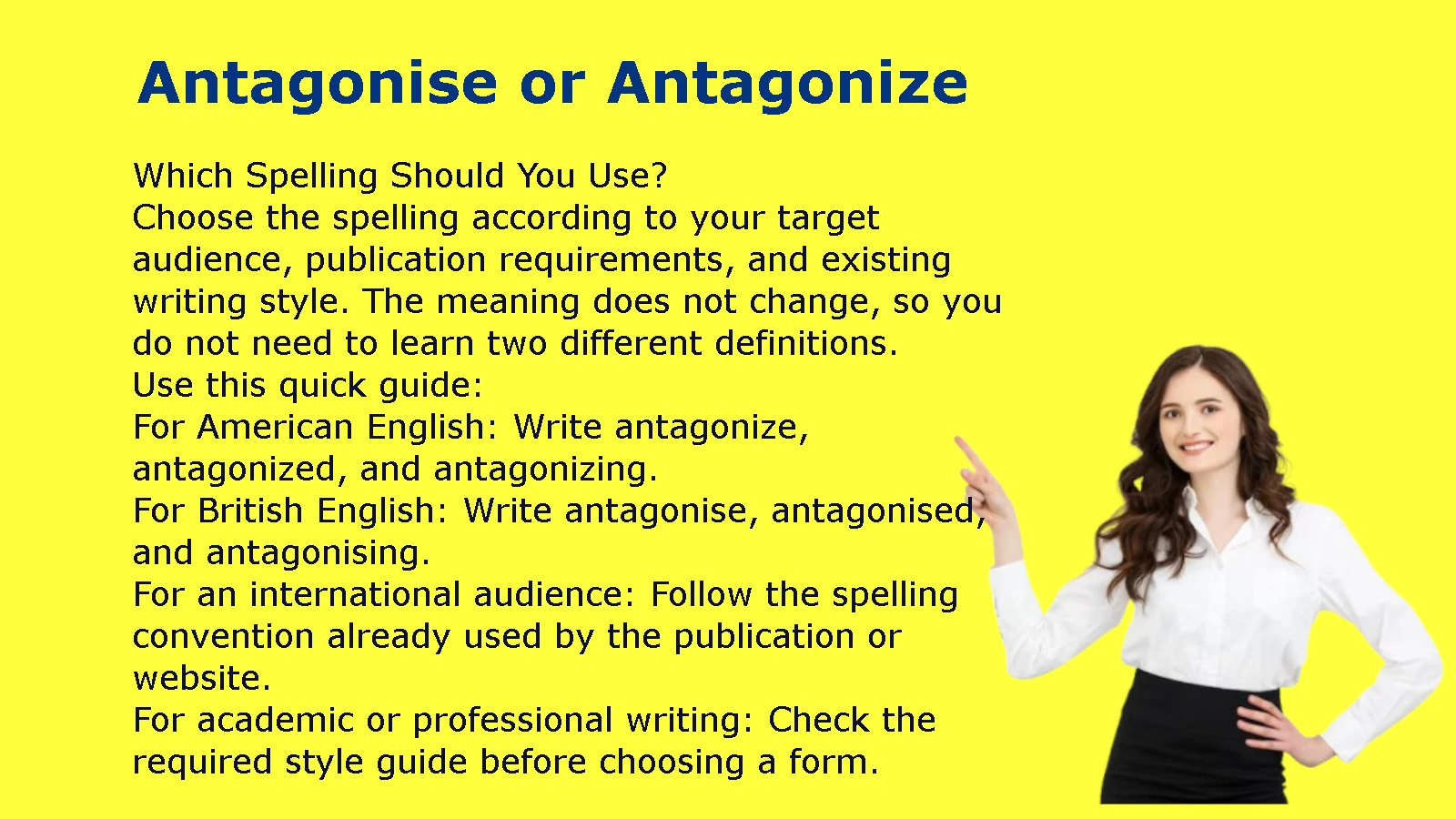
Choose the spelling according to your target audience, publication requirements, and existing writing style. The meaning does not change, so you do not need to learn two different definitions.
Use this quick guide:
- For American English: Write antagonize, antagonized, and antagonizing.
- For British English: Write antagonise, antagonised, and antagonising.
- For an international audience: Follow the spelling convention already used by the publication or website.
- For academic or professional writing: Check the required style guide before choosing a form.
Consider a website that publishes articles for readers in both the United States and the United Kingdom. It can use either spelling convention, but it should establish a clear editorial policy. That policy should cover related words, not just the main verb.
For example, a British English article should normally use antagonise, antagonised, and antagonising together. An American English article should use antagonize, antagonized, and antagonizing.
The simplest rule is to choose one variety of English and apply it consistently.
Antagonize Meaning and Definition
Antagonize means to provoke, irritate, or offend someone in a way that creates anger, opposition, or hostility. A person can antagonize someone intentionally, such as by making a deliberately insulting remark, or unintentionally, such as by behaving in a way that another person finds disrespectful.
The word is stronger than a simple description of annoyance in many contexts because it often suggests tension or opposition between people.
For example, repeatedly interrupting a colleague might irritate them. Publicly mocking their work could antagonize them because it may create resentment and damage the relationship.
Antagonize Meaning in Simple English
In simple English, to antagonize someone means to make them angry or turn them against you.
You might antagonize a friend by repeatedly making jokes about something they find embarrassing. A manager might antagonize employees by dismissing their concerns without listening. A public speaker might antagonize an audience by insulting people who disagree.
The important point is that antagonizing someone involves more than simply having a different opinion. It usually means that a person’s words or actions create irritation, resentment, opposition, or hostility.
Consider these examples:
- Friendship: Mark antagonized his friend by bringing up an embarrassing mistake in front of everyone.
- Workplace: The supervisor antagonized the team by criticizing them without hearing their side.
- Public debate: The candidate antagonized some voters with an insulting comment.
- Family: She did not want to antagonize her parents by turning a small disagreement into an argument.
Notice that antagonizing someone does not always lead to an open fight. A person may remain quiet while becoming less cooperative or trusting.
Antagonize in a Sentence
The best way to understand antagonize is to see how it works in different situations.
Everyday examples
- Please do not antagonize your brother when he is already upset.
- He antagonized his friends by repeatedly ignoring their requests.
- Her sarcastic comments antagonized the people around her.
- I disagree with you, but I have no reason to antagonize you.
- The neighbors tried to resolve the dispute without antagonizing each other.
Workplace examples
- The manager avoided making personal remarks that might antagonize the staff.
- Criticizing a colleague in front of clients could antagonize them.
- The company wanted to introduce the new policy without antagonizing long-term customers.
- His dismissive response antagonized the team and made cooperation harder.
Formal writing examples
- The government sought to address public concerns without antagonizing neighboring states.
- The proposal risked antagonizing groups that already opposed the policy.
- Her response antagonized the committee and weakened support for the recommendation.
These examples show that the word works in both informal and formal contexts. It is particularly useful when you want to describe behavior that creates opposition rather than merely causes temporary discomfort.
Antagonize Meaning in Different Contexts
The meaning remains broadly consistent across situations, but the consequences can vary.
In personal relationships, antagonizing someone can damage trust. Repeated teasing, dismissive remarks, or unnecessary criticism may turn a manageable disagreement into a lasting conflict.
In the workplace, antagonizing colleagues can make collaboration more difficult. A manager who publicly embarrasses an employee may get immediate compliance but lose that employee’s trust.
In politics and public debate, a statement can antagonize a group by insulting its members or dismissing their concerns. The resulting opposition may affect public support or negotiations.
In negotiations, antagonizing the other side can reduce the chances of reaching an agreement. A firm position does not automatically antagonize people, but personal attacks and unnecessary provocation can make compromise harder.
A useful distinction is that disagreement does not automatically mean antagonism. You can challenge an idea, question a decision, or refuse a request without attacking the person who holds that position.
Antagonise Pronunciation
Antagonise is pronounced /ænˈtæɡ.ə.naɪz/. The American spelling, antagonize, has the same standard pronunciation. The word has four syllables, with the main stress on the second syllable.
The final sound resembles the ending in recognise/recognize. Although the spelling changes between British and American English, the pronunciation generally stays the same.
How Do You Pronounce Antagonise?
The standard pronunciation of antagonise is /ænˈtæɡ.ə.naɪz/.
Break the word into four syllables:
- an
- tag
- uh
- nize
The second syllable receives the main stress. The final syllable rhymes with the ending of realise or organise in accents that pronounce those words with the same ending.
When saying the word aloud, avoid placing equal stress on every syllable. The stressed second syllable helps the word sound natural.
How Do You Pronounce Antagonize?
Antagonize has the same standard pronunciation as antagonise: /ænˈtæɡ.ə.naɪz/.
The final letter z in the American spelling reflects the /z/ sound. In the British spelling, the final s also represents that /z/ sound in this word.
Here is a quick comparison:
| Word | Pronunciation | Main stress |
| Antagonise | /ænˈtæɡ.ə.naɪz/ | Second syllable |
| Antagonize | /ænˈtæɡ.ə.naɪz/ | Second syllable |
| Antagonistic | /ænˌtæɡ.əˈnɪs.tɪk/ | Usually the third syllable |
| Antagonism | /ænˈtæɡ.ə.nɪ.zəm/ | Usually the second syllable |
Pronunciation can vary slightly between accents. Still, the British and American spellings of the main verb do not represent two different words or meanings.
Antagonize Synonyms and Related Words
Several words can replace antagonize, but the best choice depends on the action and its effect. Provoke emphasizes triggering a reaction, irritate emphasizes annoyance, aggravate can mean making a problem worse, and alienate emphasizes creating distance or losing someone’s support.
Choosing a precise synonym makes your writing clearer and helps you avoid repeating the same word.
Common Synonyms for Antagonize
| Synonym | Meaning | Example |
| Provoke | Trigger a reaction, often anger | His remark provoked an argument. |
| Irritate | Cause annoyance | The constant interruptions irritated her. |
| Aggravate | Make a problem or feeling worse | His response aggravated the disagreement. |
| Annoy | Cause mild displeasure | The repeated questions annoyed the speaker. |
| Alienate | Make someone feel distant or opposed | The decision alienated loyal supporters. |
| Incite | Encourage a strong reaction or action | The speech incited public anger. |
| Exasperate | Cause intense frustration | The repeated delays exasperated the team. |
| Offend | Hurt someone’s feelings or violate their sense of propriety | His personal remark offended the guest. |
| Inflame | Intensify anger or conflict | The accusation inflamed tensions. |
| Needle | Deliberately tease or irritate someone | He kept needling his opponent. |
These words overlap, but they are not exact substitutes in every sentence.
For instance, annoy works well for a minor inconvenience, while incite often suggests encouraging people to take action. Alienate is useful when the result is emotional distance or lost support.
Antagonize vs. Provoke
Antagonize and provoke both describe behavior that can trigger a reaction, especially anger. However, provoke has a broader range of meanings, while antagonize often emphasizes hostility, opposition, or a deteriorating relationship.
Compare these examples:
- The loud noise provoked a startled reaction.
- His repeated insults antagonized his colleagues.
- The question provoked an interesting discussion.
- Her dismissive attitude antagonized the committee.
You can provoke laughter, curiosity, thought, or anger. You would not normally use antagonize for a positive or neutral reaction.
Choose provoke when you mean to trigger a particular response. Choose antagonize when you want to emphasize that an action creates hostility or opposition.
Antagonize vs. Irritate
Irritate means to annoy or bother someone. Antagonize often suggests a greater risk of conflict or opposition.
For example:
- The buzzing light irritated everyone in the room.
- His repeated personal attacks antagonized his coworkers.
The first sentence describes annoyance caused by a distraction. The second describes behavior that may turn coworkers against the person responsible.
Still, the distinction depends on context. A seemingly small action can antagonize someone if it targets a sensitive issue or occurs repeatedly.
For example, repeatedly interrupting a colleague may initially irritate them. If the interruptions continue after they ask you to stop, the behavior may antagonize them.
Antagonize vs. Aggravate
Aggravate can mean to worsen an existing problem or intensify someone’s irritation. Antagonize focuses more directly on provoking a person or creating opposition.
Compare:
- His rude response antagonized the customer.
- His rude response aggravated an already difficult situation.
The first sentence emphasizes the customer’s reaction. The second emphasizes how the situation became worse.
The word aggravate also has a medical use. For example, running may aggravate an existing knee injury. In that context, it means to make the condition worse, not to provoke a person.
Use the surrounding context to determine which meaning applies.
Antagonistic Meaning and Antagonism Meaning
Antagonistic is an adjective that describes hostility, opposition, or resistance. Antagonism is a noun that refers to hostility, opposition, or conflict itself. Both words relate to the verb antagonize, but they perform different grammatical jobs.
Understanding these distinctions helps you form accurate sentences and choose the right word for the situation.
What Does Antagonistic Mean?
Antagonistic means showing or expressing opposition, hostility, or an unwillingness to cooperate. It can describe a person’s attitude, a conversation, a relationship, or the behavior of a group.
For example:
- His antagonistic tone made the meeting uncomfortable.
- The two departments developed an antagonistic relationship.
- She became antagonistic when her suggestions were repeatedly dismissed.
- The debate turned antagonistic after the speakers began making personal attacks.
An antagonistic person does not necessarily shout or behave aggressively. They might show opposition through sarcasm, dismissive comments, persistent resistance, or an unwillingness to cooperate.
The word can also describe relationships between groups. Two rival organizations may have an antagonistic relationship because their goals conflict or because they distrust each other.
Antagonistic does not always mean openly violent or aggressive. It can describe a hostile attitude even when no physical confrontation occurs.
What Does Antagonism Mean?
Antagonism is a noun that describes active opposition, hostility, or conflict between people, groups, ideas, or interests.
Examples include:
- Antagonism between the departments delayed the project.
- Years of competition created antagonism between the two companies.
- The discussion exposed deep antagonism over the proposed changes.
- Mutual antagonism prevented the groups from reaching an agreement.
The word often describes an ongoing condition rather than one isolated action.
Suppose two coworkers repeatedly undermine each other’s work. Each person may antagonize the other through specific actions. Over time, those actions can create antagonism between them.
The distinction is straightforward:
- Antagonize: to provoke someone.
- Antagonistic: showing opposition or hostility.
- Antagonism: the opposition or hostility itself.
These three words belong to the same word family, but you cannot substitute them freely without changing the sentence’s grammar.
Antagonize vs. Antagonistic vs. Antagonism
The following table summarizes their differences.
| Word | Part of speech | Core meaning | Example |
| Antagonize | Verb | To provoke or create opposition | He antagonized the audience. |
| Antagonistic | Adjective | Showing hostility or opposition | His tone was antagonistic. |
| Antagonism | Noun | Hostility or opposition | Antagonism grew between the teams. |
| Antagonizer | Noun | Someone who provokes others | The antagonizer kept making insulting remarks. |
| Antagonist | Noun | An opponent or opposing force | The antagonist challenged the hero. |
Here is another way to understand the relationship:
Action → Behavior → Result
- Action: A manager antagonizes an employee by publicly mocking their work.
- Behavior: The manager’s comments appear antagonistic.
- Result: Antagonism develops between the manager and employee.
This pattern is useful when writing explanations, reports, essays, or fictional scenes. It helps you describe both the action and the resulting relationship accurately.
Antagonizer Meaning
An antagonizer is a person who antagonizes or provokes other people. The word emphasizes the person’s role in creating irritation, hostility, or conflict. It is understandable in ordinary English, although antagonist is more common in literature and discussions of opposition.
For example, a person who repeatedly insults others to start arguments could be described as an antagonizer.
The word does not necessarily imply that the person is always hostile. Someone might antagonize others in one situation without making it a defining feature of their personality.
Antagonizer vs. Antagonist
An antagonizer is someone who provokes others. An antagonist is someone who opposes another person or force. The distinction matters because an antagonist does not have to provoke anyone.
In a novel, the antagonist is the character or force that stands in the protagonist’s way. The antagonist might oppose the hero through a competing goal, a moral disagreement, or a direct struggle.
An antagonizer, by contrast, is defined by the act of provoking someone.
Consider these examples:
- The antagonist tried to prevent the detective from solving the case.
- The antagonizer repeatedly mocked the detective to make him lose his temper.
One character could perform both roles, but the terms emphasize different things.
In everyday writing, antagonizer can describe someone who deliberately stirs up trouble. In literary analysis, antagonist is usually the more appropriate term for the main opposing character.
Examples of Antagonizer in a Sentence
Here are several examples that show how the word can be used:
- The teacher addressed the student’s behavior without labeling him an antagonizer.
- Everyone knew that the online commenter enjoyed acting as an antagonizer during debates.
- The antagonizer kept making personal remarks after the group asked him to stop.
- In the story, the prince becomes an antagonizer whenever another character challenges his authority.
The word can sound judgmental because it labels a person according to their behavior. In formal writing, consider describing the specific action instead.
For example, instead of writing, “He is an antagonizer,” you might write, “He repeatedly makes provocative comments during team meetings.” The second version gives readers concrete information and avoids turning a behavior into a permanent label.
Hostile Meaning: Is It the Same as Antagonistic?
Hostile means unfriendly, aggressive, or openly opposed to someone or something. It overlaps with antagonistic, but the words are not identical. Hostile often conveys a more direct sense of ill will or aggression, while antagonistic can describe a broader pattern of opposition or resistance.
Both words can describe a person’s attitude, behavior, or relationship with another person.
Examples:
- The customer became hostile when the employee refused the request.
- His antagonistic attitude made productive discussion difficult.
- The two groups maintained a hostile relationship for years.
- She gave an antagonistic response to every proposed change.
The distinction is one of emphasis rather than a rigid boundary. In some situations, either word can fit.
Hostile vs. Antagonistic
The main difference is how the words frame the behavior.
| Feature | Hostile | Antagonistic |
| Main idea | Unfriendly, aggressive, or openly opposed | Opposing, confrontational, or resistant |
| Typical emphasis | Direct ill will or aggression | Opposition or conflict |
| Common combinations | Hostile attitude, hostile environment, hostile reaction | Antagonistic behavior, antagonistic relationship, antagonistic response |
| Example | The visitor became hostile and threatened the guard. | The visitor remained antagonistic throughout the discussion. |
A hostile person may make threats, display aggression, or communicate clear ill will. An antagonistic person may oppose others through persistent criticism, sarcasm, or resistance.
However, context matters. A person can be both hostile and antagonistic, and an antagonistic remark can create a hostile situation.
Hostile vs. Antagonize
The main difference is grammatical.
Hostile is usually an adjective, while antagonize is a verb. You use hostile to describe a person, attitude, environment, or reaction. You use antagonize to describe an action that provokes someone.
Compare these sentences:
- The manager was hostile toward the new employee.
- The manager antagonized the new employee.
- The conversation became hostile.
- His sarcastic comments antagonized the group.
In the first and third sentences, hostile describes a condition or attitude. In the second and fourth, antagonized identifies an action.
This distinction also helps prevent common grammatical mistakes. You would not normally say, “He hostile his colleague.” Instead, write “He antagonized his colleague” or “He was hostile toward his colleague.”
Antagonize in Everyday English and Other Contexts
The word antagonize works in casual conversation, professional communication, public debate, and storytelling. It is especially useful when you want to explain how an action creates opposition or makes a difficult relationship worse.
The key is to use it when the situation involves more than a neutral disagreement. If someone simply expresses a different opinion, disagree may be more accurate. If their behavior provokes resentment or hostility, antagonize may fit.
How to Use Antagonize Without Sounding Unnatural
The verb commonly takes a direct object: you antagonize someone, a group, or an audience.
Common grammatical patterns include:
- Antagonize someone: He antagonized his neighbor.
- Antagonize a group: The announcement antagonized several employees.
- Antagonize an audience: The speaker antagonized the audience with personal insults.
- Avoid antagonizing someone: She tried to avoid antagonizing her supervisor.
- Risk antagonizing someone: The policy risked antagonizing loyal customers.
- Feel antagonized: The employee felt antagonized by the repeated criticism.
The word also appears in negative advice, such as “Do not antagonize the customer.” This construction is common when someone wants to prevent an argument or keep a tense situation under control.
A Practical Workplace Example
Imagine a company introducing a new attendance policy. Employees already feel that management does not listen to them.
The manager has two ways to announce the change.
Approach A:
“Everyone must follow this policy. Complaints will not change anything.”
Approach B:
“We are introducing a new attendance policy next month. We understand that it will affect some routines, so we will explain the reasons for the change and answer questions before it takes effect.”
The first approach may antagonize employees because it dismisses their concerns. The second approach communicates the decision while giving employees a chance to understand it.
This does not mean managers should avoid every difficult conversation. Sometimes they must enforce rules, reject requests, or communicate unpopular decisions. The goal is to be firm without provoking unnecessary hostility.
A Practical Rule for Everyday Use
Before using antagonize, ask yourself:
- Did someone’s behavior provoke irritation or anger?
- Did it create opposition or damage cooperation?
- Does the sentence describe an action rather than simply a person’s attitude?
If the answer is yes, antagonize may be a good choice. Otherwise, a more precise word such as disagree, annoy, criticize, or offend may communicate the situation better.
Antagonize Peaceful Kraggons: What Does It Mean?
The phrase “antagonize peaceful Kraggons” does not have a clear, established meaning in ordinary English. It may refer to a quest, achievement, game mechanic, fictional species, or another specialized context. Without the source, it is not possible to identify a specific intended reference reliably.
The ordinary English interpretation is straightforward: antagonize peaceful Kraggons means to provoke or upset a group called the Kraggons even though they are peaceful.
The phrase contains three parts:
- Antagonize: provoke, irritate, or create opposition.
- Peaceful: calm, non-aggressive, or not seeking conflict.
- Kraggons: a name that appears to refer to a fictional group or entity, depending on the context.
In a fictional setting, the phrase might describe a character provoking a normally peaceful group. In a game, it could refer to an objective or interaction involving named characters or creatures. Those are possible interpretations, not confirmation of a particular game mechanic.
For example, in an imaginary story, a character might antagonize peaceful Kraggons by insulting their leader or damaging something they value. The phrase would then describe behavior that turns a peaceful encounter into a conflict.
To interpret the phrase in a specific game or story, the relevant title or surrounding text would be needed. The ordinary definition of antagonize explains the wording, but it cannot establish what a specialized reference requires a player or reader to do.
Common Mistakes When Using Antagonize
Even though the word is straightforward, writers sometimes confuse its spelling, meaning, or grammatical form.
Mistake: Mixing British and American spelling
Incorrect for a consistent American English document: “The manager antagonised the team and later apologized.”
Consistent American English: “The manager antagonized the team and later apologized.”
Consistent British English: “The manager antagonised the team and later apologised.”
The issue is consistency, not whether one spelling is universally correct.
Mistake: Treating antagonize and antagonist as synonyms
Incorrect: “The character was the main antagonize in the story.”
Correct: “The character was the main antagonist in the story.”
Antagonize is a verb. Antagonist is a noun.
Mistake: Using hostile as a verb
Incorrect: “She hostile her colleagues.”
Correct: “She antagonized her colleagues.”
You could also write, “She was hostile toward her colleagues.”
Mistake: Assuming every disagreement is antagonistic
Incorrect interpretation: Anyone who challenges your opinion is antagonizing you.
Better interpretation: A disagreement becomes antagonistic when the interaction involves hostility, persistent opposition, or provocative behavior. Respectful disagreement alone does not necessarily qualify.
Mistake: Using antagonize when you mean simply to annoy
If someone taps a pencil and distracts you, annoy or irritate may be more precise. If someone deliberately humiliates you or repeatedly provokes conflict, antagonize may better capture the situation.
Precise word choice improves clarity and keeps your writing from sounding exaggerated.
Antagonise or Antagonize: Quick Summary
Antagonise and antagonize are two regional spellings of the same verb. British English generally prefers antagonise, while American English generally prefers antagonize. Both mean to provoke, irritate, or create opposition, and both have the same standard pronunciation.
Keep these points in mind:
- Use antagonise when following British English spelling conventions.
- Use antagonize when following American English spelling conventions.
- Use antagonistic as an adjective describing opposition or hostility.
- Use antagonism as a noun describing hostility or conflict.
- Use antagonizer for someone who provokes others, while antagonist usually refers to an opponent or the opposing force in a story.
- Choose synonyms such as provoke, irritate, aggravate, and alienate according to the exact meaning you want to express.
- Do not confuse a disagreement with antagonism; the latter suggests hostility or opposition.
For example, an American writer might say, “The manager antagonized the staff,” while a British writer might say, “The manager antagonised the staff.” Both sentences communicate the same idea.
Frequently Asked Questions
Is Antagonise or Antagonize Correct?
Both spellings are correct. Antagonise is the usual British English spelling, while antagonize is the standard American English spelling. Both mean to provoke, irritate, or create opposition, so the choice depends on your preferred English variety.
What Does Antagonize Mean?
Antagonize means to provoke, irritate, or offend someone in a way that creates anger, opposition, or hostility. For example, repeatedly mocking a colleague may antagonize them and make cooperation more difficult.
What Is a Synonym for Antagonize?
Common synonyms include provoke, irritate, aggravate, annoy, and alienate. Provoke emphasizes triggering a reaction, irritate emphasizes annoyance, and alienate emphasizes creating distance or losing someone’s support.
How Do You Pronounce Antagonise?
Antagonise is pronounced /ænˈtæɡ.ə.naɪz/. It has four syllables, with the main stress on the second syllable. The American spelling, antagonize, has the same standard pronunciation.
What Is the Difference Between Antagonistic and Antagonism?
Antagonistic is an adjective describing hostility, resistance, or opposition. Antagonism is a noun describing the hostility or opposition itself. For example, an antagonistic attitude can contribute to antagonism between two groups.
What Does Antagonize Peaceful Kraggons Mean?
In ordinary English, the phrase means to provoke a group called the Kraggons despite their peaceful nature. However, the phrase may refer to a specific fictional or gaming context, so its exact meaning depends on the source.













