Have you ever seen the words “Genesis” and “Geneses” and wondered which one is correct? While Genesis vs Geneses can look confusing at first glance, these words have different meanings, forms, and uses in English.
Genesis is a noun that means the origin, beginning, or creation of something. It can also refer to the first book of the Bible. Geneses, on the other hand, is the plural form of genesis, meaning multiple origins or beginnings.
Examples:
- The genesis of the project began with a simple idea.
- Researchers studied the geneses of several ancient civilizations.
The confusion is understandable. People often search for Genesis vs Geneses, Genesis plural, what is the plural of genesis, or is geneses a word because the spelling changes slightly when genesis becomes plural. And here’s the kicker: although geneses is grammatically correct, it isn’t nearly as common as genesis.
In this guide, you’ll learn the complete difference between Genesis and Geneses, including their meanings, definitions, pronunciations, plural forms, and correct usage. You’ll also see clear examples in sentences and learn when to use genesis, geneses, and other related words.
Genesis vs. Geneses at a Glance
The quickest way to understand the difference is to compare the forms side by side.
| Word | Number | Meaning | Example |
| genesis | Singular | One origin or beginning | The genesis of the idea was unexpected. |
| geneses | Plural | More than one origin or beginning | The study compares the geneses of several traditions. |
| Genesis | Proper noun | The first book of the Bible | Genesis is the first book of the Old Testament. |
The core rule is simple:
One genesis, multiple geneses.
The spelling changes because genesis belongs to a group of Greek derived English words whose plural forms can change the ending rather than simply adding -s.
Dictionary.com lists geneses directly as the plural of genesis. It defines the common noun genesis as “an origin, creation, or beginning.”
Cambridge also defines genesis as the origin of something or the point at which it begins to exist.
That gives you a reliable rule for everyday writing: use genesis for one beginning and geneses for multiple beginnings.
What Does Genesis Mean?
Genesis means the origin, beginning, creation, or coming into existence of something.
You can use it when you want to talk about how something started. The word often appears in formal, academic, historical, scientific, and literary writing.
For example:
- The genesis of the company began with a small family business.
- The article explores the genesis of the political movement.
- Researchers investigated the genesis of the disease.
- The artist explained the genesis of her most famous painting.
- The genesis of the disagreement goes back several years.
The word doesn’t necessarily mean the very first moment in a literal sense. Instead, it points to the origin or development of something.
Consider this sentence:
The idea had its genesis in a conversation between two friends.
This doesn’t mean the entire idea appeared fully formed during that conversation. It means the conversation gave rise to the idea.
Cambridge uses a similar construction when it explains genesis as the origin of something and gives the example of a story having its genesis in a conversation.
Genesis Meaning in Simple English
In plain English, genesis means where something began.
You can think of it as the starting point of a story, idea, event, process, organization, or development.
Here are a few simple equivalents:
- beginning
- origin
- start
- source
- creation
- emergence
- birth
However, these words aren’t perfect substitutes in every sentence.
For example, genesis sounds natural in:
The genesis of the project was a simple question.
You could replace genesis with beginning:
The beginning of the project was a simple question.
The meaning remains close, but the tone changes. Genesis often sounds more formal and analytical than beginning.
Genesis in Context
The word becomes easier to understand when you see the kinds of things that can have a genesis.
| Subject | Example |
| Idea | The genesis of the idea came during a brainstorming session. |
| Movement | Historians studied the genesis of the movement. |
| Conflict | The report examines the genesis of the conflict. |
| Company | The founder described the genesis of the company. |
| Theory | The paper traces the genesis of the theory. |
| Tradition | Researchers explored the genesis of the tradition. |
| Disease | Scientists investigated the genesis of the condition. |
| Work of art | The museum discussed the genesis of the painting. |
This is why genesis appears frequently in academic and professional writing. It lets you discuss not just what something is but where it came from.
What Does Geneses Mean?
Geneses is the plural form of genesis.
It means multiple origins, beginnings, creations, or processes of coming into existence.
For example:
The researchers compared the geneses of several political movements.
The sentence discusses more than one movement and more than one origin. Therefore, the plural geneses fits.
Another example:
The book examines the different geneses of modern scientific theories.
Here, the writer isn’t talking about one theory or one origin. The discussion involves several theories and their separate beginnings.
Geneses in Simple English
You can remember it this way:
Genesis = one beginning.
Geneses = multiple beginnings.
Think of it like this:
one story → several stories
and:
one genesis → several geneses
The unusual spelling may make geneses look strange at first. It is nevertheless a recognized English plural. Dictionary.com explicitly identifies geneses as the plural form of genesis.
Is Geneses the Plural of Genesis?
Yes. Geneses is the standard plural form of the common noun genesis.
The change looks like this:
genesis → geneses
The ending changes rather than simply taking an additional -s.
This can feel unfamiliar because many English nouns use straightforward plural patterns:
- book → books
- idea → ideas
- beginning → beginnings
- project → projects
But English contains many words inherited from Greek and Latin that retain older plural patterns.
In the case of genesis, the recognized plural is geneses. Dictionary.com lists it under the noun’s “Other Word Forms” and gives the plural explicitly.
Is “Genesises” Correct?
For the ordinary noun genesis, geneses is the standard dictionary plural.
Therefore, in formal writing, use:
several geneses
rather than:
several genesises
The second form may seem logical if you simply attach -es to the original word. English morphology doesn’t work that way here.
Is “Genesi” Correct?
Genesi isn’t the standard English plural of the common noun genesis.
If you need the plural in standard English, choose geneses.
That’s the form recognized by dictionaries such as Dictionary.com.
Why Does Genesis Become Geneses?
The unusual plural makes more sense when you look at the word’s history.
Genesis entered English through Latin from Greek génesis, a word associated with origin, source, generation, and coming into being. Dictionary.com traces the English noun to Greek génesis through Latin.
The Greek background also helps explain why the plural doesn’t behave like a typical English noun.
You don’t need to memorize Greek grammar to use the word correctly. The practical rule is enough:
genesis → geneses
This pattern appears in other English words derived from Greek, although their exact plural forms vary. The important point is that genesis does not form its standard plural by simply adding an ordinary English plural ending to the whole word.
That distinction matters because people often try to create a plural by sight rather than by established usage.
When in doubt, don’t guess from the spelling. Check the dictionary form.
Genesis vs. Geneses Pronunciation
The singular and plural sound different at the end.
How to Pronounce Genesis
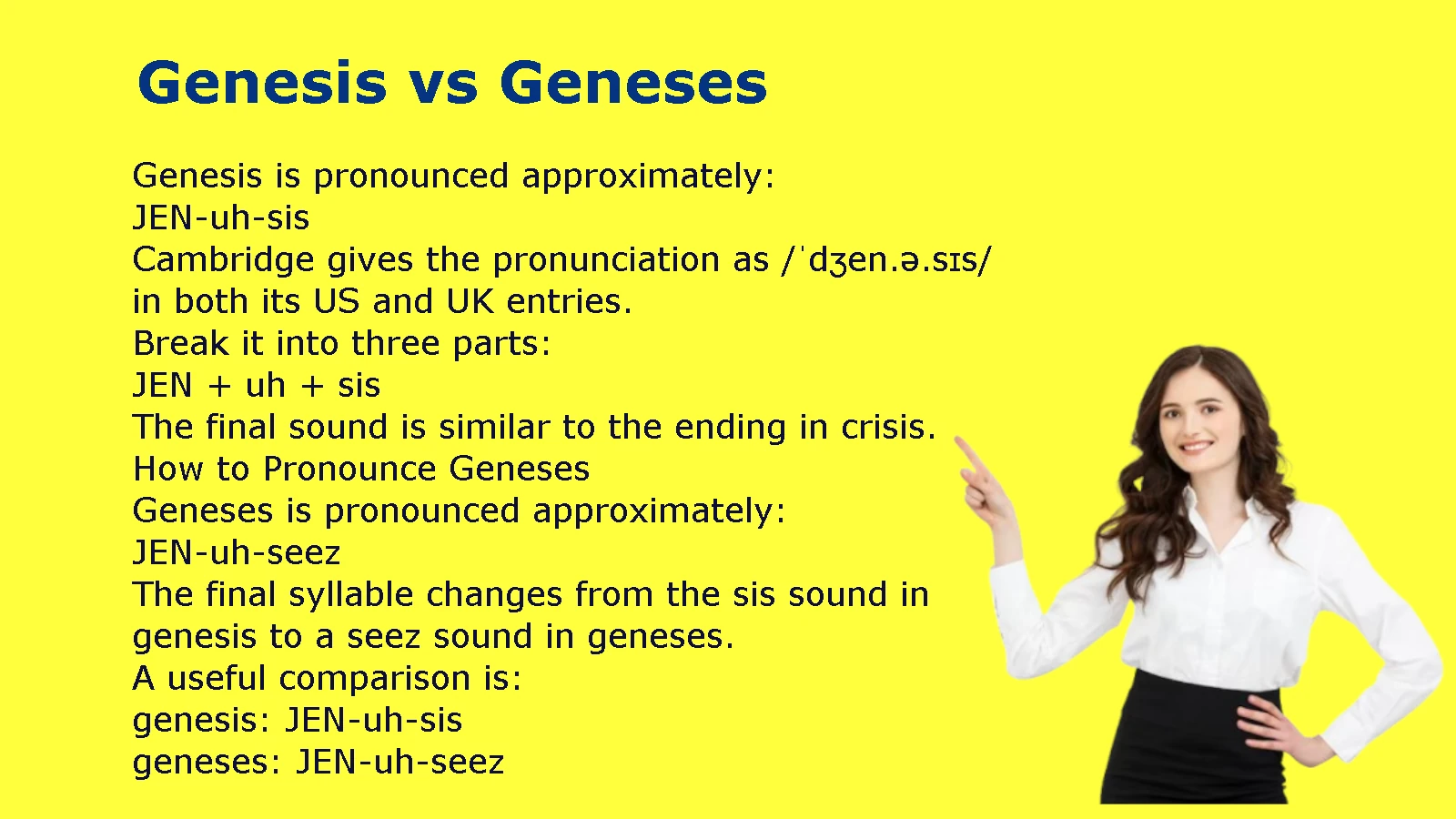
Genesis is pronounced approximately:
JEN-uh-sis
Cambridge gives the pronunciation as /ˈdʒen.ə.sɪs/ in both its US and UK entries.
Break it into three parts:
JEN + uh + sis
The final sound is similar to the ending in crisis.
How to Pronounce Geneses
Geneses is pronounced approximately:
JEN-uh-seez
The final syllable changes from the sis sound in genesis to a seez sound in geneses.
A useful comparison is:
- genesis: JEN-uh-sis
- geneses: JEN-uh-seez
This pronunciation difference is one reason the plural may sound unfamiliar when you first hear it.
Dictionary.com gives genesis as /ˈdʒɛn ə sɪs/ and identifies geneses as its plural.
Genesis in a Sentence
Seeing genesis in context is one of the easiest ways to understand its role.
Examples of Genesis in Sentences
- The genesis of the project was a single question.
- The researchers traced the genesis of the theory to earlier experiments.
- The book explores the genesis of the conflict.
- Her childhood experiences influenced the genesis of her interest in art.
- The report explains the genesis of the new policy.
- The genesis of the company can be traced to a small workshop.
- Scientists continue to investigate the genesis of the phenomenon.
- The historian examined the genesis of the movement.
- The novel describes the genesis of an unlikely friendship.
- The team’s first meeting marked the genesis of a successful partnership.
Notice the pattern. In each example, genesis identifies the origin of one thing.
You can often replace it with origin without changing the basic meaning:
The genesis of the movement
The origin of the movement
The first version has a somewhat more formal tone.
Geneses in a Sentence
Geneses works when you need to discuss more than one origin or beginning.
Examples of Geneses in Sentences
- The researchers compared the geneses of several cultural traditions.
- The study examines the different geneses of the theories.
- Historians debated the separate geneses of the two movements.
- The book explores the geneses of several modern institutions.
- Researchers identified multiple geneses for the competing ideas.
- The paper compares the geneses of related scientific concepts.
- The scholars examined the geneses of different literary traditions.
- The study focuses on the geneses of several social practices.
The plural becomes necessary when the sentence contains a genuine sense of multiple origins.
For example:
The historian studied the genesis of three movements.
This sentence is possible if the writer treats the origins collectively as one subject.
However:
The historian studied the geneses of three movements.
This version emphasizes that each movement had its own origin or developmental beginning.
That subtle difference can matter in academic writing.
Genesis vs. Geneses in Different Contexts
The choice depends on what you’re describing.
| Situation | Use | Example |
| One origin | genesis | The genesis of the theory |
| Several origins | geneses | The geneses of several theories |
| One beginning | genesis | The genesis of the movement |
| Several beginnings | geneses | The geneses of different movements |
| Biblical book | Genesis | Genesis is the first book of the Bible |
The capitalization in the last row matters.
genesis and Genesis can look almost identical, but they don’t always perform the same grammatical job.
Genesis as a Common Noun vs. Genesis as a Proper Noun
One of the most important details in genesis vs. geneses is capitalization.
When genesis means an origin or beginning, it normally appears as a common noun:
The genesis of the idea was unexpected.
When Genesis refers to the biblical book, it is capitalized:
Genesis is the first book of the Bible.
Cambridge defines Genesis as the first book of the Bible and separately defines lowercase genesis as the origin of something.
Dictionary.com makes the same distinction by providing separate entries for the common noun and the biblical book.
What Is Genesis in the Bible?
Genesis is the first book of the Bible and the first book of the Old Testament.
Its name comes through Greek and is associated with origin, creation, and generation. The book itself includes accounts involving creation, Adam and Eve, Noah, Abraham, Isaac, Jacob, and Joseph.
When you write about the biblical book, use the capitalized form:
Genesis
When you write about an ordinary beginning, use:
genesis
For example:
The genesis of the tradition is difficult to determine.
versus:
The story appears in Genesis.
The context makes the difference clear.
Genesis vs. Geneses: A Useful Case Study
Imagine a historian studying three social movements.
Each movement developed at a different time and under different circumstances.
If the historian writes:
The study investigates the genesis of the movements.
the word genesis can work if the researcher is treating the overall question of how the movements originated.
But suppose the study specifically compares the individual beginnings:
The study investigates the geneses of the three movements.
Now the plural emphasizes that the researcher is examining separate origins.
This is the practical value of knowing the distinction. The choice isn’t just about grammar. It can also communicate how you want the reader to understand the relationship between the origins you’re discussing.
Another Example: Scientific Research
Imagine a scientific paper comparing several hypotheses.
One hypothesis has one historical origin:
The genesis of the hypothesis can be traced to an early experiment.
If the paper compares how several hypotheses developed:
The study examines the geneses of competing hypotheses.
Again, the plural tells the reader that the discussion involves multiple origin stories.
Common Mistakes With Genesis and Geneses
A few mistakes appear again and again because the plural looks unusual.
Mistake: Writing “Genesises”
The most common temptation is to add an ordinary plural ending to genesis.
Incorrect for the standard common noun plural:
The genesises of the movements
Correct:
The geneses of the movements
Dictionary.com lists geneses as the plural.
Mistake: Writing “Genesi”
Some writers assume that because the word has Greek or Latin roots, the plural should be genesi.
That isn’t the standard English plural of genesis.
Use:
genesis → geneses
Mistake: Using Genesis When You Mean an Origin
Capitalizing Genesis can unintentionally suggest the biblical book.
Compare:
The genesis of the company was surprisingly simple.
with:
Genesis is the first book of the Bible.
The lowercase form refers to an origin. The capitalized form refers to the biblical title.
Mistake: Using Geneses for One Origin
Because geneses sounds unfamiliar, a writer may use it as a more formal sounding version of genesis.
That’s not correct.
Use genesis for one origin:
The genesis of the problem remains unclear.
Use geneses for multiple origins:
The geneses of the problems differ considerably.
Is Genesis Singular or Plural?
Genesis is singular when it functions as the common noun meaning an origin or beginning.
Its plural is:
geneses
The basic pattern is:
| Singular | Plural |
| genesis | geneses |
For example:
One genesis can explain the beginning of a movement.
Several geneses can explain the development of related movements.
However, you’ll often see genesis used in a way that doesn’t require a plural because writers frequently discuss “the genesis” of a particular thing as a concept of origin.
Cambridge labels the ordinary noun genesis as formal and defines it as the origin of something.
Is Geneses Singular or Plural?
Geneses is plural.
If you can replace the word with origins or beginnings, geneses may be appropriate.
For example:
The researchers studied the geneses of several traditions.
You could rewrite it as:
The researchers studied the origins of several traditions.
The second version sounds more natural in everyday English. The first sounds more formal and specialized.
That distinction matters. Just because geneses is grammatically correct doesn’t mean you need to use it in every situation.
Genesis vs. Geneses vs. Genesis’s
These forms can look confusing when they appear together.
| Form | Function | Example |
| genesis | Singular noun | The genesis of the idea |
| geneses | Plural noun | The geneses of several ideas |
| genesis’s | Singular possessive | The genesis’s historical context |
The first two forms are the key distinction in this article.
The possessive form genesis’s follows the normal English treatment of a singular noun ending in s when you need to show possession.
For example:
The genesis’s historical context is complicated.
However, this construction can sound awkward. In polished writing, rewriting the sentence may make it clearer:
The historical context of the genesis is complicated.
That version avoids a string of s sounds and usually reads more smoothly.
When Should You Use Genesis Instead of Geneses?
Use genesis when you’re talking about one origin, one beginning, or one process of coming into existence.
Use geneses when you’re talking about two or more distinct origins or beginnings.
A quick decision test can help.
Ask:
Am I discussing one origin?
If yes, use genesis.
Am I comparing multiple origins?
If yes, use geneses.
Quick Examples
One:
We studied the genesis of the organization.
More than one:
We studied the geneses of several organizations.
One:
The article examines the genesis of the theory.
More than one:
The article examines the geneses of competing theories.
One:
The genesis of the conflict remains unclear.
More than one:
The geneses of the conflicts were completely different.
It’s that simple.
When “Origins” Is Better Than “Geneses”
Although geneses is correct, it isn’t always the best word stylistically.
The word has a formal, specialized feel. If you’re writing for a broad audience, origins may sound more natural.
Compare:
The researchers examined the geneses of the traditions.
with:
The researchers examined the origins of the traditions.
Both can communicate the basic idea. The second is more familiar to most readers.
Likewise:
The geneses of the competing theories
could become:
The origins of the competing theories
There’s no rule saying you must use the more unusual word simply because it exists.
Good writing isn’t about choosing the fanciest word in the dictionary. It’s about choosing the clearest accurate word for the context.
Use geneses when its precise meaning or formal tone adds value. Otherwise, origins may serve your reader better.
Genesis vs. Geneses: Grammar Test
Try these sentences before checking the answers.
Fill in the Blank
- The ______ of the project began with a short conversation.
- Historians compared the ______ of several traditions.
- The ______ of the conflict remains disputed.
- Researchers examined the ______ of three competing theories.
- The story appears in the Book of ______.
- The study traces the ______ of the movement.
- Scholars investigated the separate ______ of the institutions.
- The ______ of the idea can be traced to an early experiment.
Answers
- genesis
- geneses
- genesis
- geneses
- Genesis
- genesis
- geneses
- genesis
The pattern is consistent:
one origin = genesis
multiple origins = geneses
biblical book = Genesis
Frequently Asked Questions About Genesis and Geneses
What is the plural of genesis?
The standard plural of genesis is geneses. Dictionary.com explicitly lists geneses as the plural form.
Is geneses a real word?
Yes. Geneses is a recognized English plural of genesis. It refers to multiple origins or beginnings.
What does genesis mean?
Genesis means an origin, beginning, creation, or the point at which something comes into existence. Cambridge defines it as the origin of something or when something begins to exist.
What does geneses mean?
Geneses means multiple origins or beginnings. It is the plural form of the common noun genesis.
How do you pronounce genesis?
Genesis is pronounced approximately JEN-uh-sis, with the IPA pronunciation /ˈdʒen.ə.sɪs/ in Cambridge’s US entry.
How do you pronounce geneses?
Geneses is approximately pronounced JEN-uh-seez. The final sound differs from the singular genesis.
Is genesi the plural of genesis?
No. Genesi isn’t the standard English plural of genesis. Use geneses instead.
Is genesises the plural of genesis?
No. For the ordinary English noun, the standard plural is geneses.
Is Genesis a proper noun?
Yes, when Genesis refers to the first book of the Bible, it functions as a proper noun and takes a capital G.
Can genesis mean “beginning”?
Yes. Beginning is one of the clearest everyday equivalents of genesis. The word can refer to the origin or starting point of an idea, event, process, organization, or other development.
Is genesis formal or informal?
Genesis tends to sound more formal than everyday words such as start or beginning. Cambridge labels the word as formal.
Should you use geneses in everyday conversation?
You can, but you may not need to. Genes es is correct, yet origins or beginnings will often sound more natural in casual speech.
Can genesis refer to more than one beginning?
The singular noun genesis refers to an origin or beginning. When you explicitly discuss multiple distinct origins, geneses is the plural form.
Final Answer: Genesis or Geneses?
The difference between genesis vs. geneses comes down to number.
- Genesis = one origin, beginning, or creation.
- Geneses = multiple origins or beginnings.
- Genesis = also the proper name of the first book of the Bible.
- Genesises = not the standard plural of the common noun.
- Genesi = not the standard English plural of genesis.
The easiest rule to remember is:
One genesis. Two or more geneses.
For example:
The genesis of the idea was a conversation.
But:
The researchers compared the geneses of several ideas.
And when referring to the Bible:
Genesis is the first book of the Old Testament.
Once you separate singular, plural, and proper noun usage, the word pair becomes much less mysterious. The spelling may look unusual, but the rule itself is refreshingly simple.