Have you ever come across the words Sclerosis vs Scleroses and wondered why they look almost identical but are used differently? Although both terms come from the same medical word, their meaning, number, and usage are not exactly the same.
Sclerosis is a medical term that generally refers to the hardening or abnormal thickening of tissue. It is a singular noun and can describe a condition affecting different parts of the body. Scleroses, on the other hand, is the plural form of sclerosis, used when referring to more than one type or instance of sclerosis.
Examples:
- The doctor explained that sclerosis had affected the tissue.
- Researchers studied several scleroses affecting different organs.
The confusion is understandable. People often search for sclerosis vs scleroses, what is the plural of sclerosis, sclerosis meaning, or how to use scleroses in a sentence because the two words differ by only one letter. The tricky part is knowing when you are talking about one condition or process and when you are referring to multiple conditions or instances.
In this guide, you’ll learn the complete difference between Sclerosis and Scleroses, including their definitions, pronunciation, plural form, correct usage, and examples in sentences. You’ll also discover how these terms are used in medical contexts and how to choose the right word when writing or speaking.
Sclerosis vs. Scleroses at a Glance
| Word | Number | Basic meaning | Common pronunciation |
| sclerosis | Singular | One sclerosis or sclerosis as a condition | sklə-ROH-sis |
| scleroses | Plural | Two or more scleroses | sklə-ROH-seez |
| multiple sclerosis | Disease name | A specific neurological disease | MUHL-tuh-pul sklə-ROH-sis |
The most important distinction is grammatical:
- Sclerosis is singular.
- Scleroses is plural.
- Sclerosis can also describe a condition generally rather than one countable instance.
- Scleroses specifically signals multiple instances or forms when a plural noun is needed.
Merriam-Webster gives the medical pronunciation of sclerosis as approximately sklə-ROH-səs and lists the plural scleroses with an ending pronounced approximately -seez.
Cambridge likewise treats sclerosis as a specialized medical noun and gives its American pronunciation as /skləˈroʊ.sɪs/.
What Does Sclerosis Mean?
Sclerosis refers to abnormal hardening of tissue. In medicine, this hardening can result from changes such as an increase in fibrous tissue or other alterations within tissue.
Merriam-Webster defines it as the pathological hardening of tissue, especially through fibrous or interstitial changes. It also notes that the word can refer to a disease characterized by sclerosis.
The word comes from Greek sklērōsis, meaning hardening, which comes from sklēros, meaning hard. Merriam-Webster records the first known English use of sclerosis in the medical sense in 1846.
In plain English, imagine a material that should remain flexible becoming unusually firm or hardened. That’s the basic idea behind the medical term, although the biological process varies depending on the tissue and disease involved.
For example, arteriosclerosis involves hardening and loss of elasticity in arteries. Multiple sclerosis involves areas of hardened or scar-like tissue associated with damage in the central nervous system. Other medical terms also use sclerosis as part of their names.
Sclerosis Can Describe a Condition Generally
One reason sclerosis causes grammatical confusion is that you don’t always need to count it.
For example:
“Sclerosis can affect different types of tissue.”
Here, sclerosis describes a condition generally. You aren’t necessarily talking about one isolated piece of hardened tissue.
This resembles other medical nouns that can describe a condition without requiring a number:
- “Inflammation can occur in several tissues.”
- “Fibrosis may develop over time.”
- “Sclerosis can result from different pathological processes.”
In such sentences, forcing a plural would make the wording less natural.
What Does Scleroses Mean?
Scleroses is the plural of sclerosis.
Use it when you genuinely mean more than one sclerosis. Merriam-Webster’s medical entry explicitly gives scleroses as the plural form.
For example:
“The researchers compared several distinct scleroses.”
The sentence refers to multiple forms or instances, so the plural noun scleroses fits grammatically.
Another example:
“The report documented two separate scleroses.”
Here, two makes the plural meaning especially clear.
However, scleroses isn’t a word you’ll see constantly in everyday medical writing. That’s an important usage point. Writers often choose phrases such as forms of sclerosis, types of sclerosis, or cases of sclerosis when those alternatives communicate the idea more naturally.
Compare:
- “The researchers studied several scleroses.”
- “The researchers studied several forms of sclerosis.”
Both can communicate a plural concept. The second may be easier for a general audience to understand immediately.
Why Is the Plural of Sclerosis Scleroses?
The spelling sclerosis → scleroses follows a pattern found in several words derived from Greek.
The ending -sis changes to -ses when the noun becomes plural.
The Pattern
| Singular | Plural |
| sclerosis | scleroses |
| diagnosis | diagnoses |
| analysis | analyses |
| basis | bases |
| crisis | crises |
The pattern can look strange if you’re more familiar with ordinary English plurals such as book → books or car → cars. English contains many words borrowed from Greek and Latin that retain older plural patterns.
That’s why scleroses isn’t formed by simply adding -s to sclerosis.
The incorrect form would be:
scleroses + s → sclerosises
That’s not the standard plural.
Instead:
sclerosis → scleroses
The change also affects pronunciation.
- sclerosis ends with a sound like “sis.”
- scleroses ends with a sound like “seez.”
Once you recognize the pattern, the spelling becomes much easier to remember.
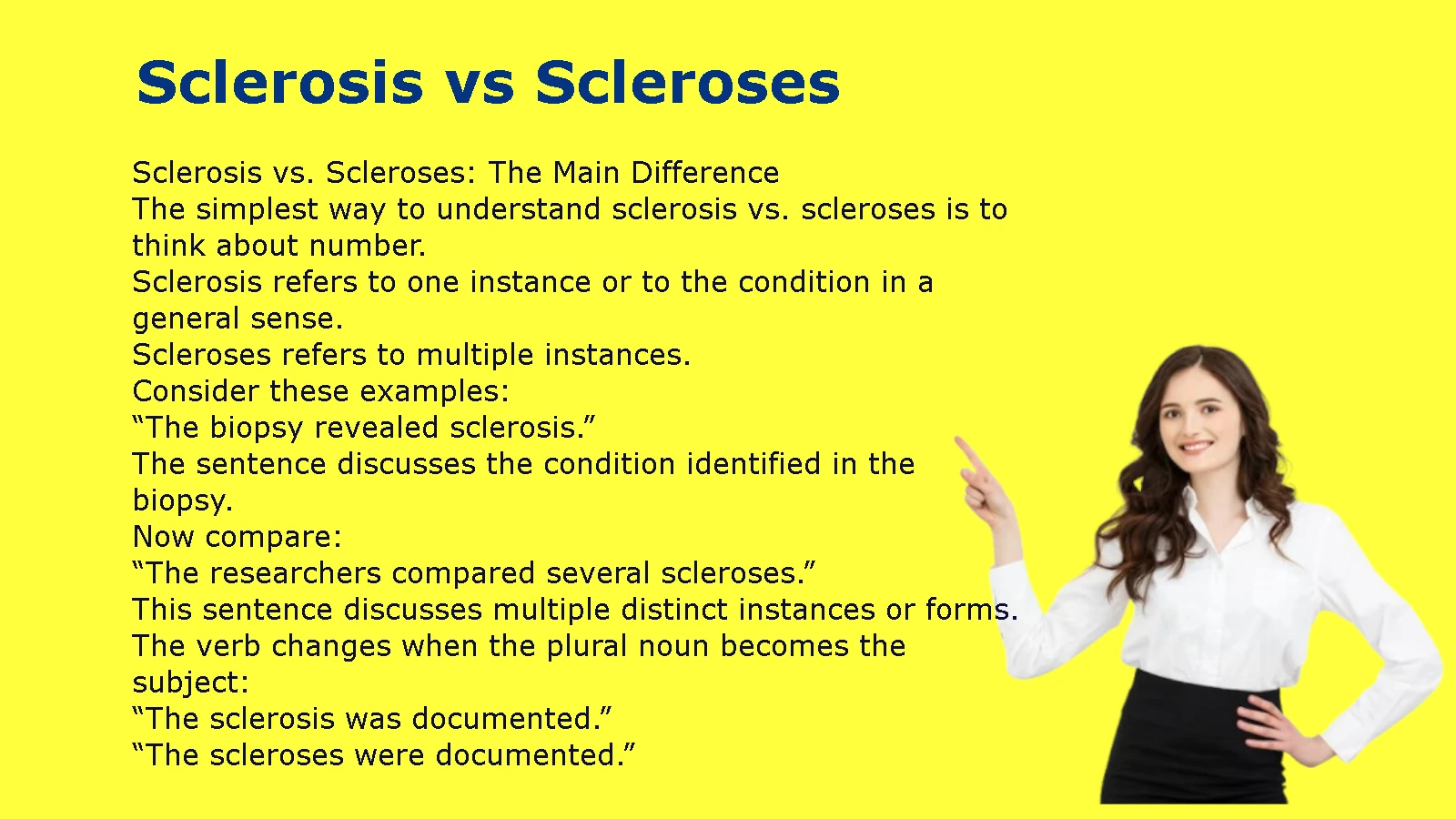
Sclerosis vs. Scleroses: The Main Difference
The simplest way to understand sclerosis vs. scleroses is to think about number.
Sclerosis refers to one instance or to the condition in a general sense.
Scleroses refers to multiple instances.
Consider these examples:
“The biopsy revealed sclerosis.”
The sentence discusses the condition identified in the biopsy.
Now compare:
“The researchers compared several scleroses.”
This sentence discusses multiple distinct instances or forms.
The verb changes when the plural noun becomes the subject:
“The sclerosis was documented.”
“The scleroses were documented.”
That subject-verb agreement provides a useful grammar test.
If you can naturally use is or was, sclerosis may be the correct form.
If you need are or were because you’re discussing multiple instances, scleroses may be appropriate.
Is Sclerosis Singular or Plural?
Sclerosis is singular.
The final s can make the word look plural, but its spelling doesn’t determine its grammatical number.
This happens with many English words borrowed from other languages. The ending may resemble an ordinary English plural even when the word is singular.
For example:
- “The diagnosis is confirmed.”
- “The analysis is complete.”
- “The crisis was unexpected.”
- “The sclerosis was documented.”
The noun sclerosis behaves as singular in these constructions.
Can Sclerosis Be Used Without an Article?
Yes. In medical contexts, sclerosis can function as a general or uncountable noun.
For example:
“Sclerosis may develop in affected tissue.”
You don’t necessarily need to write a sclerosis when discussing the condition generally.
However, when you mean a particular instance, a construction such as a sclerosis can be grammatically possible depending on the context.
That distinction matters because medical terminology doesn’t always behave like ordinary countable nouns.
Is Scleroses Singular or Plural?
Scleroses is plural.
It refers to more than one sclerosis.
The easiest test involves a number:
- one sclerosis
- two scleroses
- several scleroses
- many scleroses
You can also test the verb:
- “The sclerosis is visible.”
- “The scleroses are visible.”
The second sentence clearly requires the plural.
A Quick Grammar Test
When you’re unsure, insert one or several before the noun.
If the sentence means:
“one ______”
use sclerosis.
If it means:
“several ______”
use scleroses.
For example:
“The scan showed one sclerosis.”
“The researchers compared several scleroses.”
This simple test solves most grammar questions involving the two forms.
How to Pronounce Sclerosis
The American pronunciation of sclerosis is approximately:
sklə-ROH-sis
Merriam-Webster gives the pronunciation as sklə-ˈrō-səs, while Cambridge gives the American phonetic form /skləˈroʊ.sɪs/.
Break it into three parts:
scle + ro + sis
The middle syllable carries the main stress:
sklə-ROH-sis
The final -sis sounds similar to the ending in words such as analysis when pronounced in its singular form.
Pronunciation Example
You might say:
“The doctor discussed sclerosis.”
The key is not to pronounce the final s as a simple plural s. The ending has the -sis sound.
How to Pronounce Scleroses
Scleroses changes the ending:
sklə-ROH-seez
The final sound is approximately -seez, not -sis.
That difference gives you another clue about number:
| Form | Ending | Approximate pronunciation |
| sclerosis | -sis | sklə-ROH-sis |
| scleroses | -sees | sklə-ROH-seez |
So the spelling and pronunciation change together.
Sclerosis → scleroses
-sis → -seez
Once you learn the pair as a unit, the distinction becomes much easier to recall.
Sclerosis in Medical Terms
The word sclerosis rarely appears in isolation in medical terminology. It often forms part of a larger term that identifies the tissue, organ, or disease involved.
Several familiar medical words contain sclerosis.
Multiple Sclerosis
Multiple sclerosis, commonly abbreviated MS, is the best-known example.
It is a neurological disease involving the central nervous system. The condition is associated with damage to myelin and the development of areas of hardened or scar-like tissue in the brain and spinal cord. Merriam-Webster defines multiple sclerosis as a demyelinating disease involving patches of hardened tissue in the brain or spinal cord.
The crucial language point is this:
Multiple sclerosis is the name of a disease.
It isn’t simply the plural form of sclerosis.
The word multiple belongs to the established disease name. It doesn’t mean that the noun should be changed to scleroses.
That’s why these are different constructions:
- multiple sclerosis = the disease
- multiple scleroses = grammatically, multiple instances of sclerosis
The two phrases may look nearly identical, but their meanings aren’t interchangeable.
Arteriosclerosis
Arteriosclerosis refers broadly to hardening and loss of elasticity in arteries.
The word combines arterio- with sclerosis, making the underlying meaning easier to understand:
arteries + hardening
It illustrates how sclerosis functions as a word-forming element in medical terminology rather than simply appearing as an isolated noun.
Myelosclerosis
Myelosclerosis is another medical term built around sclerosis. Here, myelo- relates to bone marrow, while sclerosis refers to hardening or increased fibrous tissue.
Again, the important language lesson is that sclerosis can become part of a larger medical term while retaining its underlying sense of abnormal hardening.
Is “Multiple Scleroses” Correct?
This is where sclerosis vs. scleroses gets especially tricky.
From a purely grammatical standpoint, scleroses is the plural of sclerosis. Therefore, multiple scleroses can be grammatically possible when the writer genuinely means multiple instances of sclerosis.
But multiple sclerosis is the established name of a specific disease.
Those meanings shouldn’t be mixed.
Consider the following:
“She was diagnosed with multiple sclerosis.”
Here, the phrase names the disease.
Now consider:
“The researchers examined several scleroses.”
Here, scleroses functions as a plural noun.
The safest approach in medical writing is to use the established disease name when referring to the disease itself.
If you’re discussing people who have the disease, cases of multiple sclerosis is often clearer than trying to pluralize the disease name.
Why “Multiple Sclerosis” Doesn’t Mean “Several Scleroses”
The adjective multiple doesn’t automatically make the following noun plural.
English has many expressions where an adjective describes something without changing the noun’s grammatical number.
For example:
- “multiple sclerosis”
- “multiple pregnancy”
- “multiple choice”
- “multiple regression”
The noun remains singular within the established phrase.
In multiple sclerosis, multiple describes the disease’s multiple areas or features. It isn’t functioning as a simple instruction to turn sclerosis into a plural noun.
Sclerosis vs. Scleroses in Sentences
Seeing the words in context makes the difference much easier to grasp.
Examples With Sclerosis
“The biopsy showed sclerosis in the affected tissue.”
Here, sclerosis identifies the pathological change observed in the tissue.
“The report described sclerosis of the vessel wall.”
The noun refers to a particular pathological process.
“Sclerosis can occur in several diseases.”
Here, sclerosis has a general meaning.
“The physician documented an area of sclerosis.”
The phrase an area of makes the singular reference clear.
“Multiple sclerosis affects the central nervous system.”
Here, sclerosis forms part of a specific disease name.
Examples With Scleroses
“The researchers compared several scleroses.”
The plural several requires a plural noun.
“Two scleroses were identified in the specimens.”
The number two clearly establishes the plural.
“The study discussed different scleroses affecting distinct tissues.”
The writer is referring to multiple forms or instances.
“The scleroses were documented separately.”
The plural subject takes the plural verb were.
Case Study: A Simple Grammar Mix-Up
Imagine a writer preparing a medical vocabulary article and wants to say that researchers examined three separate instances.
The first draft reads:
“Researchers examined three sclerosis.”
The problem becomes obvious once the number appears. Three requires a plural noun.
The corrected version is:
“Researchers examined three scleroses.”
Now imagine the writer is discussing the condition generally:
“Scleroses can develop in several diseases.”
That sentence may be grammatically possible, but it could sound unnecessarily technical. A clearer alternative might be:
“Sclerosis can develop in several diseases.”
Or, if the writer specifically means different forms:
“Different forms of sclerosis can occur in several diseases.”
The lesson isn’t simply “always use scleroses after several.” The better lesson is to choose the form that expresses the intended meaning clearly.
Case Study: Multiple Sclerosis vs. Multiple Scleroses
Consider two statements:
“The patient has multiple sclerosis.”
and
“The researchers studied multiple scleroses.”
The first uses multiple sclerosis as a disease name. The second uses scleroses as a plural noun.
Changing one letter changes more than the spelling. It changes the grammatical structure and potentially the meaning.
This distinction matters in medical communication because a reader shouldn’t have to stop and decode whether multiple scleroses refers to the disease multiple sclerosis or to several separate sclerosis processes.
When precision matters, clarity wins.
Common Mistakes With Sclerosis and Scleroses
Mistake: Treating Sclerosis as a Plural
Because sclerosis ends in s, some readers assume it’s already plural.
It isn’t.
Sclerosis is singular.
For example:
“The sclerosis is extensive.”
The singular verb is works here.
Mistake: Writing “Sclerosises”
The standard plural isn’t sclerosises.
The correct plural is:
sclerosis → scleroses
Merriam-Webster’s medical dictionary explicitly lists scleroses as the plural.
Mistake: Writing “Sclerosi”
Some English speakers may expect sclerosi because other Greek- or Latin-derived words have plurals ending in -i.
That’s not the pattern here.
The standard English plural is:
scleroses
Not:
- sclerosies
- sclerosi
- sclerosises
- sclerosis’s
Mistake: Confusing Multiple Sclerosis With a Plural
This is probably the most common conceptual mistake.
Multiple sclerosis is a disease name.
It isn’t the ordinary plural of sclerosis.
If you’re talking about multiple examples of sclerosis, use scleroses when a plural noun is appropriate.
If you’re talking about the neurological disease, use multiple sclerosis.
Mistake: Forcing a Plural When “Forms of Sclerosis” Is Clearer
Even though scleroses is a legitimate plural, it isn’t always the clearest choice.
Compare:
“The article describes several scleroses.”
with:
“The article describes several forms of sclerosis.”
The second version may work better for a broad audience because the phrase forms of sclerosis immediately tells readers what “several” refers to.
Good writing isn’t just about grammatical correctness. It also considers clarity, audience, and context.
Sclerosis vs. Scleroses: Which One Should You Use?
Use sclerosis when you mean the condition generally, one instance, or when the word appears in a specific medical term.
Use scleroses when you specifically mean multiple instances of sclerosis.
| If you mean… | Use… | Example |
| One instance | sclerosis | “The biopsy showed sclerosis.” |
| The condition generally | sclerosis | “Sclerosis can affect tissue.” |
| A specific disease | multiple sclerosis | “She has multiple sclerosis.” |
| Two or more instances | scleroses | “The study compared two scleroses.” |
| Several forms | scleroses or “forms of sclerosis” | “Several forms of sclerosis were examined.” |
When the audience isn’t medically specialized, forms of sclerosis or types of sclerosis may often communicate the plural concept more naturally than scleroses.
Why Medical Terms Like Sclerosis Have Unusual Plurals
English medical vocabulary contains many words derived from Greek and Latin. Their endings sometimes preserve patterns that differ from ordinary English plurals.
Consider:
| Singular | Plural |
| diagnosis | diagnoses |
| analysis | analyses |
| crisis | crises |
| basis | bases |
| sclerosis | scleroses |
These aren’t random spellings. They reflect historical patterns that entered English through borrowed vocabulary.
That history explains why scleroses looks unusual but isn’t irregular in the sense of being arbitrary.
The same pattern can help you remember other words.
If you already know:
analysis → analyses
then:
sclerosis → scleroses
becomes easier to recognize.
Sclerosis vs. Scleroses: Grammar and Medical Context
Grammar alone doesn’t always determine the best word choice.
Medical writing has its own conventions. A physician, researcher, textbook writer, and general reader may describe the same concept differently depending on context.
For example, a technical research paper might use scleroses when distinguishing multiple pathological findings. A patient education page might instead say forms of sclerosis because the phrase requires less specialized vocabulary.
That doesn’t make one version grammatically correct and the other incorrect.
It reflects a difference in register.
Technical Register
“The study identified several scleroses across the examined specimens.”
This is concise and technical.
General Reader Register
“The study identified several forms of sclerosis in the examined specimens.”
This version makes the relationship clearer to readers who don’t routinely encounter medical terminology.
Both sentences communicate a plural concept. The second simply spells out the relationship.
A Useful Memory Trick for Sclerosis vs. Scleroses
Here’s a simple way to lock the difference into memory:
One sclerosis ends in “sis.” More than one scleroses ends in “seez.”
Think:
1 → sclerosis
2+ → scleroses
You can also remember the spelling pattern:
-sis → -ses
So:
sclerosis → scleroses
And remember that multiple sclerosis is a disease name, not a plural form.
If you remember those three points, you’ll avoid nearly every common mistake.
Quick Sclerosis vs. Scleroses Practice
Choose sclerosis or scleroses in each sentence.
- “The physician documented an area of ______.”
- “The researchers compared several ______.”
- “______ can involve abnormal tissue hardening.”
- “Two separate ______ were described in the report.”
- “The patient was diagnosed with multiple ______.”
Answers
- sclerosis
- scleroses
- sclerosis
- scleroses
- multiple sclerosis
The fifth example is especially important. The correct disease name remains multiple sclerosis.
Frequently Asked Questions About Sclerosis vs. Scleroses
What is the plural of sclerosis?
The standard plural of sclerosis is scleroses. Merriam-Webster’s medical dictionary lists scleroses directly as the plural form.
Is sclerosis singular or plural?
Sclerosis is singular. It can also function as a general or uncountable medical noun when discussing sclerosis as a condition rather than counting individual instances.
Is scleroses a real word?
Yes. Scleroses is the recognized plural of sclerosis. It is a specialized medical term and may appear less frequently than the singular form.
Is “sclerosises” correct?
No. The standard plural is scleroses, not sclerosises.
The correct transformation is:
sclerosis → scleroses
Is “sclerosi” the plural of sclerosis?
No. Scleroses is the standard English plural.
How do you pronounce sclerosis?
In American English, sclerosis is pronounced approximately sklə-ROH-sis. Cambridge gives the American pronunciation as /skləˈroʊ.sɪs/.
How do you pronounce scleroses?
Scleroses is approximately pronounced sklə-ROH-seez. The final sound changes from the singular -sis to the plural -seez.
What is the difference between sclerosis and multiple sclerosis?
Sclerosis is a general medical term for abnormal hardening of tissue or a disease characterized by that process. Multiple sclerosis is the established name of a specific neurological disease.
Does “multiple sclerosis” mean multiple scleroses?
No. Multiple sclerosis is a disease name. The word multiple doesn’t turn sclerosis into a plural noun.
Can you say “multiple scleroses”?
Grammatically, scleroses is the plural of sclerosis, so multiple scleroses can be possible when referring to multiple instances. However, it should not be confused with the disease name multiple sclerosis. In many contexts, multiple cases of sclerosis, different forms of sclerosis, or another more specific phrase will be clearer.
Why does sclerosis become scleroses?
The plural follows the -sis → -ses pattern found in several Greek-derived words. Thus:
sclerosis → scleroses
Similar patterns occur in:
diagnosis → diagnoses
analysis → analyses
crisis → crises
Is sclerosis always a medical word?
Not necessarily. Merriam-Webster also records a figurative meaning of sclerosis involving an inability or reluctance to adapt or compromise.
For example, a writer might describe an institution as suffering from “bureaucratic sclerosis.” In that context, the word uses the idea of hardening metaphorically.
Final Takeaway: Sclerosis or Scleroses?
The difference between sclerosis vs. scleroses is straightforward once you separate grammar from disease names.
Sclerosis is the singular form.
Scleroses is the plural form.
The core rule is:
One sclerosis. Two or more scleroses.
The pronunciation changes as well. Sclerosis ends with an approximate -sis sound, while scleroses ends with an approximate -seez sound.
Most importantly, don’t confuse the plural noun scleroses with multiple sclerosis. The latter is the established name of a specific neurological disease.
When you’re writing for a general audience, context should guide the choice. Sclerosis works for the condition generally or a singular instance. Scleroses works when you truly need a plural. In many cases, phrases such as forms of sclerosis or cases of sclerosis may make the meaning clearer.
Once that distinction clicks, the spelling stops looking like a medical tongue twister. Sclerosis is singular; scleroses is plural. That’s the rule worth remembering.