Real and authentic both describe something genuine or not fake, but they aren’t always interchangeable. Real usually means something actually exists, is true, or isn’t imaginary or fake, while authentic means something is genuine, original, or true to its claimed identity or source.
If you’re searching for “real vs authentic,” “difference between real and authentic,” or “real and authentic meaning,” the main question is when to use each word. Real focuses more on whether something is genuine or actually exists, whereas authentic often emphasizes whether it’s original, legitimate, or faithful to its source.
| Question | Answer |
|---|---|
| What is the difference between real and authentic? | Real means genuine or actually existing; authentic means genuine, original, or true to its source. |
| Are real and authentic synonyms? | Often, but not always. Their meanings overlap in many contexts. |
| What does real mean? | Genuine, actual, true, or not imaginary. |
| What does authentic mean? | Genuine, original, legitimate, or true to its source. |
What Does “Real” Mean?
Real is one of the broadest words in English for talking about actuality and genuineness.
Cambridge defines real as existing in fact and not being imaginary. It also uses real for things that aren’t false or that genuinely possess the quality they appear to have.
In everyday English, real can describe several different ideas:
- Something that actually exists
- Something that isn’t imaginary
- Something that isn’t fake
- Something genuine or sincere
- Something that actually happened
- Something important or serious
- Something that exists in everyday life rather than in fiction
Consider these examples:
- “The story is based on real events.”
- “Are those flowers real?”
- “She has real talent.”
- “That was a real problem.”
- “He showed real concern.”
- “The character isn’t real. He’s fictional.”
Notice how widely the word works. Real can describe a physical object, an event, an emotion, a person, a problem, or an experience.
What Does “Real” Emphasize?
The central question behind real is often:
Does this actually exist, happen, or genuinely possess the quality being described?
Suppose someone shows you a diamond.
If you ask, “Is it real?”, you’re questioning whether it is actually a diamond rather than glass, cubic zirconia, or another substitute.
Likewise, if someone says, “There’s a serious threat,” you might respond, “Is the threat real?” You’re asking whether the danger actually exists.
That’s why real is such a flexible word. It can move from physical reality to emotional sincerity without much effort.
What Does “Authentic” Mean?
Authentic also means real or genuine, but it often carries a more specific sense.
Cambridge defines authentic as something that is real, true, or what people say it is. Dictionary.com adds meanings involving an origin supported by evidence, being true to one’s nature or beliefs, and being reliable or trustworthy.
For example:
- “The museum confirmed that the painting is authentic.”
- “They serve authentic Italian food.”
- “The historian found an authentic document.”
- “She has an authentic voice.”
- “He gave an authentic account of what happened.”
Here, the word often does more work than simply saying something exists.
An authentic painting isn’t merely a physical painting. The important question is whether it genuinely comes from the artist or period it claims to represent.
An authentic document isn’t simply a document that exists. Its origin and legitimacy matter.
Authentic food often refers to food that faithfully reflects a particular culinary tradition, style, or method.
An authentic person, meanwhile, is often someone whose behavior and expression genuinely reflect who they are.
What Does “Authentic” Emphasize?
The central question behind authentic is often:
Is this genuinely what it claims to be, or does it faithfully represent its original source, character, or identity?
That extra layer explains why authentic is especially common in discussions about art, antiques, cultural traditions, historical documents, personal expression, and identity.
Real vs Authentic: The Key Difference
The simplest distinction is that real has a broader meaning, while authentic often points toward genuineness connected to identity, origin, or representation.
| Real | Authentic |
| Means actual or genuine | Means genuine or truly what it claims to be |
| Often contrasts with imaginary or fake | Often contrasts with counterfeit, imitation, or inauthentic |
| Has a very broad range of uses | Often has a more specific use |
| Can describe actual events | Can describe reliable or genuine accounts |
| Can describe emotions and experiences | Can describe sincere or true personal expression |
| Can describe physical objects | Can emphasize an object’s genuine origin |
| Common in ordinary conversation | Common when origin, tradition, or identity matters |
Consider two sentences:
“This is a real painting.”
“This is an authentic painting.”
The first sentence can simply mean the object is an actual painting rather than an image, reproduction, or imaginary object.
The second sentence can suggest that the painting is genuinely the work it claims to be.
That distinction isn’t absolute. Context decides how much meaning the adjective carries.
Collins makes this distinction particularly clear: real is the most general term for actuality, while authentic can carry a stronger sense that an object has the origin or identity it claims to have.
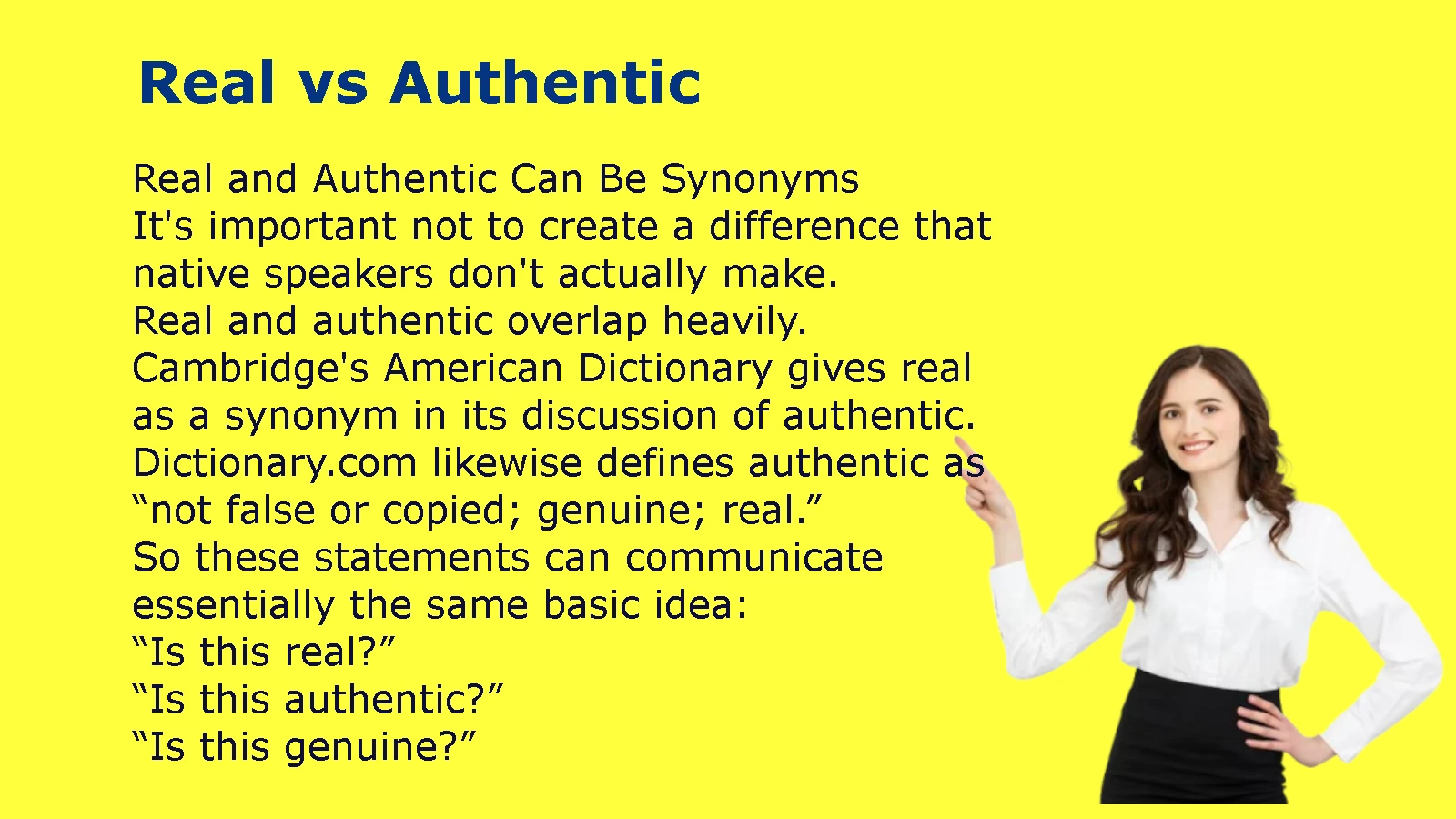
Real and Authentic Can Be Synonyms
It’s important not to create a difference that native speakers don’t actually make.
Real and authentic overlap heavily.
Cambridge’s American Dictionary gives real as a synonym in its discussion of authentic. Dictionary.com likewise defines authentic as “not false or copied; genuine; real.”
So these statements can communicate essentially the same basic idea:
- “Is this real?”
- “Is this authentic?”
- “Is this genuine?”
All three can ask whether something is fake.
The difference appears when the context gives authentic a more precise job.
Example: A Painting
Imagine that a gallery has a painting labeled as the work of a famous artist.
You could say:
“Is the painting real?”
That’s understandable. You’re asking whether it is genuine.
But:
“Is the painting authentic?”
sounds more precise if the question concerns whether the work genuinely came from the claimed artist.
The second wording naturally brings provenance, authorship, and verification into the discussion.
That’s why experts often use authenticate as a technical verb. To authenticate something means to establish that it is real, true, or what it claims to be.
When Should You Use “Real”?
Use real when you want to emphasize actual existence, reality, or the absence of falseness.
Real for Actual Events
Use real when something actually happened.
- “The movie is based on a real story.”
- “The characters were inspired by real people.”
- “The accident was a real event.”
Here, real contrasts with fictional or imaginary.
Calling the story authentic wouldn’t always communicate the same thing. An authentic story could mean a truthful or reliable account, while a real story means that the events actually occurred.
Real for Emotions
Real works naturally with emotions.
- “She showed real happiness.”
- “His apology sounded real.”
- “I felt real fear.”
- “They have a real connection.”
The word emphasizes that the feeling isn’t fake or pretended.
Authentic can also work:
“She showed authentic emotion.”
However, it sounds more deliberate and can suggest that the emotion genuinely reflects her inner state or character.
For ordinary conversation, real emotion is often the more natural choice.
Real for Physical Objects
Use real when you’re distinguishing an actual material or object from a substitute.
- real gold
- real leather
- real flowers
- real diamonds
- real wood
For example:
“Are these real flowers or artificial ones?”
That’s perfectly natural.
You could use authentic in some of these contexts, but the meaning may shift. Authentic leather, for instance, focuses more specifically on whether the material genuinely is leather rather than a synthetic imitation.
Real for People
Real person normally means an actual person rather than a fictional character or imaginary individual.
- “Is Sherlock Holmes a real person?”
- “She is a real person, not a fictional character.”
- “The documentary follows real people.”
Here, authentic person wouldn’t normally express the same basic idea.
When Should You Use “Authentic”?
Use authentic when the question involves genuine identity, origin, reliability, tradition, or faithful representation.
Authentic for Art and Antiques
This is one of the clearest uses.
Suppose someone sells you a painting as a work from the nineteenth century. You want to know whether it actually originated during that period and whether the claimed artist created it.
You might ask:
“Is this painting authentic?”
That’s more precise than simply asking whether it is real.
The same applies to:
- authentic antiques
- authentic signatures
- authentic manuscripts
- authentic artifacts
- authentic documents
- authentic artwork
Dictionary.com specifically includes objects whose origins are supported by evidence, such as historical documents and works by old masters.
Authentic for Food
Food is another important area where authentic has a distinct advantage.
You might say:
“This restaurant serves authentic Mexican food.”
That doesn’t merely mean the food physically exists. Obviously, it does.
The word authentic addresses whether the food represents the cuisine in a way that is considered faithful to its traditions, ingredients, methods, or regional character.
Cambridge uses examples such as authentic Italian food and notes that authentic can describe food that genuinely represents the claimed culinary tradition.
However, there’s an important nuance: authenticity in food isn’t always an objective yes-or-no test.
Cuisines evolve. Recipes vary by region. Families adapt traditional dishes. Ingredients change when cooks move to different countries.
So calling food authentic usually makes a claim about how faithfully it represents a particular culinary tradition or style, not about whether one person possesses the final authority to define an entire cuisine.
Authentic for Documents
Consider these two sentences:
“I found a real document.”
“I found an authentic document.”
The first tells us that a document exists.
The second raises a more specific question: Is the document genuinely what it claims to be?
For historical or legal material, that distinction matters.
A document could physically exist while still being forged. In that case, the document is real in the sense that someone created a physical document. It isn’t authentic if it falsely claims to be an original historical or official document.
That’s one of the clearest examples of why real and authentic aren’t perfect substitutes.
Real vs Authentic in Common Phrases
Some combinations sound much more natural with one word than the other.
| Phrase | Best Choice | Reason |
| real story | Real | Emphasizes that the story actually happened |
| authentic account | Authentic | Emphasizes reliability or genuine origin |
| real person | Real | Contrasts with fictional or imaginary |
| authentic person | Authentic | Emphasizes sincerity and being true to oneself |
| real emotions | Real | Emphasizes genuine feelings |
| authentic voice | Authentic | Emphasizes a natural, genuine expression |
| real danger | Real | Emphasizes actual existence |
| authentic document | Authentic | Emphasizes genuine origin or legitimacy |
| real antique | Real | Commonly emphasizes that it isn’t fake |
| authentic antique | Authentic | Emphasizes genuine age or provenance |
| real food | Real | Can mean actual food rather than a substitute |
| authentic food | Authentic | Emphasizes traditional or culturally faithful preparation |
| real experience | Real | Emphasizes that the experience actually happened |
| authentic experience | Authentic | Emphasizes that the experience genuinely represents something |
This table isn’t a list of rigid grammar rules. English doesn’t work that mechanically.
Instead, think of the choices as different lenses. Real looks toward actuality. Authentic often looks toward genuineness and identity.
Real vs Authentic: Examples in Context
The difference becomes much easier to understand when you see the words working in complete sentences.
Example: Gold
“Is this real gold?”
The speaker wants to know whether the material is actually gold.
“Is this authentic gold jewelry from the designer?”
Now the focus can include whether the jewelry genuinely comes from the claimed designer or source.
Example: A Story
“The movie is based on a real story.”
This means the events actually happened.
“The movie gives an authentic account of the events.”
This makes a stronger claim about the accuracy or faithful representation of those events.
Those aren’t identical claims.
A story can be real while a particular retelling of it is inaccurate.
Example: A Person
“He’s a real person.”
He actually exists.
“He’s an authentic person.”
He behaves in a genuine way rather than putting on a false persona.
The first sentence is about existence.
The second is about character and sincerity.
Example: Food
“This is real cheese.”
The speaker may be distinguishing cheese from a substitute or imitation product.
“This is authentic Italian cheese.”
The speaker is making a more specific claim about the cheese’s origin, style, or relationship to Italian culinary tradition.
Real vs Authentic for People and Personality
The distinction becomes especially interesting when you describe people.
“Real Person”
A real person is usually an actual person.
For example:
“The novel’s main character wasn’t based on a real person.”
This means the character is fictional.
“Authentic Person”
An authentic person is someone who behaves in a genuine way and doesn’t constantly pretend to be someone else.
For example:
“She has an authentic personality.”
The point isn’t that she exists. Nobody needs to establish that.
The point is that her behavior, beliefs, emotions, or communication seem true to who she really is.
Dictionary.com includes this sense directly, defining authentic as representing one’s true nature or beliefs.
That’s why you can say:
“Be yourself and speak authentically.”
Here, authentically means in a way that honestly represents who you are. Cambridge similarly describes authentically as acting in an honest or sincere way and accurately representing how something really is.
Real vs Authentic for Stories and Accounts
The distinction between real and authentic matters when discussing stories.
A real story is generally a story about events that actually happened.
An authentic account suggests that the account is genuine, trustworthy, or faithful to what happened.
Consider a historical event.
The event itself can be real.
A diary describing that event can be authentic if experts establish that the diary genuinely came from the claimed writer and period.
But authenticity doesn’t automatically guarantee perfect factual accuracy. A genuine diary can contain mistakes, misunderstandings, or personal bias.
That’s an important point:
Authentic does not always mean objectively correct in every detail.
It can mean that the source itself is genuine or that a representation faithfully reflects a particular perspective.
Real vs Authentic for Art
Art provides one of the clearest practical differences.
Imagine that a gallery displays a painting and claims it was created by a famous artist.
There are several separate questions you could ask:
- Is there a physical painting?
- Is it an original?
- Is it a reproduction?
- Did the claimed artist create it?
- Is the signature genuine?
- Does the work come from the claimed period?
- Has its provenance been established?
The word authentic becomes particularly useful because it can address the relationship between the object and its claimed source.
For example:
“Experts authenticated the painting.”
This means experts established that it was genuine or what it claimed to be. Cambridge gives authenticate this core meaning: to prove that something is real, true, or what it claims to be.
A Simple Art Case Study
Imagine two paintings that look almost identical.
Painting A is the original work.
Painting B is a modern reproduction.
Both paintings are real physical objects.
But only Painting A may be authentic to the claimed artist and work.
This illustrates the heart of the distinction:
Something can be real as an object without being authentic as the thing it claims to be.
That’s one of the most useful ways to understand Real vs Authentic.
Real vs Authentic for Cultural Traditions
Authentic often appears when people discuss culture.
You might hear:
- authentic Japanese cuisine
- authentic Mexican recipes
- authentic folk music
- authentic traditional clothing
- authentic cultural practices
Here, the word points toward faithful representation.
By contrast, real may sound too broad:
“This is real Japanese food.”
That could simply mean the food exists or isn’t fake.
“This is authentic Japanese food.”
The second sentence tells the reader that the speaker is making a claim about the food’s relationship to Japanese culinary traditions.
Still, cultural authenticity can be complicated. No cuisine remains frozen in time. Recipes change across regions, generations, families, and communities.
Therefore, authentic should not automatically be treated as a synonym for “the only correct version.”
Can Something Be Real but Not Authentic?
Yes.
This is one of the most useful distinctions between the two words.
Imagine someone creates a fake historical document.
The document is real in the physical sense. Someone actually created it.
But it isn’t authentic if it falsely claims to be an original document from a different period.
Another example is a counterfeit designer bag.
The bag is real as a physical object.
However, it isn’t authentic designer merchandise if it falsely claims to have been made by the designer.
This gives you a practical formula:
Real asks whether something exists or is genuine in a broad sense. Authentic often asks whether it genuinely is what it claims to be.
Can Something Be Authentic but Not “Real”?
In ordinary usage, authentic generally carries the idea of being real or genuine. So it would be misleading to treat authentic things as somehow unreal.
However, authentic can describe a representation rather than the original thing itself.
For example:
“The film authentically recreates the period.”
The film isn’t the historical period itself. It is a modern representation.
Yet it can still be authentic in its portrayal if it accurately and faithfully represents the period.
Cambridge gives authentically this broader sense of accurately representing how something really is.
So authenticity can apply not only to an original object but also to how accurately something represents an original reality, style, tradition, or voice.
Real vs Authentic vs. Genuine
A third word often enters this discussion: genuine.
The three words overlap, but each has its own common emphasis.
| Word | Typical emphasis |
| Real | Actual existence or reality |
| Authentic | Genuine identity, origin, representation, or faithful character |
| Genuine | Not fake, counterfeit, pretended, or insincere |
Collins treats genuine, authentic, and real as synonyms in several senses. It also notes that genuine can describe emotions that are real rather than pretended.
Compare:
- real diamond → an actual diamond
- authentic diamond → a genuine diamond, often with emphasis on what it is claimed to be
- genuine diamond → not fake or counterfeit
With emotions:
- real happiness → actual happiness
- authentic happiness → happiness that genuinely reflects the person
- genuine happiness → sincere, unpretended happiness
The context determines which adjective sounds most natural.
Common Mistakes With Real and Authentic
Mistake: Assuming the Words Are Completely Different
They’re not.
Authentic can directly mean real. Major dictionaries say so.
The goal isn’t to memorize an artificial rule. Instead, learn the nuance that each word commonly brings.
Mistake: Using “Authentic” Everywhere
Because authentic sounds precise, some writers overuse it.
For example:
“I had an authentic bad day.”
That sounds unnatural.
“I had a really bad day” or “I had a real bad day” may fit the intended meaning better depending on the sentence.
Likewise:
“She lives an authentic life.”
works when the writer means she lives according to her values.
But:
“She lives a real life.”
usually means something quite different or sounds incomplete.
Mistake: Thinking “Real” Only Means Physical
Real can describe far more than physical objects.
You can have:
- real fear
- real love
- real concern
- real evidence
- real problems
- real opportunities
- real experiences
- real consequences
Cambridge includes uses of real involving actual existence, genuineness, and emphasis.
Mistake: Treating “Authentic” as Proof of Absolute Accuracy
An authentic source can still contain mistakes.
For example, an authentic historical letter may genuinely come from the person who wrote it. That doesn’t mean every statement in the letter is factually correct.
Authenticity concerns genuineness. Accuracy concerns correctness.
Those ideas overlap sometimes, but they aren’t identical.
Real vs Authentic: How to Choose the Right Word
When you’re unsure, ask yourself what you actually want to emphasize.
Choose “Real” if you mean:
- Actually existing
- Not imaginary
- Not fake
- Actually happening
- Genuine feelings
- Actual people
- Actual experiences
- Serious or substantial
Examples:
“Is this a real problem?”
“The story is based on real events.”
“Those are real diamonds.”
Choose “Authentic” if you mean:
- Genuine origin
- Verified identity
- Faithfulness to an original
- True cultural representation
- Genuine personal expression
- A trustworthy or genuine account
- Something that is truly what it claims to be
Examples:
“The museum confirmed that the artifact is authentic.”
“The restaurant serves authentic Thai food.”
“She has an authentic voice.”
“Experts verified that the signature was authentic.”
A Quick Decision Test
Use this simple test:
Are you asking whether something exists or is fake?
→ Real will often work.
Are you asking whether something genuinely comes from the claimed source or faithfully represents it?
→ Authentic will often work.
Are you describing sincerity or unpretended feeling?
→ Real, genuine, or authentic may all work depending on context.
Are you describing cultural or historical fidelity?
→ Authentic is usually the stronger choice.
Real vs Authentic: Quick Comparison
| Question | Real | Authentic |
| Does it actually exist? | Yes | Can imply yes |
| Is it not imaginary? | Yes | Sometimes |
| Is it not fake? | Yes | Yes |
| Does it genuinely come from the claimed source? | Sometimes | Strongly |
| Is it faithful to an original? | Sometimes | Strongly |
| Does it represent a tradition faithfully? | Sometimes | Commonly |
| Does it express someone’s true character? | Sometimes | Strongly |
| Does it describe an actual event? | Very common | Less direct |
| Does it describe a genuine document? | Possible | Very common |
| Does it describe traditional food? | Possible | Very common |
Frequently Asked Questions About Real vs Authentic
Is authentic the same as real?
Often, yes. Both words can mean genuine or not fake. However, authentic can add the idea that something is genuinely what it claims to be or faithfully represents its original source, tradition, or character.
Is authentic stronger than real?
Not necessarily.
They emphasize different things.
Real is broader and more common in everyday speech. Authentic is often more specific when origin, identity, tradition, or faithful representation matters.
Can a person be real but not authentic?
Yes, depending on what you mean.
A real person is an actual person rather than a fictional character.
An authentic person is someone whose behavior and expression genuinely reflect who they are.
So:
Real = actual person.
Authentic = genuine person.
Is “real food” or “authentic food” better?
It depends on the intended meaning.
Real food usually contrasts with something artificial, processed, fake, or not actually made from the expected ingredient.
Authentic food usually describes food that genuinely represents a particular cuisine, tradition, or style.
For example:
“This is real cheese.”
means the product is actually cheese.
“This is authentic Italian cheese.”
makes a more specific claim about its relationship to Italian cheese traditions.
Is a real painting the same as an authentic painting?
Not always.
A real painting can simply mean an actual painting rather than a photograph or imaginary work.
An authentic painting often means the painting genuinely is what it claims to be, such as an original work by a particular artist.
What is the opposite of authentic?
Common opposites include:
- inauthentic
- fake
- counterfeit
- imitation
- spurious
The best choice depends on the context.
For a person, inauthentic or insincere may work.
For a product, counterfeit or fake may be more precise.
Dictionary.com defines inauthentic as not authentic or false.
What is the opposite of real?
Possible opposites include:
- fake
- imaginary
- unreal
- fictional
- artificial
Final Verdict: Real vs Authentic
The difference between real and authentic is subtle because the words genuinely overlap.
Real is the broader term. It usually tells you that something actually exists, actually happened, or isn’t fake or imaginary.
Authentic also means real and genuine. However, it often adds a more specific idea: something is genuinely what it claims to be, comes from the claimed source, accurately represents an original, follows a cultural tradition, or honestly reflects someone’s character.
Think of it this way:
Real asks, “Is this actually real?”
Authentic asks, “Is this genuinely what it claims to be?”
So you might have a real painting that physically exists. But if you’re trying to determine whether it truly came from the artist whose name appears on the label, authentic is the more precise word.
Likewise, a real story is one based on events that actually happened. An authentic account suggests that the account genuinely and faithfully represents those events.
In everyday conversation, you can often use the two words interchangeably. When origin, identity, tradition, accuracy of representation, or personal genuineness matters, however, authentic gives you a sharper tool.
And that’s the real difference: real is broader; authentic is often more specific.