Have you ever wondered whether you should write “traveled” or “travelled”? Both spellings are correct, but the right choice depends on the English variety you’re using. While Traveled vs Travelled may look like a simple spelling difference, the two forms follow different spelling conventions in American and British English.
Traveled is the standard spelling in American English, while travelled is the standard spelling in British English and other varieties such as Canadian and Australian English. Both forms mean the same thing: to have gone from one place to another.
Examples:
- She traveled to New York last summer.
- She travelled to London last summer.
The confusion is understandable. People often search for traveled or travelled, traveled vs travelled spelling, is traveled or travelled correct, or American vs British spelling because both versions appear in books, websites, and everyday writing. And here’s the kicker: neither spelling is wrong. You just need to match the spelling to the type of English you’re using.
In this guide, you’ll learn the complete difference between Traveled vs Travelled, including their meaning, spelling, pronunciation, usage, and examples in sentences. You’ll also discover why American English uses traveled, why British English uses travelled, and which spelling you should use in formal and everyday writing.
Traveled vs Travelled: What Is the Difference?
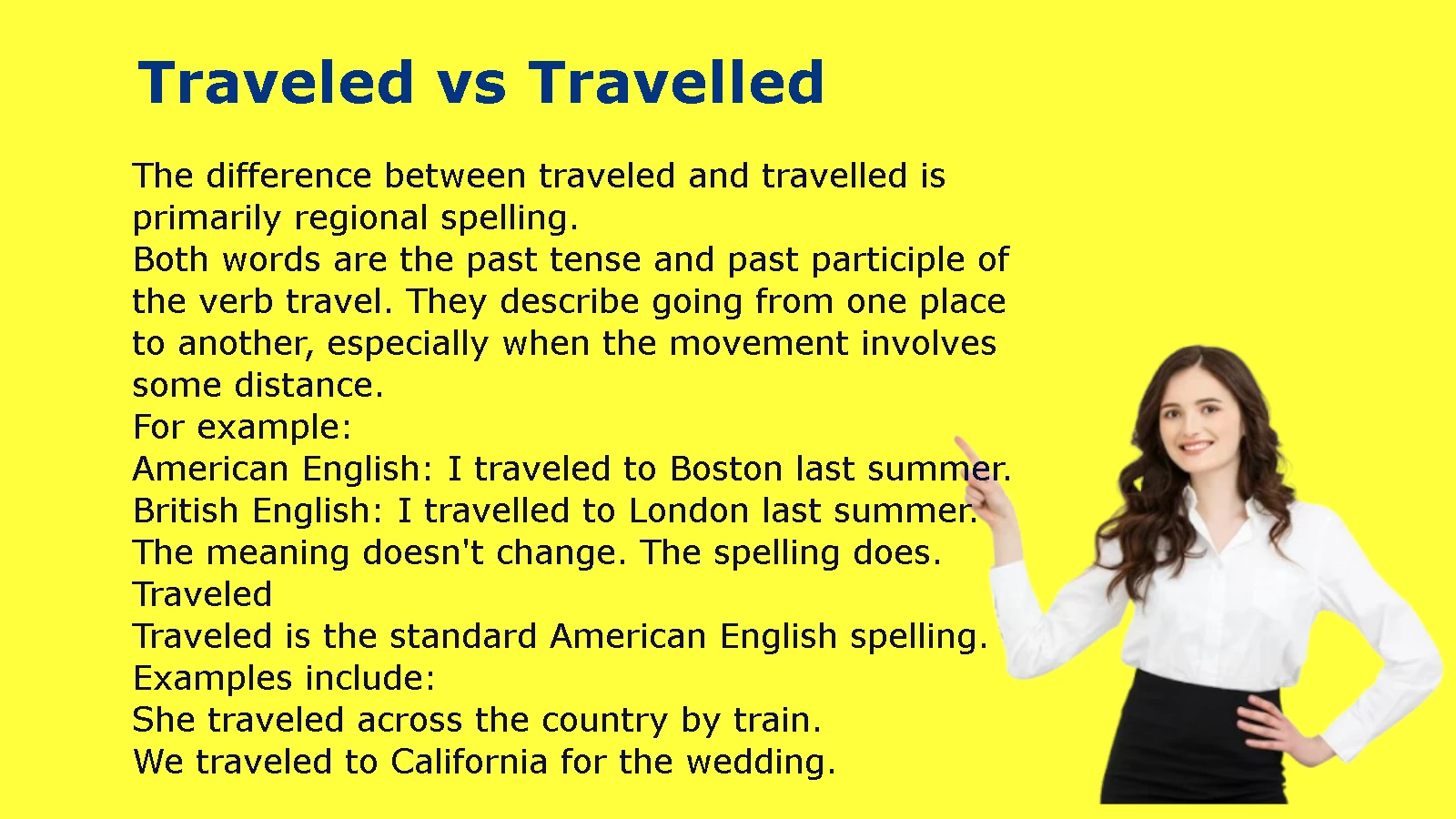
The difference between traveled and travelled is primarily regional spelling.
Both words are the past tense and past participle of the verb travel. They describe going from one place to another, especially when the movement involves some distance.
For example:
- American English: I traveled to Boston last summer.
- British English: I travelled to London last summer.
The meaning doesn’t change. The spelling does.
Traveled
Traveled is the standard American English spelling.
Examples include:
- She traveled across the country by train.
- We traveled to California for the wedding.
- He has traveled extensively for work.
- They traveled through several states.
- I traveled alone for the first time last year.
Oxford’s American English dictionary gives traveled as the past simple and past participle of travel.
Travelled
Travelled is the standard British English spelling.
Examples include:
- She travelled across Europe by train.
- We travelled to Scotland last summer.
- He has travelled extensively for work.
- They travelled through several countries.
- I travelled alone for the first time last year.
Oxford’s general English dictionary lists travelled as both the past simple and past participle, while marking traveled as the US English alternative.
Is Traveled or Travelled Correct?
Both are correct.
That’s the simplest answer.
The choice depends on the form of English you are using:
- Use traveled in American English.
- Use travelled in British English.
- Follow your employer’s, school’s, publisher’s, or client’s style guide when one exists.
- Don’t switch between the two forms without a reason.
Think of it like color and colour. One spelling isn’t a mistake simply because another English speaking country uses a different convention.
The same principle applies here.
Is Traveled Correct in American English?
Yes. Traveled is the normal American English spelling.
For example:
I traveled to New York last month.
That sentence follows standard American spelling.
American English also normally uses:
- traveling
- traveler
- traveled
- traveling salesman
- well traveled
Oxford’s American dictionary explicitly gives traveled as the American past form of travel and traveling as its -ing form.
Is Travelled Correct in British English?
Yes. Travelled is the normal British English spelling.
For example:
I travelled to Manchester last month.
British English generally uses the double-l forms:
- travelled
- travelling
- traveller
- well travelled
Oxford identifies travelled as the standard form and gives traveled as the US English spelling.
Traveled vs Travelled Meaning
Traveled and travelled mean exactly the same thing when they function as forms of the verb travel.
The verb travel can describe movement from one place to another, movement over a particular distance, or movement at a particular speed. Oxford gives examples involving journeys, distance, speed, and movement.
Consider these sentences:
She traveled across Texas.
She travelled across England.
The locations differ, but the spelling difference has nothing to do with the meaning.
Likewise:
We traveled by train.
and
We travelled by train.
Both sentences mean that we went somewhere by train.
The important point is that the extra l does not add a new meaning.
Traveled vs Travelled Pronunciation
Another common question is whether traveled and travelled sound different.
They generally have the same pronunciation.
The additional l in travelled represents a spelling convention rather than a separate sound. Cambridge provides pronunciations for both forms that reflect the same spoken word.
So you don’t need to change the way you say the word when you change the spelling.
Compare:
- traveled → pronounced like travelled
- travelled → pronounced like traveled
This makes the distinction especially easy to remember: your keyboard changes, but your pronunciation doesn’t.
Why Does Traveled Have One L While Travelled Has Two?
The difference comes from the spelling conventions that developed in different varieties of English.
American English often uses a single l in forms such as traveled and traveling, while British English generally doubles the l in travelled and travelling.
The same regional pattern appears in other words, although the exact spelling rules vary from word to word.
For example:
| American English | British English |
| traveled | travelled |
| traveling | travelling |
| traveler | traveller |
| canceled | cancelled |
| labeled | labelled |
| modeled | modelled |
However, you shouldn’t assume that every word ending in l follows exactly the same pattern. English spelling has plenty of exceptions and historical quirks.
That’s why it’s better to learn traveled/travelled as part of a regional spelling system rather than trying to create one universal rule.
Traveled vs Travelled in American English
American English normally favors the single-l forms.
If your audience is primarily in the United States, traveled is the natural choice.
American English Examples
- I traveled to Chicago last weekend.
- She traveled abroad after graduating from college.
- We traveled by car instead of flying.
- He traveled more than 2,000 miles for the job.
- They have traveled throughout the western United States.
- My family traveled to Florida every summer.
- The journalist traveled across the country to report the story.
Notice how the spelling stays consistent in every example.
That’s important because American English also uses traveling, not travelling, in the related -ing form.
We are traveling to Seattle tomorrow.
Not:
We are travelling to Seattle tomorrow.
The second version isn’t inherently incomprehensible or grammatically wrong. It simply uses the spelling convention associated with British English and several other varieties.
Traveled vs Travelled in British English
British English normally favors the double-l forms.
If you’re writing for readers in the United Kingdom, travelled is the natural choice.
British English Examples
- I travelled to London last weekend.
- She travelled abroad after graduating from university.
- We travelled by train instead of flying.
- He travelled hundreds of miles for the job.
- They have travelled throughout Europe.
- My family travelled to France every summer.
- The journalist travelled across the country to report the story.
The related -ing form is also normally written with two l’s:
We are travelling to Edinburgh tomorrow.
This spelling pattern is reflected in Oxford’s entry for travelling, which identifies traveling as the US English form.
Traveled vs Travelled: Verb Forms
Understanding the grammar makes the difference even clearer.
The verb travel has several common forms:
| Verb form | American English | British English |
| Base form | travel | travel |
| Third-person singular | travels | travels |
| Past tense | traveled | travelled |
| Past participle | traveled | travelled |
| -ing form | traveling | travelling |
The present tense doesn’t create a spelling difference:
I travel often.
She travels often.
The regional difference becomes noticeable in the past and -ing forms.
Past Tense
Use traveled in American English:
We traveled to Miami last year.
Use travelled in British English:
We travelled to Edinburgh last year.
Past Participle
The same distinction applies when travel appears with have, has, or had.
American English:
She has traveled to five countries.
British English:
She has travelled to five countries.
Both sentences are grammatically correct.
Present Participle
American English:
They are traveling through Arizona.
British English:
They are travelling through Scotland.
Again, the meaning remains unchanged.
Traveled vs Travelled in Related Words
The spelling difference doesn’t stop with the past tense.
It also appears in several related forms.
| American English | British English |
| traveled | travelled |
| traveling | travelling |
| traveler | traveller |
| well traveled | well travelled |
| widely traveled | widely travelled |
| much traveled | much travelled |
Oxford lists traveled as the American form of the adjective and gives examples such as much-traveled and less traveled.
Cambridge likewise uses traveled for US English and travelled for UK English in adjective constructions such as well-traveled.
Traveler vs Traveller
The noun traveler/traveller follows the same broad regional distinction.
American English:
The traveler asked for directions.
British English:
The traveller asked for directions.
Traveling vs Travelling
The same pattern appears in the -ing form.
American English:
Traveling can be expensive during the holidays.
British English:
Travelling can be expensive during the holidays.
Cambridge identifies traveling as the US spelling of travelling.
Traveled vs Travelled in Formal Writing
Neither spelling is too informal for professional or academic writing.
The real issue is consistency.
Suppose an American company publishes a report and writes:
Our employees traveled to Europe in June.
That spelling fits American English.
Now imagine the same report contains:
The team was travelling throughout Germany.
The second spelling suddenly shifts to a British convention.
Readers will probably understand the sentence without trouble. Still, the inconsistency can make the document look poorly edited.
Why Consistency Matters
A professional document should normally follow one spelling system from beginning to end.
For example, American English commonly uses:
- traveled
- traveling
- traveler
- color
- favorite
- center
British English commonly uses:
- travelled
- travelling
- traveller
- colour
- favourite
- centre
You don’t need to choose one system because it’s objectively better. Choose the system that fits your audience.
Traveled vs Travelled for Websites and SEO Content
For online content, spelling should match the audience you’re trying to reach.
If a website primarily targets readers in the United States, traveled is generally the better choice for American English copy.
If a site targets readers in the United Kingdom, travelled is generally more appropriate.
However, search engines can understand both forms. You don’t need to awkwardly repeat both spellings in every paragraph simply because they are variants.
A better approach is to write naturally.
For example, an American travel article might use:
Traveled to Europe recently? These tips can help you plan your next trip.
A British publication could naturally write:
Travelled to Europe recently? These tips can help you plan your next trip.
If you specifically want to explain the spelling difference, then using both terms makes sense because the distinction itself is the subject of the page.
Traveled vs Travelled in Academic Writing
Academic writing follows the same basic principle.
If your institution requires American English, use traveled.
If it requires British English, use travelled.
Some academic journals and publishers provide their own style guides. Those guidelines take priority over general assumptions about regional English.
A Simple Academic Example
American English:
The researchers traveled to three regions to collect field data.
British English:
The researchers travelled to three regions to collect field data.
The grammar remains identical. Only the spelling changes.
This is why marking one form as “wrong” without considering the variety of English can lead to a misleading correction.
Traveled vs Travelled in Business Writing
Business documents often move across borders, so regional spelling can become especially noticeable.
Imagine a US company preparing a customer report:
Our sales team traveled across the Midwest to meet clients.
A UK company might write:
Our sales team travelled across the Midlands to meet clients.
Both versions work.
For international organizations, the best practice is usually to establish a house style. That style can specify whether the organization uses American English, British English, or another recognized variety.
Once the choice is made, editors can apply it consistently.
Traveled vs Travelled: Common Mistakes
Most mistakes involving these words aren’t grammar mistakes. They’re consistency mistakes.
Mistake: Treating Traveled as the Only Correct Form
Some writers assume that traveled is the only correct spelling because that’s the form they learned.
That’s not accurate.
Travelled is the standard British spelling.
Mistake: Treating Travelled as a Misspelling
The opposite mistake happens too.
A British English writer may see traveled and assume someone left out an l.
In American English, however, traveled is the standard form.
Mistake: Mixing Regional Forms
A document might contain:
- traveled
- travelling
- traveller
- color
- favourite
That combination can look inconsistent because it mixes spelling conventions.
Mistake: Assuming the Extra L Changes the Meaning
It doesn’t.
Traveled and travelled describe the same action.
The extra l doesn’t indicate a longer trip, a different type of journey, or a different tense.
Mistake: Changing the Pronunciation
The spelling difference doesn’t require a different pronunciation.
Say the word naturally whether you’re writing traveled or travelled.
Traveled vs Travelled: A Practical Case Study
Consider a company that operates in both the United States and the United Kingdom.
Its US website says:
Our consultants traveled across the United States to meet clients.
Its UK website says:
Our consultants travelled across the United Kingdom to meet clients.
Neither version needs to be “corrected” to match the other.
The audiences are different, so the spelling conventions can differ too.
Now imagine the UK page contains:
Our consultants traveled across the United Kingdom.
That’s understandable, but if the rest of the page uses British spelling such as organisation, favour, and travelling, the single-l form stands out.
The lesson is simple: regional consistency matters more than choosing one spelling for the entire English-speaking world.
Traveled vs Travelled: Which One Should You Use?
Use this quick rule:
| If you’re writing for… | Use |
| United States | traveled |
| United Kingdom | travelled |
| American English audience | traveled |
| British English audience | travelled |
| A publication with a specific style guide | Follow its guide |
| An international audience | Choose one consistent style |
If you’re writing in US English, the answer is straightforward:
Use traveled.
If you’re writing in British English, use:
travelled.
There’s no need to complicate it.
Traveled vs Travelled: Quick Comparison
| Feature | Traveled | Travelled |
| Meaning | To have gone from one place to another | To have gone from one place to another |
| Main variety | American English | British English |
| Past tense | Yes | Yes |
| Past participle | Yes | Yes |
| Pronunciation | Same | Same |
| Number of l’s | One | Two |
| Related -ing form | traveling | travelling |
| Related noun | traveler | traveller |
| Correct in US English | Yes | Less common |
| Correct in UK English | Less common | Yes |
Oxford and Cambridge both support the regional distinction between these forms.
Traveled vs Travelled Examples
Seeing the two forms side by side makes the difference almost impossible to miss.
| American English | British English |
| I traveled to Paris. | I travelled to Paris. |
| She has traveled widely. | She has travelled widely. |
| We are traveling tomorrow. | We are travelling tomorrow. |
| He is an experienced traveler. | He is an experienced traveller. |
| It was a well-traveled road. | It was a well-travelled road. |
| They traveled by train. | They travelled by train. |
| I enjoy traveling alone. | I enjoy travelling alone. |
The important thing is not to memorize every sentence. Learn the spelling pattern.
Frequently Asked Questions About Traveled vs Travelled
Is “traveled” grammatically correct?
Yes. Traveled is grammatically correct and is the standard American English spelling of the past tense and past participle of travel.
Is “travelled” grammatically correct?
Yes. Travelled is grammatically correct and is the standard British English spelling.
Is traveled or travelled correct in the US?
Traveled is the preferred American English spelling.
For example:
We traveled to California last summer.
Is traveled or travelled correct in the UK?
Travelled is the preferred British English spelling.
For example:
We travelled to Wales last summer.
Do traveled and travelled have different meanings?
No. They have the same meaning when used as forms of travel.
The difference is primarily regional spelling.
Are traveled and travelled pronounced differently?
Generally, no. The two spellings represent the same spoken word.
Is traveling or travelling correct?
Both are correct.
American English normally uses traveling, while British English normally uses travelling. Oxford and Cambridge both identify the US form as traveling.
Is traveler or traveller correct?
Both are correct regional spellings.
- Traveler is standard in American English.
- Traveller is standard in British English.
Is “well-traveled” correct?
Yes.
In American English:
She is a well-traveled writer.
British English normally uses:
She is a well-travelled writer.
Cambridge lists well-traveled as an American form and notes the British spelling well travelled.
Can I use travelled in American English?
You can encounter travelled in American contexts, especially in material that follows British or international spelling conventions. However, traveled is the normal American spelling.
If you’re deliberately writing in US English, stick with traveled for consistency.
Can I use traveled in British English?
Yes, readers will understand it. However, travelled is the conventional British spelling.
If you’re writing specifically in British English, travelled is the better choice.
Does the extra L change the tense?
No.
Both forms are the past tense and past participle of travel:
- American: traveled
- British: travelled
The number of l’s doesn’t change the tense.
Why does British English use two L’s?
British English spelling traditionally doubles the final consonant in this form of travel, producing travelled and travelling. American English generally uses the single-l forms traveled and traveling.
The difference is a matter of spelling convention rather than grammar or meaning.
Final Answer: Traveled or Travelled?
Traveled and travelled are both correct.
The deciding factor is which variety of English you’re using.
Use traveled in American English:
I traveled to New York last year.
Use travelled in British English:
I travelled to London last year.
The same distinction carries over to related forms:
- traveled / travelled
- traveling / travelling
- traveler / traveller
- well traveled / well travelled
So, if you’re writing for a US English audience, choose traveled. If you’re following British English, choose travelled.
There’s no grammatical battle to win here. It’s simply two spelling conventions describing the same word. Pick the version that fits your audience, follow the same convention throughout your writing, and you’re on solid ground.