Stoma vs stomata comes down to one basic grammatical difference: stoma is singular, while stomata is the traditional plural form used in biology. A stoma is a microscopic pore in a plant’s surface that helps regulate gas exchange and water loss. In medicine, the same word describes an opening created or brought to the body’s surface through surgery.
Understanding stoma meaning, stomata function, guard cells, and the difference between stoma and stroma makes these terms easier to remember. Although the words look similar, each has a specific role in biology or healthcare. This guide explains their meanings, pronunciation, anatomy, and practical uses, with examples and comparisons to help you choose the correct term.
Stoma vs Stomata: What Is the Difference?
Stoma refers to one opening, while stomata refers to multiple openings. In plant biology, a stoma is a tiny pore surrounded by specialized guard cells, and stomata are the pores found across a plant’s leaves and other surfaces. In medical English, stomas is also widely used as the plural of a surgically created opening.
The main difference is grammatical, but the context matters, too. Both words can refer to openings, yet plant biology and medicine use them in different ways.
| Feature | Stoma | Stomata |
| Grammatical form | Singular | Plural |
| Basic meaning | One opening or pore | Multiple openings or pores |
| Plant biology | One pore in a plant’s epidermis | Multiple pores involved in gas exchange |
| Medical usage | One surgically created or redirected opening | May refer to multiple openings in technical usage |
| Example | A stoma allows carbon dioxide to enter a leaf. | Stomata regulate gas exchange and water loss. |
For example, a biology student examining a leaf under a microscope might identify one stoma and then count several stomata across a larger section of the leaf.
Remember this simple rule: one stoma, two or more stomata. When discussing surgical openings, however, stomas is common in modern medical English.
Stoma Meaning and Definition
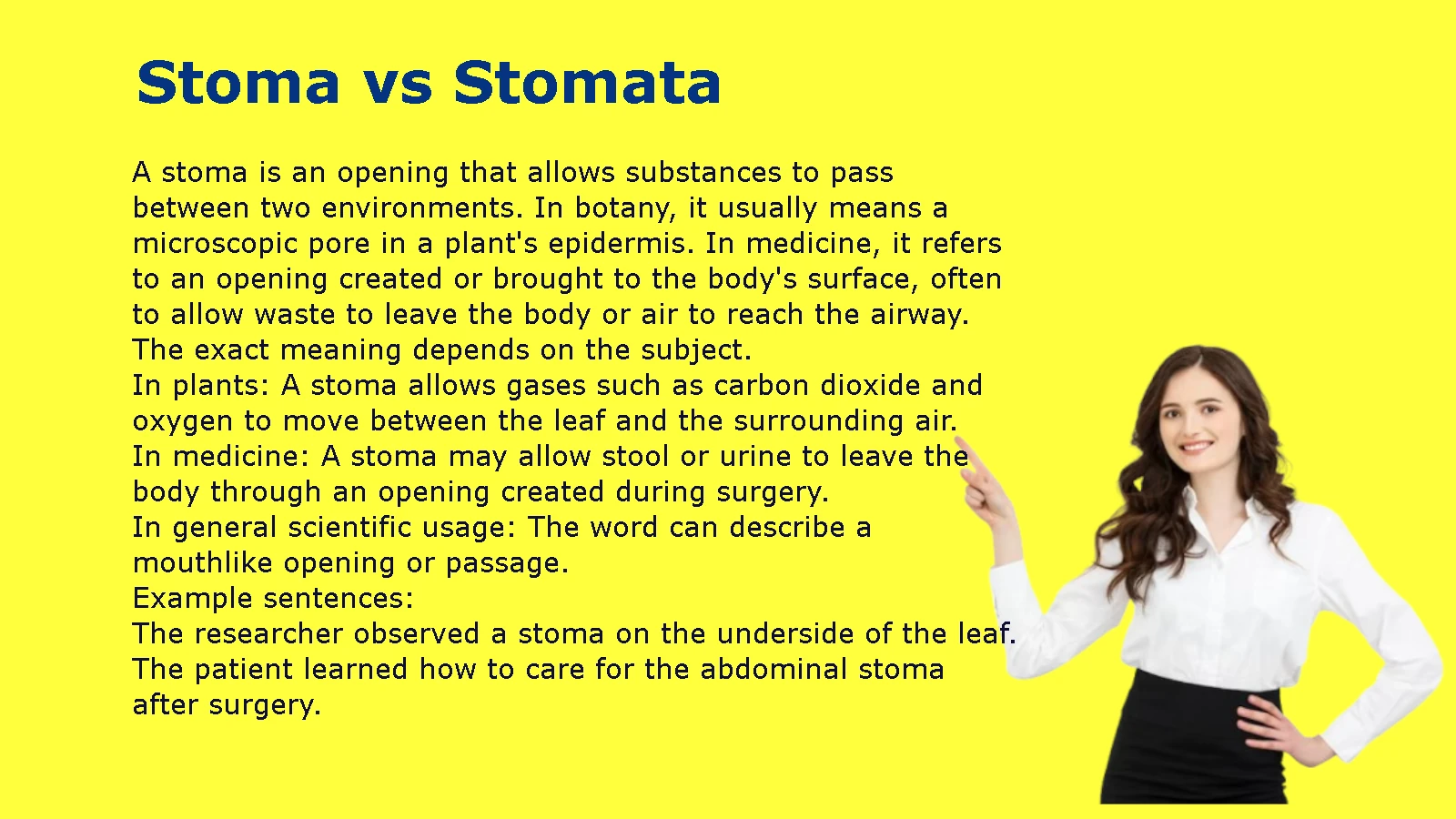
A stoma is an opening that allows substances to pass between two environments. In botany, it usually means a microscopic pore in a plant’s epidermis. In medicine, it refers to an opening created or brought to the body’s surface, often to allow waste to leave the body or air to reach the airway.
The exact meaning depends on the subject.
- In plants: A stoma allows gases such as carbon dioxide and oxygen to move between the leaf and the surrounding air.
- In medicine: A stoma may allow stool or urine to leave the body through an opening created during surgery.
- In general scientific usage: The word can describe a mouthlike opening or passage.
Example sentences:
- The researcher observed a stoma on the underside of the leaf.
- The patient learned how to care for the abdominal stoma after surgery.
Both sentences use the same singular noun, but the first concerns plant anatomy and the second concerns healthcare.
Stomata: The Plural of Stoma
Stomata is the standard scientific plural of stoma, especially in botanical writing. The word comes from Greek, where stoma means mouth. Its plural form follows a traditional Greek grammatical pattern rather than the usual English rule of adding -s.
Other words follow a similar pattern:
| Singular | Plural | Common context |
| Stoma | Stomata | Plant biology |
| Schema | Schemata | Plans or conceptual structures |
| Stigma | Stigmata | Marks or signs; also a specialized biological term |
| Bacterium | Bacteria | Microbiology |
| Datum | Data | Information and measurements |
These examples show why scientific vocabulary sometimes uses plural forms that differ from everyday English.
Although stomata is preferred in botanical terminology, stomas is an accepted and common plural in medical English. A clinical document might discuss a patient’s stomas when referring to multiple surgical openings.
Avoid treating the two plural forms as interchangeable in every setting. For a school biology assignment, use stomata when referring to plant pores. For medical communication, follow the terminology used by the healthcare team or institution.
How to Pronounce Stoma and Stomata
The usual English pronunciations are:
- Stoma: STOH-muh
- Stomata: stoh-MAH-tuh
The main difference is the number of syllables and the stressed syllable. Stoma has two syllables, with stress on the first. Stomata has three syllables, with stress on the second.
Practice with these sentences:
- “A stoma is visible under the microscope.”
- “The stomata help the plant exchange gases.”
Saying the terms aloud can help you remember their spelling and grammatical forms. If you are preparing for a biology exam, connect the singular form with one pore and the plural form with many pores.
What Is a Stoma in Plants?
A stoma in a plant is a tiny pore in the epidermis, or outer protective layer, of a leaf, stem, or other plant organ. It allows gases to move between the plant and the surrounding air. Most stomata also provide a pathway for water vapor to escape during transpiration, making them essential for photosynthesis and water regulation.
Plants need carbon dioxide to produce sugars through photosynthesis. However, they can lose water whenever stomata open. These pores help plants balance the need to obtain carbon dioxide with the need to conserve moisture.
Stomata are particularly important in leaves because leaves receive sunlight and perform much of a plant’s photosynthesis. Their location, density, and opening patterns vary by species and environment.
Stoma Definition in Biology
In biology, a stoma is a specialized epidermal pore that connects the air outside a plant with internal air spaces. A typical leaf stoma consists of a pore, two guard cells, and nearby epidermal cells that help form the surrounding surface.
The pore itself is not a complete cell. Instead, it is a gap between the two guard cells. These cells change shape as their internal water pressure changes, controlling how widely the pore opens.
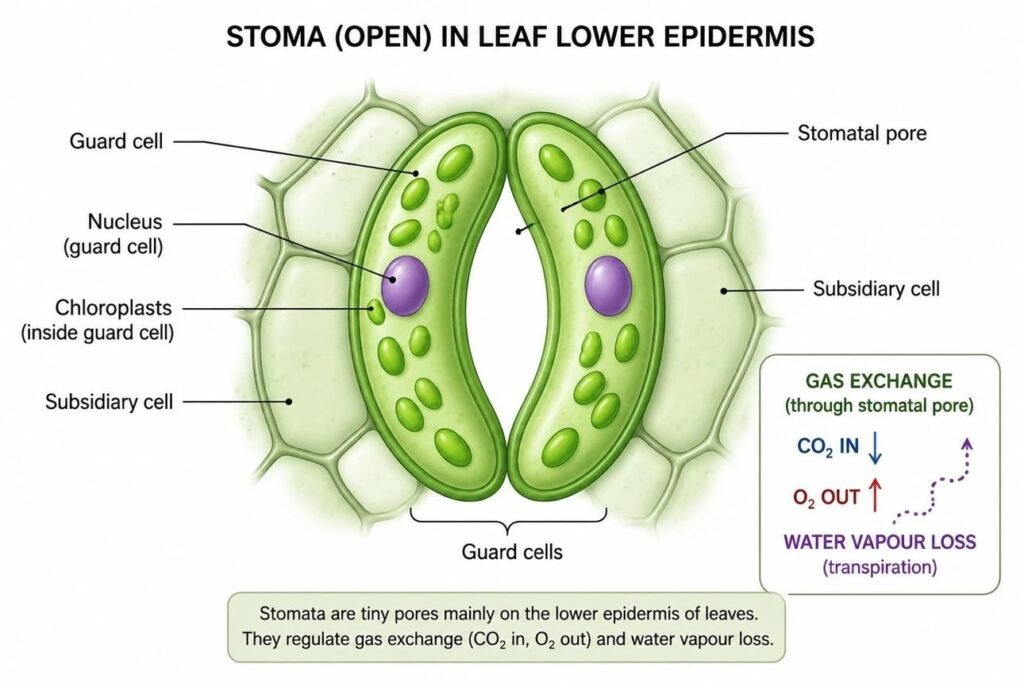
A typical stomatal structure: the pore sits between two guard cells in the leaf epidermis.
Stomata occur on different plant surfaces. Many broad-leaved plants have more stomata on the lower leaf surface than on the upper surface. This arrangement can reduce direct exposure to sunlight and moving air, helping limit water loss. However, the distribution depends on the species and its growing conditions.
Some plants have stomata on both leaf surfaces, while certain aquatic plants have them mainly on the upper surface of floating leaves.
A few key facts help explain their importance:
- Location: Commonly found in the epidermis of leaves.
- Structure: Each typical stoma has two guard cells surrounding a pore.
- Main purpose: Regulating gas exchange and water-vapor loss.
- Biological importance: Supporting photosynthesis while helping maintain water balance.
For example, a sunflower needs carbon dioxide to manufacture sugars. Its stomata provide a route for carbon dioxide to enter the leaf, while also allowing oxygen and water vapor to leave.
Stoma vs. Guard Cell: Understanding the Difference
A stoma is the opening, while a guard cell is one of the specialized cells that controls that opening. A typical stoma has two guard cells positioned on opposite sides of the pore. The cells regulate the pore by changing their shape as their internal pressure changes.
Students often confuse these terms because they appear together in diagrams. However, they represent different parts of the same structure.
| Feature | Stoma | Guard cell |
| What it is | A pore or opening | A specialized living cell |
| Number | One opening | Usually two cells surround a typical stoma |
| Main role | Provides a route for gas exchange | Controls the opening and closing of the pore |
| Movement | The pore widens or narrows | The cells change shape and pressure |
| Position | Between the guard cells | On either side of the pore |
How Guard Cells Open and Close a Stoma
Guard cells respond to environmental signals, including light, carbon dioxide levels, humidity, and the plant’s water status. Their movement depends partly on changes in turgor pressure, which is the pressure of the cell contents against the cell wall.
The process works roughly like this:
- Guard cells take up solutes. In many circumstances, they accumulate potassium ions and other dissolved substances.
- Water enters the cells. Osmotic movement draws water into the guard cells.
- The cells become more turgid. Their shape changes because their walls and internal pressure respond to the added water.
- The pore opens. The guard cells bend apart, allowing gases to move through the opening.
- The pore can close. When the cells lose water and turgor pressure decreases, the opening narrows.
This process is not simply an on-and-off switch. Plants continually adjust stomatal openings as conditions change. During drought, for example, many plants close their stomata partly or fully to reduce water loss. That response also limits carbon dioxide uptake, which can slow photosynthesis.
Guard cells therefore help plants manage a trade-off: opening stomata supports photosynthesis, while closing them conserves water.
Stomata Function in Plants
The main functions of stomata are gas exchange and transpiration control. They allow carbon dioxide to enter for photosynthesis and provide pathways for oxygen and water vapor to leave. By adjusting the size of their pores, plants can influence how quickly gases move and how much water escapes from their leaves.
Three processes explain their importance.
Gas Exchange
Plants use carbon dioxide during photosynthesis to make sugars from carbon dioxide and water, using energy from sunlight. Stomata provide the main pathway through which carbon dioxide enters most leaves.
Oxygen produced during photosynthesis can diffuse out through the same pores. Plants also use oxygen for cellular respiration, a process that releases energy from stored sugars.
The direction and amount of gas movement depend on concentration gradients and the plant’s metabolic activity. Stomata do not actively pump every gas through the pore. Instead, they regulate the opening through which gases diffuse.
Transpiration
Transpiration is the loss of water vapor from a plant, mainly through its leaves. Water absorbed by the roots travels through the xylem to the leaves. Some of that water evaporates from moist internal surfaces and then diffuses out through open stomata.
Transpiration helps drive water movement through the plant and can cool leaf surfaces. However, excessive water loss can cause wilting and stress.
Stomatal regulation helps plants respond to changing conditions:
- In hot, dry weather, many plants reduce stomatal opening to conserve water.
- When water is plentiful and light supports photosynthesis, stomata may open more widely.
- During drought, chemical signals such as abscisic acid can encourage stomatal closure.
Temperature and Water Balance
Stomata affect leaf temperature partly through evaporative cooling. When water evaporates from leaf surfaces, it removes heat. If a plant closes its stomata during hot weather, it may conserve water but lose some of that cooling effect.
This explains why stomatal behavior involves more than maximizing photosynthesis. Plants must balance carbon gain, water conservation, and temperature regulation.
Sunken Stomata and Water Conservation
Sunken stomata are stomata positioned in small depressions below the surrounding epidermal surface. This arrangement occurs in some plants adapted to dry environments. The depressions can help maintain a more humid layer of air near the pores, reducing the gradient that drives water vapor away from the leaf.
Sunken stomata are one of several adaptations that help certain plants conserve water. They often appear alongside other features, such as thick cuticles, reduced leaf area, or specialized leaf shapes.
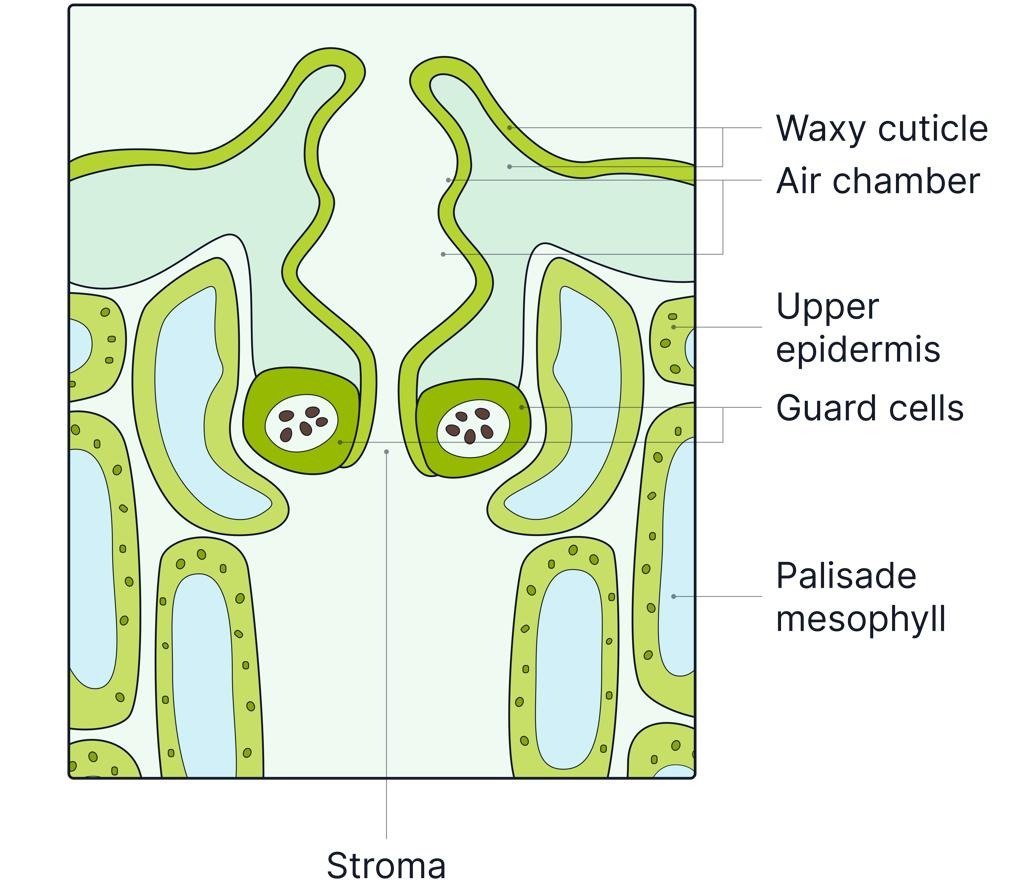
A cross-sectional illustration of sunken stomata, which sit below the surrounding leaf surface.
Why Do Some Plants Have Sunken Stomata?
Plants growing in deserts or other dry environments face a major challenge: they need carbon dioxide for photosynthesis but cannot afford to lose too much water.
A depression around the stoma can slow air movement and help retain moist air near the pore. This reduces the rate at which water vapor escapes under some conditions.
Sunken stomata may be found in certain conifers and xerophytic plants. Some species also have stomatal crypts, which are larger recessed spaces that can contain hairs and trap humid air.
However, sunken stomata do not eliminate transpiration. Their effectiveness depends on factors such as humidity, wind, temperature, and the plant’s overall leaf structure.
Example: A plant growing in a dry, windy habitat may benefit from recessed stomata because the surrounding depression can reduce exposure to moving air. Combined with other water-saving features, this adaptation can improve survival when water is scarce.
Stomata Diagram: How to Identify the Main Parts
A stomata diagram usually shows a pore surrounded by guard cells, with ordinary epidermal cells around the outside. Some diagrams also include a cross-section of the leaf to show how the pore connects with internal air spaces.
When studying a diagram, look for these structures:
- Stomatal pore: The opening between the guard cells.
- Guard cells: The specialized cells that change shape to regulate the opening.
- Epidermal cells: Cells forming the leaf’s outer protective layer.
- Substomatal cavity: An internal air space beneath the pore that supports gas movement.
- Mesophyll: Internal leaf tissue containing cells involved in photosynthesis.
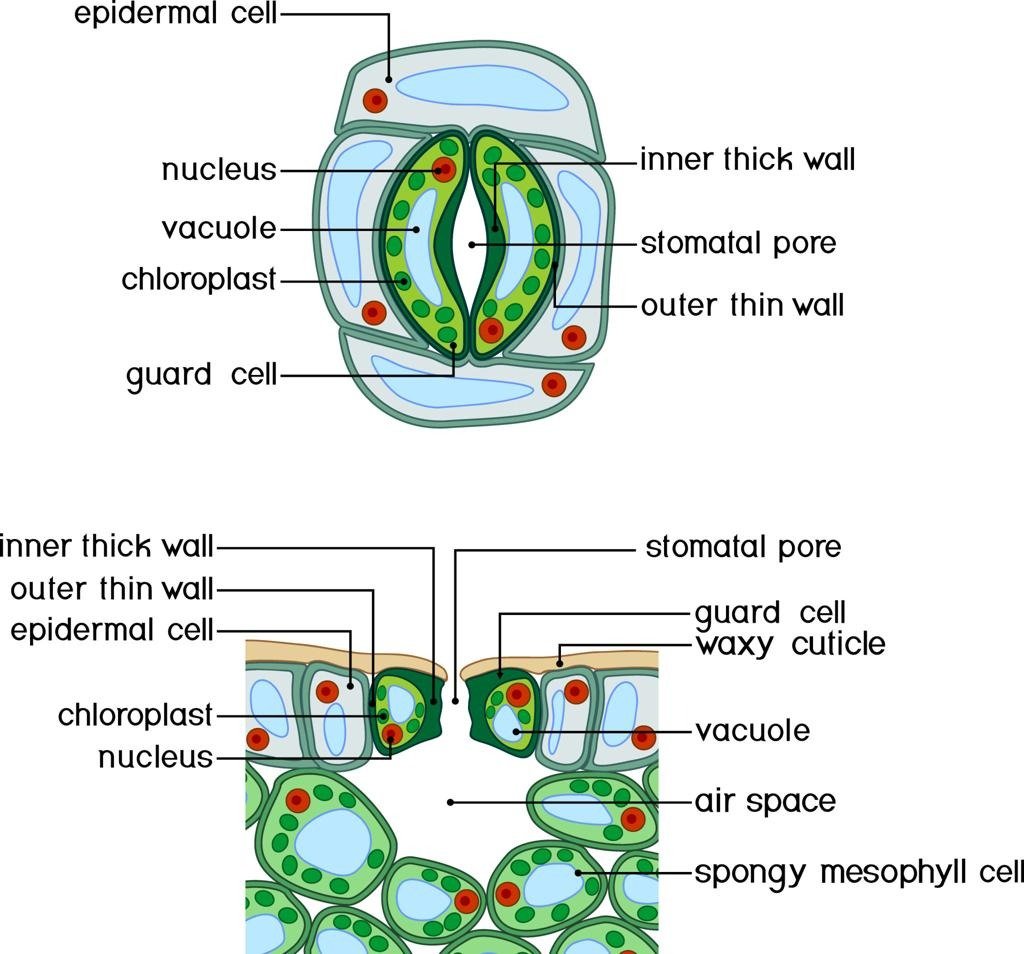
When reading a diagram, distinguish the pore from the guard cells and the air spaces below the epidermis.
Stomata vs. Palisade Mesophyll
The palisade mesophyll is a layer of elongated cells inside many leaves, usually beneath the upper epidermis. These cells contain numerous chloroplasts and carry out much of the leaf’s photosynthesis.
Stomata and palisade mesophyll work together, but they are not the same structure.
| Feature | Stomata | Palisade mesophyll |
| Location | Leaf epidermis | Inside the leaf, usually near the upper surface |
| Structure | Pores surrounded by guard cells | Elongated photosynthetic cells |
| Main role | Regulates gas exchange and water-vapor loss | Captures light and performs photosynthesis |
| Relationship | Allows carbon dioxide to enter the leaf | Uses carbon dioxide during photosynthesis |
Carbon dioxide enters through stomata and moves through internal air spaces before reaching photosynthetic cells. The palisade mesophyll then uses that carbon dioxide, along with water and light energy, to help produce sugars.
This relationship explains why both structures matter: stomata control access to gases, while palisade mesophyll uses those gases during photosynthesis.
What Does Stoma Mean in Medicine?
In medicine, a stoma is an opening on the body’s surface that allows waste to leave the body or provides a route for breathing. Surgeons may create an opening by bringing part of an internal organ to the skin or by making an opening into the airway. The exact purpose depends on the procedure.
Medical stomas can help people whose normal routes for eliminating waste or breathing no longer work as intended. Some are temporary, while others remain for life.
Although a medical stoma shares its name with a plant stoma, the two have different structures and functions. A plant stoma is a naturally occurring microscopic pore. A medical stoma is an opening created or surgically established as part of treatment.
Medical Stoma vs. Plant Stoma
The main difference between a medical stoma and a plant stoma lies in their origin and purpose. A plant develops stomata as part of its normal anatomy. A medical stoma results from a surgical procedure that creates a new route for a bodily function.
| Feature | Plant stoma | Medical stoma |
| Origin | Develops naturally as the plant grows | Created or surgically established |
| Typical location | Leaf or stem epidermis | Skin, abdomen, or neck |
| Size | Usually microscopic | Visible to the naked eye |
| Main function | Gas exchange and regulation of water loss | Waste diversion or breathing |
| Surrounding structure | Guard cells and epidermal tissue | Body tissue around the surgical opening |
| Example | A pore on the underside of a leaf | An abdominal opening following an ostomy |
The shared name makes sense because both structures function as openings. However, you should not assume they operate in the same way.
For example, a leaf stoma responds to environmental signals and changes in guard-cell pressure. A medical stoma instead relies on the anatomy and surgical arrangement of the affected organ. An intestinal stoma may connect the bowel to the abdominal surface so that waste can leave the body.
Common Types of Medical Stomas
Medical stomas serve different purposes depending on which organ or body system requires an alternative route.
Colostomy
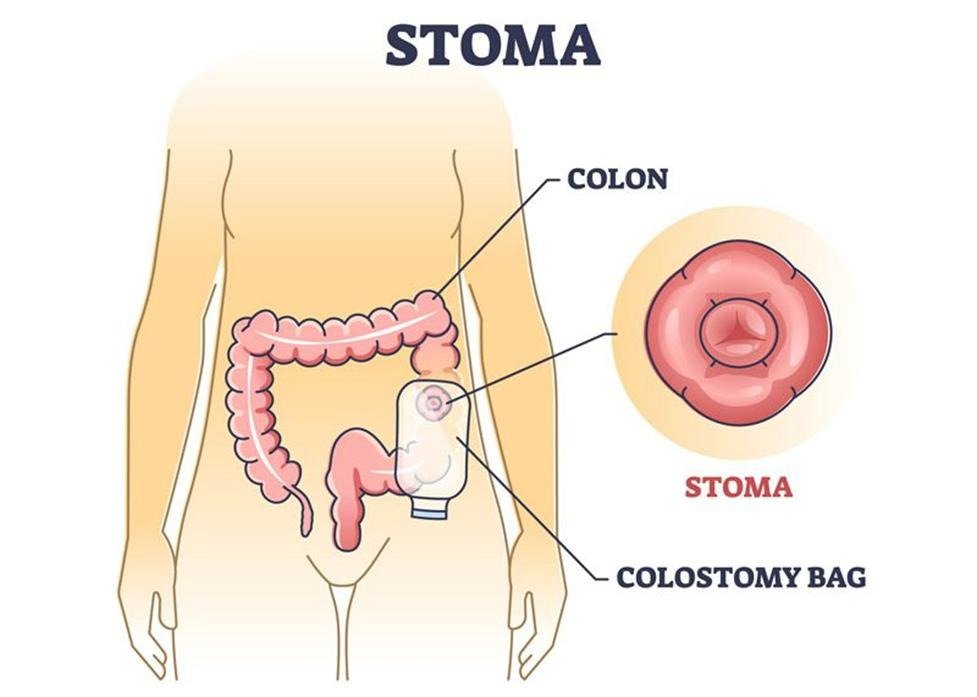
A colostomy connects part of the colon, or large intestine, to an opening in the abdominal wall. It allows stool to leave the body through the stoma, often into an ostomy pouch. Surgeons may perform the procedure when disease, injury, or another condition makes the usual route unsuitable.
Ileostomy
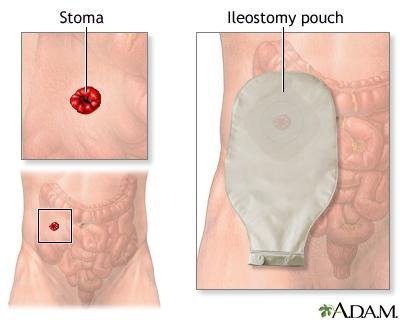
An ileostomy brings the ileum, the final section of the small intestine, to an abdominal opening. It allows intestinal contents to leave the body when the colon or rectum cannot perform its usual role. The output is often more liquid than output from a colostomy because the colon normally absorbs water.
Urostomy
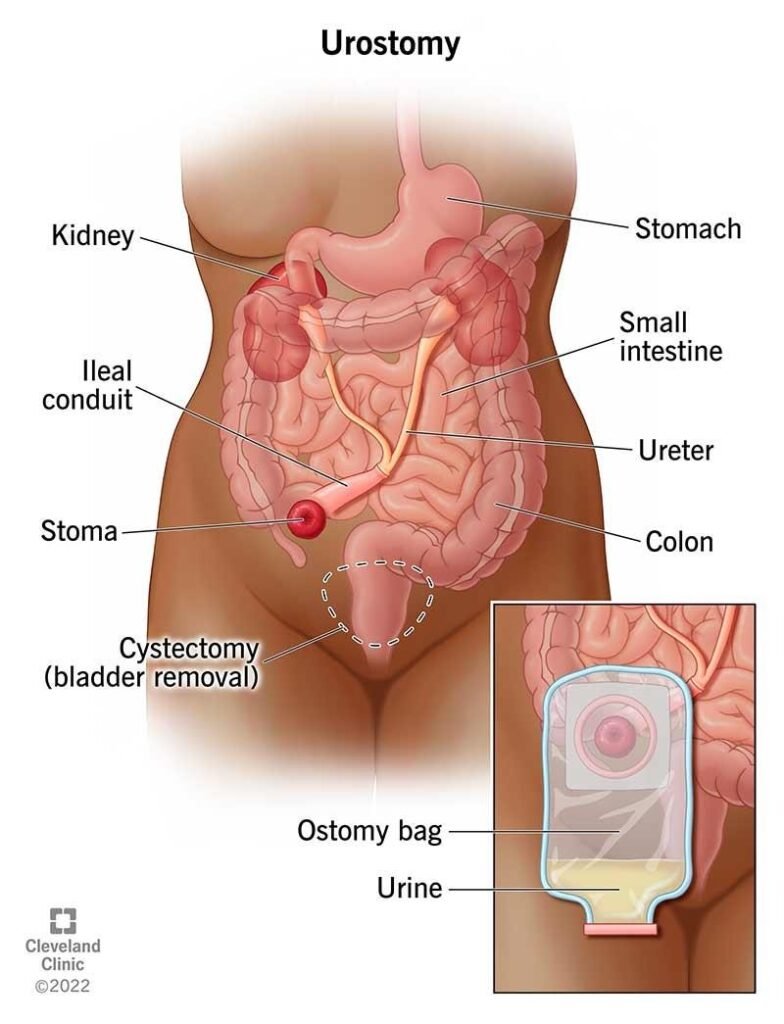
A urostomy provides a route for urine to leave the body when the usual urinary pathway is no longer suitable. Surgeons commonly use a segment of intestine to create a conduit that carries urine to an opening on the abdomen. Urine drains into an attached collection pouch.
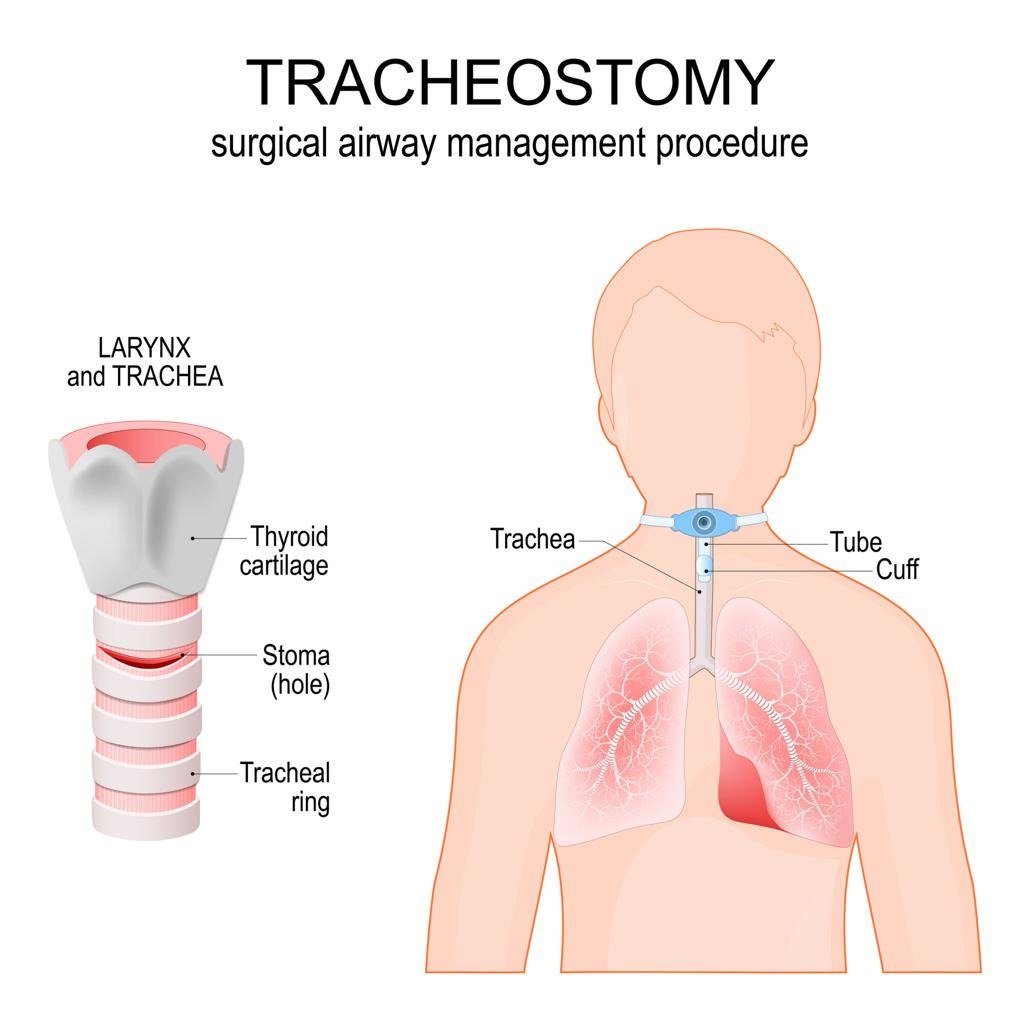
Tracheostomy
A tracheostomy is a surgical opening into the trachea, or windpipe, through the neck. Clinicians may use it to provide an airway or support breathing. A tube may sit in the opening to help air pass into the lungs.
These procedures differ in their goals, but the basic idea remains the same: the stoma provides an alternative opening for a necessary bodily function.
Is a Medical Stoma Permanent?
A medical stoma can be temporary or permanent, depending on the patient’s condition, the type of surgery, and whether surgeons can safely restore the original route.
A temporary stoma may protect a healing section of bowel or allow the body to recover after an operation. If the underlying problem improves and the anatomy allows it, surgeons may later perform a reversal procedure.
A permanent stoma may be necessary when the affected organ or pathway cannot be restored or when doing so would not be medically appropriate.
For example, someone who receives a temporary ileostomy after bowel surgery may later undergo another operation to reconnect the intestine. Another patient may need a permanent colostomy after surgery removes the rectum.
The presence of a stoma alone does not tell you whether it will be permanent. That depends on the specific medical circumstances.
Is the Plural Stomas or Stomata in Medicine?
Both stomas and stomata can appear as plural forms in medical contexts, but stomas is common in contemporary clinical English.
The distinction is largely one of convention and context:
- Stomata: The traditional scientific plural, especially familiar in botany.
- Stomas: A widely used plural in clinical discussions of surgical openings.
For example:
- Botanical usage: “The leaf contains numerous stomata.”
- Medical usage: “The surgeon examined both stomas.”
If you are writing a biology assignment about plant pores, use stomata. If you are discussing patients with surgical openings, stomas is a natural and widely understood choice.
The key is consistency. Choose the plural that fits your subject and audience rather than switching between forms without a reason.
Stoma vs Stomata vs. Stroma: Quick Comparison
Stoma refers to one opening, stomata refers to multiple openings, and stroma describes a supporting framework or internal substance in certain biological structures. Confusing these terms can lead to errors in biology assignments, lab reports, and exam answers.
| Term | Meaning | Example of use |
| Stoma | One opening or pore | A stoma regulates gas exchange in a leaf. |
| Stomata | Multiple pores; the standard botanical plural of stoma | Stomata allow carbon dioxide to enter a leaf. |
| Stomas | An alternative plural, common in medical English | The clinician examined the patient’s stomas. |
| Stroma | Supporting tissue or material within a biological structure | The chloroplast stroma contains enzymes involved in carbon fixation. |
| Guard cell | A specialized cell that controls a stoma | Guard cells open and close the stomatal pore. |
| Palisade mesophyll | Photosynthetic tissue inside many leaves | Palisade mesophyll cells absorb light for photosynthesis. |
What Is Stroma?
In biology, stroma is the supporting material or framework within a structure. Its precise meaning depends on the organ or cell being discussed.
In plant biology, the word commonly refers to the fluid-filled internal space of a chloroplast that surrounds the thylakoid membranes. The stroma contains enzymes, DNA, ribosomes, and other components. It plays an important role in the Calvin cycle, through which plants incorporate carbon dioxide into organic molecules during photosynthesis.
This is different from a stoma, which is a pore in the plant’s outer surface.
Consider this comparison:
- Stoma: Helps control the movement of gases and water vapor.
- Stroma: Provides an internal environment where particular cellular processes take place.
- Stomata: Refers to multiple stomatal pores.
Although stoma and stroma look similar, their meanings are not interchangeable. Remembering their different roles helps you avoid one of the most common terminology mistakes in plant biology.
Frequently Asked Questions About Stoma and Stomata
What is the plural of stoma?
The traditional scientific plural of stoma is stomata. This form is standard in plant biology. In medical English, stomas is also a common plural when referring to multiple surgical openings.
Can you use stomas in plant biology?
Stomas is understandable as an English plural, but stomata is the preferred standard term for plant pores in botanical writing. Use stoma for one pore and stomata for more than one, especially in schoolwork, exams, and scientific reports.
Why do stomata close at night?
Many plants close their stomata at night because light is no longer available to drive photosynthesis in the usual way, and keeping the pores open may cause unnecessary water loss. However, not all plants follow this pattern. Some plants, including many CAM plants, open their stomata at night to take in carbon dioxide while conserving water during the day.
What is the difference between a stoma and a guard cell?
A stoma is the pore, while a guard cell is a specialized cell that controls the pore’s opening and closing. Most stomata have two guard cells. These cells change their internal water pressure and shape to regulate gas exchange and water loss.
Are stoma and stomata used in medicine?
Yes. Stoma can refer to one surgically created opening, such as a colostomy opening. Stomata is the traditional scientific plural, but stomas is common in medical English when referring to multiple surgical openings.
What is the difference between stoma and stroma?
A stoma is an opening, whereas stroma is a supporting substance or framework within a biological structure. In a leaf, stomata help regulate gas exchange. Inside a chloroplast, the stroma contains the enzymes and other components needed for important stages of photosynthesis.
How do stomata help plants survive?
Stomata help plants take in carbon dioxide for photosynthesis while regulating the loss of water vapor. Their ability to open and close allows plants to respond to changes in light, temperature, humidity, and water availability. Some species also have adaptations, such as sunken stomata, that help conserve moisture.
Conclusion: Remember One Stoma, Many Stomata
The difference between Stoma vs Stomata is straightforward once you understand the grammar and context. Stoma is singular, and stomata is the traditional plural used in plant biology. In medical English, stomas is also widely used when referring to multiple surgical openings.
The surrounding scientific terms describe different structures, too. Guard cells control a plant stoma, palisade mesophyll performs much of a leaf’s photosynthesis, and stroma refers to supporting material within certain biological structures.
Use this quick memory guide whenever you study the terms:
- One stoma: One pore or opening.
- Many stomata: Multiple pores, especially in plants.
- Medical stoma: A surgically established opening.
- Stroma: Supporting material within a biological structure.