Creek vs. Creak is a common point of confusion in writing-focused learning because both are homophones with similar sound, but very different meanings, spellings, and usage. In my experience improving writing skills, this confusion often appears when learners mix creak as a verb or noun, showing harsh sound, grating sound, squeaking, or prolonged sound, sometimes even a soft moan used in a metaphorical way to show weakness, strain, or pressure on an object. This often comes from old materials, strained materials, like a swinging door, loose hinge, tired floorboard, or rocking chair, inside familiar settings, where movement creates noise.
In contrast, a creek refers to a narrow stream, small river, or minor tributary found in natural settings and rural settings within geography, where water flows along a path through wooded areas. A bubbling creek often feels peaceful, and it may connect to a river, forming part of a larger water system. This difference in distinct roles helps build clarity and depth in writing, especially when forming sentences and example sentences found in the Spellzone dictionary, where words are heard, listened to, made, and produced to strengthen understanding of language.
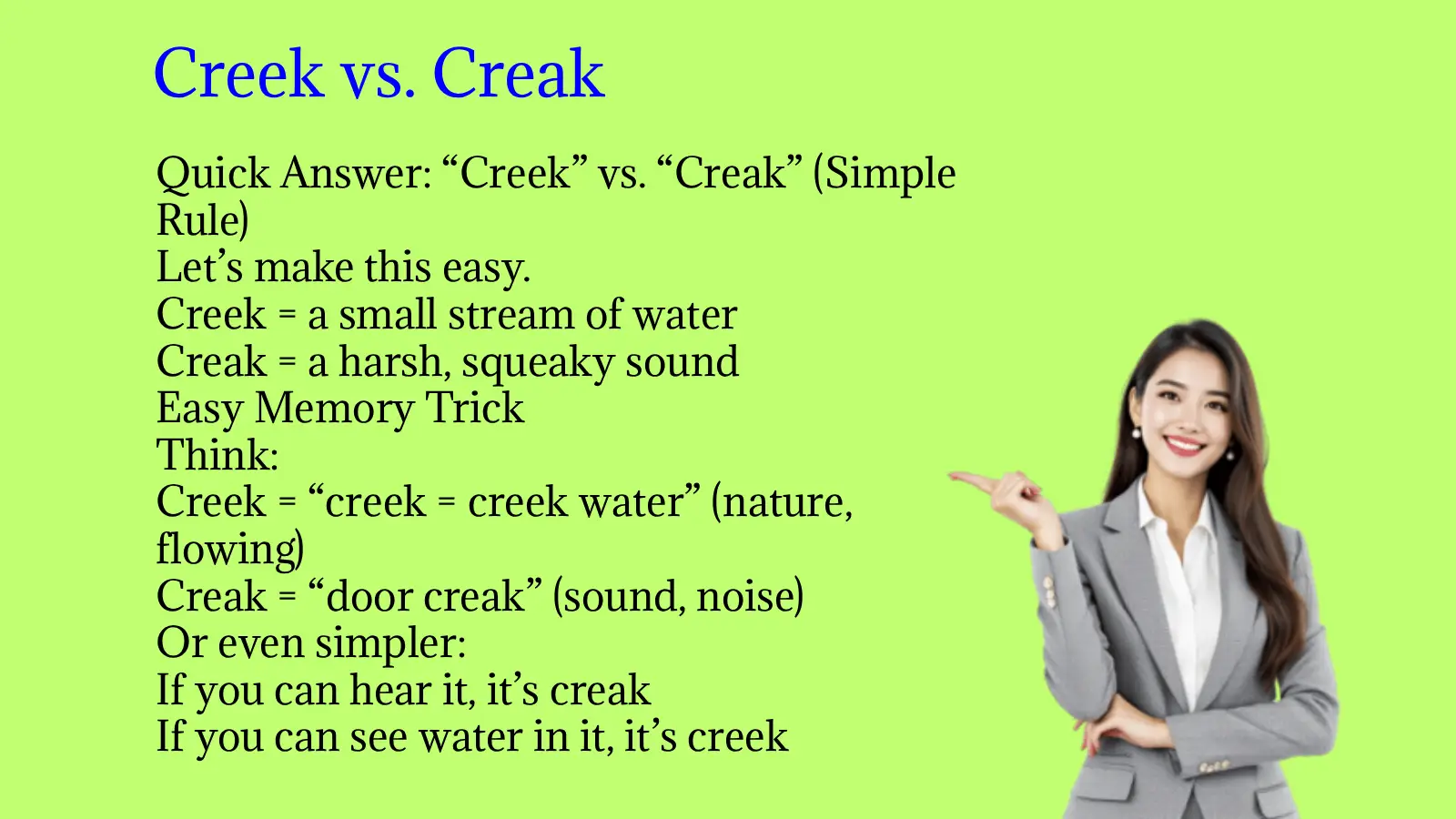
Quick Answer: “Creek” vs. “Creak” (Simple Rule)
Let’s make this easy.
- Creek = a small stream of water
- Creak = a harsh, squeaky sound
Easy Memory Trick
Think:
- Creek = “creek = creek water” (nature, flowing)
- Creak = “door creak” (sound, noise)
Or even simpler:
- If you can hear it, it’s creak
- If you can see water in it, it’s creek
How People Actually Confuse “Creek” and “Creak”
This confusion usually happens because:
- They sound slightly similar when spoken quickly
- Both are short, simple English words
- Non-native speakers rely on spelling memory instead of meaning
In Real Life
People mix them up in:
- Writing captions
- School essays
- Casual texting
- Story writing
And sometimes it creates hilarious misunderstandings.
Example:
“The old door made a loud creek”
Now it sounds like the door turned into a river.
The Meaning Behind “Creek” (Simple Explanation)
A creek is a small natural stream of water.
Standard Meaning
- Smaller than a river
- Found in forests, valleys, countryside
- Often flows gently
Real-Life Examples
- “We crossed the creek behind the house.”
- “Fish were swimming in the creek.”
- “The children played near the creek.”
Visual Idea
Think of:
- Calm water
- Stones
- Small flowing stream
Key Insight
If it involves water + nature, it’s almost always “creek.”
The Meaning Behind “Creak” (Simple Explanation)
A creak is a sharp, high-pitched sound, usually caused by something old or under pressure.
Standard Meaning
- A slow, squeaky sound
- Often from wood, doors, stairs, or hinges
Real-Life Examples
- “The door creaked open.”
- “The old floorboards creaked under my feet.”
- “The chair creaked when he sat down.”
Visual Idea
Think of:
- Haunted house
- Old wooden stairs
- Rusty door hinge
Key Insight
If it’s a sound you can hear, it’s “creak.”
Side-by-Side Comparison Table
| Word | Meaning | Category | Example |
|---|---|---|---|
| Creek | Small stream of water | Nature | A creek runs behind the village |
| Creak | Squeaky, sharp sound | Sound | The door creaks at night |
Why This Confusion Happens So Often
This mix-up is super common because:
- The words differ by only one letter
- They are pronounced similarly in fast speech
- English doesn’t visually group them clearly
- Context is often ignored in writing
Real Mistake Example
“I heard a creek in the hallway”
Now it sounds like a river is flowing inside the house instead of a door making noise.
Real-Life Examples of “Creek”
Let’s make it clear with real usage:
- “We sat by the creek and had lunch.”
- “The creek flooded after heavy rain.”
- “A small bridge crosses the creek.”
Meaning Check
Every sentence involves:
✔ Water
✔ Nature
✔ Flow
Real-Life Examples of “Creak”
Now compare:
- “The stairs creak every time I step on them.”
- “The old bed creaked loudly.”
- “He creaked the door open slowly.”
Meaning Check
Every sentence involves:
✔ Sound
✔ Movement
✔ Pressure on objects
The Biggest Mistake People Make
Here’s the real problem:
People memorize spelling instead of meaning.
What Goes Wrong
- They see “creek” and “creak” as similar
- They forget context matters
- They guess based on sound only
Result
Wrong usage in writing and speaking.
Quick Memory Trick That Actually Works
Use this:
“EA = sound, EE = water”
- Creak → EA → sound (door squeak, speak, break vibe)
- Creek → EE → water (green, stream, clean vibe)
Not perfect grammar logic—but it works in real recall situations.
How to Never Confuse Them Again
Follow these simple rules:
Step 1: Ask
- Is it water? → Creek
- Is it noise? → Creak
Visualize
- Creek = river scene
- Creak = old door scene
Double-check in writing
If unsure, replace it:
- “small stream” → creek
- “squeaky sound” → creak
Quick Decision Guide
When stuck:
- Water in nature → Creek
- Old sound/noise → Creak
- Still unsure → describe it instead
Simple. Clean. Reliable.
FAQ: “Creek” vs. “Creak”
Are “creek” and “creak” pronounced the same?
Not exactly. “Creek” sounds like “kreek”, while “creak” sounds like “kreek/kree-ak” depending on accent, but they are very close.
Can “creek” ever mean sound?
No. It only refers to water.
Can “creak” refer to water?
No. It only refers to sound.
Why do people confuse them?
Because they look similar and sound similar, especially in fast speech.
Key Facts You Should Remember
- Creek = water stream in nature
- Creak = sound of something old or stiff
- One letter changes meaning completely
- Context always decides the word
Final Takeaway: The One Rule That Never Fails
Here’s the simplest way to lock it in:
If it flows → Creek
If it squeaks → Creak
And if you’re ever unsure, don’t guess. Just describe it clearly instead of risking confusion.
Because in English, small spelling differences can create completely different worlds—a peaceful stream or a haunted house sound.