Ever wondered whether Criticise vs. Criticize is a spelling mistake or if both versions are actually correct? You’re not alone. This pair of words often causes confusion among writers, students, and professionals because both appear frequently in English grammar, academic writing, and everyday communication.
The problem is that choosing the wrong spelling for your audience can make your writing seem inconsistent. And here’s the kicker: both words mean the same thing—to express disapproval, offer constructive criticism, or provide an evaluation—but their usage depends on whether you’re following British English or American English conventions.
The good news? The difference is surprisingly simple.
In this guide, you’ll learn the distinction between Criticise vs. Criticize, when each spelling should be used, and how spelling differences, language variations, and regional writing standards affect your choice. You’ll also see clear examples to help you avoid common mistakes in professional writing, essays, emails, and online content.
So, if you’ve ever questioned which spelling is correct, keep reading—we’ll clear up the confusion once and for all.
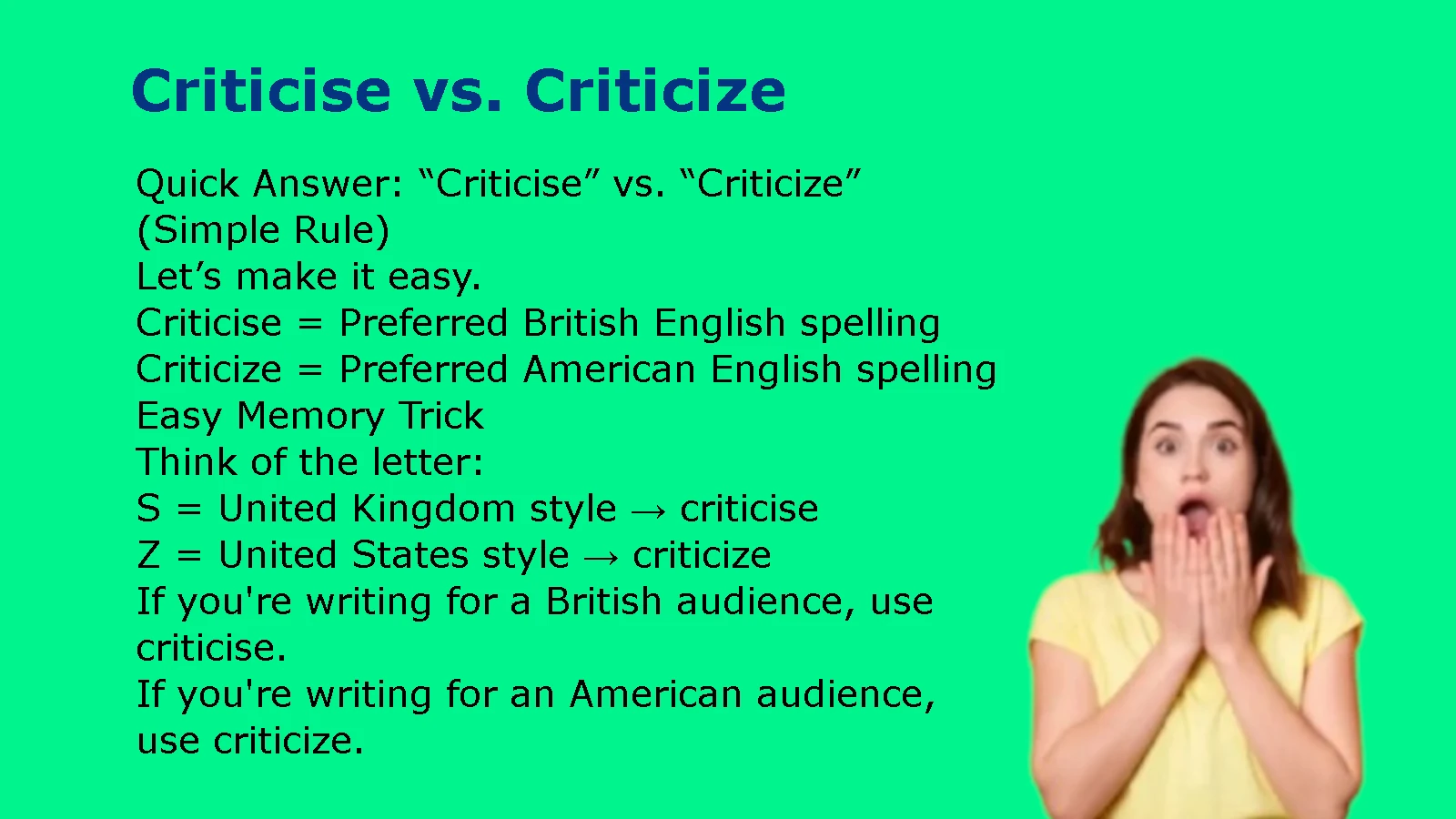
Quick Answer: “Criticise” vs. “Criticize” (Simple Rule)
Let’s make it easy.
Criticise = Preferred British English spelling
Criticize = Preferred American English spelling
Easy Memory Trick
Think of the letter:
- S = United Kingdom style → criticise
- Z = United States style → criticize
If you’re writing for a British audience, use criticise.
If you’re writing for an American audience, use criticize.
How People Actually Use “Criticise” and “Criticize”
Here’s where many writers get confused.
Some people assume one spelling is correct and the other is wrong. That’s not true.
In Everyday Writing
British writers often use criticise
American writers almost always use criticize
Most readers understand both spellings
In Professional Settings
Companies usually follow a style guide
Consistency matters more than which spelling you choose
Mixing both spellings in one document looks unprofessional
Why This Happens
English has multiple standard varieties
Different countries adopted different spelling conventions
Both forms developed from the same word
The Language Logic Behind “Criticise” vs. “Criticize”
To understand the difference, it helps to look at the bigger pattern.
Similar Words Follow the Same Rule
| British English | American English |
|---|---|
| Criticise | Criticize |
| Organise | Organize |
| Realise | Realize |
| Recognise | Recognize |
Key Insight
The meaning never changes.
Only the spelling changes.
Whether you write criticise or criticize, readers understand exactly the same thing.
“Criticise” Explained Clearly
In British English, criticise is the most common spelling.
Meaning
To express disapproval of something or point out faults.
Examples
- The teacher criticised the student’s work.
- Many voters criticised the policy.
- She criticised the company’s decision.
Common Uses
Academic writing in the UK
British newspapers
UK business communication
General British English
Key Takeaway
If your audience primarily uses British English, criticise is usually the safest choice.
“Criticize” Explained Clearly
In American English, criticize is the standard spelling.
Meaning
Exactly the same as criticise.
Examples
- The coach criticized the team’s performance.
- Reviewers criticized the film.
- He criticized the proposal during the meeting.
Common Uses
American schools and universities
US media outlets
Business communication in the United States
General American English
Key Takeaway
If you’re writing for an American audience, criticize is the expected spelling.
The Biggest Mistake People Make
The most common mistake isn’t choosing the wrong spelling.
It’s mixing both spellings in the same piece of writing.
What Goes Wrong
A report starts with criticise
Later it switches to criticize
Readers notice the inconsistency
The writing appears less polished
Example
❌ The article criticised the policy. Later, several experts criticized the decision.
✅ The article criticised the policy. Later, several experts criticised the decision.
✅ The article criticized the policy. Later, several experts criticized the decision.
Lesson
Choose one style and stick with it.
Side-by-Side Comparison Table
| Feature | Criticise | Criticize |
|---|---|---|
| Meaning | Express disapproval | Express disapproval |
| British English | Preferred | Accepted but less common |
| American English | Rare | Preferred |
| Pronunciation | Same | Same |
| Formal Writing | Yes | Yes |
Real-Life Examples of “Criticise”
Let’s see how it appears in everyday British English.
Common Situations
- Journalists criticised the government.
- Customers criticised the service.
- Experts criticised the report.
- Parents criticised the decision.
Mini Scenario
A newspaper in London reports:
“The opposition criticised the new proposal.”
British readers see this spelling as completely normal.
Real-Life Examples of “Criticize”
Now compare the American version.
Common Situations
- Analysts criticized the strategy.
- Fans criticized the referee.
- Investors criticized the management team.
- Reviewers criticized the product.
Mini Scenario
A newspaper in New York reports:
“Several economists criticized the policy.”
American readers expect this spelling.
Regional Differences You Should Know
English spelling varies around the world.
In the United States
Criticize is the standard spelling.
Most schools, publishers, and businesses use it.
In the United Kingdom
Criticise is more common.
Many British publications prefer the -ise ending.
In Other English-Speaking Countries
Usage may vary.
Countries such as Australia, New Zealand, and South Africa often lean toward British spelling conventions, though style guides differ.
Key Tip
Always consider your audience before choosing a spelling.
How to Avoid Confusion Every Time
Want an easy system?
Know Your Audience
American audience → criticize
British audience → criticise
Follow a Style Guide
Many organizations specify which spelling to use.
Stay Consistent
Never switch styles halfway through a document.
Use Spell Check Carefully
Your device may be set to a different variety of English.
What to Use in Academic and Professional Writing
If you’re writing for school, work, or publication, consistency is essential.
Best Practice
Use the spelling required by:
- Your university
- Your employer
- Your publisher
- Your client
Example
An American university paper should generally use criticize.
A British academic journal may prefer criticise.
Quick Tip
When in doubt, check the organization’s style guide.
Quick Decision Guide (Use This Instantly)
When choosing between the two spellings:
Writing in American English → criticize
Writing in British English → criticise
Mixed audience → Choose one style and remain consistent
Still unsure → Follow your organization’s style guide
Simple. Reliable. Done.
FAQ: “Criticise” vs. “Criticize”
Is “criticise” correct?
Yes. It is a standard British English spelling.
Is “criticize” correct?
Yes. It is the standard American English spelling.
Do they have different meanings?
No. They mean exactly the same thing.
Which spelling is more common worldwide?
Both are widely accepted, but usage depends heavily on region and publication style.
Can I use either spelling?
Yes, as long as you remain consistent throughout your writing.
Case Study: A Student’s Spelling Mistake
A university student wrote an essay using British spelling.
At the beginning, they used:
“Many scholars criticised the theory.”
Later, they wrote:
“Several researchers criticized the approach.”
What Happened
The professor noticed inconsistent spelling
The essay appeared less polished
The student lost marks for presentation
Fix
The student revised the document and used one spelling style throughout.
Problem solved.
Key Facts You Should Remember
- Criticise and criticize have the same meaning.
- The difference is spelling, not grammar.
- Criticise is preferred in British English.
- Criticize is preferred in American English.
- Both are correct.
- Consistency matters more than the spelling you choose.
- Always consider your audience.
Final Takeaway: The One Rule That Never Fails
Here’s the truth.
The debate over “criticise” vs. “criticize” isn’t really about right and wrong. Both spellings are accepted and understood by English speakers around the world.
The real goal is consistency.
If you’re writing in British English, use criticise.
If you’re writing in American English, use criticize.
And if you’re working on something important—an essay, report, article, or business document—stick with one style from beginning to end.
Think of it like choosing between miles and kilometers. Both measure the same thing, but mixing them creates confusion.
The same principle applies here.
When it comes to “criticise” vs. “criticize,” consistency is what makes your writing look professional.