Ever found yourself wondering whether Weaved vs Woven is the correct word to use? You’re not alone. This common grammar question confuses many writers because both words appear in books, articles, and everyday conversations—but they aren’t always interchangeable.
Weaved and woven are both forms of the verb weave, but they are used in different situations. Weaved is commonly used as the past tense when describing movement, such as moving through traffic or crowds. Woven is the standard past participle and is usually used when referring to fabric, baskets, or anything made by weaving.
Examples:
- The driver weaved through heavy traffic.
- The blanket was woven from soft wool.
The confusion often starts when people search for weaved meaning, woven meaning, weaved pronunciation, or woven pronunciation, trying to figure out which form sounds natural and which one is grammatically correct. And here’s the kicker: choosing the wrong word can make your writing sound awkward or even incorrect, especially in academic, professional, or creative contexts.
In this guide, you’ll learn the difference between Weaved vs Woven, discover the correct usage, understand when to use weaved, when to use woven, and see plenty of weaved vs woven examples in real sentences. You’ll also learn how to use woven correctly, whether weaved is a word, and simple memory tips to help you choose the right form every time.
Quick Answer: Weaved or Woven?
If you’re looking for the fastest answer, here it is.
Use woven in almost every situation. It is the standard past participle of weave and the form you’ll find in books, newspapers, academic writing, and professional communication.
Weaved isn’t wrong. Dictionaries recognize it, but it appears much less often and usually describes movement rather than the creation of fabric or similar objects.
Weaved vs Woven Comparison
| Feature | Weaved | Woven |
| Recognized English word | ✅ Yes | ✅ Yes |
| Standard past participle | ❌ No | ✅ Yes |
| Preferred in formal writing | ❌ Rarely | ✅ Yes |
| Common in everyday English | Less common | Very common |
| Used with “has,” “have,” or “had” | ❌ Usually no | ✅ Yes |
| Common with fabric or textiles | ❌ No | ✅ Yes |
| Common with figurative expressions | Rare | ✅ Very common |
Quick Rule to Remember
Think of it this way:
- Weave → Wove → Woven
- Woven belongs after has, have, or had.
- Weaved may appear when describing someone moving back and forth, although many writers still prefer wove depending on the sentence.
Examples
| Sentence | Correct? |
| She has woven a scarf. | ✅ |
| They have woven baskets for years. | ✅ |
| The artist wove the basket yesterday. | ✅ |
| The car weaved through traffic. | ✅ Acceptable |
| She has weaved a blanket. | ❌ |
Bottom line: If you’re ever unsure, choose woven. It’s the safer and more widely accepted option.
What Does “Woven” Mean?
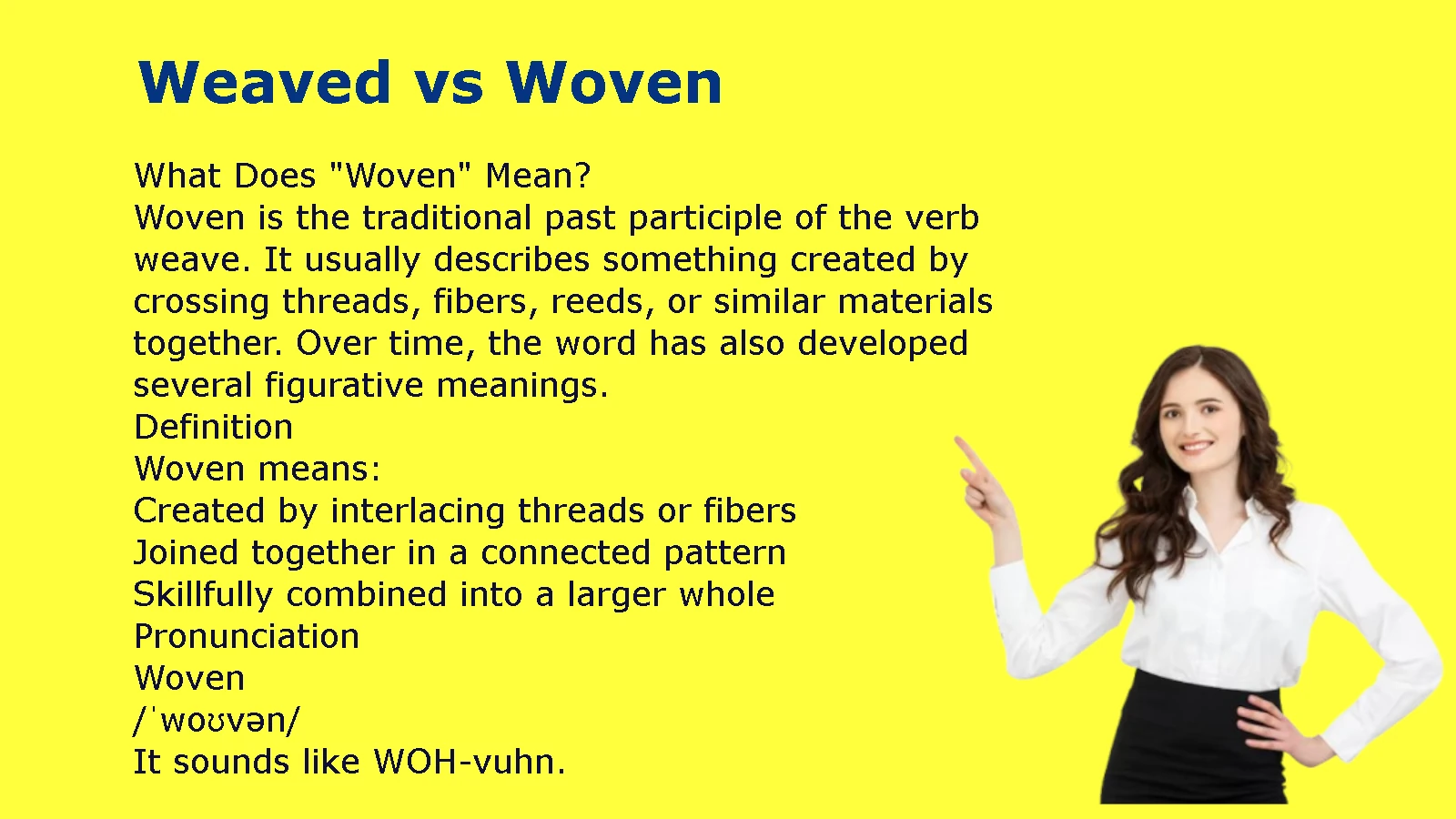
Woven is the traditional past participle of the verb weave. It usually describes something created by crossing threads, fibers, reeds, or similar materials together. Over time, the word has also developed several figurative meanings.
Definition
Woven means:
- Created by interlacing threads or fibers
- Joined together in a connected pattern
- Skillfully combined into a larger whole
Pronunciation
Woven
/ˈwoʊvən/
It sounds like WOH-vuhn.
Why Is “Woven” the Standard Form?
English contains many irregular verbs whose past participles don’t simply end in -ed.
Here are a few familiar examples:
| Base Verb | Past Tense | Past Participle |
| Write | Wrote | Written |
| Break | Broke | Broken |
| Speak | Spoke | Spoken |
| Freeze | Froze | Frozen |
| Weave | Wove | Woven |
Notice the pattern.
Instead of adding -ed, these verbs change internally. That’s why woven feels natural to most English speakers.
Literal Meaning of Woven
The most common meaning relates to textiles.
Examples include:
- woven fabric
- woven basket
- woven rug
- woven blanket
- woven mat
Imagine making a basket from thin strips of wood. Instead of laying each strip separately, you cross them over and under each other until they form a strong structure. That finished basket is woven.
Example Sentences
- My grandmother has woven dozens of baskets by hand.
- The village is famous for its woven rugs.
- They have woven silk into beautiful clothing.
- The artist carefully woven? No. The artist has woven colorful patterns into the design.
Figurative Meaning of Woven
English often uses woven as a metaphor.
Instead of threads, ideas or emotions become interconnected.
Examples include:
- Trust is woven into every strong relationship.
- Music is woven throughout the film.
- Family traditions are woven into their culture.
- Humor is woven naturally into the story.
- Ancient myths are woven into the novel’s plot.
These expressions sound natural because woven suggests that different parts fit together smoothly.
Common Expressions with Woven
You’ll encounter woven in many everyday phrases.
Examples include:
- woven together
- closely woven
- finely woven fabric
- woven into history
- woven throughout the story
- tightly woven community
- expertly woven design
These phrases appear in books, journalism, education, marketing, and casual conversation.
Why Writers Prefer Woven
Editors usually recommend woven because it matches standard English grammar.
You’ll regularly see it in:
- Newspapers
- Novels
- Academic journals
- Government publications
- Business documents
- Product descriptions
- Fashion magazines
Because it’s the conventional choice, readers immediately recognize it as correct.
What Does “Weaved” Mean?
Unlike woven, weaved usually attracts attention because many people assume it’s incorrect. Surprisingly, that’s not entirely true.
Weaved is a legitimate English word. The key difference is that it appears much less often and serves a narrower purpose.
Definition
Weaved is a past tense or past participle form that some speakers use, especially when describing repeated side-to-side movement.
For example:
- The motorcycle weaved through traffic.
- Smoke weaved between the trees.
- The boxer weaved to avoid punches.
Here, the emphasis isn’t on creating fabric. Instead, it focuses on moving back and forth in a winding path.
Why Does Weaved Exist?
English changes constantly.
Some irregular verbs gradually become regular by adding -ed.
Examples include:
- Dream → dreamed (alongside dreamt)
- Learn → learned (alongside learnt)
- Spoil → spoiled (alongside spoilt)
Similarly, some speakers naturally form weaved instead of wove because it follows the regular -ed pattern.
Although this happens in everyday speech, major style guides still recommend wove and woven for standard writing.
Where You’ll Most Often See Weaved
The word commonly appears in descriptions involving movement.
Examples:
- The skier weaved around the trees.
- The child weaved through the crowd.
- The river weaved across the valley.
- The rabbit weaved between bushes.
These sentences describe a zigzag or winding path rather than the act of making cloth.
Can Weaved Describe Fabric?
Technically, some people use it this way.
For example:
- She weaved a basket.
However, this construction sounds unusual to most native speakers.
Editors almost always prefer:
- She wove a basket.
- She has woven a basket.
Those versions match standard grammar and appear far more frequently in published writing.
Why Many People Think Weaved Is Wrong
The confusion comes from expectation.
Most irregular verbs don’t follow the simple -ed pattern.
Consider these examples:
| Incorrect | Correct |
| writed | wrote |
| breaked | broke |
| speaked | spoke |
| freezed | froze |
| weaved (for fabric, in many contexts) | wove / woven |
Because readers expect wove and woven, weaved often sounds unfamiliar when discussing textiles.
Everyday Examples of Weaved
Here are sentences where weaved sounds natural to many speakers.
- The cyclist weaved through rush-hour traffic.
- The fox weaved between the trees.
- The runner weaved around defenders.
- The canoe weaved through narrow channels.
- The dancer weaved gracefully across the stage.
Notice that every example describes movement rather than making something from threads.
Is “Weaved” Actually a Word?
Yes. Weaved is a real word, and reputable dictionaries include it. That surprises many people because teachers and editors often emphasize wove and woven as the preferred forms.
The important point is this:
Being listed in a dictionary doesn’t always mean a word is the best choice in every context.
Many English words have accepted variants, regional preferences, or specialized uses. Weaved falls into that category.
Dictionary Recognition vs. Preferred Usage
A dictionary records how people use language. It doesn’t always recommend one form over another.
That’s why you’ll often find notes explaining that:
- Woven is the standard past participle.
- Wove is the traditional simple past tense.
- Weaved appears in some contexts, particularly when describing movement or as a less common variant.
Professional editors, teachers, and publishers generally choose wove and woven because readers expect those forms and they align with standard written English.
Why Dictionaries Include Weaved
Language evolves through everyday use. When enough speakers consistently use a form, dictionaries document it—even if it’s less common than the traditional version.
This doesn’t mean both forms carry equal weight in every situation. In practice, woven remains the preferred choice for writing about fabric, baskets, textiles, and figurative expressions, while weaved appears more often in descriptions of movement.
Why Is “Woven” More Common Than “Weaved”?
Although weaved is a real word, woven dominates modern English. You’ll find it in books, newspapers, magazines, academic papers, and professional documents. That isn’t an accident. It reflects centuries of language development and established grammar.
In most situations, native speakers instinctively choose woven because it’s the traditional past participle of weave. It sounds familiar, reads naturally, and matches what readers expect.
A Look at the History
The verb weave comes from Old English, where it followed an irregular pattern. Over time, English preserved many irregular verbs even as the language evolved.
Here are a few examples that have survived for hundreds of years:
| Base Verb | Past Tense | Past Participle |
| Drive | Drove | Driven |
| Fly | Flew | Flown |
| Grow | Grew | Grown |
| Weave | Wove | Woven |
Because English speakers have used woven for generations, it became the accepted standard.
Why Some People Say “Weaved”
Language naturally changes over time. Many speakers prefer regular verb patterns because they’re easier to remember.
For example:
- Walk → Walked
- Paint → Painted
- Wash → Washed
Following that pattern, some people naturally form weaved instead of wove. While this makes sense logically, standard English still favors wove and woven.
Where You’ll See Woven Most Often
You’ll encounter woven across many industries and types of writing.
Examples include:
- Fashion
- Interior design
- Home décor
- Manufacturing
- History
- Literature
- Journalism
- Academic research
Examples:
- A woven wool blanket
- Hand-woven baskets
- A tightly woven plot
- Woven carbon fiber
- Woven textiles
Notice how naturally these phrases sound.
Why Editors Prefer Woven
Professional editors value consistency and clarity.
Using woven offers several advantages:
- It follows standard grammar.
- It matches major dictionaries and style guides.
- Readers recognize it immediately.
- It avoids distracting your audience.
- It creates a polished, professional tone.
Unless you’re intentionally describing movement with weaved, woven is almost always the better choice.
Weaved vs Woven: Side-by-Side Comparison
Sometimes the easiest way to understand grammar is through comparison.
The table below highlights the biggest differences between weaved and woven.
| Feature | Weaved | Woven |
| English word | ✅ Yes | ✅ Yes |
| Standard past participle | ❌ No | ✅ Yes |
| Common in published writing | Rare | Very common |
| Preferred by editors | Rarely | Yes |
| Common with textiles | No | Yes |
| Common with figurative language | Rare | Yes |
| Sounds natural to most native speakers | Sometimes | Yes |
| Best for formal writing | No | Yes |
Quick Summary
If your sentence talks about creating fabric, baskets, rugs, or anything made by interlacing materials, choose woven.
If your sentence describes someone moving in a zigzag pattern, weaved may be acceptable. Even then, many writers still prefer wove.
When Should You Use “Woven”?
For most writers, this question has a simple answer.
Whenever you’re describing something created by weaving or using the past participle after has, have, or had, choose woven.
It works in both literal and figurative writing.
Use Woven for Textiles and Fabrics
This is the most common use.
Examples include:
- woven cotton
- woven silk
- woven blanket
- woven carpet
- woven basket
- woven rope
Example Sentences
- The blanket was woven from organic cotton.
- Local artisans have woven baskets for generations.
- This rug was carefully woven by hand.
- The scarf has been woven using traditional techniques.
These sentences sound natural because woven refers to completed craftsmanship.
Use Woven with Perfect Tenses
Whenever your sentence includes has, have, or had, the past participle should almost always be woven.
Examples:
- She has woven several beautiful blankets.
- They have woven baskets for years.
- The artist had woven the design before sunrise.
- We have woven different colors into the pattern.
Incorrect examples:
- ❌ She has weaved a blanket.
- ❌ They have weaved rugs.
Correct versions:
- ✅ She has woven a blanket.
- ✅ They have woven rugs.
Use Woven in Figurative Writing
English often borrows weaving as a metaphor.
Instead of discussing cloth, writers describe ideas becoming connected.
Examples:
- Hope is woven into the story.
- Music is woven throughout the film.
- Family traditions are woven into their culture.
- Humor is woven into every chapter.
- Friendship is woven through the novel.
These expressions appear regularly in literature, speeches, advertising, and journalism.
Common Expressions Using Woven
Here are phrases you’ll often encounter.
| Expression | Meaning |
| Woven together | Closely connected |
| Woven into history | Deeply embedded |
| Finely woven fabric | High-quality cloth |
| Tightly woven community | Strong social bonds |
| Expertly woven narrative | Well-connected story |
| Woven throughout | Present everywhere |
Learning these expressions helps your writing sound more natural.
When Can You Use “Weaved”?
Although woven is the safer choice, weaved isn’t always incorrect.
You’ll usually see it when the emphasis is on movement rather than creating something.
Think about a winding path instead of fabric.
Movement Through Obstacles
Examples:
- The driver weaved through heavy traffic.
- The rabbit weaved between bushes.
- The skier weaved around the gates.
- The boxer weaved to avoid punches.
- The child weaved through the crowd.
In these examples, the subject moves from side to side.
Describing Zigzag Motion
Many speakers naturally use weaved when describing repeated directional changes.
Examples:
- Smoke weaved through the trees.
- The river weaved across the valley.
- The cyclist weaved around parked cars.
- The snake weaved across the trail.
Although these sentences are acceptable, you’ll also find writers using wove in similar contexts.
Why Some Style Guides Still Prefer Wove
Many grammar experts continue to recommend wove as the simple past tense regardless of meaning.
Examples:
Preferred:
- The driver wove through traffic.
- The river wove across the valley.
Less common:
- The driver weaved through traffic.
Both forms appear in modern English, but wove remains the traditional choice.
Grammar Rule: Past Tense and Past Participle of “Weave”
Understanding verb forms removes most of the confusion.
Here’s the complete conjugation.
| Verb Form | Correct Form |
| Base Verb | Weave |
| Third-Person Singular | Weaves |
| Present Participle | Weaving |
| Simple Past | Wove (standard), Weaved (less common in movement contexts) |
| Past Participle | Woven |
Understanding Each Verb Form
Base Verb
Use the base form for the present tense or after modal verbs.
Examples:
- I weave baskets every weekend.
- They can weave quickly.
Present Participle
Use weaving for continuous tenses.
Examples:
- She is weaving a blanket.
- They were weaving baskets all afternoon.
Simple Past
Use wove when describing a completed action.
Examples:
- She wove a beautiful rug.
- The artisan wove the basket yesterday.
Past Participle
Use woven after helping verbs.
Examples:
- The blanket has been woven by hand.
- The story is woven with symbolism.
- They have woven dozens of rugs.
Common Mistakes People Make
Even experienced writers occasionally confuse these verb forms.
Here are the most common mistakes and their corrections.
Mistake: Using “Weaved” After Has, Have, or Had
Incorrect:
- She has weaved a sweater.
- They have weaved baskets.
Correct:
- She has woven a sweater.
- They have woven baskets.
Why?
After has, have, or had, English requires the past participle. For weave, that’s woven.
Mistake: Confusing Wove and Woven
Many learners use these forms interchangeably.
They aren’t the same.
| Word | Use |
| Wove | Simple past |
| Woven | Past participle |
Examples:
- Yesterday she wove a basket.
- She has woven many baskets.
The helping verb makes all the difference.
Mistake: Using Woven Without a Helping Verb
Incorrect:
- Yesterday she woven a scarf.
Correct:
- Yesterday she wove a scarf.
Correct:
- She has woven a scarf.
Remember this simple pattern:
- Yesterday → Wove
- Has/Have/Had → Woven
Mistake: Assuming Weaved Is Always Wrong
This misconception is surprisingly common.
While weaved isn’t the preferred choice in most writing, dictionaries recognize it. You’ll often see it in descriptions of movement, especially in informal speech or creative writing.
Still, if you’re writing for school, work, publishing, or professional communication, wove and woven remain the safest options.
Quick Reference Table
Keep this table handy whenever you write.
| If Your Sentence Uses… | Choose |
| Yesterday | Wove |
| Last year | Wove |
| Has | Woven |
| Have | Woven |
| Had | Woven |
| Is/Was + fabric | Woven |
| Describing zigzag movement | Weaved or Wove (Wove preferred in formal writing) |
Weaved vs Woven in Everyday Examples
Understanding grammar rules is helpful, but seeing them in real sentences makes the difference much clearer. The examples below show when each form fits naturally and when it doesn’t.
Correct and Incorrect Examples
| Incorrect | Correct | Why? |
| She has weaved a blanket. | She has woven a blanket. | Woven is the standard past participle. |
| They have weaved baskets for years. | They have woven baskets for years. | Use woven after have. |
| Yesterday, he woven a rug. | Yesterday, he wove a rug. | Wove is the simple past tense. |
| The fabric was weaved by hand. | The fabric was woven by hand. | Woven is the accepted form. |
| The artisan has weaved several scarves. | The artisan has woven several scarves. | Past participle should be woven. |
Examples Using Wove
Use wove when you’re talking about a completed action in the past.
Examples:
- She wove a colorful scarf yesterday.
- The craftsperson wove the basket in just one afternoon.
- They wove traditional rugs for the local market.
- My grandmother wove blankets every winter.
- The artist wove gold thread into the design.
Examples Using Woven
Use woven after helping verbs or as an adjective.
Examples:
- The blanket has been woven by skilled artisans.
- These baskets are woven from natural reeds.
- She has woven dozens of beautiful scarves.
- Tradition is woven into every celebration.
- The novel has woven several storylines together.
Examples Using Weaved
Although less common, weaved often appears when describing movement.
Examples:
- The driver weaved through morning traffic.
- The child weaved between shoppers at the market.
- Smoke weaved through the trees.
- The football player weaved around defenders.
- The canoe weaved through narrow waterways.
Many editors would still choose wove in these examples, especially in formal writing. However, weaved remains an accepted variant in this context.
Weaved vs Woven in Different Contexts
The best word often depends on what you’re describing.
| Context | Preferred Word |
| Making fabric | Woven |
| Creating a basket | Woven |
| Textile manufacturing | Woven |
| Handcrafted rugs | Woven |
| Literature and storytelling | Woven |
| Figurative expressions | Woven |
| Zigzag movement (informal) | Weaved or Wove |
| Formal writing | Wove/Woven |
A simple rule is to ask yourself this question:
Am I talking about making something from threads or describing movement?
If you’re discussing cloth, baskets, or anything made by interlacing materials, woven is almost always the right choice.
Memory Trick to Remember the Difference
Grammar becomes much easier when you have a simple way to remember it.
Think of Fabric
When you picture cloth, rugs, or baskets, think:
Fabric is woven.
This phrase works because you’ll almost always see woven used with textiles.
Remember the Three-Step Pattern
Most English learners remember the verb like this:
| Base Verb | Past Tense | Past Participle |
| Weave | Wove | Woven |
If your sentence contains has, have, or had, your brain should immediately think:
Has → Woven
Examples:
- She has woven a blanket.
- They have woven several baskets.
- We had woven enough cloth before sunset.
Another Easy Trick
Notice how many irregular verbs end with -en in the past participle.
Examples:
| Verb | Past Participle |
| Break | Broken |
| Freeze | Frozen |
| Speak | Spoken |
| Write | Written |
| Weave | Woven |
Seeing this pattern makes woven much easier to remember.
Case Study: Editing a Product Description
Imagine an online store that sells handmade blankets.
Original Description
Our blankets are carefully weaved by experienced artisans using natural cotton.
The sentence communicates the idea, but the verb doesn’t follow standard written English.
Revised Description
Our blankets are carefully woven by experienced artisans using natural cotton.
The revised version sounds more polished and professional. It also matches the wording customers expect on product labels, catalogs, and retail websites.
Why This Matters
Small grammar choices influence how readers perceive your writing.
Using the standard form:
- Improves credibility
- Builds trust with readers
- Creates a more professional impression
- Reduces distractions
- Aligns with standard English
Whether you’re writing a blog, business email, or product description, choosing woven in these contexts strengthens your message.
What Grammar Experts Say
Most grammar references agree on one key point:
“Woven is the standard past participle of weave, while weaved survives as a less common variant, especially in certain movement-related contexts.”
This reflects the guidance found in modern dictionaries and usage references. Although weaved appears in some contexts, woven remains the preferred form in standard written English.
The takeaway is simple:
- Choose woven for almost all professional, academic, and everyday writing.
- Recognize weaved as an accepted but less common alternative, primarily when describing movement.
Frequently Asked Questions About Weaved vs Woven
Is “weaved” grammatically correct?
Yes. Weaved is a recognized English word. However, it isn’t the standard past participle of weave. In most writing, woven is the preferred choice.
Is “woven” the past tense of “weave”?
Not exactly.
The standard forms are:
- Weave — base verb
- Wove — simple past
- Woven — past participle
Example:
- Yesterday, she wove a basket.
- She has woven many baskets.
Why do people say “weaved through traffic”?
Many speakers naturally use weaved to describe repeated side-to-side movement. While this usage appears in modern English, many editors still prefer wove in formal writing.
Can I say “has weaved”?
It’s better not to.
Instead, write:
- ✅ She has woven a basket.
- ❌ She has weaved a basket.
Using woven after has, have, or had follows standard English grammar.
Why is “woven” more common?
Because woven has been the accepted past participle for centuries. It’s the form used most often in books, newspapers, academic writing, and professional communication.
Which word should I use in professional writing?
Choose woven.
Whether you’re writing an essay, report, website, or business email, woven is the safest and most widely accepted option.
Is “weaved” found in dictionaries?
Yes. Major dictionaries recognize weaved as a valid form. However, dictionary recognition doesn’t always mean it’s the preferred choice in every situation.
What’s the difference between “wove” and “woven”?
The difference lies in grammar.
- Wove is the simple past tense.
- Woven is the past participle.
Examples:
- She wove a rug yesterday.
- She has woven many rugs.
Is “woven” only used for fabric?
No.
Although woven often describes textiles, it’s also widely used in figurative language.
Examples:
- Trust is woven into strong relationships.
- Music is woven throughout the film.
- History is woven into the city’s architecture.
Common Phrases That Use “Woven”
Many everyday expressions use woven because it conveys connection and structure.
Examples include:
- Woven into the story
- Woven throughout the book
- Closely woven community
- Expertly woven narrative
- Finely woven fabric
- Hand-woven basket
- Woven traditions
- Intricately woven design
These phrases appear regularly in journalism, literature, marketing, and everyday conversation.
Final Verdict: Weaved vs Woven
The debate over weaved vs woven becomes much simpler once you understand how each word functions.
Although both words exist, they don’t play the same role.
Here’s the simplest rule to remember:
- Weave is the base verb.
- Wove is the standard simple past tense.
- Woven is the standard past participle.
- Weaved is an accepted but much less common variant that usually appears in descriptions of movement.
If you’re writing about fabrics, baskets, rugs, clothing, or anything created by interlacing materials, woven is almost always the correct choice.
Likewise, whenever your sentence includes has, have, or had, use woven instead of weaved.
When describing movement, such as someone moving through traffic or around obstacles, you may encounter weaved. Even so, many editors and style guides still favor wove in formal writing.
Quick Recap
| Use | Correct Form |
| Base verb | Weave |
| Simple past | Wove |
| Past participle | Woven |
| Less common movement variant | Weaved |
Whenever you’re unsure, choose woven. It’s the standard form, the one readers expect, and the option that fits almost every formal and everyday writing situation. By remembering the simple pattern “Weave → Wove → Woven,” you’ll avoid common grammar mistakes and write with greater confidence every time.