Have you ever wondered whether Plow vs. Plough is just a spelling difference or if the two words have different meanings? You’re not alone. Many writers, students, and English learners search for the difference between plow and plough because both spellings appear in books, websites, and everyday writing.
Plow and plough have the same meaning—they both refer to a farming tool used to turn over soil or the act of preparing land for planting. The only difference is the spelling. Plow is the preferred spelling in American English, while plough is the standard spelling in British English and many other English-speaking countries.
Examples:
- The farmer used a plow to prepare the field. (American English)
- The farmer used a plough before planting wheat. (British English)
The confusion usually comes from American vs British spelling. You might see plow spelling in one article and plough spelling in another, leaving you unsure which one is correct. And here’s the kicker: choosing the wrong version for your audience can make your writing feel inconsistent.
In this guide, you’ll learn the Plow vs. Plough difference, discover the correct spelling for American English and British English, understand the meaning of plow and plough, and see plow vs plough examples in real sentences. You’ll also learn how to pronounce plow and plough, when to use each spelling, and why both versions are accepted in modern English.
Plow vs. Plough: Quick Answer
The difference between plow and plough is purely regional spelling.
- Plow is the standard American English spelling.
- Plough is the standard British English spelling.
- Both words have identical meanings.
- Both can function as nouns and verbs.
- Both are pronounced the same way.
Whether you’re describing a farming tool or talking about clearing snow from a road, the meaning doesn’t change. Only the spelling does.
Plow vs. Plough at a Glance
| Feature | Plow | Plough |
| Preferred English | American English | British English |
| Meaning | Preparing soil or the farming tool | Same |
| Part of Speech | Noun and Verb | Noun and Verb |
| Pronunciation | /plaʊ/ | /plaʊ/ |
| Used in the United States | Yes | Rare |
| Used in the United Kingdom | Rare | Yes |
| Used in Australia | Rare | Yes |
| Used in New Zealand | Rare | Yes |
| Used in Ireland | Rare | Yes |
| Used in Canada | Both, depending on style | Both, depending on style |
What Does “Plow” Mean?
The word plow has been part of the English language for centuries. It refers to both a farming implement and the act of preparing land for planting.
Farmers have relied on plows for thousands of years to loosen soil, remove weeds, bury crop residue, and create the right conditions for seeds to grow. Although modern agriculture now uses advanced machinery, the basic purpose remains unchanged.
Plow as a Noun
As a noun, plow refers to a tool or machine used to turn over soil before planting crops.
Early plows were simple wooden implements pulled by people or animals. Today’s versions are often attached to powerful tractors and designed for specific farming conditions.
Common Types of Plows
| Type | Primary Use |
| Moldboard plow | Turns soil completely over |
| Chisel plow | Breaks compacted soil while preserving residue |
| Disc plow | Works well in rocky or hard ground |
| Rotary plow | Uses rotating blades for cultivation |
| Subsoiler | Breaks compacted layers beneath the surface |
Each design serves a different agricultural purpose. Farmers choose the right plow based on soil type, moisture, crop rotation, and conservation practices.
Example Sentences
- The farmer repaired the plow before spring planting.
- A new plow improved soil preparation across the field.
- They purchased a heavy-duty plow for clay-rich farmland.
- The antique plow now sits in a local farming museum.
Plow as a Verb
When used as a verb, plow means to prepare land by turning over the soil.
This process helps:
- Loosen compacted earth
- Improve air circulation
- Mix nutrients into the soil
- Control weeds
- Prepare seedbeds
- Incorporate organic matter
Examples
- Farmers plow fields before planting corn.
- We usually plow the vegetable garden every spring.
- The tractor plowed several hundred acres in one week.
- They will plow the field after the harvest.
Modern Uses Beyond Agriculture
English speakers also use plow figuratively.
Instead of referring to farming, it often describes moving through something with force or determination.
Common Figurative Meanings
| Expression | Meaning |
| Plow through work | Finish a large amount of work quickly |
| Plow through traffic | Move slowly through congestion |
| Plow through snow | Push through heavy snow |
| Plow into | Strike something forcefully |
| Plow ahead | Continue despite challenges |
Examples
- She plowed through three reports before lunch.
- The truck plowed through deep snow.
- He plowed ahead despite several setbacks.
- The ship plowed through rough waves all night.
These figurative meanings are common in newspapers, novels, and everyday conversation.
What Does “Plough” Mean?
Plough has exactly the same meaning as plow. The only distinction is that plough follows British English spelling conventions.
If you’re writing for readers in the United Kingdom, Ireland, Australia, New Zealand, or many Commonwealth countries, plough is the expected spelling.
Everything else remains identical.
- Same pronunciation
- Same definition
- Same grammar
- Same historical origin
Plough as a Noun
A plough is a farming implement used to prepare land for cultivation.
British agricultural publications, farming manuals, and government documents consistently use this spelling.
Examples
- The farmer bought a new plough before autumn.
- A horse pulled the traditional plough across the field.
- Modern tractors can pull several ploughs at once.
Plough as a Verb
As a verb, plough means to turn over soil before planting or to move forcefully through an obstacle.
Examples
- Farmers plough the fields every spring.
- The snowplough ploughed through several feet of snow.
- Ships plough through rough seas during storms.
- She ploughed through hundreds of pages before the exam.
Again, the meaning remains identical to the American spelling.
How Agriculture Shaped the Word
The concept behind plow and plough dates back thousands of years.
Long before tractors existed, farmers relied on simple wooden tools to scratch the soil’s surface. Over time, civilizations improved these tools by adding metal blades and stronger frames.
Today, plowing remains one of agriculture’s most recognizable practices, although many farmers now use reduced-tillage or no-till methods to improve soil health and reduce erosion.
Why Farmers Plow Land
Plowing offers several benefits when used appropriately.
- Loosens compacted soil
- Improves root penetration
- Mixes fertilizer into the ground
- Controls weeds
- Incorporates crop residue
- Helps prepare an even seedbed
However, excessive plowing can also increase erosion and reduce soil moisture. Modern farming often balances traditional plowing with conservation practices.
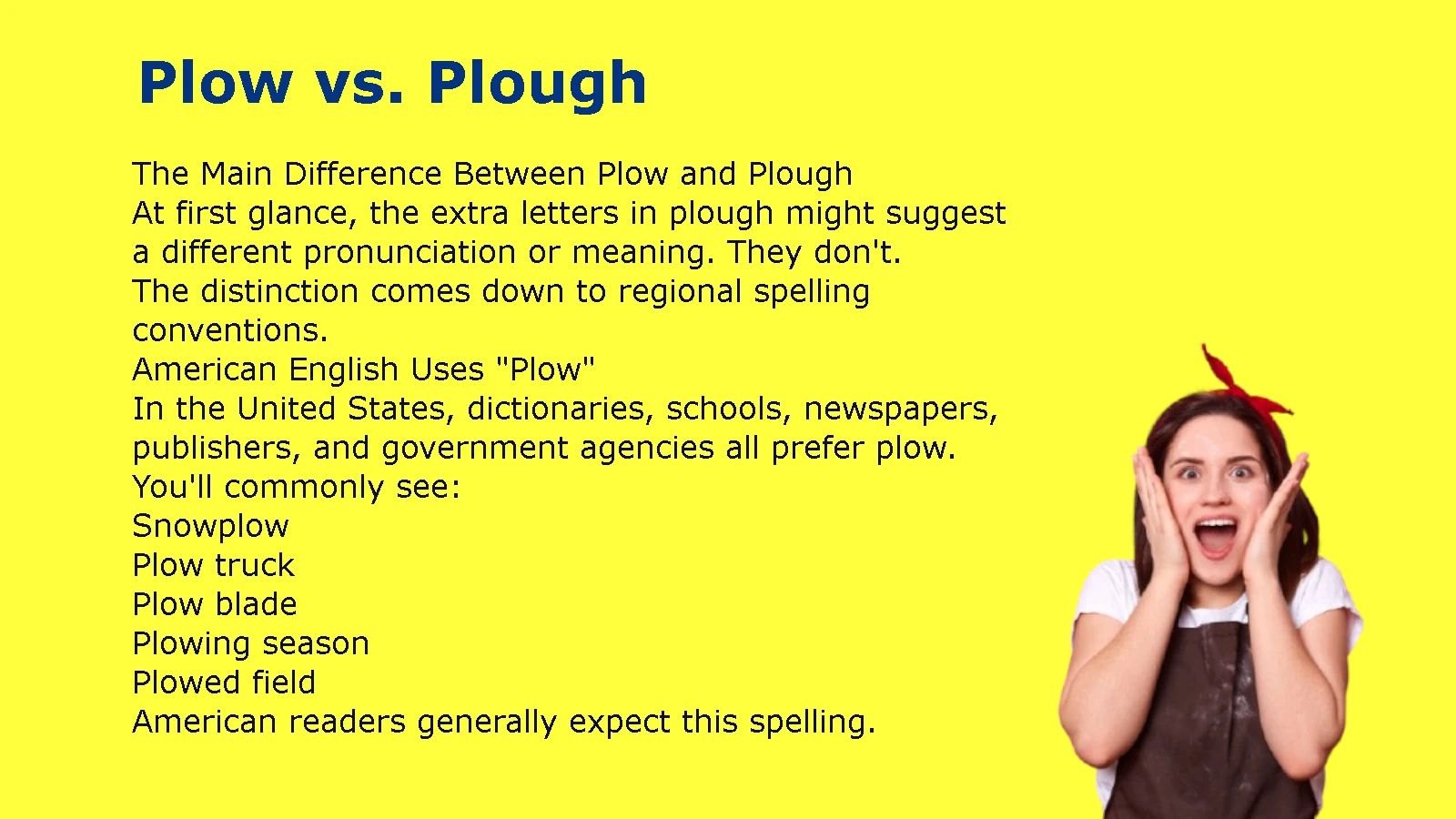
The Main Difference Between Plow and Plough
At first glance, the extra letters in plough might suggest a different pronunciation or meaning. They don’t.
The distinction comes down to regional spelling conventions.
American English Uses “Plow”
In the United States, dictionaries, schools, newspapers, publishers, and government agencies all prefer plow.
You’ll commonly see:
- Snowplow
- Plow truck
- Plow blade
- Plowing season
- Plowed field
American readers generally expect this spelling.
British English Uses “Plough”
In the United Kingdom and most Commonwealth nations, writers use plough.
Examples include:
- Snowplough
- Ploughing competition
- Ploughed field
- Ploughshare
- Tractor plough
British publications consistently follow this convention.
Pronunciation
Despite their different spellings, plow and plough sound exactly alike.
IPA Pronunciation
/plaʊ/
It rhymes with words such as:
- cow
- now
- how
- allow
The silent -ugh ending in plough reflects older English spelling traditions rather than modern pronunciation.
Are They Interchangeable?
Technically, yes.
Practically, no.
If you’re writing for a specific audience, you should use the spelling they expect.
| Audience | Recommended Spelling |
| United States | Plow |
| United Kingdom | Plough |
| Australia | Plough |
| New Zealand | Plough |
| Ireland | Plough |
| International audience | Choose one style and use it consistently |
Consistency matters more than the choice itself. Mixing plow and plough within the same article, report, or website can distract readers and make your writing appear unpolished.
Quick Comparison
| Category | Plow | Plough |
| Meaning | Prepare soil; farming tool | Same |
| Pronunciation | Same | Same |
| Origin | Same historical word | Same historical word |
| Grammar | Noun and verb | Noun and verb |
| American English | Standard | Uncommon |
| British English | Uncommon | Standard |
| Modern Usage | Preferred in the US | Preferred in the UK and Commonwealth |
Why Are There Two Spellings: Plow vs. Plough?
One of the most interesting aspects of plow vs. plough is that the difference isn’t about meaning or pronunciation. Instead, it’s the result of how English evolved over hundreds of years.
Many English words have developed regional spellings over time. For example:
| American English | British English |
| Color | Colour |
| Honor | Honour |
| Theater | Theatre |
| Center | Centre |
| Gray | Grey |
| Plow | Plough |
The same pattern explains why plow and plough coexist today.
The Word’s Ancient Origins
The word traces its roots to Old English, where it appeared in forms such as plōh and plōg. Similar words also existed in several Germanic languages, suggesting the term has been part of European farming vocabulary for well over a thousand years.
As English developed through the Middle English period, spelling wasn’t standardized. Scribes often wrote words according to local pronunciation or personal preference.
Because of that, historical records show numerous spellings, including:
- Plow
- Plough
- Plogh
- Plou
- Plouh
All referred to the same agricultural tool.
The Rise of Standardized Spelling
Until the eighteenth century, English spelling remained surprisingly flexible.
The publication of dictionaries gradually introduced consistency. Printers, educators, and publishers began favoring particular spellings, making written English more uniform.
The biggest divergence came when American English and British English started following different spelling conventions.
Noah Webster’s Influence
American educator and lexicographer Noah Webster believed English spelling should be simpler and more logical.
His dictionaries popularized several spelling reforms in the United States.
Some of the best-known examples include:
| British | American |
| Colour | Color |
| Honour | Honor |
| Labour | Labor |
| Favourite | Favorite |
| Plough | Plow |
These changes removed letters that no longer affected pronunciation. Over time, schools, publishers, and government agencies across the United States adopted these simplified spellings.
British English, however, retained many traditional forms, including plough.
Does the Spelling Change the Meaning?
No.
This is perhaps the most important point to remember.
Whether you write plow or plough, you’re referring to exactly the same thing.
For example:
American English: Farmers plow the fields every spring.
British English: Farmers plough the fields every spring.
The sentence means the same thing.
The same rule applies when referring to the farming implement itself.
The tractor pulled a large plow.
The tractor pulled a large plough.
Again, the only difference is regional spelling.
Where Each Spelling Is Used
Although the meanings match, readers naturally expect the spelling used in their variety of English.
Using the preferred regional spelling makes your writing feel polished and professional.
United States
American English consistently uses plow.
You’ll find this spelling in:
- Newspapers
- School textbooks
- Agricultural publications
- Government documents
- Road maintenance manuals
- Dictionaries
Examples include:
- Snowplow
- Plow truck
- Plow blade
- Plowing season
United Kingdom
British English uses plough.
Common examples include:
- Snowplough
- Ploughshare
- Ploughing match
- Ploughed fields
British newspapers, farming organizations, and educational institutions all follow this spelling.
Canada
Canada presents an interesting case.
Both spellings appear in Canadian writing because Canadian English blends influences from both American and British English.
The preferred spelling often depends on:
- Provincial style guides
- Government publications
- Individual publishers
- Educational institutions
Many Canadian agricultural organizations continue using plough, while businesses with strong ties to the United States often choose plow.
The key is consistency within the same document.
Australia and New Zealand
Australian and New Zealand English overwhelmingly favor plough.
You’ll encounter it in:
- Farming magazines
- Government resources
- Educational materials
- Agricultural equipment documentation
Ireland
Irish English also follows the British convention.
You’ll generally see:
- Plough
- Ploughed
- Ploughing
- Snowplough
One well-known example is the National Ploughing Championships, one of Europe’s largest agricultural events.
Regional Usage Table
| Country | Preferred Spelling |
| United States | Plow |
| United Kingdom | Plough |
| Canada | Both |
| Australia | Plough |
| New Zealand | Plough |
| Ireland | Plough |
| South Africa | Plough |
Plow vs. Plough in Modern Writing
Today, the correct spelling depends almost entirely on your audience.
If you’re writing for readers in the United States, plow is the natural choice.
If your audience lives in the United Kingdom or another Commonwealth country, plough fits their expectations.
Let’s look at different writing situations.
Academic Writing
Universities generally require consistency rather than one universally “correct” spelling.
For example:
- An American university usually expects plow.
- A British university usually expects plough.
Always follow the style guide provided by your instructor, department, or publisher.
Business Writing
Companies often tailor spelling to their customers.
Imagine an agricultural equipment manufacturer with offices in both Chicago and London.
Their American website would likely advertise:
Heavy-duty tractor plows
Meanwhile, the UK website would promote:
Heavy-duty tractor ploughs
Both describe identical products.
Journalism
News organizations maintain detailed style guides.
American publications consistently write:
- Snowplow
- Plowed roads
- Road plows
British publications prefer:
- Snowplough
- Ploughed roads
- Road ploughs
Editors rarely mix the two.
Technical Writing
Agricultural manuals also follow regional conventions.
For example:
An American equipment manual might include:
Attach the plow securely before operating the tractor.
A British manual would instead say:
Attach the plough securely before operating the tractor.
The instructions remain identical.
Online Content and SEO
Choosing the right spelling can improve search visibility.
If your audience is primarily American, optimize for:
- Plow
- Snowplow
- Plow truck
- Plowing
If you’re targeting readers in the United Kingdom, use:
- Plough
- Snowplough
- Ploughing
- Ploughshare
Trying to rank in Google with the wrong regional spelling may reduce relevance for local searches.
Common Expressions Using Plow and Plough
Although the spelling changes, these expressions carry the same meaning across English varieties.
Plow Through
One of the most common figurative expressions.
It means to complete something difficult or time-consuming with determination.
Examples
- She plowed through five chapters before dinner.
- We plowed through hundreds of customer emails.
- The lawyer plowed through thousands of documents.
British English simply changes the spelling.
- She ploughed through five chapters.
Plow Ahead
This phrase means to continue despite obstacles.
Examples include:
- The project team plowed ahead despite budget cuts.
- The hikers plowed ahead through heavy rain.
- The company plowed ahead with expansion plans.
Plow Into
This expression usually describes a forceful collision.
Examples:
- The truck plowed into a fence.
- The ship plowed into heavy waves.
- The car plowed into a snowbank.
Snowplow / Snowplough
One of the most recognizable compound words.
It refers to either:
- A vehicle that clears snow.
- A blade mounted on a vehicle.
Regional spelling follows the usual pattern.
| American | British |
| Snowplow | Snowplough |
Plowshare / Ploughshare
A plowshare is the cutting blade attached to a plow.
Historically, it transformed agriculture by allowing farmers to turn soil more efficiently.
The word also appears in the famous expression:
“Beat swords into plowshares.”
The phrase symbolizes turning instruments of war into tools for peaceful and productive purposes.
British English spells it ploughshare.
Common Mistakes to Avoid
Even experienced writers occasionally confuse these spellings.
Here are the most common mistakes.
Mixing Spellings
Avoid this:
The farmer bought a new plow and repaired his old plough.
Choose one spelling unless you’re intentionally comparing the two.
Assuming One Is Incorrect
Neither spelling is wrong.
Both appear in respected dictionaries.
The only question is which variety of English you’re using.
Changing Spellings Mid-Article
Consistency matters.
If your title uses Plow vs. Plough, your explanations should clearly identify which variety each spelling belongs to. If the rest of the article targets American readers, use plow throughout except when discussing the British variant.
Forgetting Compound Words
Remember that related words follow the same regional pattern.
| American English | British English |
| Snowplow | Snowplough |
| Plowshare | Ploughshare |
| Plowed | Ploughed |
| Plowing | Ploughing |
Plow vs. Plough: Side-by-Side Comparison
| Feature | Plow | Plough |
| Meaning | Prepare soil or farming tool | Same |
| Pronunciation | /plaʊ/ | /plaʊ/ |
| Part of Speech | Noun and verb | Noun and verb |
| Primary Region | United States | United Kingdom and Commonwealth |
| Modern Usage | Standard in American English | Standard in British English |
| Compound Forms | Snowplow, Plowshare | Snowplough, Ploughshare |
Case Study: Choosing the Right Spelling for Your Audience
Imagine an agricultural machinery company launching two versions of the same product brochure.
Version A: United States
The brochure uses:
- Plow
- Plowing
- Snowplow
- Plow blade
American customers immediately recognize the familiar spelling, making the content feel natural and credible.
Version B: United Kingdom
The same brochure changes only the regional spellings:
- Plough
- Ploughing
- Snowplough
- Ploughshare
Which Spelling Should You Use: Plow or Plough?
Choosing between plow vs. plough depends on one simple factor: your audience.
Neither spelling is more correct than the other. Both versions have a long history and appear in respected dictionaries. The best choice is the one that matches the English variety your readers expect.
Think of it like choosing between “color” and “colour.” The word means the same thing, but the spelling tells readers which version of English you follow.
Use “Plow” When Writing for American Readers
If your audience is primarily in the United States, plow is the natural choice.
American English uses simplified spellings in many words, and plow follows that pattern.
Choose plow for:
- US based websites
- American newspapers
- School assignments using US English
- Business documents for American customers
- Agricultural content targeting US farmers
Examples
✅ The farmer used a tractor to plow the field.
The city sent a snowplow after the storm.
Farmers begin plowing their fields in early spring.
❌ The farmer used a tractor to plough the field.
(This isn’t grammatically wrong, but it may look unusual in American writing.)
Use “Plough” When Writing for British or Commonwealth Readers
Choose plough when your audience follows British English conventions.
This includes readers in places such as:
- United Kingdom
- Ireland
- Australia
- New Zealand
- South Africa
Examples
✅ The farmer used a tractor to plough the field.
The council sent a snowplough to clear the road.
The fields were ploughed before planting season.
How to Stay Consistent With Plow vs. Plough
The biggest writing mistake isn’t choosing the “wrong” version. It’s mixing both versions in the same piece of content.
Consistency makes your writing look professional.
For example:
Incorrect Mixed Style
The farmer used a plow to prepare the field. Later, the snowplough cleared the road.
The reader can understand the meaning, but the spelling inconsistency creates a distraction.
Consistent American Style
The farmer used a plow to prepare the field. Later, the snowplow cleared the road.
Consistent British Style
The farmer used a plough to prepare the field. Later, the snowplough cleared the road.
Plow vs. Plough in Different Industries
Different industries follow regional spelling standards.
Agriculture
Agriculture is the original context for the word, so spelling differences appear frequently in farming publications.
| Region | Common Usage |
| United States | Plow |
| United Kingdom | Plough |
| Australia | Plough |
| Canada | Both |
Farm equipment manufacturers often localize product names and manuals based on their target market.
Transportation and Road Maintenance
Snow clearing provides another common example.
American cities use:
- Snowplow trucks
- Plow drivers
- Plow blades
British cities use:
- Snowplough trucks
- Plough drivers
- Plough blades
The equipment performs the same job: removing snow and ice from roads.
Literature and Historical Writing
Historical texts often use plough because the word appears frequently in older English literature.
The image of a plough represents:
- Agriculture
- Hard work
- Rural life
- Human connection to the land
For example, writers have used the plough as a symbol of building, creating, and working toward progress.
Related Word Variations: Plow vs. Plough
The spelling difference continues into related words.
Understanding these variations helps you avoid mistakes.
| American English | British English | Meaning |
| Plow | Plough | Farming tool or action |
| Plowed | Ploughed | Past tense |
| Plowing | Ploughing | Present participle |
| Snowplow | Snowplough | Snow clearing vehicle |
| Plowshare | Ploughshare | Cutting blade of a plow |
Plowed vs. Ploughed
The past tense follows the same regional pattern.
American English
- The farmer plowed the field.
- The road crew plowed the snow.
British English
- The farmer ploughed the field.
- The road crew ploughed the snow.
Both forms are correct depending on the variety of English.
Plowing vs. Ploughing
The same rule applies to the -ing form.
American English
Farmers begin plowing after the winter frost disappears.
British English
Farmers begin ploughing after the winter frost disappears.
Snowplow vs. Snowplough
Many people encounter this spelling difference during winter.
A snowplow or snowplough is a vehicle or attachment used to remove snow from roads, parking lots, and runways.
American Example
The snowplow cleared the highway before morning traffic began.
British Example
The snowplough cleared the motorway before morning traffic began.
The function remains identical.
Frequently Asked Questions About Plow vs. Plough
Is plow or plough correct?
Both are correct.
Plow is the standard American English spelling, while plough is the standard British English spelling. The words have the same meaning and pronunciation.
Are plow and plough pronounced differently?
No.
Both words are pronounced:
/plaʊ/
They sound like:
- cow
- how
- now
The extra letters in plough do not change the pronunciation.
Why does American English spell it plow?
American English adopted many simplified spellings during the nineteenth century.
Influential dictionary writer Noah Webster promoted changes that removed unnecessary letters, which helped establish spellings like:
- Color instead of colour
- Honor instead of honour
- Plow instead of plough
Is plough an old-fashioned spelling?
No.
Although plough looks traditional, it remains the standard spelling in many modern countries.
You’ll see it regularly in:
- British newspapers
- Australian publications
- Agricultural documents
- Government websites
- Educational materials
Do Canadians use plow or plough?
Canadian English uses both.
Canada sits between American and British language influences, so spelling depends on the writer, organization, and region.
Many Canadian publishers follow British spellings, while others use American conventions.
Is plow a noun or a verb?
It can be both.
As a noun:
The farmer repaired the plow.
The word refers to the agricultural tool.
As a verb:
The farmer will plow the field tomorrow.
The word describes the action of preparing soil.
What is a plowshare?
A plowshare is the sharp blade attached to a plow that cuts through soil.
It plays an important role in agriculture because it helps break and turn the earth.
The British spelling is ploughshare.
What does “plow through” mean?
Plow through means to complete something difficult with determination.
Examples:
- She plowed through her homework before dinner.
- He plowed through a stack of paperwork.
- The team plowed through technical problems.
British English uses:
- She ploughed through her homework.
Common Examples of Plow and Plough in Sentences
Seeing both words in context makes the difference easier to remember.
| American English | British English |
| The farmer plowed the field. | The farmer ploughed the field. |
| The snowplow arrived early. | The snowplough arrived early. |
| They are plowing the land. | They are ploughing the land. |
| The tractor has a new plow. | The tractor has a new plough. |
Final Takeaways: Plow vs. Plough
The difference between plow and plough comes down to regional spelling, not meaning.
Remember these key points:
- Plow is the preferred spelling in American English.
- Plough is the preferred spelling in British English and many Commonwealth countries.
- Both words have the same pronunciation: /plaʊ/.
- Both can be used as nouns and verbs.
- Related words follow the same pattern:
- Plowed vs. ploughed
- Plowing vs. ploughing
- Snowplow vs. snowplough
- Neither spelling is wrong.
- The best choice depends on your readers.
When you match your spelling to your audience, your writing feels more natural and professional. A small spelling choice can make a big difference in how smoothly your message connects with readers.
Whether you write plow or plough, you’re using a word that represents one of humanity’s oldest tools: a simple invention that helped transform farming, shape civilizations, and connect people with the land they depend on.