Have you ever wondered whether to use hypothesis vs hypotheses when talking about one idea or several? Although these words look almost identical, they have different meanings and grammatical uses. Understanding the difference can help you write more accurately in academic, scientific, and everyday contexts.
Hypothesis is the singular form, meaning one proposed explanation, idea, or prediction that can be tested or investigated. Hypotheses is the plural form, referring to two or more proposed explanations, ideas, or predictions.
Examples:
- The researcher proposed a hypothesis about the cause of the disease.
- The scientists tested several hypotheses during the experiment.
The confusion is understandable. People often search for hypothesis vs hypotheses, hypothesis meaning, hypotheses meaning, or what is the plural of hypothesis because the spelling changes in an unusual way. Instead of simply adding s, hypothesis changes to hypotheses, which can make the two forms easy to mix up.
In this guide, you’ll learn the complete difference between hypothesis and hypotheses, including their definitions, pronunciation, plural form, usage, examples in sentences, and common mistakes. You’ll also discover how to correctly use hypothesis and hypotheses in academic and scientific writing.
Hypothesis vs. Hypotheses at a Glance
The fastest way to understand hypothesis vs. hypotheses is to look at the difference side by side.
| Word | Number | Meaning | Example |
| Hypothesis | Singular | One proposed explanation or assumption | The scientist proposed a hypothesis. |
| Hypotheses | Plural | Two or more proposed explanations or assumptions | The scientists proposed several hypotheses. |
The distinction is grammatical rather than semantic. Both words refer to proposed explanations or assumptions. The difference lies in how many you mean.
Cambridge defines hypothesis as an idea or explanation based on known facts that has not yet been proved. It lists hypotheses as its plural form.
The simple rule
Remember this:
- 1 = hypothesis
- 2 or more = hypotheses
For example:
- The researcher developed one hypothesis.
- The researcher developed three hypotheses.
That’s the whole grammatical difference in a nutshell.
What Does “Hypothesis” Mean?
A hypothesis is a proposed explanation, assumption, or prediction that you can examine or test.
In scientific writing, the word usually describes an idea that attempts to explain an observation or predict an outcome. The idea isn’t treated as an established fact. Researchers test it against evidence.
Cambridge describes a hypothesis as an idea or explanation based on known facts that has not yet been proved. Merriam Webster similarly defines it as a proposed explanation that is tentatively assumed so researchers can test whether it agrees with known or discoverable facts.
For example:
Hypothesis: Plants that receive more sunlight will grow faster than plants that receive less sunlight.
That’s a hypothesis because you can test it. You could grow plants under different amounts of light, measure their growth, and compare the results.
A hypothesis doesn’t have to be correct. In fact, testing a hypothesis can show that the idea doesn’t hold up.
Hypothesis in scientific research
Science often begins with a question or observation.
Imagine that a researcher notices that plants near a window seem to grow faster than plants in a darker corner. The researcher might ask:
Does increased exposure to sunlight increase plant growth?
From there, the researcher can develop a hypothesis:
Plants exposed to more sunlight will grow faster than plants exposed to less sunlight.
The researcher then gathers evidence to determine whether the prediction fits the results.
This gives the word hypothesis an important quality: it isn’t simply a random guess. A useful scientific hypothesis connects an idea to something that can be investigated.
Hypothesis in everyday language
You don’t have to work in a laboratory to use hypothesis correctly.
The word can describe a proposed explanation in ordinary situations, too.
For example:
- My hypothesis is that the missing keys are in the car.
- Her hypothesis was that the delay came from heavy traffic.
- The manager’s hypothesis was that customers preferred the shorter checkout process.
- His hypothesis is that the website loads slowly because of oversized images.
These statements present possible explanations. They don’t automatically establish facts.
That’s an important distinction. A hypothesis says, in effect, “This might explain what we’re seeing. Let’s examine it.”
What Does “Hypotheses” Mean?
Hypotheses is simply the plural of hypothesis.
Use it when you’re referring to more than one proposed explanation, assumption, or prediction.
Cambridge explicitly identifies hypotheses as the plural of hypothesis. Its examples include references to multiple hypotheses in scientific and academic contexts.
For example:
- The researchers developed several hypotheses.
- The study tested two competing hypotheses.
- These hypotheses explain the results in different ways.
- The researchers rejected three hypotheses after analyzing the data.
Notice the plural verbs in these sentences:
- The hypothesis is interesting.
- The hypotheses are interesting.
That change gives you another useful clue.
Why researchers often use “hypotheses”
A research question can have more than one possible explanation.
Suppose a company notices that online sales dropped. Several explanations might exist:
- Customers don’t like the new website.
- The checkout process takes too long.
- Competitors lowered their prices.
- Search traffic declined.
- Customers shifted to another product category.
Each explanation could become a hypothesis that researchers investigate.
Once there are multiple proposed explanations, the plural hypotheses becomes appropriate.
Why Is the Plural of Hypothesis “Hypotheses”?
This is where the spelling trips people up.
You might expect the plural to be hypothesis + s. That would produce hypothesiss, which clearly isn’t correct. You might also think the word becomes hypothesises, but standard English uses hypotheses.
The spelling changes from:
hypothesis → hypotheses
The ending changes from -is to -es.
This pattern appears in several words with Greek origins that entered English with similar plural formations.
| Singular | Plural |
| hypothesis | hypotheses |
| thesis | theses |
| analysis | analyses |
| diagnosis | diagnoses |
| crisis | crises |
| synopsis | synopses |
The pattern isn’t something you should apply blindly to every English word ending in -is. English contains many exceptions and different plural patterns. However, these familiar examples can help you remember the spelling of hypotheses.
The spelling pattern to remember
Instead of trying to memorize every letter individually, remember this transformation:
-is → -es
So:
- hypothesis → hypotheses
- thesis → theses
- analysis → analyses
- diagnosis → diagnoses
Once you recognize the pattern, hypotheses becomes much easier to spell.
Hypothesis vs. Hypotheses: When Should You Use Each?
The choice between hypothesis and hypotheses depends on the number of ideas you’re discussing.
If there’s one, use hypothesis.
If there are multiple, use hypotheses.
| Situation | Correct word |
| One proposed explanation | hypothesis |
| Two proposed explanations | hypotheses |
| Three proposed explanations | hypotheses |
| Several predictions | hypotheses |
| A single research prediction | hypothesis |
| Multiple research predictions | hypotheses |
Use “hypothesis” for one
Use hypothesis when the noun refers to a single idea.
Examples:
- The researcher proposed a new hypothesis.
- This hypothesis can be tested.
- The evidence supports the hypothesis.
- The study examined one central hypothesis.
- Her hypothesis explains the unexpected result.
Words such as a, one, this, and the can often help you spot the singular form.
Use “hypotheses” for more than one
Use hypotheses when you mean multiple ideas.
Examples:
- The researchers proposed three hypotheses.
- The study tested several hypotheses.
- The evidence challenged both hypotheses.
- Researchers compared competing hypotheses.
- The results supported two of the proposed hypotheses.
Words such as two, three, several, many, both, and multiple naturally point toward the plural form.
Hypothesis vs. Hypotheses Examples
Seeing the words in real sentences makes the distinction much clearer.
| Singular: Hypothesis | Plural: Hypotheses |
| The scientist proposed a hypothesis. | The scientists proposed several hypotheses. |
| Her hypothesis was supported by the evidence. | Their hypotheses were supported by different results. |
| The study tested one hypothesis. | The study tested four hypotheses. |
| This hypothesis explains the pattern. | These hypotheses explain different patterns. |
| The researcher rejected the hypothesis. | The researchers rejected two hypotheses. |
| Our hypothesis predicts faster growth. | Our hypotheses predict different growth rates. |
The number of proposed explanations determines the form.
Examples in academic writing
Academic writing frequently uses both forms.
Singular:
The study examines the hypothesis that sleep duration affects memory performance.
Plural:
The study examines three hypotheses concerning sleep duration and memory performance.
Another example:
The researchers developed a hypothesis about the relationship between exercise and concentration.
Compare that with:
The researchers developed several hypotheses about the relationship between exercise and concentration.
The subject matter stays almost the same. Only the number changes.
Examples in everyday situations
You can also use these words outside formal research.
Hypothesis:
My hypothesis is that John left early because the meeting ended sooner than expected.
Hypotheses:
We have several hypotheses about why John left early.
In the first sentence, there’s one proposed explanation. In the second, there are several.
Hypothesis vs. Hypotheses Pronunciation
The spelling changes, but so does the pronunciation.
In US English, Cambridge gives the pronunciation of hypothesis as:
/haɪˈpɑː.θə.sɪs/
Its plural, hypotheses, is pronounced:
/haɪˈpɑː.θə.siːz/
An easier pronunciation guide is:
- Hypothesis: hy POTH uh sis
- Hypotheses: hy POTH uh seez
The final part is the biggest difference.
| Word | Ending sound |
| hypothesis | sis |
| hypotheses | seez |
So you don’t pronounce hypotheses as though it were simply hypothesis with an extra syllable.
A quick pronunciation trick
Say these pairs aloud:
- thesis → theses
- analysis → analyses
- hypothesis → hypotheses
The plural endings have a long ee sound followed by a z sound.
That gives you a practical way to remember both the spelling and pronunciation.
Is “Hypotheses” Singular or Plural?
Hypotheses is plural.
There’s no special exception here. When you write hypotheses, you’re talking about more than one hypothesis.
For example:
- One hypothesis was tested.
- Two hypotheses were tested.
- Several hypotheses were tested.
Notice the verb changes too:
The hypothesis is plausible.
but:
The hypotheses are plausible.
This makes subject verb agreement an additional clue.
Correct and incorrect examples
Correct:
The hypotheses are supported by the evidence.
Incorrect:
The hypotheses is supported by the evidence.
Why is the second sentence wrong? Because hypotheses refers to multiple hypotheses. The plural noun needs the plural verb are.
Is “Hypothesis” Singular or Plural?
Hypothesis is singular.
Use it when you’re talking about one proposed explanation, prediction, or assumption.
Examples include:
- a hypothesis
- one hypothesis
- this hypothesis
- the hypothesis
- my hypothesis
You can also see the difference through verbs:
The hypothesis is testable.
Not:
The hypothesis are testable.
The noun hypothesis behaves as a singular countable noun in this use.
Hypotheses vs. Hypothesises: Which Is Correct?
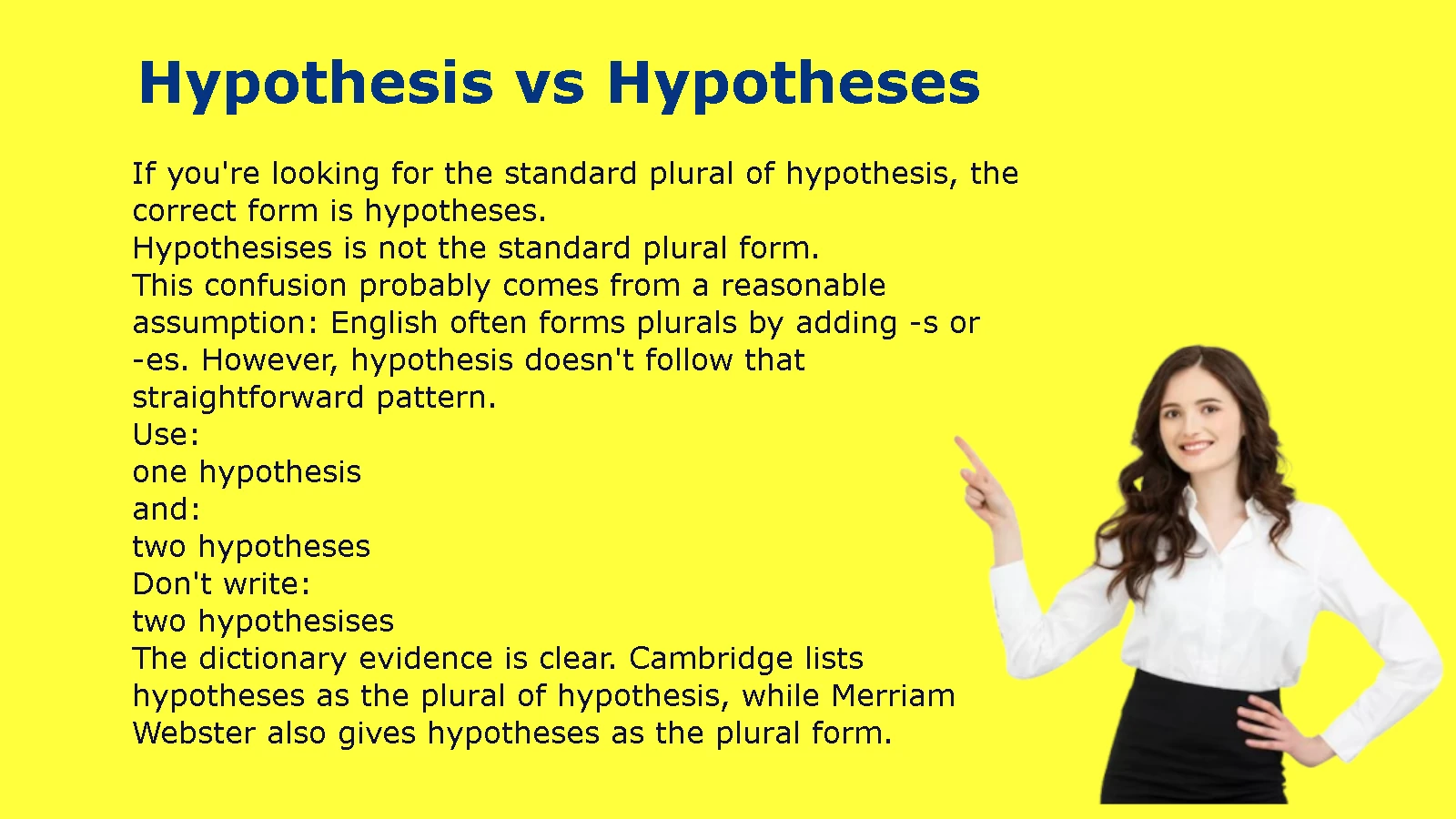
If you’re looking for the standard plural of hypothesis, the correct form is hypotheses.
Hypothesises is not the standard plural form.
This confusion probably comes from a reasonable assumption: English often forms plurals by adding -s or -es. However, hypothesis doesn’t follow that straightforward pattern.
Use:
one hypothesis
and:
two hypotheses
Don’t write:
two hypothesises
The dictionary evidence is clear. Cambridge lists hypotheses as the plural of hypothesis, while Merriam Webster also gives hypotheses as the plural form.
Don’t confuse “hypotheses” with a verb
There is another reason the spelling can feel confusing.
English has the verb hypothesize, meaning to propose a hypothesis or hypotheses.
For example:
Researchers hypothesize that the treatment will improve recovery.
That’s a completely different word from the plural noun hypotheses.
Compare:
| Word | Part of speech | Meaning |
| hypothesis | Noun | One proposed explanation |
| hypotheses | Noun | More than one proposed explanation |
| hypothesize | Verb | To propose an explanation or idea |
| hypothesized | Verb | Proposed an explanation |
| hypothesizing | Verb | The act of proposing an explanation |
Keeping these forms separate can prevent spelling mistakes.
Common Mistakes With Hypothesis and Hypotheses
The difference looks small, which makes these words easy to mix up in essays, reports, and research papers.
Mistake: Using “hypothesis” after a plural number
Incorrect:
The researchers tested three hypothesis.
Correct:
The researchers tested three hypotheses.
The number three tells you that the noun must be plural.
Mistake: Writing “hypothesises”
Incorrect:
The researchers developed several hypothesises.
Correct:
The researchers developed several hypotheses.
The plural changes the ending rather than simply adding letters to the complete singular form.
Mistake: Treating “hypotheses” as singular
Incorrect:
The hypotheses is supported by the results.
Correct:
The hypotheses are supported by the results.
Because hypotheses is plural, it takes are.
Mistake: Using “hypotheses” for one idea
Incorrect:
The researcher proposed one hypotheses.
Correct:
The researcher proposed one hypothesis.
The word one requires the singular form.
Mistake: Confusing hypothesis with theory
A hypothesis and a theory aren’t simply interchangeable terms in scientific writing.
A hypothesis usually represents a tentative proposition that researchers can test. Merriam Webster describes a hypothesis as something proposed so it can be tested to determine whether it might be true.
A scientific theory, by contrast, represents a broader explanatory framework supported by substantial evidence.
So avoid treating these words as exact synonyms.
Hypothesis vs. Hypotheses in Academic Writing
Correct word choice matters more in academic writing because small grammatical errors can make otherwise strong research look careless.
Consider these two sentences:
This study tests three hypothesis.
and:
This study tests three hypotheses.
The second sentence is correct because the study tests three separate propositions.
How to use “hypothesis” in a research paper
When discussing one central proposition, use hypothesis.
For example:
The primary hypothesis predicts that increased physical activity will improve sleep quality.
You could also write:
The researchers tested the hypothesis that increased physical activity would improve sleep quality.
Here, the word refers to one specific proposition.
How to use “hypotheses” in a research paper
When a study contains multiple propositions, use hypotheses.
For example:
The study evaluates three hypotheses concerning physical activity, sleep quality, and daytime concentration.
You might also label them:
- Hypothesis 1: Increased physical activity improves sleep quality.
- Hypothesis 2: Improved sleep quality increases daytime concentration.
- Hypothesis 3: The relationship between physical activity and concentration is partly explained by sleep quality.
Once you have several individual hypotheses, the plural form becomes necessary when discussing them collectively.
Hypothesis vs. Hypotheses in Scientific Research
Scientific research often deals with competing explanations.
Suppose researchers observe that a particular species becomes more active during warmer weather. They could develop several explanations:
- Hypothesis 1: Warmer temperatures increase the species’ metabolic activity.
- Hypothesis 2: Increased food availability causes greater activity.
- Hypothesis 3: Longer daylight hours trigger behavioral changes.
Each statement represents a hypothesis.
When researchers discuss all three together, they use hypotheses.
The researchers tested three hypotheses about the species’ seasonal behavior.
This example shows why the plural form matters. The word isn’t just a spelling variation. It tells the reader that multiple propositions are under consideration.
Case study: one research question, several hypotheses
Imagine a business notices that customers abandon an online shopping cart more often than expected.
The research team asks:
Why are customers leaving before completing their purchases?
Instead of assuming there’s only one explanation, the team develops three hypotheses:
| Hypothesis | Proposed explanation |
| H1 | Customers abandon carts because shipping costs appear too late. |
| H2 | Customers abandon carts because checkout takes too long. |
| H3 | Customers abandon carts because the site doesn’t offer enough payment options. |
The team now has three hypotheses, not one.
After testing them, the evidence might strongly support H1 while offering little support for H2 and H3.
The important point is that the researchers started with multiple possible explanations. That’s exactly when hypotheses is appropriate.
Hypothesis vs. Hypotheses in Research Questions
Research questions and hypotheses often appear together, but they aren’t the same thing.
A research question asks what you want to investigate.
A hypothesis proposes a possible answer or prediction.
For example:
Research question:
Does reducing screen time improve sleep quality?
Hypothesis:
Reducing screen time before bed improves sleep quality.
If researchers have multiple predicted relationships, they may develop several hypotheses:
The study evaluates three hypotheses about screen time, sleep duration, and sleep quality.
This distinction becomes particularly useful when writing research papers, dissertations, or reports.
How to Remember Hypothesis vs. Hypotheses
You don’t need a complicated grammar rule.
Just remember:
One hypothesis. Two hypotheses.
That’s the easiest memory trick.
Another useful comparison is:
One thesis → several theses
One analysis → several analyses
One hypothesis → several hypotheses
You can also use the number in front of the noun as a quick test.
If you can say:
- a hypothesis
- one hypothesis
use hypothesis.
If you can say:
- two hypotheses
- several hypotheses
- many hypotheses
- both hypotheses
use hypotheses.
A five second test
Before submitting a paper, replace the word with one or several.
If the sentence means:
One proposed explanation…
use hypothesis.
If it means:
Several proposed explanations…
use hypotheses.
This simple substitution catches many errors.
Hypothesis vs. Hypotheses in Sentences
Here are more examples across different contexts.
Science
The scientist proposed a hypothesis about the reaction.
The scientists considered several hypotheses about the reaction.
Education
The researcher tested the hypothesis that shorter lessons improve retention.
The researchers compared several hypotheses about student performance.
Business
The manager’s hypothesis was that customers wanted faster delivery.
The team developed three hypotheses about the decline in sales.
Technology
The engineer’s hypothesis was that the software failure came from a memory leak.
The engineers considered several hypotheses before identifying the source of the problem.
Everyday conversation
My hypothesis is that we missed the turn.
We have several hypotheses about what happened.
Hypothesis vs. Hypotheses: Grammar Table
For a quick reference, keep this table handy.
| Feature | Hypothesis | Hypotheses |
| Number | Singular | Plural |
| Refers to | One idea | Two or more ideas |
| Article | a hypothesis | no “a” |
| Number words | one hypothesis | two hypotheses |
| Demonstrative | this hypothesis | these hypotheses |
| Verb | hypothesis is | hypotheses are |
| Pronunciation ending | “sis” | “seez” |
| Correct plural | — | hypotheses |
The table reveals a useful pattern: determiners, verbs, and numbers can all help you identify the correct form.
Hypothesis vs. Hypotheses: Final Answer
The difference between hypothesis and hypotheses is straightforward once you focus on number.
Hypothesis is the singular form. It refers to one proposed explanation, assumption, or prediction.
Hypotheses is the plural form. It refers to two or more proposed explanations, assumptions, or predictions. Cambridge and Merriam Webster both identify hypotheses as the plural of hypothesis.
Remember:
One hypothesis → two hypotheses
The spelling changes from -is to -es, and the pronunciation changes from an ending like “sis” to “seez.”
So, if a researcher develops one proposed explanation, write:
The researcher developed a hypothesis.
If the researcher develops three proposed explanations, write:
The researcher developed three hypotheses.
That’s the key distinction. Once you connect the words to one versus more than one, the choice becomes much easier.
Frequently Asked Questions About Hypothesis vs. Hypotheses
What is the plural of hypothesis?
The plural of hypothesis is hypotheses.
Example:
One hypothesis was tested, but three hypotheses were rejected.
Is hypotheses the plural of hypothesis?
Yes. Hypotheses is the standard plural form of hypothesis.
Is hypothesis singular or plural?
Hypothesis is singular.
Example:
The hypothesis is testable.
Is hypotheses singular or plural?
Hypotheses is plural.
Example:
The hypotheses are testable.
Can you say “two hypothesis”?
No. Use two hypotheses.
Correct:
The study tested two hypotheses.
Incorrect:
The study tested two hypothesis.
Is “hypothesises” the plural of hypothesis?
No. The standard plural is hypotheses, not hypothesises.
How do you pronounce hypothesis?
In US English, hypothesis is pronounced approximately hy POTH uh sis, with the final syllable sounding like “sis.” Cambridge gives the US pronunciation as /haɪˈpɑː.θə.sɪs/.
How do you pronounce hypotheses?
In US English, hypotheses is pronounced approximately hy POTH uh seez. Cambridge gives the US pronunciation as /haɪˈpɑː.θə.siːz/.
What is the difference between hypothesis and hypotheses?
Hypothesis means one proposed explanation or prediction, while hypotheses means two or more.
One hypothesis
Several hypotheses
What is the easiest way to remember hypothesis vs. hypotheses?
Use the number rule:
One = hypothesis. More than one = hypotheses.
Also remember the spelling change:
hypothesis → hypotheses
The ending changes from -is to -es.
Can hypothesis be used outside science?
Yes. Although hypothesis appears frequently in scientific and academic writing, you can use it for a proposed explanation in everyday situations.
For example:
My hypothesis is that the train arrived early.
The word simply presents an explanation that you haven’t established as fact.