Quick Answer: Reveling or Revelling?
Reveling and revelling are both correct spellings. The difference is mainly regional: reveling is the standard spelling in American English, while revelling is commonly used in British English and other varieties of English.
The main difference is the number of l’s:
R-E-V-E-L-I-N-G → reveling
R-E-V-E-L-L-I-N-G → revelling
Unlike a typical spelling mistake, revelling is not an incorrect version of reveling. Both spellings are accepted in standard English, but the preferred form depends on the variety of English you’re using.
The word reveling/revelling is the present participle or gerund form of revel. It means enjoying something with great pleasure or celebrating in a lively way. For example, someone might be described as reveling in their success or revelling in the excitement of a celebration.
| Spelling | Usage | Meaning |
| reveling | Standard American English | Enjoying something greatly or celebrating |
| revelling | Standard British English and other varieties | Enjoying something greatly or celebrating |
So, if you’re deciding between reveling vs revelling, use reveling in American English and revelling in British English. Both spellings are correct, so choose the form that matches the variety of English you’re writing in.
Quick Answer: Reveling vs Revelling?
Both reveling and revelling are correct spellings. The difference is mainly based on American and British English.
Reveling is the standard American English spelling, while revelling is the standard British English spelling. Both forms come from the verb revel, which means to enjoy yourself in a lively or celebratory way, often by having fun, partying, or taking great pleasure in something.
The spelling difference occurs because American English often uses a single consonant before the -ing ending when the final syllable is unstressed, while British English commonly doubles the final consonant in words such as revel → revelling.
| Spelling | Usage | Meaning |
| reveling | American English | Enjoying yourself in a lively or celebratory way |
| revelling | British English | Enjoying yourself in a lively or celebratory way |
So, if you’re deciding between reveling vs revelling, both are correct. Use reveling for American English and revelling for British English.
What Does Reveling Mean?
Reveling is the American English spelling of the present participle of revel.
The verb revel can mean to enjoy yourself in a lively way, particularly in a celebration or social setting. It can also be used in the expression revel in something, meaning to take great pleasure in a situation, activity, achievement, or experience.
For example:
She was reveling in her success after months of hard work.
Here, reveling means that she was taking great pleasure in her success.
The word doesn’t necessarily describe a party. You can revel in success, revel in freedom, revel in attention, or revel in a beautiful experience.
Cambridge Dictionary defines revel in something as getting great pleasure from a situation or activity.
Examples of Reveling in American English
- The players were reveling in their victory.
- She spent the afternoon reveling in the attention.
- He was reveling in his newfound freedom.
- The audience was reveling in the excitement.
- They were reveling in the success of the event.
- The children were reveling in the freedom of the summer holidays.
In each example, reveling describes an ongoing action.
What Does Revelling Mean?
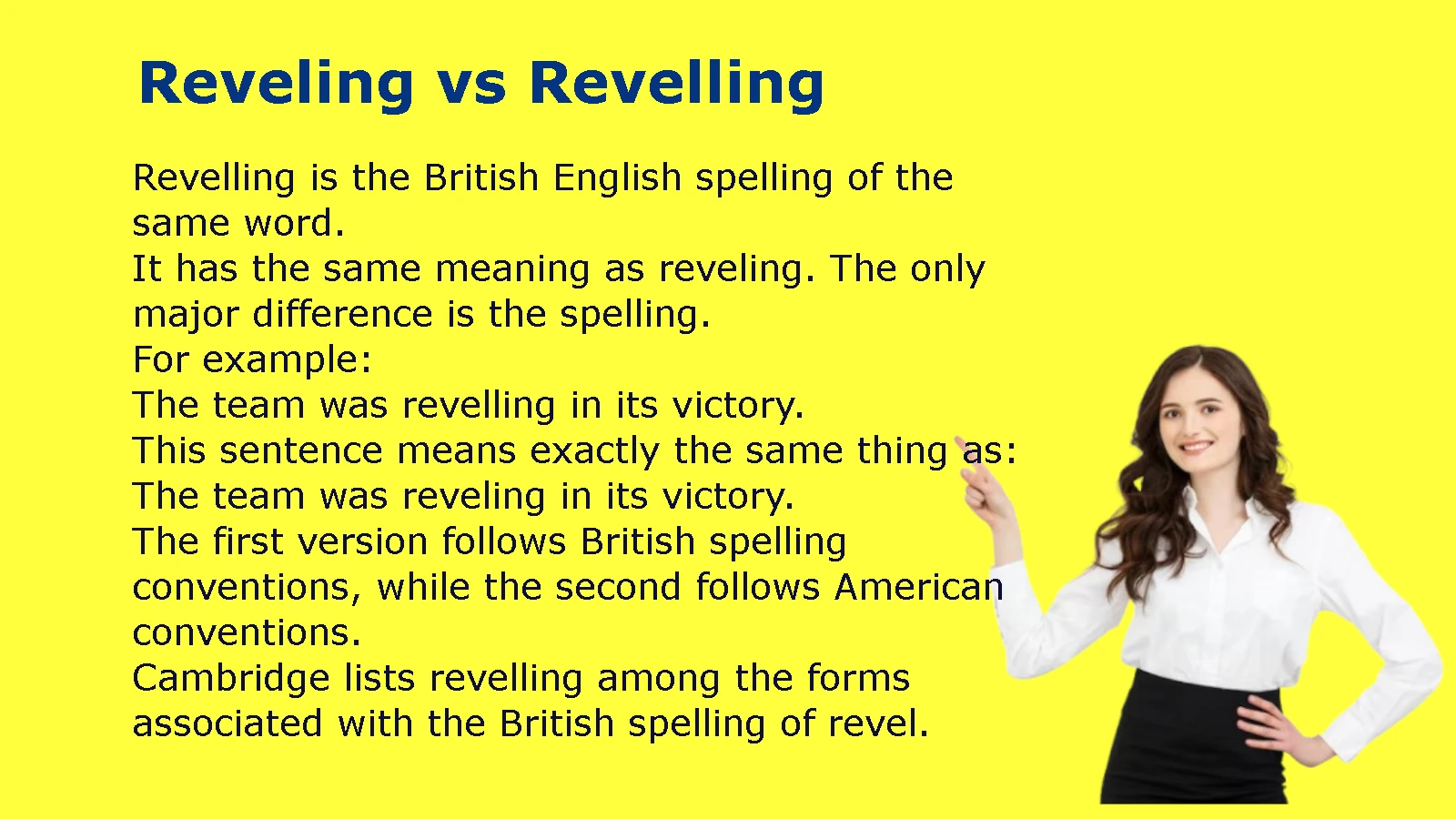
Revelling is the British English spelling of the same word.
It has the same meaning as reveling. The only major difference is the spelling.
For example:
The team was revelling in its victory.
This sentence means exactly the same thing as:
The team was reveling in its victory.
The first version follows British spelling conventions, while the second follows American conventions.
Cambridge lists revelling among the forms associated with the British spelling of revel.
Examples of Revelling in British English
- The players were revelling in their victory.
- She was revelling in the attention.
- He was revelling in his newfound freedom.
- The crowd was revelling in the excitement.
- They were revelling in the atmosphere.
- The team was revelling in its success.
The meaning remains unchanged when the spelling changes from revelling to reveling.
Reveling vs Revelling: What Is the Difference?
The main difference between reveling and revelling is the spelling convention used by different varieties of English.
American English generally uses one l: reveling.
British English generally uses two l’s: revelling.
This is similar to other British-American spelling differences, although the exact spelling rules vary from word to word.
Cambridge’s entry for revel explicitly gives the pattern as “-ll- or US usually -l-.”
Reveling vs Revelling at a Glance
| Feature | Reveling | Revelling |
| Meaning | Taking great pleasure | Taking great pleasure |
| Base word | revel | revel |
| Main usage | American English | British English |
| Pronunciation | Essentially the same | Essentially the same |
| Present participle | Yes | Yes |
| Gerund | Yes | Yes |
| Meaning difference | None | None |
The important point is that neither word represents a different action.
If an American writer says:
The fans were reveling in the team’s success.
A British writer could write:
The fans were revelling in the team’s success.
The spelling changes, but the underlying meaning does not.
Why Is It Reveling in American English but Revelling in British English?
The difference comes from the spelling conventions used in American and British English.
British English retains the doubled l in revelling, while American English generally uses a single l in reveling. The same distinction appears in the past-tense forms:
- American English: reveled
- British English: revelled
And in the noun:
- American English: reveler
- British English: reveller
Cambridge gives reveler as the US form and reveller as the UK form.
This isn’t an isolated difference between two completely separate words. Instead, it is part of a broader pattern of spelling variation between British and American English.
Cambridge Grammar notes that British and American English differ in spelling as well as pronunciation and vocabulary.
The Pattern Across Related Forms
Consider the following comparison:
| American English | British English |
| revel | revel |
| reveled | revelled |
| reveling | revelling |
| reveler | reveller |
The base form remains identical, but the doubled l appears in the common British forms.
This is why you may see both spellings in dictionaries, books, newspapers, websites, and other English-language publications.
Reveling vs Revelling Pronunciation
Reveling and revelling are generally pronounced the same way despite their different spellings.
Cambridge gives revel the pronunciation /ˈrev.əl/ in both British and American English.
The extra l in revelling is therefore a spelling difference rather than a cue to pronounce an additional sound.
This is an important distinction. English spelling doesn’t always provide a one-to-one representation of pronunciation. A word can gain or lose a letter between regional spelling systems without acquiring a corresponding difference in spoken form.
For practical writing purposes, you don’t need to change how you pronounce the word simply because you change from reveling to revelling.
Reveling as a Verb Form
Reveling is the present participle of revel in American English.
It can perform two closely related grammatical roles.
Reveling as Part of a Continuous Verb
In a progressive construction, reveling forms part of a verb phrase:
They were reveling in their success.
Here, were is the auxiliary verb and reveling is the present participle.
The action is presented as ongoing.
Reveling as a Gerund
The -ing form can also function as a noun-like expression:
Reveling in success can be enjoyable after years of hard work.
In this sentence, reveling in success acts as the subject of the sentence.
The British equivalent would be:
Revelling in success can be enjoyable after years of hard work.
Again, the grammatical function and meaning remain the same.
Examples of Reveling in a Sentence
Here are several natural examples of reveling in American English.
Reveling in Success
The company was reveling in its success after launching the new product.
The phrase means that the company was taking great pleasure in its achievement.
Reveling in Victory
The players spent the evening reveling in their victory.
Here, reveling refers to celebrating and enjoying the result.
Reveling in Attention
The performer seemed to be reveling in the attention from the audience.
The phrase emphasizes enjoyment of the attention rather than merely receiving it.
Reveling in Freedom
After finishing the project, she was reveling in her newfound freedom.
The object of reveling in doesn’t have to be something connected with a party or celebration.
Reveling in the Moment
The audience was reveling in the moment as the performance came to an end.
This construction means enjoying the experience as it happens.
Examples of Revelling in a Sentence
The same sentences can be written in British English with revelling.
The company was revelling in its success after launching the new product.
The players spent the evening revelling in their victory.
The performer seemed to be revelling in the attention from the audience.
After finishing the project, she was revelling in her newfound freedom.
The audience was revelling in the moment as the performance came to an end.
The difference is strictly spelling in these examples.
Reveling or Revelling: Which Spelling Should You Use?
The easiest rule is to match the spelling system of your audience and the rest of your document.
Use Reveling in American English
Choose reveling when you’re following American English conventions.
This is appropriate for writing intended for audiences such as:
- Readers in the United States
- American publications
- US-focused websites
- American academic or educational contexts
- Documents using American spelling throughout
For example:
The fans were reveling in the team’s victory.
Use Revelling in British English
Choose revelling when you’re following British English conventions.
This is appropriate for writing such as:
- UK publications
- British English educational materials
- UK-focused websites
- Writing that consistently follows British spelling
- Publications using British spelling conventions
For example:
The fans were revelling in the team’s victory.
The most important principle is consistency. Don’t switch between American and British spellings randomly within the same document.
Reveling vs Revelling in American and British English
The difference becomes easier to understand when you look at related words.
| American English | British English |
| reveling | revelling |
| reveled | revelled |
| reveler | reveller |
| revel | revel |
| revelry | revelry |
The base verb revel is spelled the same in both varieties.
The regional difference becomes visible in several derived forms.
Cambridge’s dictionary entries confirm reveler as the US form and reveller as the UK form.
A Useful Comparison With Other Regional Spellings
English contains many differences between American and British spelling. For example:
| American English | British English |
| color | colour |
| center | centre |
| traveled | travelled |
| traveler | traveller |
| reveling | revelling |
| reveler | reveller |
These examples shouldn’t be treated as one universal spelling rule. English spelling developed through several historical and regional conventions, so individual words can behave differently.
The useful lesson is simply that regional spelling variation is normal in English.
Common Mistakes With Reveling and Revelling
Mistake: Assuming One Spelling Is Always Wrong
Seeing revelling in an American context or reveling in a British context doesn’t necessarily mean the word itself is incorrect.
The spelling may simply reflect a different English variety.
Mistake: Thinking the Extra L Changes the Meaning
It doesn’t.
Reveling and revelling both refer to the same action.
The extra l is a spelling distinction associated with British usage.
Mistake: Mixing Regional Forms
A document can become inconsistent if it uses American and British spellings without a reason.
For example, a writer might use:
The travelers were reveling in the city’s atmosphere.
and later write:
The travellers were revelling in the celebration.
Each individual spelling can be legitimate, but mixing conventions in the same piece may look inconsistent.
If you’re writing for a particular audience, choose one spelling system and apply it consistently.
Mistake: Assuming the Pronunciation Changes
The additional l doesn’t normally create a different pronunciation.
Both forms come from the same verb and have the same basic pronunciation.
Reveling vs Revelling vs Revel
These three forms are easy to confuse because they belong to the same word family.
Revel
Revel is the base verb.
They revel in the excitement.
Reveling
Reveling is the American present participle or gerund.
They are reveling in the excitement.
Revelling
Revelling is the British spelling of the same -ing form.
They are revelling in the excitement.
The difference can therefore be summarized simply:
revel → reveling in American English
revel → revelling in British English
Reveling vs Revelling: Related Words and Forms
Understanding the related forms helps prevent spelling mistakes.
| Word | American English | British English | Function |
| Base verb | revel | revel | Verb |
| Present form | revels | revels | Verb |
| Past tense | reveled | revelled | Verb |
| Past participle | reveled | revelled | Verb |
| Present participle | reveling | revelling | Verb form/gerund |
| Person noun | reveler | reveller | Noun |
Reveler vs Reveller
The noun reveler means a person who participates in lively enjoyment or celebration.
In British English, it is spelled reveller.
Cambridge identifies reveler as the US form and reveller as the UK form.
For example:
American English:
Thousands of revelers filled the streets.
British English:
Thousands of revellers filled the streets.
The meaning stays the same.
Reveled vs Revelled
The same regional distinction appears in the past tense.
American English:
The crowd reveled in the celebration.
British English:
The crowd revelled in the celebration.
Cambridge’s revel entry provides examples using both forms and identifies the US preference for the single-l spelling.
Is Reveling or Revelling More Common?
There isn’t a single spelling that is universally correct or universally appropriate.
The relevant question is which variety of English you’re using.
American English generally favors reveling, while British English favors revelling. Cambridge explicitly distinguishes the British -ll- form from the US -l- form.
This means that frequency by itself isn’t the most useful way to decide which spelling to use. A US publication and a UK publication can have different preferred spellings while both following their respective standards.
For writers, audience and consistency are more useful guides than trying to determine one globally dominant spelling.
Reveling in the Moment: Meaning and Usage
The phrase reveling in the moment means enjoying an experience as it happens.
For example:
The audience was reveling in the moment during the final song.
The expression doesn’t necessarily imply loud partying. It can simply describe someone taking great pleasure in a particular experience.
The British spelling would be:
The audience was revelling in the moment during the final song.
Similarly, you might see:
- reveling in success
- reveling in victory
- reveling in freedom
- reveling in attention
- reveling in the atmosphere
- reveling in the experience
The common grammatical pattern is often revel in + noun or noun phrase.
Cambridge specifically lists revel in something as a phrasal verb meaning to get great pleasure from a situation or activity.
Reveling Synonyms
Depending on the context, several words can express a similar idea to reveling.
Possible alternatives include:
- enjoying
- celebrating
- delighting in
- taking pleasure in
- rejoicing in
- relishing
- basking in
However, these aren’t perfect replacements in every sentence.
For example:
She was reveling in the attention.
could become:
She was enjoying the attention.
But reveling can carry a stronger sense of enthusiastic or uninhibited enjoyment, particularly in literary or expressive writing.
Cambridge labels revel as a literary verb and defines revel in as taking great pleasure in a situation or activity.
Reveling vs Revelling: How to Remember the Difference
A simple memory trick is to associate the spelling with the variety of English:
American English → reveling
British English → revelling
You can also remember the related noun:
US → reveler
UK → reveller
If you’re writing an American English article, use:
reveling
If you’re writing a British English article, use:
revelling
Once you recognize that the difference belongs to a larger regional spelling pattern, the two forms become much easier to remember.
Frequently Asked Questions About Reveling vs Revelling
Is reveling or revelling correct?
Both are correct. Reveling is the usual American English spelling, while revelling is the usual British English spelling.
Is reveling American or British English?
Reveling is the American English spelling of the present participle of revel.
Is revelling American or British English?
Revelling is the British English spelling.
Do reveling and revelling mean the same thing?
Yes. Reveling and revelling have the same meaning. They both describe taking great pleasure in something or enjoying yourself, particularly in a lively or enthusiastic way.
How do you pronounce reveling and revelling?
The two spellings are generally pronounced the same way. Cambridge gives revel as /ˈrev.əl/ in both British and American English.
Is “reveling” a word?
Yes. Reveling is a standard American English form of the verb revel.
Is “revelling” a word?
Yes. Revelling is a standard British English form of the same verb.
What is the past tense of revel?
The American English past tense is reveled, while British English commonly uses revelled.
What is the difference between reveled and revelled?
There is no difference in meaning. Reveled is the American spelling, while revelled is the British spelling.
What is the difference between reveler and reveller?
Reveler is the American English spelling, and reveller is the British English spelling. Both refer to someone taking part in lively enjoyment or celebration.
Is “reveling in” grammatically correct?
Yes. Revel in is an established verb phrase meaning to take great pleasure in something.
For example:
She was reveling in her success.
The British version is:
She was revelling in her success.
Final Answer: Reveling vs Revelling
Reveling and revelling are two regional spellings of the same word.
- Reveling = standard American English spelling
- Revelling = standard British English spelling
- Both come from the verb revel
- Both have the same meaning
- Both can mean taking great pleasure in something
- Their pronunciation is generally the same
- The related past forms are reveled and revelled
- The related nouns are reveler and reveller
So, if you’re writing in American English, choose reveling. If you’re following British English, choose revelling.
The key isn’t deciding that one spelling is universally correct. It’s recognizing the regional convention and using it consistently throughout your writing.