Channelled vs channeled is a common spelling question, especially when you’re writing for an American or British audience. Both forms are correct, but the preferred spelling depends on the variety of English you’re using. If you’ve come across “channelled” and “channeled” and wondered which spelling is right, the difference is mainly connected to American English, British English, verb forms, spelling conventions, and the word “channel.”
The channelled vs channeled difference comes from how English forms the past tense and past participle of channel. Channeled is the standard spelling in American English, while channelled is commonly used in British English and other varieties that follow British spelling conventions. Both words have the same meaning and can refer to directing, guiding, or conveying something through a particular channel.
In this guide, you’ll learn whether “channelled” or “channeled” is correct, which spelling to use in American and British English, how to pronounce both forms, and how to use them correctly in sentences. You’ll also see clear examples that show why the spelling changes from one variety of English to another.
By the end, you’ll know exactly when to use channelled vs channeled and which spelling is best for your audience, writing style, and preferred form of English.
Channelled vs Channeled: Quick Answer
Here’s the simplest way to remember the difference:
| Spelling | English variety | Example |
| channeled | American English | She channeled her anger into exercise. |
| channelled | British English | She channelled her anger into exercise. |
| channeling | American English | He is channeling his creativity into music. |
| channelling | British English | He is channelling his creativity into music. |
Both channeled and channelled are correct. You shouldn’t mark one as a spelling error simply because you normally use the other.
Cambridge specifically identifies -ll- as the British pattern and -l- as the usual American pattern for this verb. Cambridge Dictionary
The short rule
American English uses one L. British English uses two Ls.
That’s the core difference.
What Does Channel Mean?
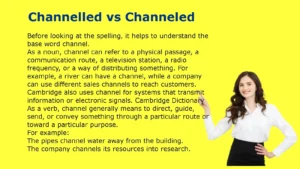
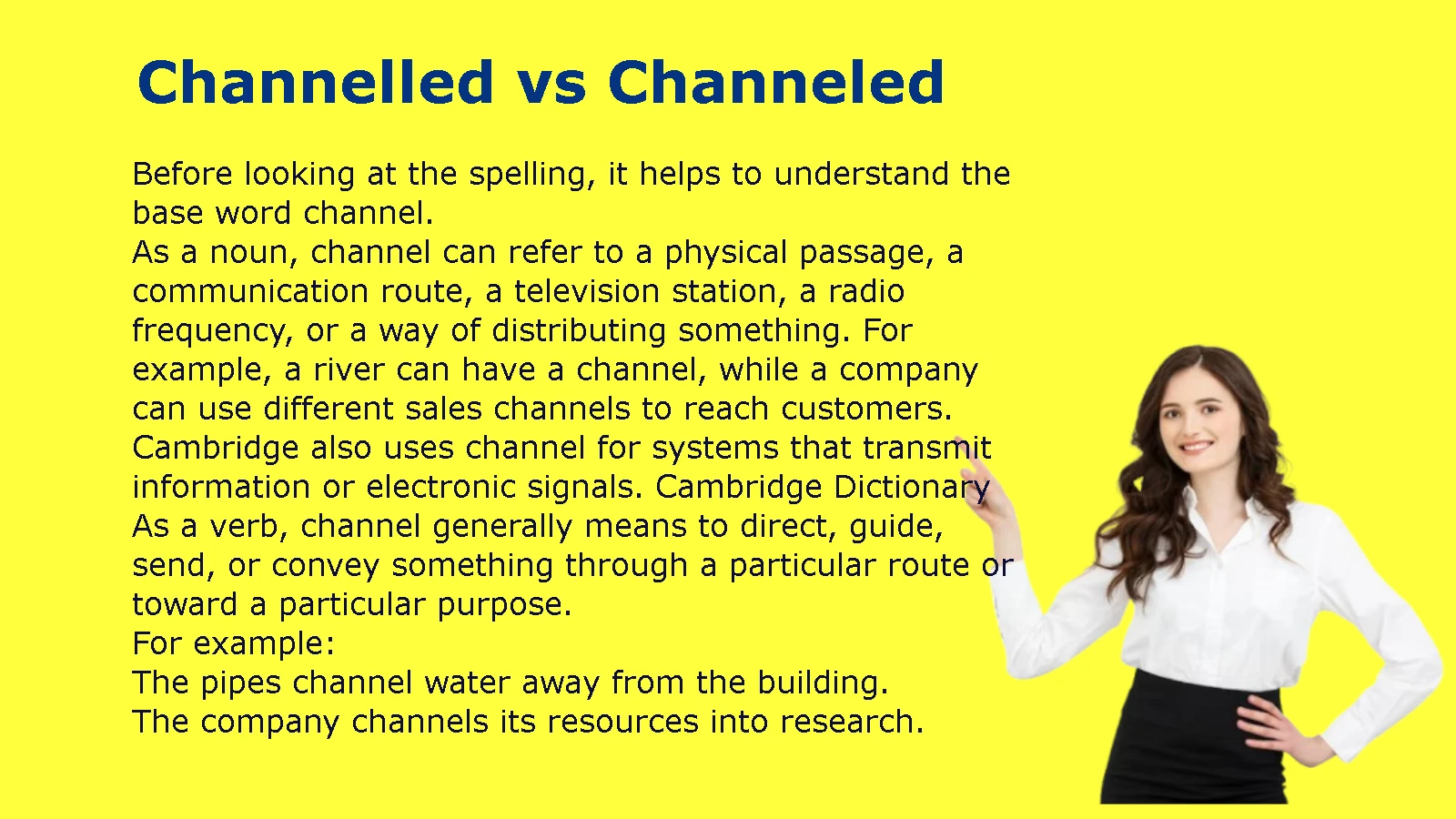
Before looking at the spelling, it helps to understand the base word channel.
As a noun, channel can refer to a physical passage, a communication route, a television station, a radio frequency, or a way of distributing something. For example, a river can have a channel, while a company can use different sales channels to reach customers. Cambridge also uses channel for systems that transmit information or electronic signals. Cambridge Dictionary
As a verb, channel generally means to direct, guide, send, or convey something through a particular route or toward a particular purpose.
For example:
- The pipes channel water away from the building.
- The company channels its resources into research.
- She channels her emotions into her artwork.
- The network channels information through secure systems.
The verb can describe both literal and figurative movement.
You can channel water through a pipe. You can also channel energy into a project.
Channeled: American English Spelling
Channeled is the standard American English spelling of the past tense and past participle of channel.
American English normally writes the word with one L before -ed:
channel → channeled
The spelling doesn’t change the meaning of the verb. It simply follows the American convention for words of this type.
Examples of channeled in American English
- She channeled her frustration into exercise.
- He channeled his creativity into writing.
- The organization channeled donations toward disaster relief.
- The engineer channeled the water away from the foundation.
- The company channeled more money into research.
- The musician channeled his emotions into the new album.
Notice that channeled can describe physical movement, money, effort, emotions, creativity, or information.
Channelled: British English Spelling
Channelled is the standard British English spelling.
British English doubles the final l before the ending in this word:
channel → channelled
Again, the extra l doesn’t create a different meaning. It signals a different spelling convention.
Examples of channelled in British English
- She channelled her frustration into exercise.
- He channelled his creativity into writing.
- The organization channelled donations toward disaster relief.
- The engineer channelled the water away from the foundation.
- The company channelled more money into research.
- The musician channelled his emotions into the new album.
Cambridge lists channelled as the British past-tense and past-participle form and channeled as the US form. Cambridge Dictionary
Why Are Channelled and Channeled Spelled Differently?
The difference comes from regional spelling conventions, particularly the treatment of a final l when certain suffixes are added.
British English commonly doubles the final l in words such as:
- travelled
- cancelled
- labelled
- channelled
- channelling
American English commonly uses one l in these corresponding forms:
- traveled
- canceled
- labeled
- channeled
- channeling
Cambridge’s dictionary entry summarizes the pattern directly as UK -ll- and US usually -l- for channel. Cambridge Dictionary
This doesn’t mean British writers randomly add letters. It’s a long-established spelling convention.
A useful comparison
Think of the pair as two regional settings for the same word:
American English
channel + ed → channeled
British English
channel + ed → channelled
The pronunciation and meaning remain essentially the same.
Channelled vs Channeled: What’s the Difference?
The difference is spelling and regional usage, not meaning.
Both words can function as:
- the past tense of channel
- the past participle of channel
Both can mean that someone or something directed something toward a particular destination, purpose, or route.
Side-by-side comparison
| Feature | Channeled | Channelled |
| Meaning | Same | Same |
| Past tense | Yes | Yes |
| Past participle | Yes | Yes |
| American English | Standard | Not the usual US form |
| British English | Not the usual UK form | Standard |
| Pronunciation | Essentially the same | Essentially the same |
| Present participle | channeling | channelling |
The spelling changes. The underlying word does not.
Channelled vs Channeled in a Sentence
The easiest way to understand the distinction is to compare equivalent sentences.
| American English | British English |
| She channeled her anger into exercise. | She channelled her anger into exercise. |
| He channeled his creativity into music. | He channelled his creativity into music. |
| The company channeled its resources into research. | The company channelled its resources into research. |
| They channeled the water away from the road. | They channelled the water away from the road. |
| The organization channeled donations to local communities. | The organization channelled donations to local communities. |
The sentence meaning stays exactly the same.
If you’re writing for an American audience, choose channeled. If you’re following British English, choose channelled.
Common Uses of Channeled and Channelled
The verb channel has several practical uses. Its past forms appear in everyday conversation as well as technical, academic, business, and creative writing.
Channeled or Channelled Energy
One common use involves directing physical or emotional energy toward a particular activity.
For example:
She channeled her energy into training for the competition.
A British writer would use:
She channelled her energy into training for the competition.
The idea is figurative. Energy isn’t literally traveling through a pipe. The sentence means that someone directed their effort toward a specific goal.
Channeled or Channelled Emotions
People also channel emotions into productive activities.
Consider:
He channeled his grief into writing music.
Here, channeled means that he used an intense emotional experience as motivation or creative material.
In British English:
He channelled his grief into writing music.
The meaning remains unchanged.
Channeled or Channelled Creativity
Creative writing often uses the verb this way:
The artist channeled her childhood memories into the painting.
This means the artist drew on those memories and expressed them through her work.
The British equivalent is:
The artist channelled her childhood memories into the painting.
Channeled or Channelled Resources
The word also works well in business, government, economics, and nonprofit contexts.
For example:
The company channeled more resources into product development.
Here, the resources aren’t physically moving through a tunnel. The sentence means the company directed money, employees, time, or other resources toward product development.
Cambridge gives similar uses for directing money and effort toward a particular purpose. Cambridge Dictionary
Channeled and Channelled as Past Tense
Both spellings can serve as the simple past tense of channel.
American English
The team channeled its efforts into improving customer service.
British English
The team channelled its efforts into improving customer service.
The base verb is channel.
The present form:
The team channels its efforts into customer service.
The past form:
The team channeled/channelled its efforts into customer service.
The spelling depends on the variety of English.
Channeled and Channelled as Past Participles
The same forms also work as past participles.
You’ll often see them after auxiliary verbs such as has, have, had, and been.
Present Perfect
American English:
The company has channeled its resources into renewable energy.
British English:
The company has channelled its resources into renewable energy.
Past Perfect
American English:
The organization had channeled most of its funding into education.
British English:
The organization had channelled most of its funding into education.
Passive Voice
American English:
The funds were channeled through several agencies.
British English:
The funds were channelled through several agencies.
The grammatical role stays the same. Only the spelling changes.
Channeling vs Channelling
The spelling difference doesn’t stop with -ed.
The present participle and gerund also have two regional forms:
- channeling = American English
- channelling = British English
For example:
American English
She is channeling her creativity into photography.
British English
She is channelling her creativity into photography.
Cambridge lists channeling as the US form and channelling as the mainly UK form. Cambridge Dictionary
Collins likewise gives channeling or channelling and channeled or channelled as the verb’s forms. Collins Dictionary
Quick comparison
| American English | British English |
| channel | channel |
| channels | channels |
| channeled | channelled |
| channeling | channelling |
This makes the pattern much easier to remember.
Channelled vs Channeled in Different Contexts
The spelling choice matters most when you’re writing for a specific audience.
Everyday Writing
In American English:
I channeled my frustration into cleaning the house.
In British English:
I channelled my frustration into cleaning the house.
Both sound natural within their respective spelling systems.
Academic Writing
Academic writers should follow the spelling convention required by their institution, publisher, or chosen style guide.
For example:
The researchers channeled their efforts toward developing a more efficient model.
An American publication would typically use channeled.
A British publication could use:
The researchers channelled their efforts toward developing a more efficient model.
The important point is consistency.
Business Writing
The word frequently appears when discussing money, resources, investment, or organizational effort.
American:
The company channeled $5 million into product development.
British:
The company channelled £4 million into product development.
Here, the verb means directed resources toward a particular purpose.
Scientific and Technical Writing
The verb can also describe physical processes.
For example:
The system channeled excess water away from the structure.
British English:
The system channelled excess water away from the structure.
The word can describe the movement of liquids, signals, data, energy, or other things through a defined route. Collins includes uses involving water, information, electronic signals, and other forms of transmission. Collins Dictionary
Channelled vs Channeled in Professional Writing
Professional writing often exposes spelling differences because documents cross borders.
Imagine a British company preparing a report for a US client. The British version might say:
The company channelled additional funds into research.
The American version might say:
The company channeled additional funds into research.
Neither version needs correction merely because the other spelling appears elsewhere.
The real issue is consistency
A document that begins with British spelling should normally continue using British spelling.
For example, if you write:
The company channelled its resources and cancelled the project.
switching later to:
The company channeled its resources and canceled the project.
can make the document look inconsistent.
That doesn’t make either form inherently wrong. It simply means the document has mixed spelling conventions.
Channelled vs Channeled: Related Spelling Patterns
The difference becomes easier to recognize when you compare similar words.
| American English | British English |
| canceled | cancelled |
| labeled | labelled |
| traveled | travelled |
| modeled | modelled |
| channeled | channelled |
| channeling | channelling |
These pairs aren’t identical in every detail. English spelling has plenty of exceptions and historical quirks. Still, they illustrate the familiar British tendency to double the final l in many such forms.
Cambridge explicitly notes the UK -ll- / US usually -l- pattern for channel. Cambridge Dictionary
Is Channelled a British Spelling?
Yes.
Channelled is the standard British English spelling of the past tense and past participle of channel.
You’ll commonly encounter it in British publications, books, academic writing, and websites.
For example:
The government channelled additional funding into public transport.
British English also uses:
channelling
for the present participle.
Is Channeled an American Spelling?
Yes.
Channeled is the standard American English spelling.
For example:
The government channeled additional funding into public transportation.
American English uses:
channeling
for the corresponding present participle.
Collins specifically identifies channeled and channeling as the American forms alongside the British channelled and channelling. Collins Dictionary
Why Does the Double L Matter?
The double l doesn’t change the meaning or pronunciation of the word. It tells readers which spelling convention you’re following.
Compare:
- channeled → US spelling
- channelled → UK spelling
This is similar to:
- color → US
- colour → UK
- center → US
- centre → UK
- canceled → US
- cancelled → UK
The differences don’t necessarily indicate different words. They’re often simply regional spelling choices.
An important distinction
Don’t confuse a spelling variation with a meaning variation.
If an American writer says:
She channeled her anger into exercise.
and a British writer says:
She channelled her anger into exercise.
they are saying the same thing.
Common Mistakes With Channelled and Channeled
Several mistakes appear repeatedly when writers aren’t sure which form to use.
Treating Channelled as Incorrect
A US writer may see channelled and assume someone added an unnecessary letter.
That’s not correct.
Channelled is a legitimate British spelling.
Treating Channeled as Incorrect
The opposite mistake happens too.
A British writer may assume channeled is misspelled because British English normally uses the double l.
In American English, however, channeled is standard.
Mixing the Two Forms
Another problem occurs when a writer mixes regional conventions.
For example:
The company channelled its resources into research and canceled the old program.
This combines a British spelling with an American spelling.
A consistently British version would be:
The company channelled its resources into research and cancelled the old program.
A consistently American version would be:
The company channeled its resources into research and canceled the old program.
Mixed varieties aren’t automatically incomprehensible. However, choosing one convention usually creates a cleaner and more professional document.
A Simple Case Study: Choosing the Right Spelling
Consider a writer preparing an American business report.
The writer drafts:
The company channelled more resources into artificial intelligence.
At first glance, nothing looks wrong. The sentence is grammatically clear and the meaning is obvious.
However, if the report consistently follows US English, the better spelling is:
The company channeled more resources into artificial intelligence.
Now imagine the same report follows British English. In that case, channelled fits the document’s spelling system.
What this shows
The decision isn’t about choosing the “more correct” word.
It’s about choosing the appropriate regional spelling.
| Situation | Best choice |
| US newspaper | channeled |
| US academic paper | channeled |
| US business report | channeled |
| UK newspaper | channelled |
| UK academic paper | channelled |
| UK business report | channelled |
Always check the specific publication’s style requirements when they exist.
How to Use Channeled Correctly
Use channeled when you’re writing in American English.
Channeled + Noun
The verb can directly take an object:
She channeled her frustration into exercise.
The company channeled its profits into research.
They channeled the water away from the building.
Channeled Into
One of the most common structures is:
channeled + something + into + something
Examples:
He channeled his energy into training.
She channeled her creativity into painting.
The company channeled its investment into new technology.
Channeled Through
Another common structure is:
channeled + something + through + something
Examples:
The funds were channeled through several organizations.
The information was channeled through the central system.
This structure emphasizes the route through which something moved.
How to Use Channelled Correctly
The grammatical structures remain the same in British English. Only the spelling changes.
Channelled + Noun
She channelled her frustration into exercise.
Channelled Into
The company channelled its resources into research.
Channelled Through
The funds were channelled through several agencies.
So if you understand how to use channeled, you already understand how to use channelled. You simply need to select the spelling that matches your variety of English.
Channelled vs Channeled: Facts to Remember
Here are the essential facts in one place:
- Channeled is standard American English.
- Channelled is standard British English.
- Both spellings are correct.
- Both have the same basic meaning.
- Both function as the past tense and past participle of channel.
- Channeling is the American form.
- Channelling is the British form.
- The spelling difference doesn’t create a pronunciation difference in ordinary usage.
- The extra l reflects a regional spelling convention.
- Consistency matters when writing formal or professional documents.
Channelled vs Channeled: Quick Comparison
| Question | Answer |
| Is channeled correct? | Yes |
| Is channelled correct? | Yes |
| Which is American? | Channeled |
| Which is British? | Channelled |
| Are they different in meaning? | No |
| Are they different in pronunciation? | Generally no |
| Past tense of channel? | Channeled/channelled |
| Past participle? | Channeled/channelled |
| American present participle? | Channeling |
| British present participle? | Channelling |
| Should you use both in one document? | Usually no |
| Is channelled a typo? | No |
| Is channeled a typo? | No |
Is Channelled or Channeled More Correct?
Neither is universally more correct.
The answer depends on the variety of English you’re using.
If you’re writing for a US audience, channeled is the natural choice.
If you’re writing for a UK audience, channelled is the natural choice.
The same principle applies to related words such as canceled/cancelled and labeled/labelled.
Dictionaries don’t treat one of these two forms as an accidental misspelling. Cambridge and Collins both document the two regional forms. Cambridge Dictionary
Is Channelled a Word?
Yes.
Channelled is a standard English word and the British spelling of the past tense and past participle of channel.
For example:
The resources were channelled into education.
It’s not an informal variant or an invented spelling.
Is Channeled a Word?
Yes.
Channeled is a standard English word and the American spelling of the past tense and past participle of channel.
For example:
The resources were channeled into education.
Both dictionaries and ordinary English usage support the form.
What Is the Past Tense of Channel?
The past tense is:
- channeled in American English
- channelled in British English
Examples:
She channeled her energy into her work.
She channelled her energy into her work.
Both sentences use the simple past tense.
What Is the Past Participle of Channel?
The past participle is also:
- channeled in American English
- channelled in British English
Examples:
The money has been channeled into research.
The money has been channelled into research.
So unlike some irregular verbs, channel doesn’t change to a completely different form. The main difference is the regional spelling of the ending.
What Is the Adjective Form of Channeled?
Channeled and channelled can also function adjectivally when they describe something that has been directed or routed through a channel.
For example:
The channeled water flowed away from the foundation.
British English:
The channelled water flowed away from the foundation.
However, whether the word functions grammatically as an adjective depends on its position and context. In many sentences, it remains a past participle rather than a straightforward adjective.
What About Channeler and Channeller?
The spelling distinction also appears in the noun referring to someone or something that channels.
American English commonly uses:
channeler
British English commonly uses:
channeller
Collins lists channeler as an American form and channeller as a British spelling. Collins Dictionary
This is another example of the same broader spelling pattern.
How to Remember Channelled vs Channeled
If you frequently forget which version belongs to which variety of English, use this simple memory trick:
US = one L. UK = two Ls.
So:
US: channeled → channeling
UK: channelled → channelling
You can connect it with familiar pairs:
- traveled / travelled
- canceled / cancelled
- labeled / labelled
- channeled / channelled
Once you recognize the pattern, channeled vs channelled becomes much easier to remember.
A Quick Spelling Test
Choose the correct form for each sentence based on the stated variety of English.
American English
- The company ______ its profits into research.
- She was ______ her emotions into her art.
- The water was ______ away from the building.
Answers:
- channeled
- channeling
- channeled
British English
- The company ______ its profits into research.
- She was ______ her emotions into her art.
- The water was ______ away from the building.
Answers:
- channelled
- channelling
- channelled
The only thing that changes is the spelling convention.
Channelled vs Channeled: Which One Should You Use?
The answer is straightforward.
Use Channeled for US English
Choose channeled when your audience uses American English.
This is especially appropriate for:
- US websites
- American business documents
- US academic writing
- American news content
- US-focused marketing
- General American English content
Use Channelled for British English
Choose channelled when you’re following British English conventions.
This includes:
- UK publications
- British academic writing
- UK business documents
- British news content
- UK-focused websites
Most importantly, stay consistent
Don’t switch between channeled and channelled without a reason.
A consistent spelling system makes your writing look intentional and polished.
Final Verdict: Channelled vs Channeled
Channelled and channeled are both correct spellings.
The difference is regional:
Channeled = American English
Channelled = British English
The words have the same meaning and perform the same grammatical functions. Both can serve as the past tense and past participle of channel.
The corresponding present participles follow the same pattern:
Channeling = American English
Channelling = British English
So, if you’re writing in US English, use channeled. If you’re following British English, use channelled.
There’s no need to wonder which spelling is “wrong.” The real question is simply which English convention your writing follows. Major dictionaries such as Cambridge and Collins recognize the distinction. Cambridge Dictionary
The easiest rule to remember
One L for American English. Two Ls for British English.
That one rule will keep channelled vs channeled straight in most situations.