Ever found yourself confused about Sensuous vs. Sensual and wondered if they mean the same thing? These two words are often mixed up because they both relate to the senses—but here’s the kicker: they actually describe very different kinds of experiences.
The problem is simple. In everyday writing and conversation, people use “sensual” when they really mean “sensuous,” and vice versa. That small mix-up can completely change the tone of what you’re trying to express.
Many writers and language learners struggle with this distinction in real-life usage, especially when describing art, experiences, emotions, or attraction. That’s why searches for sensuous meaning, sensual meaning, and their differences are so common.
But don’t worry—this gets easy once you see it clearly.
In this guide, you’ll learn the clear difference between Sensuous vs. Sensual, when to use each word correctly, and how they work in real sentences. You’ll also discover simple examples that make the distinction instantly understandable and memorable.
So if you want to sound more precise, natural, and confident in your word choice, keep reading—you’re in the right place.
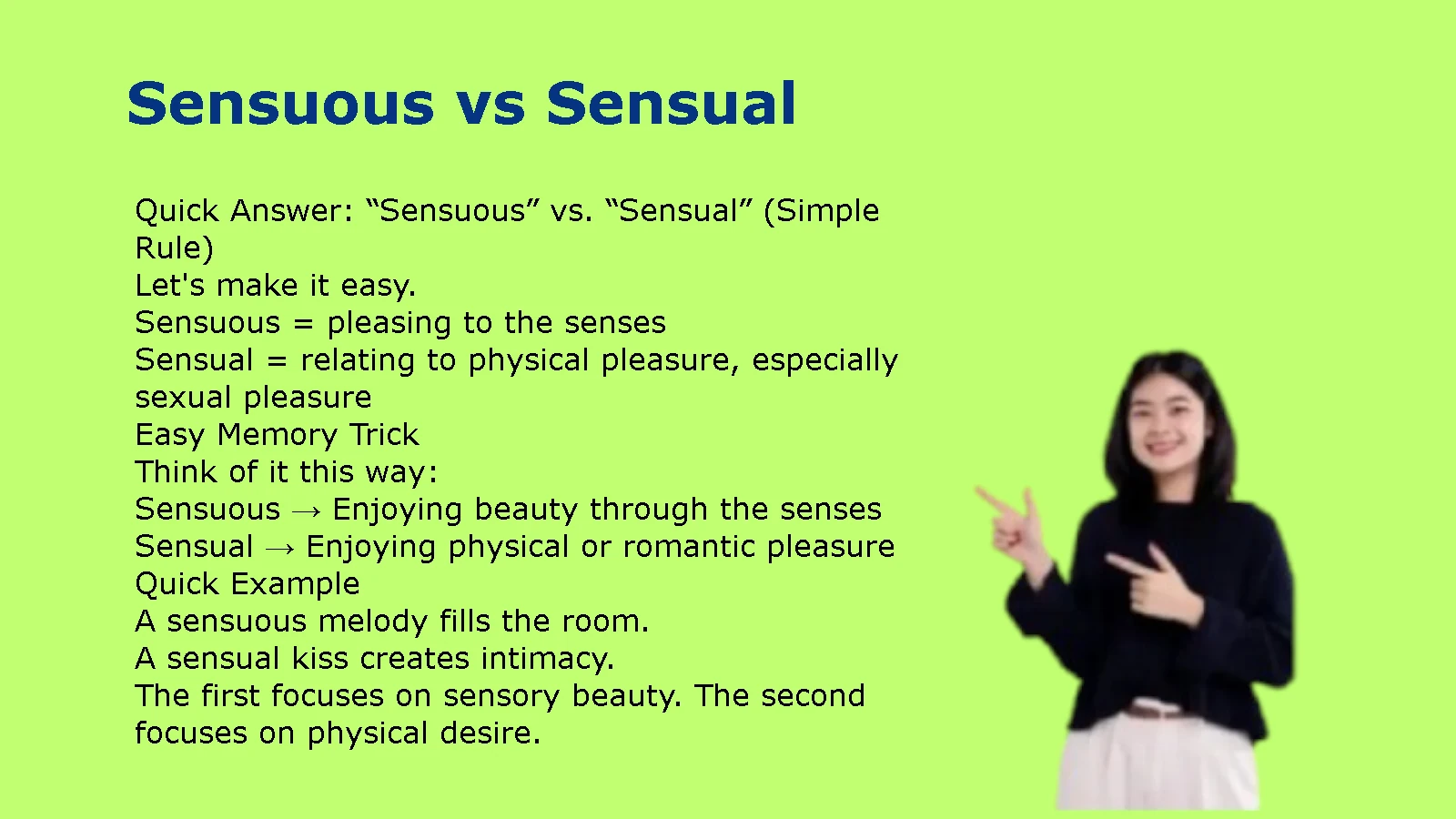
Quick Answer: “Sensuous” vs. “Sensual” (Simple Rule)
Let’s make it easy.
Sensuous = pleasing to the senses
Sensual = relating to physical pleasure, especially sexual pleasure
Easy Memory Trick
Think of it this way:
- Sensuous → Enjoying beauty through the senses
- Sensual → Enjoying physical or romantic pleasure
Quick Example
- A sensuous melody fills the room.
- A sensual kiss creates intimacy.
The first focuses on sensory beauty. The second focuses on physical desire.
How People Actually Use “Sensuous” and “Sensual”
Here’s where confusion begins.
Many people assume both words mean “appealing to the senses.” While that’s partly true, the emotional tone is different.
In Everyday Conversation
People often use “sensual” when they mean “sensuous.”
For example:
- “The restaurant had a sensual atmosphere.”
What they often mean is:
- “The restaurant had a sensuous atmosphere.”
In Literature and Art
Writers carefully choose between these words because each creates a different impression.
Why This Happens
- Both words come from the same root.
- Both involve the senses.
- Modern usage sometimes overlaps.
However, context usually determines which word is correct.
The Core Difference Between “Sensuous” and “Sensual”
The easiest way to understand these words is to focus on their purpose.
| Word | Primary Meaning | Common Association |
|---|---|---|
| Sensuous | Pleasing the senses | Beauty, art, music, nature |
| Sensual | Physical pleasure or desire | Romance, intimacy, sexuality |
Key Insight
Not everything that is sensuous is sensual.
A sunset can be sensuous.
A romantic embrace may be sensual.
“Sensuous” Explained Clearly (With Examples)
At its core, sensuous describes something that delights the senses.
It may involve:
- Sight
- Sound
- Taste
- Touch
- Smell
Importantly, it does not necessarily involve sexual attraction.
Common Examples
- A sensuous fragrance
- A sensuous painting
- A sensuous piece of music
- A sensuous garden
Example Sentences
- The violin produced a sensuous sound.
- The chef created a sensuous dining experience.
- The room was filled with sensuous aromas.
Key Takeaway
Sensuous focuses on sensory beauty and enjoyment rather than desire.
“Sensual” Explained Clearly (With Examples)
Now let’s look at the word that often causes confusion.
Sensual typically refers to physical pleasure and bodily desire.
In many contexts, it carries a romantic or sexual meaning.
Common Examples
- Sensual dancing
- Sensual touch
- Sensual attraction
- Sensual relationship
Example Sentences
- The movie featured a sensual romance.
- Their dance felt deeply sensual.
- The novel explored sensual desire.
Key Takeaway
Sensual usually involves physical enjoyment, attraction, or intimacy.
The Historical Connection Between the Two Words
Interestingly, the distinction wasn’t always so clear.
Historically, both words related to sensory experience.
Over time:
- Sensual became strongly associated with physical and sexual pleasure.
- Sensuous evolved to describe aesthetic enjoyment and sensory beauty.
Today, most style guides recognize this distinction.
Why It Matters
Modern readers often interpret “sensual” romantically, even when that wasn’t the writer’s intention.
The Biggest Mistake People Make
The most common error is using sensual when sensuous is actually intended.
Incorrect Example
“The museum displayed sensual artwork.”
This could suggest the artwork has sexual themes.
Better Choice
“The museum displayed sensuous artwork.”
Now the focus is on beauty and sensory appeal.
Lesson
If you’re describing art, music, food, or scenery, “sensuous” is often the safer choice.
Side-by-Side Comparison Table
Here’s a quick reference guide.
| Feature | Sensuous | Sensual |
|---|---|---|
| Related to the senses | Yes | Yes |
| Focus on beauty | Yes | Sometimes |
| Focus on physical desire | No | Yes |
| Common in art discussions | Yes | Less often |
| Romantic meaning | Usually no | Usually yes |
| Risk of misunderstanding | Low | Higher |
Real-Life Examples of “Sensuous”
Let’s make the meaning crystal clear.
In Art
“The artist used sensuous colors to create warmth.”
In Music
“The orchestra delivered a sensuous performance.”
In Food
“The dessert offered a sensuous blend of flavors.”
In Nature
“The garden provided a sensuous experience of color and fragrance.”
What They Share
All of these examples appeal to the senses without implying sexual desire.
Real-Life Examples of “Sensual”
Now compare them with sensual examples.
In Romance
“They shared a sensual evening together.”
In Literature
“The novel contains sensual scenes.”
In Dance
“The performance featured sensual movements.”
In Relationships
“Their connection felt intensely sensual.”
What They Share
Each example involves physical attraction, intimacy, or desire.
When “Sensuous” and “Sensual” Can Overlap
Sometimes the boundary isn’t completely rigid.
For example:
- A luxurious spa experience may be sensuous.
- It may also feel sensual depending on context.
Example
“The candlelit room created a sensuous atmosphere.”
Focus: sensory beauty.
“The candlelit room created a sensual atmosphere.”
Focus: romantic or intimate mood.
Key Insight
The difference often lies in the feeling the speaker wants to emphasize.
Common Writing Mistakes to Avoid
Writers frequently misuse these words.
Mistake #1: Using Sensual for Beautiful Things
Incorrect:
- A sensual sunset
Usually better:
- A sensuous sunset
Mistake #2: Ignoring Context
Incorrect:
- The museum offered a sensual experience.
Unless the exhibit is romantic in nature, “sensuous” works better.
Mistake #3: Assuming They Are Synonyms
While related, they are not interchangeable in every situation.
Professional and Academic Usage
In formal writing, precision matters.
Use “Sensuous” When Discussing
- Art
- Architecture
- Music
- Design
- Food
- Nature
Use “Sensual” When Discussing
- Human desire
- Intimacy
- Romance
- Sexuality
- Physical pleasure
Why Professionals Care
The wrong word can change the entire meaning of a sentence.
How to Choose the Right Word Every Time
Follow this simple test.
Ask Yourself:
Is the focus on sensory beauty?
→ Use sensuous
Is the focus on physical desire or intimacy?
→ Use sensual
Quick Formula
Beauty → Sensuous
Desire → Sensual
Simple and effective.
What to Say Instead (Clear Alternatives)
If you’re still unsure, consider alternatives.
Alternatives for Sensuous
- Beautiful
- Rich
- Evocative
- Aromatic
- Pleasing
- Lush
Alternatives for Sensual
- Romantic
- Passionate
- Intimate
- Erotic
- Seductive
- Physical
These words can sometimes communicate your meaning more clearly.
Quick Decision Guide (Use This Instantly)
When choosing between the two:
Choose “Sensuous” If:
- You’re describing art.
- You’re describing music.
- You’re describing scenery.
- You’re describing fragrance.
- You’re describing food.
Choose “Sensual” If:
- You’re describing romance.
- You’re describing attraction.
- You’re describing intimacy.
- You’re describing physical pleasure.
FAQ: “Sensuous” vs. “Sensual”
Are sensuous and sensual synonyms?
Not exactly. They overlap, but sensual usually has a stronger connection to physical or sexual pleasure.
Can a person be described as sensuous?
Yes. It can mean someone appreciates sensory beauty. However, many readers may still interpret it romantically.
Is sensual always sexual?
Not always. However, it often suggests physical desire or intimacy.
Which word is safer in formal writing?
Sensuous is generally safer when discussing art, beauty, food, music, or nature.
Case Study: A Meaning-Changing Word Choice
A travel writer reviewed a luxury resort.
Original Sentence
“The resort offers a sensual experience.”
Readers interpreted this as a romantic destination.
Revised Sentence
“The resort offers a sensuous experience.”
Now the focus shifted to:
- Beautiful views
- Relaxing sounds
- Pleasant fragrances
- Luxurious surroundings
Result
The message became much clearer.
Key Facts You Should Remember
- Sensuous means pleasing to the senses.
- Sensual usually involves physical pleasure or desire.
- Both words relate to sensory experiences.
- Sensuous is common in discussions of beauty and art.
- Sensual often carries romantic or sexual implications.
- Context determines the best choice.
- Using the wrong word can change your meaning.
Final Takeaway: The One Rule That Never Fails
Here’s the easiest way to remember the difference.
Sensuous celebrates the beauty of sensory experiences.
Sensual focuses on physical pleasure, attraction, and intimacy.
When describing a beautiful painting, delicious meal, soothing melody, or stunning landscape, choose sensuous.
When describing romance, desire, or physical affection, choose sensual.
Think of it this way:
Beauty → Sensuous
Desire → Sensual
Follow that rule, and you’ll rarely confuse “sensuous” vs. “sensual” again.