Have you ever paused while writing and wondered: is it Cryer vs Crier? These two words look almost the same, sound nearly identical, and often confuse even native English speakers.
The word Crier is a noun meaning one who cries or makes public announcements in public places, especially in older contexts of English and old books. But here’s the twist: the spelling “Cryer” sometimes appears too, leading to confusion in writing, exams, and daily English use.
Many people think both spellings are interchangeable. And that’s where the problem begins. Similar to tricky word pairs like drier vs dryer or flier vs flyer, small spelling changes can lead to different meanings or accepted usage in modern varieties of English.
But here’s the good news: this guide will make it clear, simple, and easy to understand. You’ll learn the correct word, how it is used in different situations, and why one spelling is more common today while the other is gradually disappearing.
And it gets better…
Through short sentences, real-life stories, and perfect examples, even a 4th-grade student can understand the difference easily. By the end, you’ll feel confident choosing the right word without hesitation in speaking or writing.
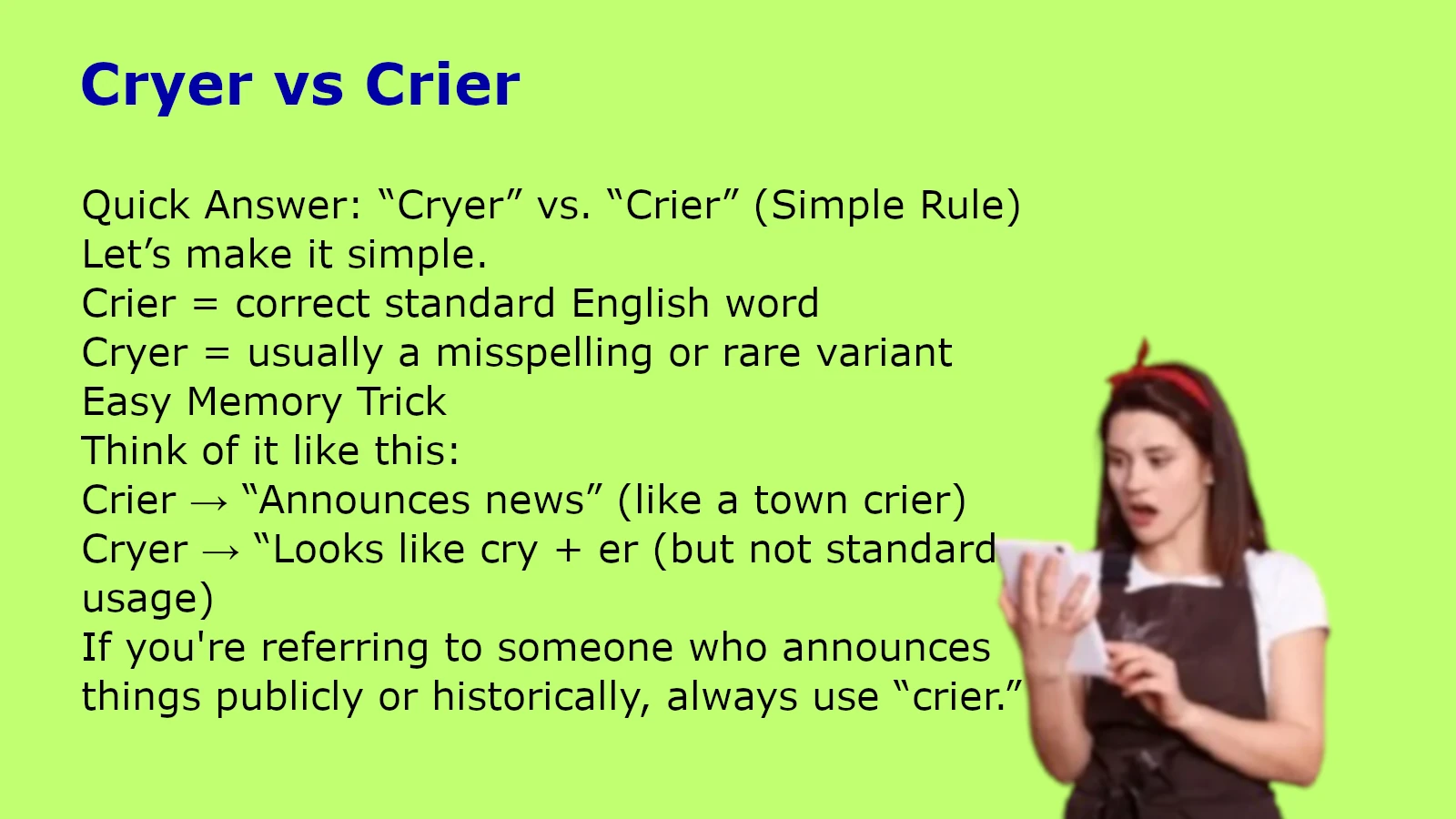
Quick Answer: “Cryer” vs. “Crier” (Simple Rule)
Let’s make it simple.
Crier = correct standard English word
Cryer = usually a misspelling or rare variant
Easy Memory Trick
Think of it like this:
- Crier → “Announces news” (like a town crier)
- Cryer → “Looks like cry + er (but not standard usage)
If you’re referring to someone who announces things publicly or historically, always use “crier.”
What “Crier” Actually Means (With Real Usage)
The word crier has a clear meaning in English.
Standard Meaning
A crier is someone who calls out news, announcements, or proclamations publicly.
Example
- “The town crier announced the king’s arrival.”
Modern Usage
Today, it’s mostly used in:
- Historical contexts
- Storytelling
- Formal writing
- Metaphorical expressions
Example in Modern Context
- “The media acted as a crier of breaking news.”
What About “Cryer”? Is It Correct?
Here’s where confusion starts.
Standard English Rule
“Cryer” is not a standard word in modern English dictionaries when referring to an announcer.
When You Might See “Cryer”
- Misspellings of crier
- Rare surname usage (e.g., a last name)
- Informal writing errors
Key Insight
If you mean someone who “cries out” or announces something, you should always write “crier.”
The Grammar Logic Behind “Crier vs. Cryer”
Let’s break it down simply.
Root Word
- Cry (verb) → to shout or call out
Correct Formation
- Cry + -er → crier
This follows a common English pattern:
- teach → teacher
- sing → singer
- cry → crier
Why “Cryer” Feels Wrong
It visually looks logical, but English spelling doesn’t use “cryer” in standard noun formation.
“Crier” in Historical Context (Easy to Visualize)
To really understand the word, picture old times.
Town Crier Scenario
Monarch-era streets:
- A man walks through the town square
- Rings a bell
- Shouts royal announcements
That person is the town crier.
Example Sentence
- “The crier gathered villagers in the square to read the decree.”
This is the most iconic use of the word.
Common Mistake People Make
Here’s the real issue:
People assume:
“Cry + er should become cryer”
But English doesn’t always follow spelling intuition.
What Goes Wrong
- Writers type “cryer” thinking it looks correct
- Spellcheck sometimes misses context
- Readers get confused or distracted
Result
A small spelling error can make writing look less professional.
Side-by-Side Comparison Table
| Word | Meaning | Correct Usage | Common Issue |
|---|---|---|---|
| Crier | Announcer or one who calls out news | ✔ Standard English | Rare usage today |
| Cryer | Usually incorrect spelling or surname | ❌ Not standard | Often a mistake |
Real-Life Examples of “Crier”
Let’s see it in action.
Historical Example
- “The royal crier declared the festival open.”
Literary Example
- “He acted as a crier of truth in a corrupt city.”
Modern Metaphor
- “Social media has become a crier of global events.”
Real-Life Examples of “Cryer”
Now compare how “cryer” appears.
Common Cases
- “John Cryer” (surname)
- Misspelled word in informal writing
- Auto-correct errors
Example (Incorrect Usage)
- ❌ “The town cryer announced the news.”
- ✔ “The town crier announced the news.”
Why This Confusion Happens
English is full of tricky patterns.
Main Reasons
- Words that sound the same
- Overgeneralization of “-er” endings
- Lack of exposure to historical vocabulary
Key Insight
People rely on sound, but English spelling relies on convention.
How to Avoid Mistakes Every Time
Here’s a simple system:
1. Think Meaning First
Ask:
- “Is this someone who announces things publicly?”
If yes → use crier
2. Use Spellcheck—but don’t fully trust it
Some tools may not flag “cryer” in all contexts.
3. Replace with a test sentence
- “town ___”
If it sounds historical → crier
What to Say Instead (If You’re Unsure)
If you don’t want to risk confusion, use clearer alternatives:
Better Words
- announcer
- speaker
- messenger
- herald
Example
Instead of:
- “The crier of news”
You can say:
- “The news announcer”
Quick Decision Guide
Use this every time:
- Historical announcer → crier
- Spelling of “cry + er” → usually wrong
- Name/surname → may be “Cryer”
Still unsure? Rewrite the sentence in simpler words.
FAQ: “Cryer vs. Crier”
Is “cryer” ever correct?
Only as a surname or proper name. Not as a common noun.
What is a “town crier”?
A historical figure who publicly announced news in towns.
Why is it spelled “crier” and not “cryer”?
Because English follows established noun patterns like “cry → crier.”
Which one should I use in writing?
Always use crier unless referring to a name.
Key Facts You Should Remember
- Crier = correct English word
- Cryer = usually incorrect or a name
- The root is “cry,” but the noun form is “crier”
- Context decides clarity, not spelling assumptions
Final Takeaway: The One Rule That Never Fails
Here’s the simplest way to lock it in:
If someone is calling out news or announcements → it’s “crier.”
English can be messy, but this rule isn’t.
So next time you see cryer vs. crier, you won’t guess—you’ll know.
Because in clear writing, one letter can make all the difference.