Computerized or computerised—which spelling should you use? Both are correct, but the choice depends on the type of English you write. Computerized is the standard spelling in American English, while computerised is commonly used in British English and other varieties that follow British spelling conventions.
The word describes something that uses computers to perform, manage, or control tasks. You will encounter it in phrases such as computerized accounting, computerized systems, computerized records, and computerized tomography. Understanding its meaning also helps you choose the right synonym, use the word naturally in a sentence, and distinguish it from related terms such as automated, digital, and computer-generated.
This guide explains the difference between computerized and computerised, covers their meanings and pronunciations, and provides practical examples for everyday writing, business, and technical contexts.
Computerized or Computerised: Which One Is Correct?
Both computerized and computerised are correct spellings of the same word. American English generally uses computerized, whereas British English commonly uses computerised. The spelling does not change the meaning or pronunciation.
Here is a quick comparison:
| Feature | Computerized | Computerised |
| Common usage | American English | British English |
| Meaning | Using or controlled by computers | Using or controlled by computers |
| Pronunciation | Generally the same | Generally the same |
| Example | The hospital computerized its records. | The hospital computerised its records. |
| Related verb | Computerize | Computerise |
| Related noun | Computerization | Computerisation |
The main difference is the spelling of the ending. American English typically favors -ize, while British English often uses -ise in words such as computerise. British usage is not completely uniform, however. Some British publications and style guides also use -ize spellings.
Computerized vs. Computerised in American and British English
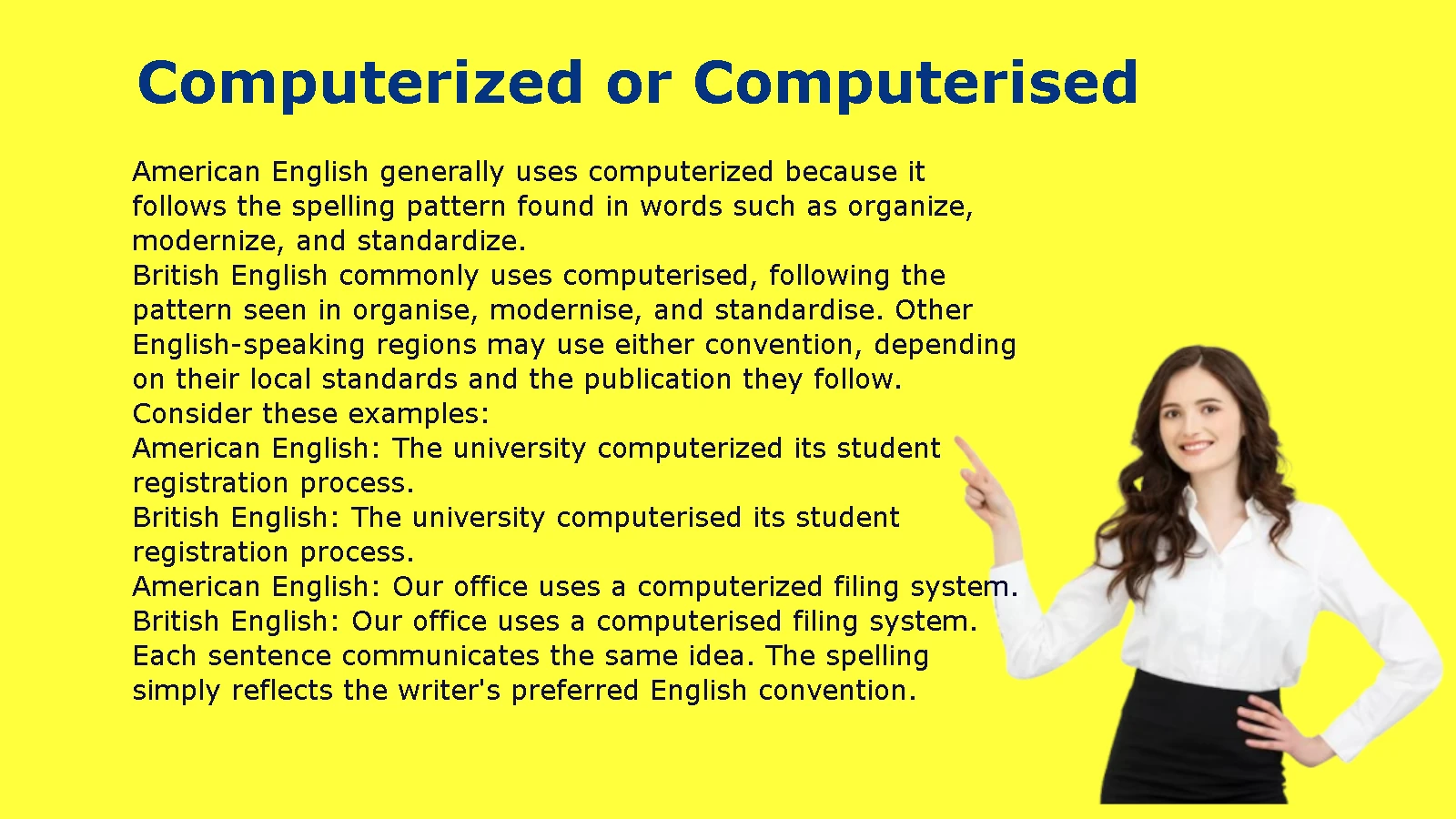
American English generally uses computerized because it follows the spelling pattern found in words such as organize, modernize, and standardize.
British English commonly uses computerised, following the pattern seen in organise, modernise, and standardise. Other English-speaking regions may use either convention, depending on their local standards and the publication they follow.
Consider these examples:
- American English: The university computerized its student registration process.
- British English: The university computerised its student registration process.
- American English: Our office uses a computerized filing system.
- British English: Our office uses a computerised filing system.
Each sentence communicates the same idea. The spelling simply reflects the writer’s preferred English convention.
One important detail is that British English does not always require -ise. Some British dictionaries, publishers, and institutions accept or prefer -ize in certain words. Therefore, do not assume that every British writer must use computerised.
Which Spelling Should You Use?
Choose the spelling that matches your audience and keep it consistent throughout your document.
Use computerized when writing for:
- American readers
- US-based businesses
- American academic institutions
- Publications that follow American spelling conventions
Use computerised when writing for:
- British readers who expect -ise spellings
- UK-based organizations that follow this convention
- Publications that specify British -ise spelling
For example, if you are preparing a report for a US accounting firm, write, “The company introduced a computerized accounting system.” If you are writing for a UK organization that follows -ise spelling, use “The company introduced a computerised accounting system.”
SEO and editing tip: Search engines can generally recognize both spelling variants. You do not need to repeat both forms unnaturally throughout an article. Use the appropriate form in the main text and mention the alternative spelling where it helps readers understand the difference.
Computerized Meaning and Definition
Computerized means converted to, operated through, or managed with the help of a computer system. It describes a process, service, record, or machine that uses computers to handle tasks that people might otherwise perform manually. For example, a computerized payroll system calculates employee wages and prepares payment records using software.
The term can describe a wide range of activities, from storing customer information to controlling industrial equipment. Its exact meaning depends on the noun it modifies.
What Does Computerized Mean in Simple Words?
In simple terms, something is computerized when a computer helps perform or manage its work.
Imagine a small shop that records every sale in a paper notebook. The owner writes down the item, price, quantity, and payment method after each transaction. As the business grows, this manual process becomes slow and difficult to manage.
The owner then starts using a computer program to record sales, calculate totals, track inventory, and generate reports. The shop has introduced a computerized sales system.
The basic task remains the same: recording sales. However, the computer now handles much of the calculation, organization, and recordkeeping.
Here are more examples:
- A computerized library system tracks books, borrowers, and return dates.
- A computerized attendance system records when employees or students arrive.
- A computerized booking system manages appointments and reservations.
- A computerized inventory system tracks stock levels and product movements.
- A computerized banking system processes transactions and maintains account records.
Computerization can improve speed and organization, but it does not guarantee accuracy. Incorrect data, software errors, and poor system design can still cause problems. Human review remains important in many applications.
Computerized as an Adjective
Computerized is an adjective. It describes a noun by explaining that a computer system plays a role in its operation or management.
For example:
- Computerized records: Records stored or managed using computer systems.
- Computerized equipment: Equipment that uses computer-based controls.
- Computerized database: A database maintained through digital computer technology.
- Computerized process: A workflow that uses computers to perform or coordinate tasks.
- Computerized system: A system that relies on computer hardware or software for some or all of its functions.
The word can also appear after a linking verb.
For example:
“The company’s inventory system is computerized.”
In this sentence, computerized describes the inventory system. It tells the reader how the system operates.
You can also use the word in its verb-related forms:
- Computerize: To introduce computers into a process or system.
- Computerized: The past tense and past participle of computerize, as well as an adjective.
- Computerizing: The present participle of computerize.
- Computerization: The process of introducing computer systems into an activity.
These forms are related, but they serve different grammatical purposes.
Computerized vs. Automated
The words computerized and automated overlap, but they do not mean exactly the same thing.
Computerized emphasizes the use of computers. Automated emphasizes the ability of a system to perform tasks with limited human intervention.
| Term | Main emphasis | Example |
| Computerized | Use of computer technology | A computerized patient database |
| Automated | Tasks performed with limited manual input | An automated payment reminder |
| Digital | Information represented or handled electronically | A digital document |
| Mechanized | Use of machinery to perform work | A mechanized production line |
| Computer-generated | Content or output produced by a computer | A computer-generated invoice |
A system can be computerized without being fully automated. For example, a computerized accounting program might store financial transactions, but an accountant still enters the information and approves the final reports.
Similarly, an automated system does not always require a general-purpose computer. Some automated devices use dedicated electronic controllers or other control mechanisms.
The distinction matters when you choose words for technical documents. If you want to emphasize the technology, use computerized. If you want to emphasize reduced manual effort, automated may be more precise.
Computerized Examples in Everyday English
The best way to understand a word is to see how it works in different contexts. Computerized usually appears before a noun to describe a process, service, record, machine, or system that relies on computers.
Computerized in Example Sentences
Here are original examples that show how to use the word naturally.
Business and office work
- The company introduced a computerized payroll system to calculate employee salaries.
- Our office keeps computerized records of customer orders.
- The manager replaced the paper filing cabinet with a computerized document management system.
- A computerized scheduling tool helps the team avoid appointment conflicts.
Education
- The school uses a computerized attendance system to record student arrivals.
- Students completed the computerized examination in a supervised laboratory.
- The university developed a computerized database for managing research projects.
Healthcare
- The clinic uses a computerized system to organize patient appointments.
- Doctors reviewed the patient’s information through a computerized medical records system.
- The hospital installed computerized monitoring equipment in its intensive care unit.
Manufacturing and technology
- The factory relies on computerized controls to operate its production equipment.
- Engineers used a computerized model to test the design before manufacturing began.
- The warehouse uses computerized inventory tracking to monitor stock levels.
Everyday life
- The library introduced a computerized catalog to help visitors find books.
- The hotel uses a computerized reservation system to manage room bookings.
- The repair shop keeps computerized records of customer vehicles and service dates.
These examples show that computerized is useful in formal and everyday contexts. The word does not necessarily mean that a process operates without people. It only indicates that computer technology plays a role in the process or system.
Computerized in Formal and Informal Writing
In formal writing, computerized often appears in reports, research papers, technical documents, and business communication.
For example:
“The organization implemented a computerized inventory management system to improve stock tracking and reporting.”
This sentence sounds appropriate in a business report because it identifies the system and explains its purpose.
In everyday conversation, a simpler expression may sound more natural.
For example:
“We keep all our customer records on the computer now.”
Both sentences communicate a similar idea, but they suit different situations.
Use computerized when you need a concise description of a system or process. Use a more specific phrase when the reader needs to understand exactly what the technology does.
Compare these sentences:
- General: The company uses a computerized system.
- More specific: The company uses a computerized system to track orders, update inventory, and generate invoices.
The second sentence provides more useful information. It explains the actual function of the system instead of relying on a broad label.
Common Grammar Patterns
You will often find computerized in compound descriptions. The noun that follows determines the exact meaning.
| Phrase | Meaning | Example |
| Computerized system | A system that uses computers | We installed a computerized system for tracking deliveries. |
| Computerized records | Records managed electronically | The clinic transferred its files to computerized records. |
| Computerized accounting | Accounting supported by computer software | Computerized accounting reduced the time needed to prepare reports. |
| Computerized equipment | Equipment with computer-based functions or controls | The factory purchased computerized equipment for production. |
| Computerized database | A database maintained through computer technology | The team searched the computerized database for customer details. |
| Computerized testing | Testing delivered or managed using computers | Applicants completed computerized testing at the center. |
A common pattern is computerized + noun. This construction makes the word useful in technical descriptions and concise business writing.
Remember that computerized does not always mean online. A computerized system can operate on a local computer or private network without an internet connection.
Computerized Synonyms and Related Words
Several words can replace computerized, but each one emphasizes a slightly different feature. The best synonym depends on whether you want to highlight computer use, electronic information, task automation, or the production of digital content.
Common Synonyms for Computerized
Computer-based is one of the closest alternatives. It emphasizes that a process or system depends on computer technology.
Example: “The training center uses a computer-based assessment.”
Automated describes a task or process that operates with limited human intervention.
Example: “The warehouse uses an automated system to sort packages.”
Digital describes information or processes handled through digital technology.
Example: “Customers can access their digital account statements.”
Electronic emphasizes the use of electronic technology to store, process, or transmit information.
Example: “The company sends electronic invoices to its clients.”
Digitized means converted into digital form, particularly when information originally existed in a physical or analog format.
Example: “The museum digitized its collection of historical photographs.”
Mechanized describes work performed with machinery rather than entirely by hand.
Example: “The farm mechanized several stages of its harvesting process.”
These alternatives are not always interchangeable. For instance, scanning a paper document makes it digital or digitized, but it does not necessarily make the entire document-handling process computerized or automated.
Computerized vs. Digital vs. Automated
Choosing the right word helps you describe technology accurately.
| Word | What it emphasizes | Best use |
| Computerized | Computer involvement | Computerized accounting software |
| Digital | Digital information or technology | Digital photographs and documents |
| Automated | Reduced manual intervention | Automated invoice reminders |
| Electronic | Electronic processing or communication | Electronic signatures and payments |
| Digitized | Conversion into digital form | Digitized paper archives |
| Computer-generated | Output created by a computer | Computer-generated reports |
Consider a company that converts old paper invoices into scanned files, stores them in a database, and automatically sends payment reminders.
The company has digitized the paper invoices, stores them in a computerized database, and uses an automated reminder process. It may send the reminders through electronic communication.
Each word describes a different part of the same workflow. Using the correct term gives readers a clearer picture of what the technology actually does.
How to Choose the Best Computerized Synonym
Ask yourself what you want to emphasize.
- If the main point is the use of a computer, choose computerized or computer-based.
- If the process runs with minimal human involvement, choose automated.
- If you mean information stored or handled in digital form, choose digital.
- If you mean a message, payment, or document transmitted electronically, choose electronic.
- If you mean converting paper or analog information into digital form, choose digitized.
- If you mean a document or report produced by software, choose computer-generated.
For example, “The company computerized its customer records” describes the adoption of a computer system. “The company digitized its paper records” emphasizes the conversion of existing physical records into digital files.
That difference can be important in business reports, project descriptions, and technical writing.
Computerized Accounting: Meaning and Examples
Computerized accounting is the use of computer systems and accounting software to record, process, organize, and report financial transactions. Instead of relying entirely on handwritten ledgers or manual calculations, businesses use software to maintain accounts, prepare invoices, reconcile transactions, and generate financial reports.
The term is common in small businesses, large companies, nonprofit organizations, and professional accounting firms.
What Is Computerized Accounting?
Computerized accounting combines accounting principles with computer software. The software helps users record financial information and process it according to the organization’s accounting procedures.
A typical computerized accounting system may handle:
- Sales and purchase transactions
- Customer invoices
- Supplier payments
- Accounts receivable and accounts payable
- Bank reconciliations
- Expense tracking
- Payroll records
- Financial statements
For example, a small online store may use accounting software to record sales, track expenses, and calculate its monthly revenue. The owner can review the information without manually adding every transaction in a notebook.
However, the software still depends on accurate input and suitable configuration. If the business records an expense incorrectly or assigns a transaction to the wrong account, the resulting reports may also be incorrect.
Computerized accounting improves the way financial data is processed, but it does not eliminate the need for sound accounting practices and human oversight.
Examples of Computerized Accounting
Consider a small business that sells clothing online.
When a customer purchases a shirt, the business records the sale in its accounting software. Depending on the system’s setup, the software may then:
- Record the sales transaction.
- Calculate applicable taxes based on the configured rules.
- Update the customer’s outstanding balance, if the sale was made on credit.
- Record the payment when it arrives.
- Include the transaction in relevant financial reports.
The business owner can then review sales, expenses, outstanding invoices, and cash flow from one system.
Other examples include:
- Invoice generation: Software prepares invoices using stored customer and product information.
- Expense tracking: Employees submit expenses that the accounting system categorizes and records.
- Payroll processing: The system calculates wages using employee data and configured payroll rules.
- Financial reporting: Accountants generate profit-and-loss statements and balance sheets from recorded transactions.
- Bank reconciliation: Software helps match recorded transactions with bank statement entries.
These functions reduce repetitive work and can make financial information easier to review.
Computerized Accounting vs. Manual Accounting
Both methods support the same underlying accounting principles, but they differ in how people record and process information.
| Feature | Computerized accounting | Manual accounting |
| Data entry | Entered into accounting software | Written in ledgers or paper records |
| Calculations | Often performed automatically by software | Frequently calculated by hand |
| Reporting | Reports can be generated from recorded data | Reports require manual preparation |
| Record retrieval | Search and filtering tools can speed up access | May require reviewing physical records |
| Error risks | Data entry and software configuration errors remain possible | Transcription and calculation errors remain possible |
| Backup | Digital backups can protect records | Paper records require physical protection or copying |
| Human oversight | Needed for review, corrections, and decisions | Needed for recording, checking, and reporting |
Computerized accounting often suits businesses with frequent transactions because it makes recordkeeping and reporting more efficient. Manual accounting may still suit very small operations with limited activity, although the right approach depends on the business’s needs and legal obligations.
Practical example: A retailer who processes 15 sales per month may manage the records with a simple spreadsheet. A retailer processing hundreds of transactions each day may benefit from dedicated accounting software that integrates with its payment and inventory systems.
In either case, accurate records, appropriate access controls, and regular reconciliation remain essential.
Computerized Letter: Meaning and Usage
A computerized letter generally refers to a letter created, formatted, or generated using a computer. The phrase is understandable, but it may not be the most natural choice in every situation. Terms such as computer-generated letter, typed letter, or digitally prepared letter often describe the intended meaning more precisely.
What Is a Computerized Letter?
The phrase can refer to several kinds of written communication.
A letter might be typed in a word processor, generated automatically from a database, or prepared through a business communication system. These processes involve computers, but they are not identical.
For example, an employee may type a personal letter using a word processor. A bank may use software to generate thousands of standardized notices containing customer names, account details, and payment dates.
The first is a computer-typed letter. The second is more accurately described as a computer-generated letter if the software produces the document automatically from stored information.
The intended meaning determines which expression works best.
Examples of Computerized Letters
Here are common examples of letters prepared or generated with computer technology:
- Billing letters: A company generates notices containing invoice numbers, amounts due, and payment deadlines.
- Appointment letters: An organization prepares standardized documents with employee names, job titles, and joining dates.
- Business correspondence: Staff members create letters using a word processor and company templates.
- Customer service letters: A company produces responses using predefined formats and customer records.
- Official notices: An institution generates formal notices from a document management system.
For instance, an employer may use a template to prepare an appointment letter. The software inserts the employee’s name, position, salary details, and start date into the appropriate fields.
This approach can save time and maintain consistent formatting, although someone should still review the letter before sending it.
Is “Computerized Letter” Grammatically Correct?
Yes, the phrase is grammatically possible because computerized can function as an adjective modifying letter. However, its meaning may be vague.
Use the following alternatives when you need greater precision:
| Intended meaning | More natural phrase | Example |
| A letter typed on a computer | Typed letter | She submitted a typed letter of application. |
| A letter produced automatically by software | Computer-generated letter | The system sent a computer-generated payment notice. |
| A letter prepared using digital tools | Digitally prepared letter | The office submitted a digitally prepared letter. |
| A letter created using a word processor | Letter created in a word processor | He drafted the letter in a word processor. |
If the distinction matters, describe how the letter was produced rather than relying on computerized alone.
Computerized Pronunciation
The pronunciation of computerized is generally the same as that of computerised. The difference between the two spellings does not usually create a difference in spoken English.
How to Pronounce Computerized
In American English, computerized is commonly pronounced with four syllables:
kuhm-PYOO-tuh-ryzd
A standard American English IPA transcription is /kəmˈpjuːtəˌraɪzd/.
The primary stress falls on the second syllable, the one containing the sound associated with -pyoo-.
To practice the word:
- Start with the unstressed opening syllable.
- Emphasize the second syllable.
- Move smoothly through the remaining sounds.
- Finish with the sound represented by -ized.
The ending sounds like a single unit rather than a separate word.
For example, say the following sentence aloud:
“The company computerized its entire filing system.”
Practicing the word within a sentence helps you maintain natural rhythm and connect the ending to the next word.
Is Computerised Pronounced Differently?
No major pronunciation difference follows from the spelling alone. Speakers may have regional differences in their vowels or rhythm, but computerized and computerised generally refer to the same spoken word.
The spelling choice is primarily a matter of written English convention.
Compare the two forms:
- American spelling: computerized
- British-style spelling: computerised
Both can appear in speech as the same word. You do not need to change the pronunciation simply because the written form contains s instead of z.
Common Pronunciation Mistakes
Some learners place the stress incorrectly or pronounce each written section too separately.
To improve your pronunciation:
- Focus on the main stress: Emphasize the second syllable.
- Avoid excessive pauses: Say the word smoothly rather than separating every syllable.
- Practice the ending: The final part should flow naturally.
- Listen to the complete sentence: Word stress often becomes easier to understand in context.
Remember that pronunciation varies by accent. A British speaker and an American speaker may produce slightly different vowel sounds while pronouncing the same word correctly.
Computerized Tomography: Meaning and Uses
Computerized tomography is a medical imaging term associated with computed tomography, commonly abbreviated as CT. A CT scan uses X-rays and computer processing to create cross-sectional images of the body. Medical professionals use these images to examine internal structures and help investigate injuries, diseases, and other health conditions.
This is a specialized use of computer technology, so its meaning is more specific than the everyday meaning of computerized.
What Is Computerized Tomography?
Tomography is an imaging method that produces views of internal structures in sections or slices. In CT imaging, an X-ray source and detectors collect information from multiple angles as the scanner rotates around the patient.
A computer processes the collected measurements to reconstruct images of the body’s internal structures. These images can show bones, organs, blood vessels, and other tissues in considerable detail.
Unlike a conventional two-dimensional X-ray image, CT imaging allows medical professionals to examine cross-sectional views and, when appropriate, reconstructed three-dimensional representations.
CT scanners serve many clinical purposes, including the assessment of certain injuries, the investigation of suspected diseases, and the planning or monitoring of some treatments.
A CT scan does involve exposure to ionizing radiation. Medical professionals therefore consider the clinical benefit, the patient’s circumstances, and whether another imaging method may be suitable.
What Is Computerized Tomography Used For?
Healthcare professionals use CT imaging in different clinical situations.
Examples include:
- Injury assessment: Examining internal injuries after certain accidents or traumatic events.
- Brain imaging: Investigating conditions such as suspected bleeding or some causes of acute neurological symptoms.
- Chest imaging: Examining the lungs and other structures in the chest.
- Abdominal imaging: Investigating selected problems involving abdominal organs.
- Cancer care: Helping assess some tumors, support treatment planning, or monitor changes over time.
- Procedure guidance: Supporting the planning or guidance of selected medical procedures.
The appropriate imaging test depends on the clinical question. CT is not automatically the best option for every condition. Ultrasound, magnetic resonance imaging (MRI), and conventional X-rays each have different strengths and limitations.
Computerized Tomography vs. CT Scan
The terms are closely related, but modern medical terminology generally favors computed tomography as the formal name of the imaging technique.
| Term | Meaning |
| Computerized tomography | A recognizable term used to describe CT imaging |
| Computed tomography | The standard technical name for the imaging method |
| CT scan | The common shortened expression for a computed tomography scan |
In everyday conversation, people usually say CT scan. In medical documentation, computed tomography is the standard technical term.
The phrase computerized tomography remains understandable because computers play a central role in reconstructing the images. However, writers preparing formal medical content should generally use computed tomography unless they are specifically discussing the alternative wording.
This example also shows why context matters when interpreting the word computerized. In a general sentence, it describes the use of computers. In a medical phrase, it forms part of a specialized technical expression.
Computerized or Computerised: Common Spelling Mistakes
The difference between computerized and computerised is part of a wider spelling pattern in English. Understanding the related forms helps you avoid inconsistent spelling in articles, reports, and professional documents.
Computerized, Computerised, and Computerize
Computerize is the American English verb meaning to introduce computers into a process or system. Computerise is its common British English counterpart.
The forms change according to their grammatical function.
| Form | American English | British-style spelling |
| Base verb | Computerize | Computerise |
| Past tense | Computerized | Computerised |
| Present participle | Computerizing | Computerising |
| Noun | Computerization | Computerisation |
| Adjective | Computerized | Computerised |
Examples:
- Base verb: The company plans to computerize its inventory system.
- Past tense: The company computerized its inventory system.
- Present participle: The company is computerizing its inventory system.
- Noun: The computerization of the inventory process took several months.
- Adjective: The computerized inventory system now tracks stock levels.
In a British-style document, the same sentences can use computerise, computerised, computerising, and computerisation.
Be careful not to mix the spelling systems without a reason. For example, a document that consistently uses organise and modernisation will usually look more consistent if it also uses computerise and computerisation.
Computerization vs. Computerisation
Computerization and computerisation are both nouns that describe the process of introducing computer technology into an activity.
Their meaning is the same. The spelling depends on the English convention being followed.
For example:
- American English: The computerization of the records reduced the time required to retrieve information.
- British-style English: The computerisation of the records reduced the time required to retrieve information.
The noun describes the overall process, not just the presence of a computer.
A company might computerize one department without computerizing its entire operation. In that case, the computerization project could involve selecting software, transferring data, training employees, and reviewing the new workflow.
This distinction can help writers explain technology projects more clearly. Instead of saying only that a company completed computerization, specify what it changed and what the new system does.
How to Keep Your Spelling Consistent
Consistency matters in professional writing because readers expect related words to follow a recognizable pattern.
Use this simple editing process:
- Identify your audience. Decide whether you are writing primarily for American, British, or another English-speaking audience.
- Choose a spelling convention. Follow the style guide used by your publisher, employer, or educational institution.
- Check related forms. Review words such as computerize, computerized, and computerization together.
- Review the complete document. Search for both spelling variants to identify accidental inconsistencies.
- Prioritize the required style guide. A client’s or organization’s instructions may take precedence over your usual preference.
For SEO content, you can mention both forms when the comparison itself answers the reader’s question. However, avoid inserting both spellings into every paragraph merely to target more keywords.
A clear article that explains the difference naturally is more useful than one that repeats the same terms unnecessarily.
Frequently Asked Questions
Is It Computerized or Computerised?
Both spellings are correct. Computerized is standard in American English, while computerised is common in British English and other varieties that follow British -ise spelling conventions. Both forms have the same meaning.
What Does Computerized Mean?
Computerized describes a process, system, or task that uses computers to perform, manage, store, or control information and activities. For example, a computerized booking system can organize reservations and maintain customer records.
What Is Another Word for Computerized?
Common alternatives include computer-based, automated, digital, electronic, and computer-generated. However, their meanings differ slightly. Use computer-based to emphasize computer use, automated to emphasize reduced manual intervention, and digitized when information has been converted into digital form.
How Do You Use Computerized in a Sentence?
You can use computerized as an adjective before a noun or after a linking verb. For example, “The clinic uses a computerized appointment system.” You could also write, “The company’s inventory records are computerized.”
Is Computerized Accounting the Same as Digital Accounting?
The terms overlap, but they do not always describe exactly the same thing. Computerized accounting emphasizes using computers and accounting software to process financial transactions. Digital accounting can refer more broadly to digital financial records, connected services, and electronic accounting workflows.
Is Computerized Tomography the Same as a CT Scan?
Yes, the expressions refer to the same general imaging technique, although computed tomography is the standard technical term and CT scan is the common everyday expression. Computerized tomography is a recognizable alternative name, but formal medical writing generally favors computed tomography.
Conclusion: Choose Computerized or Computerised for Your Audience
The choice between computerized and computerised comes down to spelling convention, not meaning. American English generally uses computerized, while British English commonly uses computerised. Both forms describe something that uses computers to perform, manage, or control tasks.
The word appears in many contexts, including computerized accounting, computerized records, computerized systems, and computerized tomography. Its synonyms include computer-based, automated, and digital, but each term emphasizes a different aspect of technology.
When writing an article, business report, or academic document, choose the spelling that suits your audience and apply it consistently. Use more specific expressions when they communicate your meaning more clearly.