Hypnotize or hypnotise—both spellings are correct, but the right choice depends on the variety of English you use. American English uses hypnotize, while British English commonly uses hypnotise. Both words have the same meaning: to put someone into a state of hypnosis or to captivate someone so completely that they give their full attention to something.
Understanding the difference between hypnotize vs. hypnotise also helps you spell related words such as hypnotized vs. hypnotised, hypnotizing vs. hypnotising, and hypnosis correctly. You may also wonder what hypnotise means in Urdu, whether everyone can be hypnotized, or whether hypnosis works without a voice. This guide answers those questions with clear definitions, original examples, and practical explanations.
Hypnotize or Hypnotise: What’s the Difference?
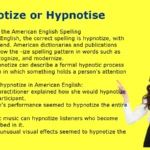
Hypnotize is the standard American English spelling, while hypnotise is commonly used in British English. Both verbs describe inducing hypnosis or captivating someone’s attention. The spelling difference does not change the meaning, pronunciation in most English varieties, or grammatical function. Choose the version that matches your audience and use it consistently.
Hypnotize Is the American English Spelling
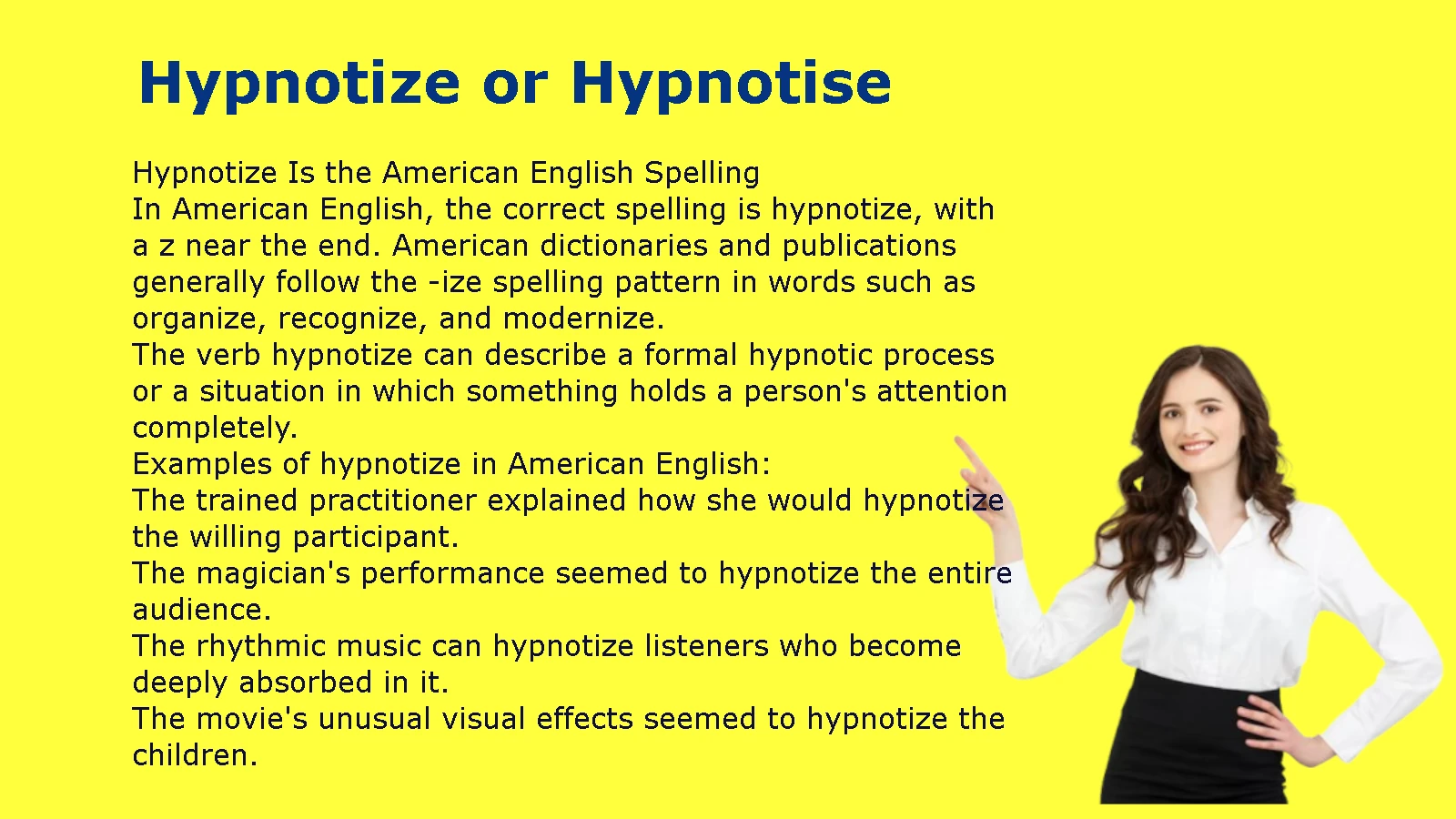
In American English, the correct spelling is hypnotize, with a z near the end. American dictionaries and publications generally follow the -ize spelling pattern in words such as organize, recognize, and modernize.
The verb hypnotize can describe a formal hypnotic process or a situation in which something holds a person’s attention completely.
Examples of hypnotize in American English:
- The trained practitioner explained how she would hypnotize the willing participant.
- The magician’s performance seemed to hypnotize the entire audience.
- The rhythmic music can hypnotize listeners who become deeply absorbed in it.
- The movie’s unusual visual effects seemed to hypnotize the children.
In the first example, hypnotize refers to a hypnosis-related process. In the other examples, the word can describe intense fascination rather than a literal hypnotic state.
Common American English forms include:
- Hypnotize: Base form
- Hypnotizes: Third-person singular present tense
- Hypnotized: Past tense and past participle
- Hypnotizing: Present participle and adjective
- Hypnotization: The act or process of hypnotizing someone
Hypnotise Is the British English Spelling
In British English, hypnotise, with an s, is a common standard spelling. The same pattern appears in words such as organise, recognise, and modernise.
The meaning remains identical to the American version. British writers use hypnotise when discussing hypnosis, describing an absorbing performance, or explaining how something captures attention.
Examples of hypnotise in British English:
- The therapist explained the procedure before attempting to hypnotise the volunteer.
- The singer’s powerful performance seemed to hypnotise the crowd.
- The documentary explored how people respond to hypnotic suggestions.
- The children watched the spinning pattern as if it could hypnotise them.
British spelling conventions are also common in many other English-speaking regions, including Australia and New Zealand, although individual style guides and publishing practices can vary.
Related British English forms include:
- Hypnotise: Base form
- Hypnotises: Third-person singular present tense
- Hypnotised: Past tense and past participle
- Hypnotising: Present participle and adjective
- Hypnotisation: The act or process of hypnotising someone
Hypnotize vs. Hypnotise: Quick Comparison
The following table shows the main differences between the two spellings.
| Feature | Hypnotize | Hypnotise |
| Main spelling convention | American English | British English |
| Final spelling pattern | -ize | -ise |
| Present tense | Hypnotizes | Hypnotises |
| Past tense | Hypnotized | Hypnotised |
| Present participle | Hypnotizing | Hypnotising |
| Noun for the process | Hypnotization | Hypnotisation |
| Meaning | To induce hypnosis or captivate | To induce hypnosis or captivate |
Remember: The difference concerns spelling, not meaning. You do not need to learn two definitions or use the words in different situations simply because their spellings differ.
How to Spell Hypnotize or Hypnotise Correctly
To spell the word correctly, first identify your intended English variety. Use hypnotize in American English and hypnotise in standard British English. Apply the same pattern to related forms, including hypnotized/hypnotised and hypnotizing/hypnotising. Consistency matters more than choosing one version as universally correct.
How to Remember the Correct Spelling
A simple memory trick is to associate the spelling with the country or style guide you are following.
- US English: Hypnotize, hypnotized, hypnotizing.
- UK English: Hypnotise, hypnotised, hypnotising.
You can remember the distinction by comparing hypnotize with organize in American English and hypnotise with organise in British English.
For example, imagine writing an article for an American psychology website. You might write:
The researcher studied how people respond when a trained professional attempts to hypnotize them.
For a British audience, you would write:
The researcher studied how people respond when a trained professional attempts to hypnotise them.
Both sentences communicate the same idea. The important point is that the spelling follows the publication’s chosen convention.
Practical tip: If you already use color, organize, and center, choose hypnotize. If your writing uses colour, organise, and centre, choose hypnotise.
Is Hypnotize or Hypnotise More Common?
The more common spelling depends on the country, audience, and publication. American publications generally favor hypnotize, while British publications commonly use hypnotise.
Neither spelling is inherently more correct worldwide. A spelling checker may flag one form if its dictionary uses a different regional setting, but that does not automatically make the word wrong.
For website owners, bloggers, and SEO writers, the best approach is to consider the target audience. If your website serves American readers, use the American spelling consistently. If it targets British readers, use the British spelling.
Search engines can recognize spelling variants and related expressions, but you should not fill an article with repeated alternatives simply to capture extra keywords. A clear explanation of both versions, followed by consistent usage, provides a better reading experience.
Hypnotize or Hypnotise Meaning and Definition
Hypnotize and hypnotise are verbs with two common senses. They can refer to inducing a state of hypnosis, or they can describe capturing someone’s attention so strongly that the person becomes absorbed in what they see or hear. The intended meaning depends on the context.
What Does Hypnotize Mean?
The verb hypnotize means to induce hypnosis in someone. In everyday language, it can also mean to fascinate, captivate, or hold someone’s attention intensely.
Hypnosis involves focused attention and responsiveness to suggestions. It is not necessarily the same as sleeping, losing consciousness, or surrendering all control.
Consider these examples:
Literal meaning:
- The qualified practitioner discussed the hypnosis session before beginning.
- The volunteer agreed to participate in an exercise designed to induce hypnosis.
- The researcher examined how participants responded to hypnotic suggestions.
Figurative meaning:
- The dancer’s precise movements seemed to hypnotize the audience.
- The child was hypnotized by the colorful lights on the ceiling.
- The storyteller’s voice seemed to hypnotize everyone around the campfire.
The figurative sense does not mean that the audience entered a clinical or experimentally induced hypnotic state. It simply suggests that people were deeply fascinated.
Usage tip: When someone says, “That painting hypnotized me,” they usually mean that the artwork held their attention. They are not necessarily claiming that they experienced hypnosis.
Hypnotize vs. Hypnosis vs. Hypnotic
These words belong to the same word family, but each serves a different grammatical purpose.
| Word | Part of speech | Meaning | Example |
| Hypnotize | Verb | To induce hypnosis or captivate | The practitioner may hypnotize a willing participant. |
| Hypnosis | Noun | A state or process involving focused attention and suggestion | The session introduced the participant to hypnosis. |
| Hypnotic | Adjective or noun | Relating to hypnosis; also something that produces fascination | The music had a hypnotic rhythm. |
| Hypnotist | Noun | A person who performs hypnosis | The hypnotist explained the procedure. |
| Hypnotized | Verb form or adjective | Put into hypnosis or intensely fascinated | The audience seemed hypnotized by the performance. |
| Hypnotizable | Adjective | Capable of responding to hypnosis | People differ in how hypnotizable they are. |
The distinction becomes easier when you look at how each word functions in a sentence.
- Verb: The practitioner may hypnotize the participant.
- Noun: The participant experienced hypnosis.
- Adjective: The music had a hypnotic effect.
- Person: The hypnotist led the demonstration.
These terms are related, but they are not interchangeable. For example, you would say “the process of hypnosis,” not “the process of hypnotic” when referring to the phenomenon itself.
Hypnotized Meaning and Usage
Hypnotized is the American English past tense and past participle of hypnotize. British English commonly uses hypnotised.
The word can describe someone who has undergone hypnosis or someone who appears completely fascinated by something.
Examples include:
- The participant was hypnotized during the demonstration.
- The audience remained hypnotized by the musician’s performance.
- She felt hypnotized by the moving shapes on the screen.
- The researcher recorded how the hypnotized participants responded to the instructions.
In the first and fourth examples, the word relates to a hypnosis procedure. In the second and third, it may be figurative.
British equivalents include:
- The participant was hypnotised during the demonstration.
- The audience remained hypnotised by the musician’s performance.
Grammar note: Hypnotized and hypnotised can function as past-tense verbs or as adjectives, depending on the sentence. For example, “The performer hypnotized the audience” uses the word as a verb, while “The hypnotized audience watched quietly” uses it as an adjective.
Hypnotize or Hypnotise in Different Sentence Forms
The spelling difference between American and British English continues through most forms of the verb. If you change the tense or use the word as a participle, maintain the same regional pattern.
Hypnotize or Hypnotise in the Present Tense
Use hypnotize as the base form in American English and hypnotise in British English.
The third-person singular form adds -s:
- American: She attempts to hypnotize the volunteer.
- American: The performer hypnotizes the willing participant.
- British: She attempts to hypnotise the volunteer.
- British: The performer hypnotises the willing participant.
After modal verbs such as can, could, may, and might, use the base form.
Correct examples:
- The practitioner can hypnotize a willing participant.
- The practitioner might hypnotise a volunteer.
- Can hypnosis hypnotize everyone? This phrasing is awkward; a clearer question is “Can everyone be hypnotized?”
Avoid adding an extra ending after a modal verb. Write “She can hypnotize him,” not “She can hypnotizes him.”
Hypnotized or Hypnotised in the Past Tense
Use hypnotized in American English and hypnotised in British English.
Examples:
- The performer hypnotized a volunteer during the show.
- The researcher hypnotized participants as part of the study.
- The performer hypnotised a volunteer during the show.
- The researcher hypnotised participants as part of the study.
The same forms appear with auxiliary verbs:
- She has hypnotized willing participants before.
- She has hypnotised willing participants before.
- The volunteer was hypnotized during the demonstration.
- The volunteer was hypnotised during the demonstration.
In American English, the -ize spelling produces the regular -ized ending. In British English, the corresponding form usually ends in -ised.
Hypnotizing or Hypnotising
The present participle is hypnotizing in American English and hypnotising in British English.
Use these forms in continuous tenses or as adjectives.
Examples:
- The practitioner is hypnotizing a volunteer.
- The practitioner is hypnotising a volunteer.
- The film’s hypnotizing visuals held my attention.
- The film’s hypnotising visuals held my attention.
The word can describe an ongoing action, as in “She is hypnotizing the participant,” or an effect, as in “The performance was hypnotizing.”
A related spelling point concerns the noun forms:
- American English: hypnotization
- British English: hypnotisation
Writers should follow the same regional convention throughout a document. Mixing hypnotized and hypnotising may look inconsistent even though readers can understand both forms.
Hypnotise Meaning in Urdu
The meaning of hypnotize or hypnotise in Urdu depends on the context. It may describe putting someone into a hypnotic state or captivating someone through a performance, image, or experience. A translation should reflect the intended sense instead of treating every use of the English word as a technical reference to hypnosis.
Hypnotize Meaning in Urdu
The word hypnotize can be translated into Urdu as مسحور کرنا when it means to captivate or fascinate someone. In a technical context involving hypnosis, a more explanatory expression may be appropriate, such as کسی کو تنویمِ نفسی کی حالت میں لانا.
The distinction matters because English uses hypnotize both literally and figuratively.
Examples:
- English: The performer hypnotized the audience.
- Urdu: فنکار نے حاضرین کو مسحور کر دیا۔
Here, مسحور کرنا conveys fascination rather than a claim that every audience member entered hypnosis.
For a technical example:
- English: The practitioner attempted to hypnotize the volunteer.
- Urdu: ماہر نے رضاکار کو تنویمِ نفسی کی حالت میں لانے کی کوشش کی۔
This translation describes an attempt to induce hypnosis. The wording can vary according to the audience and the level of technical detail required.
Hypnotized Meaning in Urdu
Hypnotized can mean مسحور in a figurative sentence or describe someone who has undergone hypnosis in a technical context.
Examples:
- English: She was hypnotized by the beautiful performance.
- Urdu: وہ خوبصورت پرفارمنس سے مسحور ہو گئی۔
Another example:
- English: The volunteer was hypnotized during the session.
- Urdu: سیشن کے دوران رضاکار کو تنویمِ نفسی کی حالت میں لایا گیا۔
These translations differ because the sentences communicate different ideas. The first describes fascination, while the second refers to a hypnosis session.
Hypnosis Meaning in Urdu
The noun hypnosis is commonly explained in Urdu through the term تنویمِ نفسی. It refers to a process or state involving focused attention and increased responsiveness to suggestions.
A simple explanation in Urdu is:
تنویمِ نفسی ایک ایسی کیفیت یا عمل ہے جس میں توجہ مرکوز ہوتی ہے اور انسان بعض تجاویز کے لیے زیادہ جواب دہ ہو سکتا ہے۔
In everyday conversation, a person might use مسحور or a similar expression to describe fascination. In psychology or clinical contexts, a more precise term helps prevent confusion between ordinary attention and hypnosis.
Can Everyone Be Hypnotized?
No, not everyone responds to hypnosis in the same way. Many people can experience some degree of hypnotic responsiveness, but the depth of the experience varies. Attention, expectations, willingness to participate, and individual differences can all affect the outcome. A person’s response also depends on the method and situation.
What Makes Someone More or Less Responsive to Hypnosis?
Hypnotic responsiveness varies between individuals. Some people respond strongly to suggestions, while others experience little change.
Several factors can influence the experience:
- Attention: A person who can focus on a task or suggestion may find some hypnosis exercises easier to follow.
- Willingness: Voluntary participation makes it easier to engage with the process.
- Expectations: Beliefs about hypnosis can influence how a person approaches the experience.
- Comfort and trust: Someone who understands the procedure may feel more comfortable participating.
- Individual differences: People vary in how strongly they respond to hypnotic suggestions.
These factors do not create a simple formula for predicting who will respond. A calm person is not automatically highly hypnotizable, and a skeptical person is not necessarily incapable of experiencing hypnosis.
For example, two volunteers might listen to the same guided exercise. One may experience a strong sense of absorption, while the other remains aware of the room and notices only mild relaxation. That difference does not prove that one person is weak-minded or that the other has surrendered control.
Can Someone Be Hypnotized Against Their Will?
Hypnosis is not a reliable method of forcing another person to obey commands. It does not give a hypnotist automatic control over someone’s thoughts, values, or actions.
In ordinary practice, the participant’s willingness and cooperation matter. People may respond differently to suggestions, and they can reject instructions that they do not want to follow.
Movies and stage performances sometimes portray hypnosis as an instant way to control another person’s mind. Those portrayals often exaggerate what hypnosis can do.
Consider this example: a performer asks a volunteer to imagine holding a heavy object. The volunteer may respond vividly to the suggestion. That experience does not mean the performer can control every decision the volunteer makes afterward.
Important distinction: Hypnosis may influence attention, perception, and responses to suggestions, but it should not be treated as a guaranteed tool for coercion or mind control.
Is Hypnosis Real or Just Acting?
Hypnosis is a recognized subject of psychological research. Researchers study hypnotic suggestion, focused attention, subjective experience, and differences in responsiveness.
However, not every behavior seen during a stage hypnosis show demonstrates a typical hypnotic response. Entertainment performances may involve volunteers who are comfortable participating, following suggestions, and performing for an audience.
It helps to distinguish three situations:
| Situation | Main purpose | What it means |
| Clinical hypnosis | Support a suitable therapeutic or health-related goal | Used by appropriately trained professionals within their scope of practice |
| Experimental hypnosis | Study attention and responses to suggestions | Helps researchers examine psychological processes |
| Stage hypnosis | Entertain an audience | Combines performance, volunteers, and suggestions |
These settings differ in their goals and standards. A stage show should not be treated as proof that hypnosis can make anyone perform any action.
Is It Possible to Hypnotize Someone?
Yes, it is possible to induce hypnosis in some willing people using established techniques. However, success is not guaranteed, and the results depend on the individual and the circumstances. Hypnosis is better understood as a process involving attention and suggestion than as a supernatural ability or a reliable way to control another person.
How Does Hypnosis Work?
Hypnosis often involves guiding a person’s attention toward a particular idea, sensation, image, or suggestion. A trained practitioner may use spoken instructions, imagery, or other agreed-upon methods to help the participant focus.
A session may include:
- Preparation: The practitioner explains the process and answers questions.
- Focused attention: The participant concentrates on a selected experience or instruction.
- Suggestions: The practitioner offers appropriate suggestions that fit the session’s purpose.
- Review: The participant discusses the experience and returns to ordinary activities.
Hypnosis does not necessarily involve sleep. Many people remain aware of their surroundings and can remember at least some of what happened.
For example, a person working with a qualified professional on a suitable goal may be invited to imagine feeling calmer in a stressful situation. The suggestion provides a focus for attention, but it does not guarantee a particular result.
Who Uses Hypnosis?
Hypnosis appears in several professional and entertainment settings.
Clinical practitioners may use hypnosis as one part of an appropriate treatment plan, provided they have suitable training and qualifications. Its suitability depends on the person’s needs and the specific problem being addressed.
Researchers use hypnosis to investigate how people respond to suggestions, how attention works, and why some individuals experience hypnotic effects more strongly than others.
Stage hypnotists use suggestion and performance techniques to entertain audiences. Their work has a different purpose from clinical care.
People should check a practitioner’s qualifications before seeking hypnosis for a health concern. A performer who entertains an audience is not automatically qualified to provide psychological or medical treatment.
What Are the Limits of Hypnosis?
Hypnosis has meaningful limits. It does not guarantee that a person will follow every suggestion, recover accurate memories, overcome a habit, or achieve a health goal.
Keep these points in mind:
- Results vary: A method that works well for one person may have little effect on another.
- Memory is not infallible: Hypnosis cannot guarantee that a recalled event is accurate.
- Suggestions are not commands with guaranteed effects: A hypnotist cannot reliably make everyone respond in a particular way.
- Health claims require care: Hypnosis should not replace appropriate medical assessment or evidence-based treatment.
- Professional qualifications matter: People seeking help for a health concern should consult a suitably qualified practitioner.
Hypnosis may be useful in some circumstances, but claims that it can solve every problem or unlock perfect memories go beyond what it can reliably deliver.
How Do You Hypnotize Someone?
Hypnosis should be approached as a voluntary process involving clear communication, consent, and realistic expectations. A person interested in learning about hypnosis should understand the basic stages of a session and avoid using techniques to pressure or manipulate someone.
The Basic Stages of a Hypnosis Session
A typical guided session may include the following stages.
Preparation and consent
The practitioner explains the process, discusses the participant’s goals, and answers questions. The participant should understand that they can decline or stop at any time.
Focused attention
The practitioner may invite the participant to concentrate on breathing, an image, a sound, or another neutral point of focus. The purpose is to help direct attention, not to force the person into a particular state.
Appropriate suggestions
The practitioner introduces suggestions suited to the agreed purpose. The wording should remain clear, respectful, and realistic.
Ending the session
The practitioner helps the participant return attention to the surrounding environment and checks how the person feels. The participant can then discuss the experience and ask questions.
These stages describe a general structure, not a guarantee that a particular technique will work. Hypnosis sessions vary according to the practitioner, the participant, and the purpose.
Why Consent and Trust Matter
Consent is essential when working with another person. A participant should know what the process involves, understand its limits, and feel free to stop without pressure.
Trust also helps prevent misunderstandings. If someone does not want to participate, attempting to hypnotize them against their wishes is inappropriate.
Before a session, discuss:
- What the session is intended to achieve.
- What the participant may experience.
- Whether the session involves a trained professional.
- How the participant can pause or stop.
- What the technique can and cannot realistically accomplish.
A responsible approach respects the participant’s choices rather than promising dramatic results.
Can You Hypnotize Yourself?
Self-hypnosis involves directing your own attention and using suggestions or imagery to support a chosen goal. People may practice it for relaxation, focus, or other suitable purposes.
A simple self-hypnosis exercise might involve sitting comfortably, focusing on breathing, and repeating a realistic statement such as, “I can take a moment to pause before responding to stress.”
For a basic practice:
- Choose a quiet place where you can sit safely.
- Set a realistic goal for the exercise.
- Focus on breathing or another comfortable point of attention.
- Use calm, positive suggestions that fit your goal.
- Stop if you feel uncomfortable or distressed.
Self-hypnosis is not a substitute for professional care when you have a medical or mental health concern. It also does not guarantee that you will change a habit or resolve a difficult problem.
Can You Hypnotize Someone Without a Voice?
Hypnosis does not always require a dramatic spoken induction, but guiding another person usually involves some form of communication. Written prompts, prerecorded audio, visual cues, and previously agreed-upon signals may support certain exercises. The method must fit the participant and should never rely on hidden manipulation.
Hypnosis Without Speaking
The phrase hypnotize without voice can refer to several different situations. Someone may want to practice self-hypnosis silently, follow written instructions, or understand whether a practitioner can guide another person without speaking.
Silent self-hypnosis is straightforward to describe: a person can focus on an image, breathing pattern, or internally repeated suggestion without saying anything aloud.
Guiding another person without speaking is more complicated. The practitioner and participant still need a way to understand the exercise. Written instructions, visual prompts, or previously agreed-upon cues may provide that communication.
For example, a participant might follow a written relaxation script at their own pace. This differs from secretly attempting to hypnotize someone who has not agreed to participate.
Key point: No special silent trick guarantees hypnosis. The participant’s attention, expectations, and willingness still matter.
Does Hypnosis Require Music or a Special Voice?
No. Music and a dramatic voice are not essential requirements for hypnosis.
Some guided exercises use a calm voice because it helps present instructions clearly. Others use silence, imagery, or simple focused-attention exercises. Music may help some people relax, but it can distract others.
A professional should choose a method based on the participant’s needs and the purpose of the session rather than relying on theatrical effects.
The familiar idea that a hypnotist needs a mysterious voice or a swinging pocket watch comes largely from popular entertainment. Such props may appear in performances, but they are not universal requirements for hypnosis.
Common Mistakes When Using Hypnotize or Hypnotise
Spelling mistakes often happen when writers mix regional conventions or confuse related words. Understanding the differences makes the article clearer and helps you avoid awkward sentences.
Mixing American and British Spellings
A common mistake is using different regional forms in the same piece without a reason.
For example:
Incorrectly inconsistent: “The practitioner hypnotized the volunteer before hypnotising another participant.”
Consistent American English: “The practitioner hypnotized the volunteer before hypnotizing another participant.”
Consistent British English: “The practitioner hypnotised the volunteer before hypnotising another participant.”
The first sentence is understandable, but the spelling changes halfway through. Consistency makes a document look more polished.
Confusing Hypnotize With Hypnotized
The base form hypnotize describes the action. The form hypnotized usually describes an action that happened in the past or a resulting state.
Compare these sentences:
- Present/base form: The practitioner may hypnotize a volunteer.
- Past tense: The practitioner hypnotized a volunteer yesterday.
- Past participle: The volunteer has been hypnotized before.
- Adjective: The hypnotized volunteer listened carefully.
The same distinction applies in British English, where the corresponding forms are hypnotise and hypnotised.
A useful proofreading method is to check the sentence’s tense and grammatical structure before selecting the form.
Treating Hypnosis as Mind Control
Another mistake is assuming that hypnotizing someone means gaining complete control over that person.
Hypnosis involves focused attention and responsiveness to suggestions, but it does not automatically erase a person’s preferences, values, or ability to make decisions. Responses vary, and a person may reject a suggestion.
For instance, someone who becomes deeply absorbed in a stage performance has not necessarily lost control of their actions. The word hypnotized can also describe fascination in a figurative sense, which adds to the confusion.
When writing about hypnosis, distinguish between established uses, individual experiences, and exaggerated claims.
Hypnotize or Hypnotise: Which Spelling Should You Use?
Choose hypnotize if you are writing in American English and hypnotise if you are following standard British English. Both forms are correct, and neither has a different definition. The best choice depends on your readers, your style guide, and the spelling conventions used throughout your article.
Use this quick checklist before publishing:
- American audience: Write hypnotize, hypnotized, and hypnotizing.
- British audience: Write hypnotise, hypnotised, and hypnotising.
- Educational content: Explain both variants if readers may encounter either spelling.
- SEO content: Use the main keyword naturally and answer the spelling question near the beginning.
- Editing: Check related forms to make sure they follow the same regional pattern.
If you publish a series of spelling guides, you can also connect this article to related comparisons such as prioritize vs. prioritise, organize vs. organise, and recognize vs. recognise. These internal links help readers explore the broader differences between American and British English.
The essential rule is simple: hypnotize is American English, while hypnotise is commonly used in British English. Both spellings communicate the same meaning.
Frequently Asked Questions
Is hypnotize or hypnotise correct?
Both spellings are correct. Hypnotize is the standard American English form, while hypnotise is commonly used in British English. The meaning remains the same, so choose the spelling that matches your intended audience.
How do you spell hypnotize or hypnotise in the UK?
In standard British English, the usual spelling is hypnotise. Related forms include hypnotises, hypnotised, and hypnotising. Keep these forms consistent when writing for a British audience.
What does hypnotise mean in Urdu?
Hypnotise can mean مسحور کرنا when it describes fascination. In a technical context, it can refer to کسی کو تنویمِ نفسی کی حالت میں لانا. The most suitable translation depends on whether the sentence describes fascination or hypnosis.
Can everyone be hypnotized?
No. Many people can experience hypnosis, but responsiveness varies. Attention, willingness, expectations, and individual differences can influence the experience. No method guarantees that everyone will respond equally.
Is it possible to hypnotize someone without speaking?
Some forms of self-hypnosis can take place silently, and certain exercises can use written or visual prompts. However, guiding another person generally requires some form of communication, and no silent technique guarantees hypnosis.
Can you hypnotize someone against their will?
Hypnosis is not a reliable method of forcing someone to obey commands. Voluntary participation and cooperation matter, and a hypnotist cannot guarantee control over another person’s thoughts or actions.
Final Thoughts
The difference between hypnotize or hypnotise comes down to regional spelling conventions. American English uses hypnotize, while British English commonly uses hypnotise. Both words share the same definition, and their related forms follow the same spelling pattern.
Once you know which version your audience expects, the choice becomes easy. Use the same convention throughout your writing, understand the difference between hypnotize, hypnosis, and hypnotic, and choose translations that match the context.