Orient vs orientate is a common English usage question because both words mean to position something, establish direction, or help someone become familiar with a new situation. Both forms are correct, but orient is more common in American English, while orientate is more widely used in British English. Your choice often depends on your audience, writing style, and regional preference.
Understanding the difference between orient and orientate, their meanings, pronunciation, synonyms, and past-tense forms can help you write more naturally. This guide explains when to use each word, whether orientate is grammatically correct, how to orientate someone, and why oriented vs orientated matters in professional writing. It also distinguishes the verb orient from Orient Star, the watch brand, which belongs to a different search context.
What Does Orient Mean?
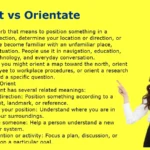
Orient is a verb that means to position something in a particular direction, determine your location or direction, or help someone become familiar with an unfamiliar place, subject, or situation. People use it in navigation, education, business, technology, and everyday conversation.
For example, you might orient a map toward the north, orient a new employee to workplace procedures, or orient a research project toward a specific question.
Definition of Orient
The verb orient has several related meanings:
- To establish direction: Position something according to a compass point, landmark, or reference.
- To determine your position: Understand where you are in relation to your surroundings.
- To familiarize someone: Help a person understand a new place, role, or system.
- To direct attention or activity: Focus a plan, discussion, or organization on a particular goal.
The central idea is direction. Sometimes that direction is physical, as when you position a building to receive sunlight. In other cases, it is mental or practical, as when a manager helps a new employee understand how a company operates.
Orient Meaning in Different Contexts
The meaning of orient becomes clearer when you examine how people use it in different situations.
In navigation and geography
Orienting yourself means identifying your position and understanding which direction to take.
Example: We stopped at the trail junction to orient ourselves before continuing the hike.
Here, the hikers need to understand their location and direction before moving forward.
In the workplace
Employers use orient when they introduce new employees to company policies, colleagues, responsibilities, and systems.
Example: The supervisor will orient the new staff members during their first week.
In this context, the supervisor helps employees understand their roles and the workplace environment.
In education
Teachers can orient students toward a topic before introducing detailed lessons.
Example: The opening activity helps students orient themselves to the main ideas of the course.
The activity gives students a foundation for understanding what follows.
In business and strategy
Companies may orient their operations toward customer needs, long-term growth, or a particular market.
Example: The company decided to orient its marketing strategy toward small businesses.
This means the company will shape its marketing decisions around that audience.
In science and design
Researchers and designers use orient to describe the position of objects, components, or measurements relative to a reference point.
Example: Orient the sensor toward the light source before recording the measurements.
The direction matters because the sensor’s position can affect the results.
Examples of Orient in Sentences
These examples show how orient works in ordinary and professional English.
- Please orient the diagram so that north appears at the top.
- The training session will orient new employees to the company’s procedures.
- I needed a few minutes to orient myself in the unfamiliar neighborhood.
- The team wants to orient its research toward practical solutions.
- The instructor helped the students orient themselves before the field exercise.
- We should orient the website’s navigation around the needs of first-time visitors.
- The building was designed to orient its main windows toward the morning sun.
Notice that orient can take a direct object, as in orient the diagram, or appear in a reflexive construction, as in orient yourself. The appropriate structure depends on what you want to express.
What Does Orientate Mean?
Orientate is a verb that means to position something, establish direction, or help someone become familiar with a place, process, or situation. It has broadly the same meaning as orient and is especially familiar in British English.
You may encounter it in workplace training, education, navigation, and discussions about adapting to unfamiliar circumstances.
Definition of Orientate
The verb orientate describes the act of determining direction, positioning something, or helping someone understand their surroundings.
It often appears in sentences involving a person who needs to become familiar with a new environment.
For example:
The school arranged a welcome session to orientate incoming students.
The session helps students understand the campus, meet staff, and learn how the school operates.
Although orientate contains an additional syllable compared with orient, the two verbs usually communicate the same basic idea. The longer form is not inherently incorrect or less grammatical.
Orientate Meaning in Everyday English
People use orientate in several practical situations.
Getting familiar with a new environment
It took me a few days to orientate myself to the new neighborhood.
The speaker needed time to understand the surroundings and feel comfortable navigating them.
Introducing new employees
The manager will orientate the new employees before they begin their regular duties.
The manager will explain workplace expectations, responsibilities, and procedures.
Helping students understand a subject
The introductory lecture is designed to orientate students to the course.
The lecture gives students a starting point before they study the material in greater depth.
Adjusting to a change
She needed time to orientate herself after moving to a different country.
The sentence describes the process of becoming familiar with a new environment and its routines.
These examples show why orientate meaning in English is closely connected to direction, familiarity, and adjustment.
Examples of Orientate in Sentences
Use the following examples to understand the verb in context.
- The guide helped us orientate ourselves before we entered the forest.
- The company uses a short workshop to orientate new employees.
- Students attended an introductory session to orientate themselves to university life.
- The engineer adjusted the equipment to orientate the antenna toward the signal.
- The team met to orientate its work toward the project’s main objective.
- A campus map can help visitors orientate themselves when they arrive.
- The first meeting will orientate participants to the structure of the program.
In each sentence, orientate refers to positioning, direction, or becoming familiar with something.
For American audiences, however, orient may sound more natural in many of these examples. For British audiences, either form may work, depending on the speaker and context.
Orient vs Orientate: What’s the Difference?
Orient and orientate have essentially the same core meaning. Both can describe positioning something, determining direction, or helping someone become familiar with a new situation. The main difference lies in regional preference: American English generally favors orient, while British English uses both forms, with orientate more common than it is in the United States.
Meaning and Grammatical Differences
The two verbs perform the same grammatical role and can appear in similar sentence structures.
| Feature | Orient | Orientate |
| Part of speech | Verb | Verb |
| Core meaning | Position, direct, or familiarize | Position, direct, or familiarize |
| American English | Generally preferred | Less common |
| British English | Common | Also common |
| Past tense | Oriented | Orientated |
| Past participle | Oriented | Orientated |
| Present participle | Orienting | Orientating |
| Example | Orient the new staff | Orientate the new staff |
The most important distinction is not a major difference in meaning. It is how speakers and writers choose between the two forms.
Both verbs can take a direct object:
- The trainer will orient the employees to the new system.
- The trainer will orientate the employees to the new system.
Both can also appear in reflexive constructions:
- I need to orient myself to the new surroundings.
- I need to orientate myself to the new surroundings.
The choice does not change the basic message.
Orient vs Orientate in American and British English
Regional usage is the most useful guide when choosing between these verbs.
American English
American English generally favors orient. It is the usual choice in workplace training, technical instructions, educational materials, and professional communication.
Example: The onboarding program will orient new hires to our software.
An American reader will generally find this phrasing natural and direct.
British English
British English uses both orient and orientate. The longer form is more established in everyday British usage than it is in American English.
Example: The induction program will orientate new staff to the organization’s procedures.
A British reader may find this phrasing entirely natural.
The distinction is a matter of preference, not a strict rule that makes one form correct and the other wrong.
| Situation | Recommended choice | Reason |
| US business report | Orient | Fits common American usage |
| US employee training | Orient | Familiar and concise |
| UK workplace communication | Orient or orientate | Both forms are acceptable |
| UK educational material | Orient or orientate | Regional preference may influence the choice |
| International publication | Orient | Often the more widely familiar default |
| Existing document using orientate | Keep orientate if consistent | Consistency matters when editing |
If you write for a specific audience, follow its usual conventions. When you write for a broad international audience, orient is a practical default because readers in both American and British English recognize it.
Which Word Should You Use?
Choose the form that sounds natural to your intended audience and remains consistent with the rest of your writing.
Use orient when:
- You write for an American audience.
- You prepare US business documents or training materials.
- You want a concise, widely understood expression.
- Your organization’s style guide prefers American English.
Use orientate when:
- You write for a British audience that commonly uses the word.
- Your workplace or publication already follows British usage.
- The surrounding text consistently uses British English conventions.
Consider a simple editing example.
Original: Our goal is to orientate new customers to the platform.
For a US audience, you might revise it to:
Our goal is to orient new customers to the platform.
For a British audience, the original may be suitable as written.
Neither version needs correction solely because it uses one form rather than the other. The best edit respects the intended audience and the document’s established style.
Orient vs Orientate Example Sentences
Comparing parallel sentences is one of the easiest ways to understand the difference.
| With orient | With orientate |
| The guide helped us orient ourselves in the city. | The guide helped us orientate ourselves in the city. |
| The manager will orient the new employees. | The manager will orientate the new employees. |
| We need to orient the project toward customer needs. | We need to orientate the project toward customer needs. |
| The instructor helped students orient themselves to the topic. | The instructor helped students orientate themselves to the topic. |
The sentences communicate substantially the same ideas. Regional preference and writing conventions determine which version is more suitable.
One useful rule is to avoid switching between the forms without a reason. If you use orient throughout a report, keep using it unless a quotation, established phrase, or specific context calls for a different form.
Is Orientate a Word?
Yes, orientate is a legitimate English word. It is a standard verb that means to position something, establish direction, or familiarize someone with a situation. Although some American English speakers prefer orient, that preference does not make orientate grammatically incorrect.
Is Orientate Grammatically Correct?
Yes. You can use orientate in standard English, particularly in British English.
For example:
The instructor will orientate the participants before the workshop begins.
The sentence follows a normal grammatical structure. The verb takes the participants as its direct object, and the rest of the sentence explains when the action will occur.
The same sentence works with orient:
The instructor will orient the participants before the workshop begins.
Both forms are correct. The choice depends mainly on regional usage and the conventions you follow.
It is useful to separate two questions:
- Is the word correct? Yes, orientate is an accepted English verb.
- Is it the best choice for every audience? No. American readers generally encounter orient more often.
A word can be grammatically valid without being the most natural choice in every region.
Why Do Some People Prefer Orient?
Several factors explain the preference for orient.
Regional familiarity: American English speakers tend to encounter orient more frequently in professional and educational settings.
Conciseness: Orient is shorter, which can make it attractive in instructions and business writing.
Style conventions: Organizations often establish a preferred form to maintain consistency across documents.
Personal preference: Some speakers simply prefer one form because it sounds more natural to them.
These factors affect usage, but they do not establish a universal rule that orientate is wrong.
For example, an American editor may change orientate new hires to orient new hires to match the organization’s style. A British editor may retain the original wording.
Both editors can make sound decisions for their audiences.
Is Orientate Formal or Informal?
Orientate is not inherently informal. You can use it in professional communication, educational material, instructions, and other standard contexts.
Examples include:
- The department will orientate new staff during induction.
- The training manual explains how to orientate the equipment.
- The introductory session helps students orientate themselves to the curriculum.
However, writers preparing American English content will usually find orient more conventional.
Do not confuse regional preference with formality. A word does not become informal merely because one regional variety uses it less often.
How to Orientate Someone or Yourself
To orientate someone means to help that person understand a new place, role, process, or situation. You can also orient someone by giving directions, explaining procedures, or introducing the key information they need to act confidently.
The verb orient works in the same way.
What Does It Mean to Orientate Someone?
When you orientate someone, you give them information or guidance that helps them understand an unfamiliar environment.
For example:
The team leader will orientate the new employee to the department’s workflow.
The leader may explain the team’s responsibilities, demonstrate the software, introduce coworkers, and answer questions.
In American English, the sentence would commonly use orient instead.
The phrase can describe several types of guidance:
- Workplace orientation: Introducing employees to policies, responsibilities, and colleagues.
- School orientation: Helping students understand campus facilities, academic expectations, and support services.
- Navigation: Helping visitors understand where they are and how to reach their destination.
- Technical guidance: Explaining how a system, device, or process works.
- Personal adjustment: Helping someone become comfortable in a new environment.
In each case, the goal is to give the person enough information to understand their situation and take the next step.
How to Use Orientate in a Sentence
The verb appears in several common grammatical patterns.
Orientate someone to something
Use this structure when you help another person become familiar with a subject, role, or system.
Example: The supervisor will orientate the new technician to the safety procedures.
Orientate yourself to something
Use the reflexive form when you describe becoming familiar with your own surroundings or circumstances.
Example: Give yourself time to orientate yourself to the new workplace.
Orientate something toward something
Use this construction when you position or direct an object, plan, or activity toward a target.
Example: The organization wants to orientate its services toward local communities.
Orientate yourself in a place
Use this structure when you need to establish your position or understand your surroundings.
Example: I paused outside the station to orientate myself in the unfamiliar city.
These patterns also work with orient. The spelling changes, but the basic grammatical relationships remain the same.
Orientate Someone at Work or School
Workplace and educational settings offer practical examples of how the verb works.
Imagine that a company hires a software developer who has never used its internal tools. The manager might:
- Introduce the developer to the team.
- Explain the company’s communication channels.
- Demonstrate the software development workflow.
- Review security policies.
- Explain where to find technical documentation.
- Answer questions about daily responsibilities.
The manager is orienting or orientating the new employee to the workplace.
Schools follow a similar process. Teachers may introduce students to the course structure, explain assessment requirements, and show them how to access learning materials.
There is also a useful distinction between the verb and the noun orientation.
- The manager will orient the new employee. — The verb describes the action.
- The employee will attend an orientation session. — The noun names the session or process.
The phrase employee orientation is common in American business English. In British workplaces, induction is also frequently used for the process of introducing new employees to an organization.
Orientate Synonyms and Alternatives
The best orientate synonym depends on what you mean. Orient is the closest alternative, but words such as familiarize, acquaint, guide, position, and align can work when the context emphasizes a particular part of the meaning.
Common Synonyms for Orientate
| Synonym | Meaning | Example |
| Orient | Establish direction or familiarity | The trainer will orient new staff to the system. |
| Familiarize | Help someone learn about something | The guide will familiarize visitors with the building. |
| Acquaint | Introduce someone to information or a subject | The course will acquaint students with basic concepts. |
| Guide | Help someone understand where to go or what to do | The mentor will guide the trainee through the process. |
| Position | Place something in a particular location or direction | Position the camera toward the entrance. |
| Align | Bring something into the correct position or agreement | Align the equipment with the reference mark. |
| Adjust | Adapt to a new condition or situation | She needed time to adjust to the new environment. |
| Direct | Point or guide attention toward a target | The campaign will direct attention toward the new service. |
These words overlap with orientate, but they are not interchangeable in every sentence.
For instance, position works well when you physically move an object. However, it does not always convey the process of helping a person understand a new role.
Likewise, familiarize emphasizes learning about something rather than establishing a physical direction.
Orient vs Familiarize vs Acquaint
These three verbs often appear in similar contexts, but each emphasizes something slightly different.
Orient focuses on direction, context, or a person’s place within a situation.
Example: The introduction will orient students to the course’s main objectives.
Familiarize focuses on helping someone gain knowledge through exposure or explanation.
Example: The demonstration will familiarize students with the new software.
Acquaint focuses on introducing someone to a person, subject, or set of facts.
Example: The briefing will acquaint employees with the updated policy.
A quick way to choose is to ask what the person needs.
- If they need to understand their position within a broader situation, use orient.
- If they need to become comfortable with a tool or process, use familiarize.
- If they need an introduction to information or people, use acquaint.
Best Alternative to Orientate in Professional Writing
For American business writing, orient is usually the simplest replacement for orientate.
Consider these edits:
Original: The onboarding session will orientate the new employees to company procedures.
Revised: The onboarding session will orient the new employees to company procedures.
Original: The guide will orientate visitors to the exhibition.
Revised: The guide will familiarize visitors with the exhibition.
Original: The manager will orientate the team toward the quarterly target.
Revised: The manager will align the team around the quarterly target.
The final example changes the wording more substantially because align emphasizes agreement and coordinated effort. That makes it useful when the original sentence concerns shared goals rather than simply becoming familiar with something.
Choose a synonym based on the intended meaning instead of replacing every occurrence of orientate with the same word.
Orientate Pronunciation
Orientate and orient differ in length and syllable structure. The exact pronunciation can vary slightly by accent, but both words have established pronunciations in English.
How to Pronounce Orientate
A common British English pronunciation of orientate is:
- IPA: /ˈɔːriənteɪt/
- Simple guide: OR-ee-en-tayt
The word typically has four syllables: or-i-en-tate. Speakers place the main stress near the beginning.
When saying it aloud, avoid rushing through the middle syllables. Clear separation makes the word easier to pronounce naturally.
How to Pronounce Orient
A common American English pronunciation of orient is:
- IPA: /ˈɔːriˌɛnt/ or /ˈɔːriənt/, depending on accent and pronunciation convention
- Simple guide: OR-ee-ent
Pronunciation varies across English-speaking regions. Some speakers pronounce the middle vowel more distinctly than others.
The main practical difference is that orient has fewer syllables than orientate. Listening to speakers from your target region can help you choose the pronunciation that fits your audience.
Are Orient and Orientate Pronounced Differently?
Yes. Orientate usually contains an additional syllable, while orient is shorter.
| Word | Approximate syllable pattern | Main difference |
| Orient | OR-ee-ent | Shorter form |
| Orientate | OR-ee-en-tayt | Additional syllable and final /t/ sound |
Pronunciation guides are approximations rather than exact substitutes for hearing the word. Regional accents may change the vowels and how speakers connect the syllables.
Oriented vs Orientated: Which Is Correct?
Orientated and Oriented are both correct. Oriented is the past-tense and past-participle form of orient, while orientated is the corresponding form of orientate. American English generally favors oriented, including in expressions such as goal-oriented and customer-oriented.
Oriented vs Orientated as Past-Tense Forms
The two verbs form their past tenses in the regular way.
| Verb form | Orient | Orientate |
| Base form | Orient | Orientate |
| Third-person singular | Orients | Orientates |
| Past tense | Oriented | Orientated |
| Past participle | Oriented | Orientated |
| Present participle | Orienting | Orientating |
Examples:
- The manager oriented the new employees last Monday.
- The manager orientated the new employees last Monday.
- We have oriented the team to the revised process.
- We have orientated the team to the revised process.
All four sentences are grammatical. The difference lies in the verb selected, not in the tense.
When you edit a document, maintain consistent usage. If the text uses orient in the present tense, oriented will normally be the matching past-tense form.
Is It Goal-Oriented or Goal-Orientated?
Both goal-oriented and goal-orientated are valid expressions. They describe a person, plan, or activity that focuses on achieving goals.
However, goal-oriented is the more familiar choice in American English and is widely understood internationally.
Example: Maya is a goal-oriented manager who tracks progress against clear targets.
The adjective describes Maya’s focus on achieving specific outcomes.
A British English writer may use goal-orientated instead:
The company is looking for a goal-orientated candidate who can manage several projects.
The intended meaning remains the same.
Other related expressions follow a similar pattern:
| Common form | Alternative form | Meaning |
| Career-oriented | Career-orientated | Focused on career development |
| Customer-oriented | Customer-orientated | Focused on customer needs |
| Results-oriented | Results-orientated | Focused on measurable outcomes |
| User-oriented | User-orientated | Designed around user needs |
| Task-oriented | Task-orientated | Focused on completing tasks |
The forms are not always equally common in every region. If you write for American readers, use the shorter -oriented form unless a specific house style requires otherwise.
Other Common Expressions With Oriented and Orientated
These adjectives appear frequently in professional, academic, and technical writing.
Customer-oriented business
A customer-oriented business makes decisions with customer needs and experiences in mind.
Example: The customer-oriented company redesigned its support process to reduce waiting times.
Results-oriented team
A results-oriented team focuses on defined outcomes rather than activity alone.
Example: The results-oriented team measures progress against quarterly targets.
User-oriented design
User-oriented design considers the needs, behavior, and expectations of the people who use a product.
Example: The user-oriented interface makes common tasks easier to complete.
Career-oriented student
A career-oriented student makes educational choices with long-term professional goals in mind.
Example: The career-oriented student chose an internship related to her intended profession.
In each example, the adjective describes a particular focus. The -orientated alternatives are possible, but the -oriented forms are generally safer for American English content.
Orient vs Orient Star: Are They Related?
The phrase orient vs Orient Star can refer to two different things: the English verb orient and Orient Star, a watch brand. The grammatical comparison concerns word usage, while the brand-related query concerns watches and products.
Orient as an English Verb
As a verb, orient means to establish direction, position something, or help someone become familiar with a situation.
Example: The instructor helped the group orient itself before the outdoor exercise.
The word functions as part of an ordinary English sentence. Its meaning depends on the context in which you use it.
What Is Orient Star?
Orient Star is a watch brand associated with mechanical watches and watchmaking. The name functions as a proper brand name rather than as a form of the verb orient.
If you are comparing orient with orientate, you are asking a grammar and vocabulary question. If you are researching Orient Star, you are looking for product information, watch models, features, or brand comparisons.
These are separate search intents. A reader looking for the meaning of a verb does not need a detailed watch-buying guide, and someone researching watches does not need a full grammar lesson.
How to Choose the Right Search Term
Use the phrase that matches the information you want.
- Search for orient vs orientate when you need help choosing the correct verb.
- Search for orient meaning when you want a definition and examples.
- Search for oriented vs orientated when you need help with past-tense forms or compound adjectives.
- Search for Orient Star watches when you want to research the brand and its products.
Keeping these queries separate helps you find the relevant information without mixing unrelated meanings.
Quick Reference: Orient vs Orientate
The following table summarizes the main differences and answers the most common questions.
| Question | Answer |
| Are orient and orientate both correct? | Yes. Both are standard English verbs. |
| Do orient and orientate mean the same thing? | Their core meanings largely overlap. |
| Which form is more common in American English? | Orient. |
| Is orientate used in British English? | Yes. It is an established form. |
| Is orientate a real word? | Yes. It is grammatically valid. |
| What is the past tense of orient? | Oriented. |
| What is the past tense of orientate? | Orientated. |
| Should I write goal-oriented or goal-orientated? | Both are valid, but goal-oriented is the usual choice in American English. |
| What is a synonym for orientate? | Orient, familiarize, acquaint, or guide, depending on context. |
| Is Orient Star related to the verb orientate? | No. Orient Star is a watch brand. |
A Practical Editing Example
Imagine that you are preparing an employee handbook for a US company. Your draft includes the following sentences:
The HR department will orientate new employees. The team will help them become familiar with company procedures. Each employee should become more goal-orientated during the first quarter.
The meaning is clear, but you can make the wording more consistent with American English:
The HR department will orient new employees. The team will help them become familiar with company procedures. Each employee should become more goal-oriented during the first quarter.
This revision uses the more conventional American forms without changing the intended message.
If you were editing a document for a British organization that regularly uses orientate and goal-orientated, you might retain those forms instead.
The lesson is simple: choose the form that suits your audience, then use it consistently.
Frequently Asked Questions
Is orient or orientate more correct?
Both words are correct. Orient is generally preferred in American English, while orientate is more common in British English than in American usage. Choose the form that fits your audience and writing conventions.
What is the difference between orient and orientate?
The words have broadly the same meaning: to establish direction, position something, or help someone become familiar with a situation. Their main difference is regional preference, not a fundamental difference in meaning.
Is orientate a word in American English?
Yes. Orientate is a recognized English word, although American speakers generally prefer orient. In US professional writing, orient is usually the more familiar choice.
What is a synonym for orientate?
Orient is the closest synonym. Other alternatives include familiarize, acquaint, guide, position, and align. The best option depends on whether you mean helping someone understand a situation, introducing information, or positioning an object.
Should I write oriented or orientated?
Both forms are correct. Oriented comes from orient, while orientated comes from orientate. American English generally favors oriented, especially in expressions such as goal-oriented, customer-oriented, and results-oriented.
How do you orientate someone?
You orientate someone by helping them understand a new place, role, system, or situation. For example, a manager might explain workplace procedures, introduce team members, and demonstrate company software to orientate a new employee.
Conclusion: Choose Orient or Orientate Based on Your Audience
The difference between orient vs orientate is mainly a matter of regional usage. Both verbs can mean to establish direction, position something, or help someone become familiar with a new environment. However, orient is generally the preferred form in American English, while orientate remains common in British English.
Use these simple guidelines when writing:
- Choose orient for most American English articles, business documents, and instructions.
- Use orientate when it fits your British English audience or established style.
- Write oriented when using the past tense of orient and orientated when using the past tense of orientate.
- Prefer familiar expressions such as goal-oriented and customer-oriented in American English.
- Keep your spelling and word choices consistent throughout the same document.
When you’re unsure, consider who will read your writing and which form they are most likely to recognize. That small decision can make your sentences sound more natural without changing their meaning.