A referring is the correct spelling when you mean directing someone to a person, place, thing, source, or idea, or mentioning something in relation to a particular subject. If you’ve come across “referring” and “refering” and wondered which spelling is correct, the difference comes down to a common spelling rule involving the verb refer and its ending -ing.
The referring vs refering distinction is straightforward: referring is the standard and correct spelling, while refering is a misspelling. The word referring is the present participle or gerund form of refer, and the final consonant is doubled before adding -ing. Related forms include refer, referred, reference, referral, referring to, and referred to.
In this guide, you’ll learn which spelling is correct, why “referring” has two r’s at the end of the base word before -ing, how to use “referring” in sentences, and why “refering” is incorrect. You’ll also see clear examples and a simple explanation of the spelling rule to help you remember the difference.
By the end, you’ll know exactly why referring is correct and how to use this common word naturally and correctly in your writing.
Referring vs Refering: Quick Answer
| Spelling | Correct? | Example |
| Referring | ✅ Correct | She is referring to the report. |
| Refering | ❌ Incorrect | She is refering to the report. |
The standard form is referring with two r’s.
The word comes from the verb refer, whose Oxford entry gives referring as its -ing form.
The Simple Rule
Remember this pattern:
refer + ing = referring
The final r in refer is doubled before -ing is added.
So:
- refer → referring
- prefer → preferring
- occur → occurring
- transfer → transferring
By contrast, refering leaves out one of the two required r’s.
Referring vs Refering: Which Spelling Is Correct?
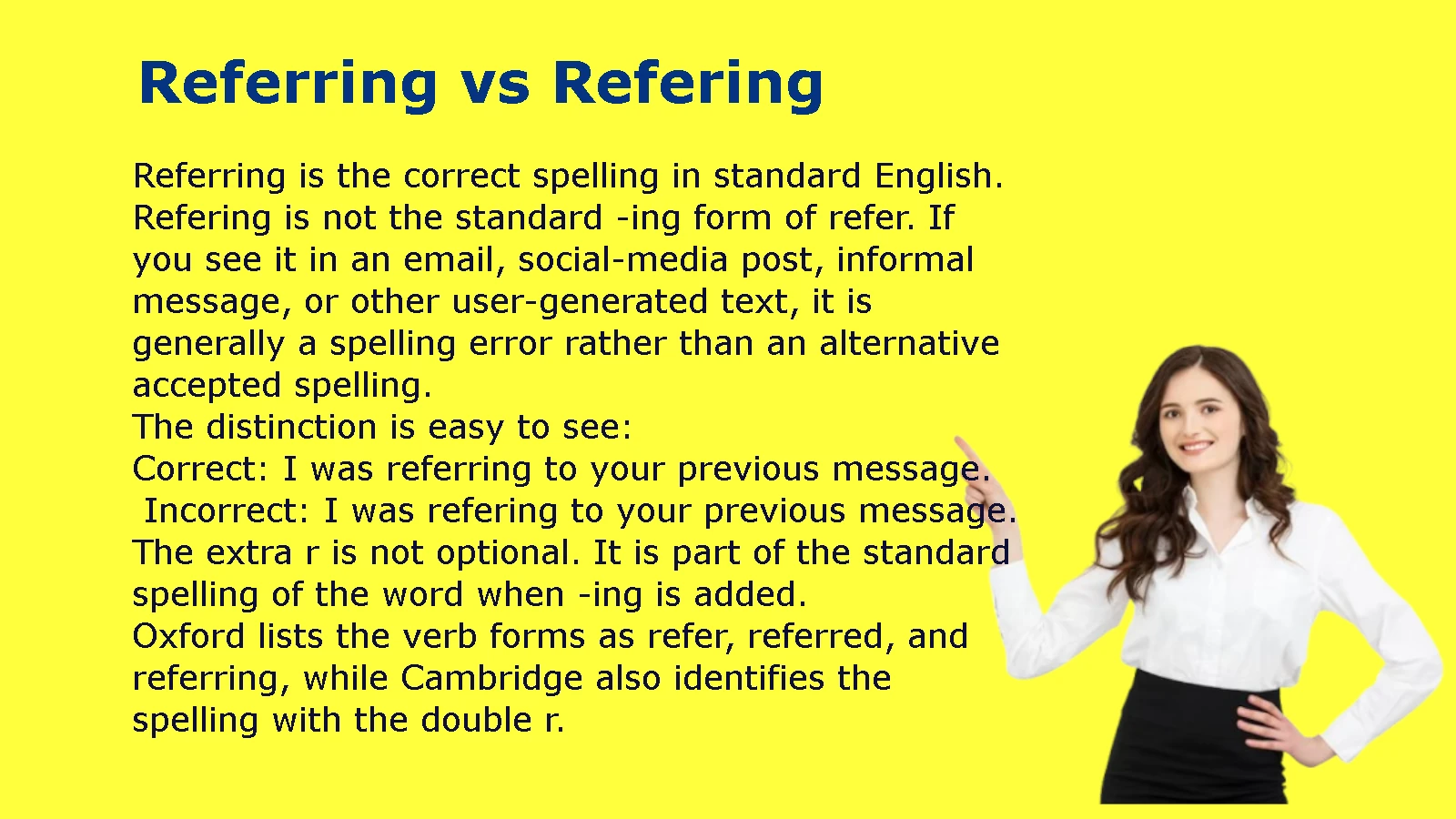
Referring is the correct spelling in standard English.
Refering is not the standard -ing form of refer. If you see it in an email, social-media post, informal message, or other user-generated text, it is generally a spelling error rather than an alternative accepted spelling.
The distinction is easy to see:
Correct: I was referring to your previous message.
Incorrect: I was refering to your previous message.
The extra r is not optional. It is part of the standard spelling of the word when -ing is added.
Oxford lists the verb forms as refer, referred, and referring, while Cambridge also identifies the spelling with the double r.
Referring vs Refering at a Glance
| Point | Referring | Refering |
| Standard spelling | Yes | No |
| Base verb | refer | refer |
| Suffix | -ing | -ing |
| Double r | Yes | No |
| Suitable for formal writing | Yes | No |
| Dictionary-listed -ing form | Yes | No |
For schoolwork, professional writing, academic papers, business communication, and edited content, choose referring.
Why Is Referring Spelled With Two Rs?
The spelling becomes easier to understand when you start with the base verb refer.
The word is:
r-e-f-e-r
When you add -ing, English spelling rules require the final consonant to be doubled:
refer + ing → referring
The result is:
r-e-f-e-r-r-i-n-g
The two r’s therefore appear together in the middle of the word.
Why Does the Final Consonant Double?
English has several consonant-doubling patterns when suffixes such as -ing are attached to verbs. One important pattern applies to verbs ending in a stressed syllable containing a short vowel followed by a single consonant.
Refer fits the relevant pattern because the stress falls on the second syllable:
re-FER
That is why the final r is doubled:
- refer → referring
- prefer → preferring
- occur → occurring
- transfer → transferring
This is not simply a special rule invented for the word refer. It belongs to a broader English spelling pattern.
A Useful Comparison
Consider these words:
| Base verb | + -ing | Correct form |
| refer | refer + ing | referring |
| prefer | prefer + ing | preferring |
| occur | occur + ing | occurring |
| transfer | transfer + ing | transferring |
| offer | offer + ing | offering |
The last example is useful because offer does not double the final r. That difference shows why consonant doubling cannot be reduced to a simple rule such as “every verb ending in r doubles the r.”
The spelling depends on the structure and stress pattern of the word.
What Does Referring Mean?
Referring is the present participle or -ing form of refer.
The meaning depends on the context. The verb refer can involve mentioning something, relating to something, consulting a source, or directing someone to another person or place. Cambridge and Oxford both document these different uses.
Referring Means Mentioning or Talking About Something
One common use is referring to something when you mention or talk about it.
For example:
I was referring to the second paragraph.
Here, referring to means talking about or mentioning the second paragraph.
More examples:
- What are you referring to?
- She was referring to the earlier discussion.
- I wasn’t referring to your brother.
- The speaker was referring to a historical event.
- He kept referring to the same example.
Cambridge defines refer to someone/something as talking or writing about someone or something, among other related uses.
Referring Means Relating to Something
A statement, term, number, or document can also refer to something in the sense of relating to it.
For example:
The figures are referring to last year’s sales.
However, depending on the exact meaning, a more natural construction may be:
The figures refer to last year’s sales.
The simple present is often better when describing a general relationship rather than an action happening at that moment.
Other examples include:
- This term refers to a specific type of process.
- The rule refers to all employees.
- The paragraph refers to several earlier studies.
- The figures refer to full-time workers.
Oxford gives examples of refer to meaning that something describes or is connected with a particular person or thing.
Referring Means Looking at a Source
Another meaning involves consulting something for information.
For example:
She is referring to her notes before answering the question.
Here, referring to her notes means looking at her notes for information.
You can also say:
- He was referring to a dictionary.
- The researcher is referring to several sources.
- I am referring to the instructions in the manual.
- She kept referring to the original document.
Cambridge specifically includes this use of refer to for looking at a book, record, or other source for information or help.
Referring: Meaning and Grammar
Referring is formed by adding -ing to the verb refer.
It can function in several grammatical constructions.
Referring in the Present Progressive
The word can appear with a form of be to describe an action in progress:
She is referring to the report.
They are referring to the new guidelines.
I am referring to the document you sent yesterday.
The structure is:
am/is/are + referring
Referring as a Present Participle
The -ing form can also occur in a participial phrase:
Referring to the earlier example, the author makes the distinction clearer.
Here, referring introduces a phrase connected to the subject of the main clause.
Another example is:
Referring to the data, the researcher explained the change.
The construction is common in formal and academic writing, although writers should make sure the introductory phrase clearly relates to the subject of the main clause.
Referring To
One of the most common combinations is:
referring to + person/thing/topic
Examples include:
- referring to the report
- referring to the policy
- referring to your question
- referring to the previous example
- referring to a specific person
- referring to historical events
Oxford documents refer to as a phrasal verb with meanings including mentioning, describing, relating to, and consulting a source.
Referring in a Sentence: Examples
The best way to understand referring is to see how its meaning changes with context.
Everyday Conversation
I think you’re referring to the restaurant we visited last week.
Who are you referring to?
I wasn’t referring to you.
She was referring to the movie we watched yesterday.
Academic Writing
The author is referring to a study published several years earlier.
The term is used when referring to a particular group of participants.
The researcher was referring to data collected during the first phase.
When referring to previous research, the writer should identify the relevant source.
Workplace Communication
I believe you are referring to the revised contract.
When I mentioned the deadline, I was referring to the date in the original agreement.
The manager was referring to the updated sales figures.
She was referring to the instructions in the employee handbook.
Professional or Medical Contexts
Refer can also mean directing someone to another professional or service.
The doctor is referring the patient to a specialist.
The clinic is referring him to a physical therapist.
In this construction, referring does not mean merely mentioning something. It means directing someone to another person or service for help, advice, or treatment. Cambridge specifically gives this sense of refer someone to a specialist or another service.
Referring vs Refering Examples
Seeing the correct and incorrect forms side by side makes the difference clear.
| Correct | Incorrect |
| She is referring to the report. | She is refering to the report. |
| I was referring to your earlier comment. | I was refering to your earlier comment. |
| Who are you referring to? | Who are you refering to? |
| The doctor is referring him to a specialist. | The doctor is refering him to a specialist. |
| We are referring to the same document. | We are refering to the same document. |
| He kept referring to the instructions. | He kept refering to the instructions. |
Correct These Sentences
Here are several common errors corrected:
Incorrect:
I was refering to the first section.
Correct:
I was referring to the first section.
Incorrect:
Who are you refering to?
Correct:
Who are you referring to?
Incorrect:
The doctor is refering her to a specialist.
Correct:
The doctor is referring her to a specialist.
The correction is the same each time: refering → referring.
Common Mistakes With Referring
Writing Refering With One R
This is the main spelling mistake.
Writers often see refer + ing and simply attach the suffix:
refer + ing = refering
That approach misses the consonant-doubling rule.
The standard form is:
refer + ing = referring
Confusing Referring With Referencing
The words referring and referencing can have related meanings, especially in academic writing, but they are not interchangeable in every situation.
Referring to usually means mentioning, talking about, relating to, or consulting something.
Referencing can mean providing or using references, especially when citing sources.
Oxford lists referencing as the -ing form of reference, and defines the verb reference as meaning to refer to something or provide a work with references.
Compare:
The lecturer was referring to the textbook.
This means the lecturer was talking about or consulting the textbook.
The student was referencing the textbook in her essay.
This can mean the student was using or citing the textbook as a source.
Confusing Refer With Referral
Refer, referring, and referral belong to the same word family, but they have different grammatical roles.
| Word | Part of speech | Example |
| refer | Verb | The doctor may refer the patient to a specialist. |
| referring | Verb form / participle | The doctor is referring the patient to a specialist. |
| referred | Past tense / past participle | The doctor referred the patient to a specialist. |
| referral | Noun | The patient received a referral to a specialist. |
Oxford defines referral as the act of sending someone who needs professional help to a person or place that can provide it.
Referring vs Referencing: What’s the Difference?
These words overlap, but their normal uses are different.
Referring
Referring to commonly means:
- mentioning something
- talking about something
- relating to something
- pointing someone toward information
- consulting a source
- directing someone to another professional or service
Example:
The professor was referring to the study discussed earlier.
Referencing
Referencing is particularly associated with sources, citations, and documentation.
Example:
The student was referencing three academic articles in her paper.
The distinction becomes especially useful in academic writing.
| Expression | Typical meaning |
| referring to the article | mentioning, discussing, or consulting the article |
| referencing the article | using the article as a reference or source |
| referring to the author | mentioning or talking about the author |
| referencing the author | citing or documenting the author’s work |
Neither word is automatically a substitute for the other.
Referring vs Referring To
There is no spelling difference between these forms. Referring is the word itself, while referring to is a common grammatical construction.
Consider:
She is referring to the report.
The word referring describes the action, while to the report identifies what she is referring to.
Common patterns include:
Referring to a Person
Who are you referring to?
Referring to an Idea
The author is referring to the concept introduced earlier.
Referring to a Document
I am referring to the contract we signed.
Referring to an Earlier Statement
When I said that, I was referring to your previous comment.
Cambridge and Oxford both document refer to in these kinds of constructions.
Referring vs Referred and Referral
The refer word family can be confusing because the spelling behaves consistently but not identically across all forms.
Refer → Referring
When -ing is added:
refer → referring
The final r is doubled.
Refer → Referred
When -ed is added:
refer → referred
The final r is also doubled.
Refer → Referral
The noun is:
refer → referral
Here, too, the spelling contains rr.
Oxford lists referred, referring, and referral as established forms in the refer word family.
Word Family Table
| Base or related word | Correct spelling | Example |
| Verb | refer | Please refer to the manual. |
| Third-person singular | refers | The statement refers to the policy. |
| Past tense | referred | She referred me to another department. |
| -ing form | referring | He is referring to the report. |
| Noun | referral | The doctor made a referral. |
| Related noun | reference | Check the reference for more information. |
| -ing form of reference | referencing | She is referencing the source. |
This table also shows why refering does not belong in the standard word family.
How to Remember the Spelling of Referring
The simplest memory trick is to keep the base verb visible:
REFER + ING = REFERRING
Notice the final r in refer and the first r that appears again when the suffix is attached.
Another useful comparison is:
- refer → referring
- prefer → preferring
- occur → occurring
- transfer → transferring
These examples can help you recognize the broader spelling pattern instead of memorizing referring as an isolated word.
A Quick Spelling Test
If you are unsure, remove -ing.
referring → refer
Now add -ing according to the spelling pattern:
refer → referring
That makes it much easier to avoid refering.
Is Refering Ever Correct?
In standard English, refering is not the correct spelling of the -ing form of refer.
The standard dictionary form is referring. Oxford explicitly gives referring as the -ing form of refer.
You may still encounter refering online because people make spelling mistakes, especially when typing quickly. A misspelling can appear repeatedly on websites or in user-generated content without becoming an accepted spelling.
Therefore, frequency alone should not determine whether a spelling is correct.
For edited English, use:
referring
not:
refering
Referring in Formal and Professional Writing
Referring is completely appropriate in formal, professional, academic, and business writing when the context calls for it.
In Emails
I am referring to the invoice attached to your previous email.
In Reports
The following section discusses the findings referring to customer satisfaction.
However, writers should check sentence structure carefully. In some cases, relating to, concerning, or a direct construction may produce a clearer sentence.
In Academic Writing
The author is referring to evidence presented in the previous chapter.
When referring to another scholar’s work, provide the appropriate citation.
In Business Writing
With regard to the figures you mentioned, I believe you are referring to the revised report.
There is no reason to avoid referring simply because it is an -ing form. The word is standard English.
Referring Synonyms
The best synonym depends on the meaning of referring in the sentence.
When Referring Means Mentioning
Possible alternatives include:
- mentioning
- discussing
- alluding to
- talking about
- indicating
Example:
She was referring to the earlier agreement.
Possible rewrite:
She was mentioning the earlier agreement.
The words are not always interchangeable, however. Alluding to, for example, can suggest an indirect or less explicit mention.
When Referring Means Consulting
Possible alternatives include:
- consulting
- checking
- looking at
- turning to
Example:
He was referring to the dictionary.
Possible rewrite:
He was consulting the dictionary.
When Referring Means Directing Someone
Possible alternatives include:
- directing
- sending
- recommending
Example:
The doctor is referring the patient to a specialist.
Possible rewrite:
The doctor is sending the patient to a specialist.
In professional contexts, referring can be more precise because it describes a formal process of directing someone to another professional or service.
Referring vs Refering: At a Glance
| Question | Answer |
| Which spelling is correct? | Referring |
| Is refering correct? | No, not in standard English |
| What is the base verb? | Refer |
| What suffix is added? | -ing |
| Why are there two r’s? | The final consonant is doubled in this spelling pattern |
| What does referring mean? | It can mean mentioning, relating to, consulting, or directing someone, depending on context |
| Is referring a verb? | It is the -ing form of the verb refer and can function as a present participle or part of a progressive construction |
| Is referring to common? | Yes |
| Is referencing the same as referring? | Not always; the meanings overlap in some contexts |
| Is referral related to refer? | Yes; referral is a related noun |
A Practical Case Study: Referring or Refering in a Professional Email?
Imagine that a manager writes:
I am refering to the figures in your report.
The intended meaning is clear, but the spelling is incorrect.
The corrected sentence is:
I am referring to the figures in your report.
Why?
The verb is refer, and its standard -ing form is referring. Oxford lists exactly this form in the verb’s conjugation.
Now consider a slightly different sentence:
I am referring you to our legal department.
Here, referring has a different meaning. The writer is not simply mentioning the legal department. The writer is directing the recipient to another source of assistance.
That distinction demonstrates why understanding the word’s meaning matters as much as learning its spelling.
Facts to Remember About Referring vs Refering
Keep these points in mind:
- Referring is the correct spelling.
- Refering is a misspelling in standard English.
- The base verb is refer.
- The correct formation is refer + ing → referring.
- The final r is doubled.
- Referring to commonly means mentioning, discussing, relating to, or consulting something.
- Refer someone to can mean directing that person to another professional, organization, or source.
- Referred is the correct past form.
- Referral is the related noun.
- Referencing comes from reference, not directly from refer.
- Referring is appropriate in formal and professional writing.
- Dictionary sources such as Oxford and Cambridge recognize referring as the standard form.
FAQs About Referring vs Refering
Is referring spelled with one R or two?
It is spelled with two r’s:
referring
The incorrect form is refering.
Is refering a word?
Refering is not the standard spelling of the -ing form of refer. The correct form is referring.
Why does referring have two Rs?
The spelling follows an English consonant-doubling pattern. When -ing is added to refer, the final r is doubled:
refer → referring
What is the correct spelling of referring?
The correct spelling is referring, with rr before -ing.
Correct: referring
Incorrect: refering
What does referring mean?
Referring can mean mentioning or talking about someone or something, relating to something, consulting a source, or directing someone to another person or service. The precise meaning depends on the sentence.
Is referring a verb?
Referring is the -ing form of the verb refer. It can function as part of a progressive verb phrase or as a present participle.
For example:
She is referring to the report.
What is the difference between referring and referencing?
Referring to often means mentioning, discussing, relating to, or consulting something. Referencing is commonly associated with using or citing sources, especially in academic writing. The appropriate word depends on the intended meaning.
How do you use referring in a sentence?
A common construction is referring to + noun or pronoun:
I was referring to the previous paragraph.
Another construction is referring someone to + person/place:
The doctor is referring the patient to a specialist.
Is refering ever the correct spelling?
No. For standard English, use referring.
Is referring formal or informal?
Referring is a standard English word and can be used in casual, professional, academic, and formal contexts. Its level of formality depends more on the surrounding sentence than on the word itself.
Conclusion: Referring or Refering?
When choosing between referring and refering, use referring.
The correct spelling is:
referring
The incorrect spelling is:
refering
The reason is straightforward: refer becomes referring when the -ing suffix is added. The final r is doubled.
Beyond spelling, referring has several useful meanings. You can be referring to a person, idea, statement, document, or source when you mention, discuss, relate to, or consult it. You can also refer someone to another person or service when directing them for help or information.
The easiest rule to remember is:
refer → referring
So if you’re writing an email, essay, report, article, or everyday message, choose referring with confidence.