“Curriculums vs Curricula” is a common grammar confusion among English learners, students, teachers, and even professional writers. Have you ever written or read the word curriculums and wondered whether it sounds correct—or if curricula is the only proper form? This confusion happens because English borrows many academic terms from Latin, and Latin plurals don’t always follow regular English rules.
Both curriculums and curricula are used to refer to more than one curriculum, but they are not equally accepted in formal English. Understanding the difference between them will help you write more accurately in academic, professional, and educational contexts. It also improves your grammar confidence when discussing schools, syllabi, or study programs.
In simple terms, curricula is the traditional and academically correct plural of curriculum, while curriculums is a modern, informal English plural that is also widely understood, especially in everyday speech. However, in formal writing—such as research papers, educational documents, and institutional communication—curricula is preferred.
This confusion leads many learners to search for phrases like curriculums meaning, curricula meaning, curriculums vs curricula difference, which is correct curriculums or curricula, and plural of curriculum. Since both forms appear in real usage, it becomes difficult to know which one is “right.”
In this guide, you’ll learn the complete difference between curriculums and curricula, including definitions, grammar rules, pronunciation, usage patterns, real-life examples, regional preferences, common mistakes, and memory tricks. By the end, you’ll know exactly when to use each form confidently in writing and conversation.
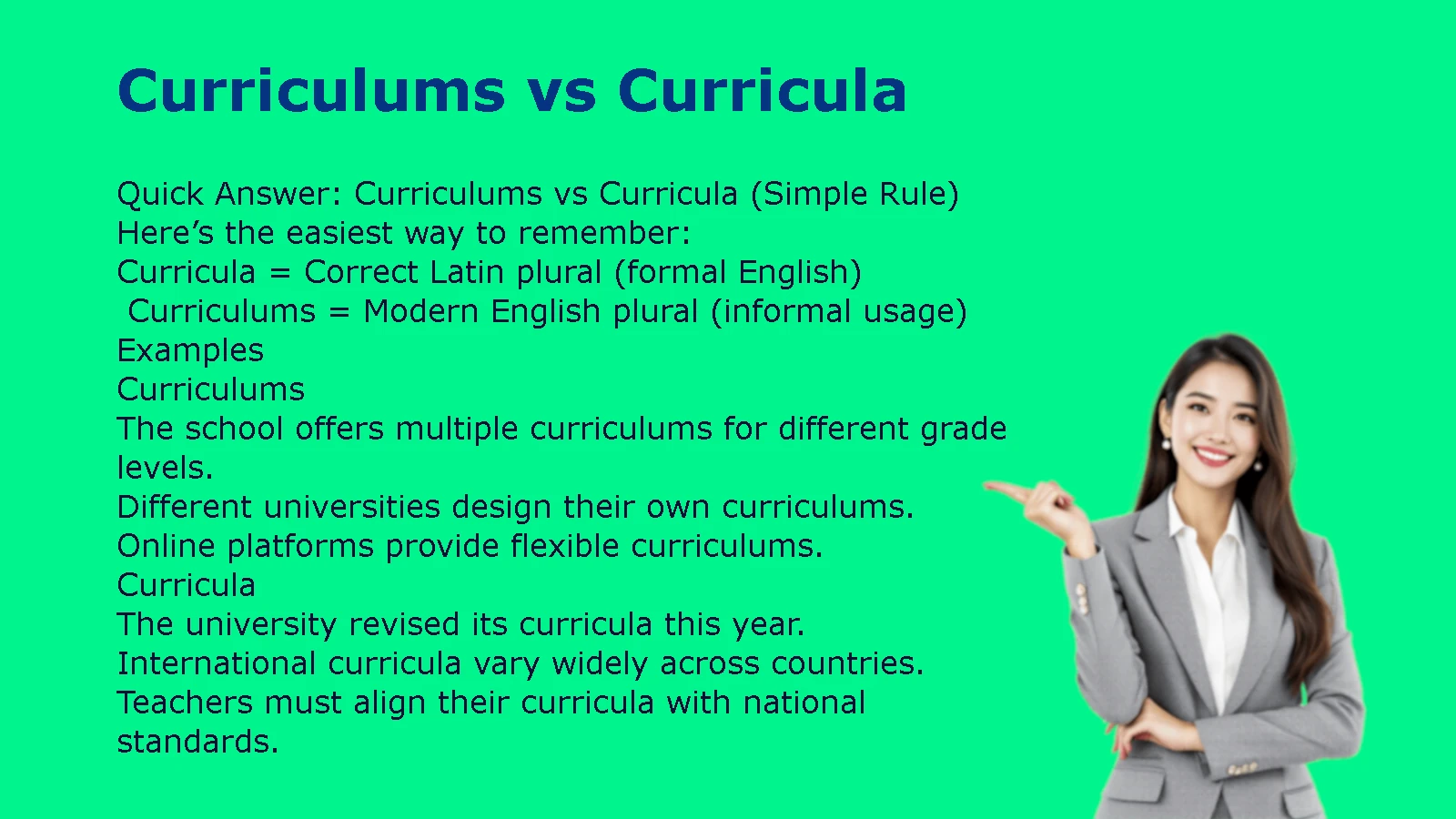
Quick Answer: Curriculums vs Curricula (Simple Rule)
Here’s the easiest way to remember:
Curricula = Correct Latin plural (formal English)
Curriculums = Modern English plural (informal usage)
Examples
Curriculums
- The school offers multiple curriculums for different grade levels.
- Different universities design their own curriculums.
- Online platforms provide flexible curriculums.
Curricula
- The university revised its curricula this year.
- International curricula vary widely across countries.
- Teachers must align their curricula with national standards.
The Simple Rule
- If you are writing formally → use curricula
- If you are speaking or using casual English → curriculums is acceptable
Easy Memory Trick
Think like this:
- Curricula = Classic Latin (C = Classic)
- Curriculums = Casual modern English usage
Or even simpler:
- Academic writing → Curricula
- Everyday speech → Curriculums
Easy Formula
- Formal education / research → Curricula
- General conversation → Curriculums
- Safety choice in exams → Curricula
How People Actually Use “Curriculums” and “Curricula”
In real life, both forms appear—but usage depends on context, not strict grammar rules.
In Education Systems
Most official institutions use:
- Curricula (in documents, reports, policies)
But teachers and students may say:
- Curriculums (in conversation)
In Everyday Speech
People often prefer simplicity:
- “Different curriculums are used in schools.”
Even if grammatically debated, it is widely understood.
In Academic Writing
You will almost always see:
- Curricula
Because academic English prefers Latin plural forms.
The Real Difference Between Curriculums and Curricula
Think of it this way:
1. Curricula
- Latin origin plural
- Formal and academic
- Used in universities, research, official documents
second : Curriculums
- Anglicized plural form
- Informal English usage
- Common in spoken English
Curriculums” Explained Clearly (With Examples)
“Curriculums” is the modern English plural of curriculum.
Common Examples
- The school offers different curriculums for science and arts.
- Private institutes design their own curriculums.
- Training curriculums vary by company.
Example Sentences
- “We are comparing curriculums from different schools.”
- “Their curriculums focus on practical skills.”
When It Sounds Natural
- Conversations
- Marketing content
- Informal writing
“Curricula” Explained Clearly (With Examples)
“Curricula” is the original Latin plural of curriculum and is considered more formal.
Common Examples
- The university updates its curricula every five years.
- Educational curricula must meet national standards.
- International curricula differ significantly.
Example Sentences
- “The school redesigned its curricula to improve learning outcomes.”
- “Modern curricula emphasize digital skills.”
When It Sounds Natural
- Academic writing
- Research papers
- Policy documents
- Formal education systems
The Biggest Mistake People Make
The most common mistake is assuming:
👉 “Curriculums is incorrect”
That is not fully true.
- It is informal, not wrong
- It is modern English usage
- It is less preferred in academic writing
Both are understandable, but context decides correctness.
Side-by-Side Comparison Table
| Feature | Curriculums | Curricula |
| Origin | Modern English | Latin |
| Correctness | Informal | Formal |
| Academic use | Rare | Standard |
| Spoken English | Common | Less common |
| Written English | Acceptable | Preferred |
| Meaning | Plural of curriculum | Plural of curriculum |
Key Takeaway So Far
- Both words are correct in usage
- Curricula = formal and academic standard
- Curriculums = informal but widely used
Real-Life Examples of “Curriculums”
- “Different curriculums are designed for online learning.”
- “Schools compare curriculums before adoption.”
- “The company offers training curriculums for employees.”
Real-Life Examples of “Curricula”
- “The ministry approved new national curricula.”
- “Universities must align their curricula with global standards.”
- “STEM curricula are becoming more popular.”
Regional Differences: Curriculums vs. Curricula
United States
- Both are used
- Curricula preferred in formal writing
- Curriculums common in speech
United Kingdom
- Curricula strongly preferred in formal contexts
- Curriculums is less common
Academic English Worldwide
- Curricula dominates in official documents
Common Expressions Using Curriculums / Curricula
- Standard curricula
- National curricula
- Academic curricula
- School curriculums
- Training curriculums
- Flexible curriculums
- Integrated curricula
Impact of Choosing the Right Word
Using the correct form matters most in:
- Academic writing
- Exams
- Research papers
- Official documents
Using curricula in formal writing shows:
- Strong grammar knowledge
- Academic fluency
- Professional tone
How to Avoid Confusion Every Time
Ask yourself:
- Am I writing formally? → Curricula
- Am I speaking casually? → Curriculums
- Is this an academic paper? → Curricula
What to Say Instead (Clear Alternatives)
- Study programs
- Educational plans
- Course structures
- Learning modules
- Training programs
These can sometimes replace both words in simpler English.
Quick Decision Guide
- Formal writing → Curricula
- Casual speech → Curriculums
- Academic context → Curricula
- Everyday talk → Either is fine
FAQs
Is “curriculums” correct?
Yes, but it is informal.
Is “curricula” singular or plural?
It is plural.
What is the singular form?
Curriculum.
Which is better for exams?
Curricula.
Case Study: Student Confusion
Maria is writing an essay.
She writes:
- “The school updated its curriculums.”
Her teacher corrects it to:
- “The school updated its curricula.”
Maria learns that both are understood, but academic English prefers Latin plural forms.
Key Facts You Should Remember
- Curriculum = singular
- Curricula = formal plural
- Curriculums = informal plural
- Both plural forms are widely understood
- Context determines best usage
Fill in the blanks: Curriculums vs Curricula
- The school updated its __________ for the new academic year.
- Many universities around the world design their __________ carefully.
- Different countries have different educational __________.
- The teacher compared several science __________ from various schools.
- Some private schools offer international __________.
- The committee reviewed all the proposed __________ before approval.
- Modern __________ focus more on skill-based learning.
- The two institutions follow very different __________.
- Educational __________ must adapt to changing technology.
- The university offers multiple specialized __________ in engineering.
- The education board is revising school __________ nationwide.
- Some experts argue that traditional __________ are outdated.
- Teachers often collaborate to design better __________.
- The ministry approved new high school __________ this year.
- Many online platforms now provide flexible learning __________.
- The debate focused on improving national __________.
- Both private and public schools must follow approved __________.
- The college offers three different business __________.
- The reform aims to modernize outdated __________.
- Students benefit from well-structured __________.
Answer Key
- curricula
- curriculums
- curricula
- curricula
- curriculums
- curricula
- curricula
- curriculums
- curricula
- curriculums
- curriculums
- curricula
- curricula
- curricula
- curriculums
- curricula
- curricula
- curriculums
- curricula
- curricula
Final Takeaway: The One Rule That Makes It Easy
The difference between curriculums and curricula is simple once you understand context. Curricula is the traditional Latin plural and remains the preferred form in academic and formal writing. Curriculums is a modern, simplified English plural used in casual conversation and informal contexts.
If you want to sound academically correct, always choose:
👉 Curricula
But if you’re speaking naturally in everyday English, both forms are understood, and meaning remains clear.
In short:
- Formal English → Curricula
- Informal English → Curriculums
Once you understand this distinction, you can confidently use both words in the right situation without confusion.