Have you ever wondered whether Dice vs Die is the correct way to refer to those small cubes used in board games? You’re not alone. Many people are confused about the difference between dice and die, especially since both words are commonly used in everyday conversation.
The confusion grows because people often search for dice meaning, die meaning, dice pronunciation, and is dice singular or plural to figure out which word is grammatically correct. And here’s the kicker: while many people use dice for both singular and plural, there are situations where die is still the correct choice.
But don’t worry—it’s much simpler than it sounds.
In this guide, you’ll learn the difference between Dice vs Die, discover the correct usage of dice and die, understand when to use dice or die, and see plenty of dice vs die examples in sentences. You’ll also learn how to pronounce dice and die, explore their meanings, and find an easy memory trick to help you choose the right word every time.
By the end, you’ll know whether die or dice fits your sentence and avoid one of the most common grammar questions surrounding these often-confused words.
Dice vs Die at a Glance
| Feature | Die | Dice |
| Meaning | One gaming cube | Two or more gaming cubes |
| Number | Singular | Plural |
| Traditional Grammar | Correct | Correct |
| Everyday Conversation | Less common | Often used as both singular and plural |
| Formal Writing | Preferred for one object | Preferred for multiple objects |
| Example | Roll the die. | Roll the dice. |
Quick Rule
- One object = die
- Two or more objects = dice
Examples
- Please hand me the die.
- The children rolled the dice.
- Every player starts with one die.
- The game includes six dice.
Remembering this rule keeps your writing accurate and consistent.
What Is a Die?
A die is a small object with multiple faces that display numbers, symbols, letters, or images. Most people picture the familiar six-sided cube used in board games, but dice come in many different shapes and sizes.
A single die has one value showing on its top face after each roll. That result determines what happens next in a game, experiment, or classroom activity.
Common Characteristics of a Die
- Usually has six faces
- Displays numbers or pips
- Produces random outcomes
- Made from plastic, wood, metal, resin, stone, or acrylic
- Used in games, education, mathematics, and probability
Although six-sided dice dominate the market, manufacturers also produce four-sided, eight-sided, ten-sided, twelve-sided, and twenty-sided versions.
Examples of Correct Usage
- Roll the die once.
- The teacher picked up a die for today’s lesson.
- Every player receives one die.
- This puzzle uses a custom-colored die.
Notice that each sentence refers to exactly one object.
When You Should Use “Die”
Use die whenever your sentence clearly mentions a single object.
Examples include:
- One die
- A die
- Each die
- Every die
- This die
- That die
These combinations follow standard English grammar and appear in dictionaries, textbooks, and style guides.
What Are Dice?
Dice is the plural form of die. It refers to two or more dice used together.
Many games require multiple dice because they create more possible outcomes. For example, games like Monopoly, Yahtzee, and many tabletop role-playing games rely on rolling several dice at once.
Examples
- Roll two dice.
- The box contains five dice.
- The casino replaces its dice regularly.
- Colorful dice filled the game tray.
Whenever you’re talking about multiple objects, dice is the correct choice.
Different Types of Dice
Although the word remains the same, dice come in many varieties.
| Type | Number of Faces | Common Use |
| d4 | 4 | Tabletop RPGs |
| d6 | 6 | Board games |
| d8 | 8 | Role-playing games |
| d10 | 10 | Probability games |
| d12 | 12 | Fantasy games |
| d20 | 20 | Dungeons & Dragons and similar games |
The abbreviation “d” stands for die, not dice. For example, d20 means one twenty-sided die, while 2d20 means two twenty-sided dice.
Is “Dice” Singular?
This question sparks countless online debates.
The traditional answer is no. Standard English grammar defines die as singular and dice as plural.
However, real-life language doesn’t always follow traditional rules.
Today, many English speakers casually use dice for both one and many. You’ll hear phrases such as:
- Pass me a dice.
- I lost my favorite dice.
- Pick up that blue dice.
These expressions appear often in conversation, online forums, and gaming communities.
Why Did This Change Happen?
Language naturally evolves over time.
Several factors contributed to the shift.
- People hear dice more often than die.
- Board games usually include multiple dice.
- Many speakers never learn the traditional singular form.
- The noun die is easily confused with the verb meaning “to stop living.”
Because of these influences, singular dice has become increasingly common in informal English.
Should You Use Singular “Dice”?
That depends on your audience.
| Situation | Recommended Choice |
| Academic writing | Die |
| Business writing | Die |
| School assignments | Die |
| Dictionaries | Die |
| Casual conversation | Either is commonly understood |
| Social media | Either, depending on style |
If clarity and professionalism matter, choose die for one object.
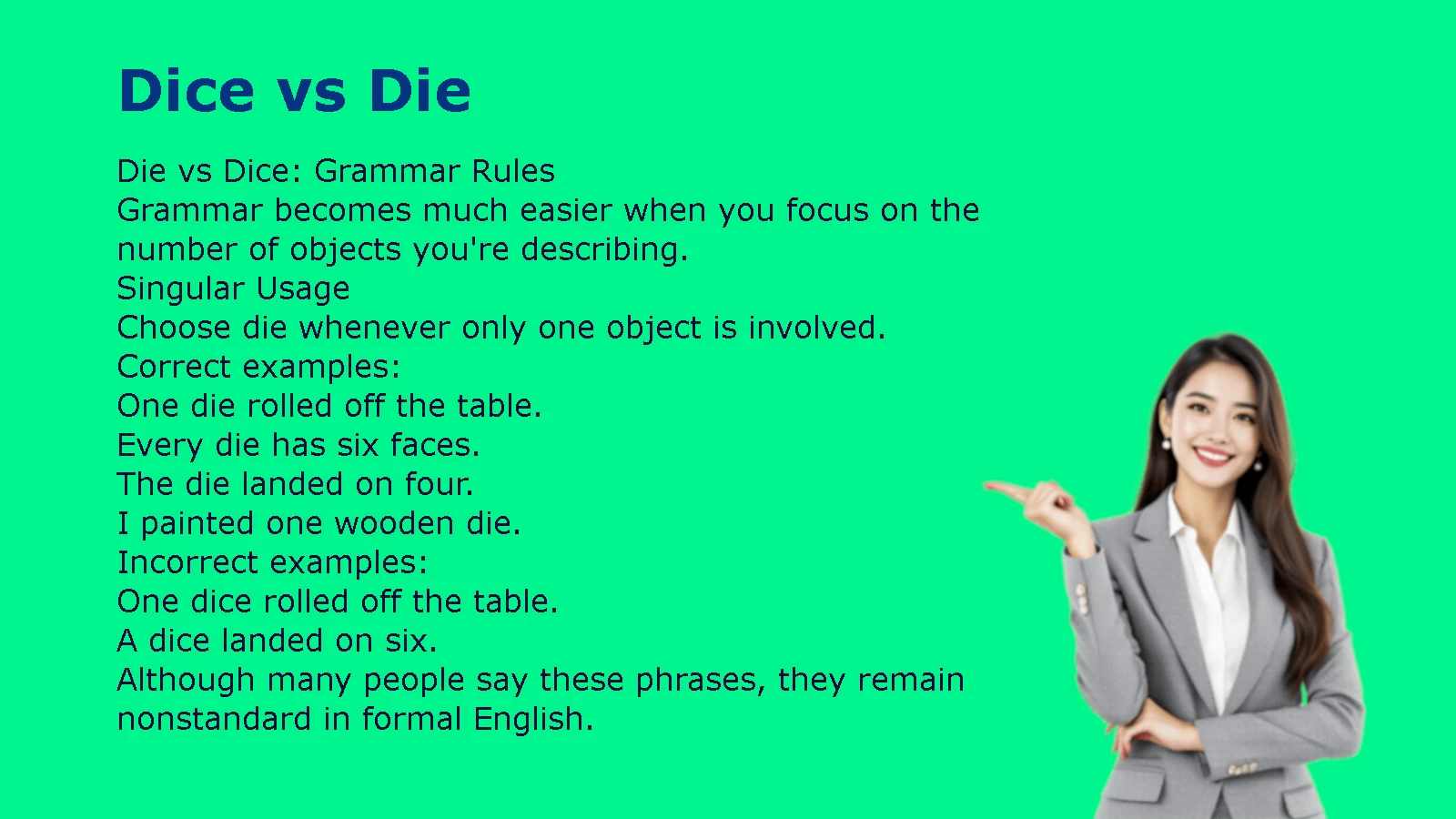
Die vs. Dice: Grammar Rules
Grammar becomes much easier when you focus on the number of objects you’re describing.
Singular Usage
Choose die whenever only one object is involved.
Correct examples:
- One die rolled off the table.
- Every die has six faces.
- The die landed on four.
- I painted one wooden die.
Incorrect examples:
- One dice rolled off the table.
- A dice landed on six.
Although many people say these phrases, they remain nonstandard in formal English.
Plural Usage
Use dice whenever two or more objects appear.
Correct examples:
- Two dice landed on doubles.
- The dice bounced across the table.
- These dice are transparent.
- Our game uses seven dice.
Plural nouns require plural verbs.
Correct:
- The dice are ready.
Incorrect:
- The dice is ready.
Subject-Verb Agreement
Proper agreement improves readability.
| Subject | Correct Verb |
| The die | is |
| A die | rolls |
| One die | lands |
| The dice | are |
| Two dice | roll |
| Several dice | land |
Examples:
- The die is balanced.
- The dice are balanced.
This simple distinction eliminates many grammar mistakes.
Articles and Determiners
Articles help signal whether you’re discussing one or many.
| Phrase | Correct |
| A die | ✔ |
| One die | ✔ |
| Each die | ✔ |
| Every die | ✔ |
| Two dice | ✔ |
| Several dice | ✔ |
| Many dice | ✔ |
Avoid combinations such as:
- A dice
- One dice
- Each dice
Those forms don’t follow standard grammar.
Die vs. Dice in American and British English
Many people assume American English and British English use different rules.
In reality, they don’t.
Both varieties traditionally recognize:
- Die as singular
- Dice as plural
The difference appears in everyday speech rather than grammar.
American English
American speakers often use dice as both singular and plural, especially in casual conversation and gaming circles.
Examples you may hear include:
- Grab a dice.
- Roll that dice.
These expressions are widely understood even though they aren’t considered standard in formal writing.
British English
British English generally preserves the traditional distinction more often, especially in published works, educational materials, and reference books.
Still, conversational British English occasionally uses singular dice, particularly among younger speakers.
Professional Writing
Editors, publishers, educators, and technical writers usually maintain the standard forms because they eliminate ambiguity.
When writing professionally, stick with:
- One die
- Multiple dice
That choice keeps your writing clear regardless of your audience’s location.
Pronunciation
Fortunately, pronunciation isn’t difficult once you know the words.
| Word | Pronunciation |
| Die | /daɪ/ |
| Dice | /daɪs/ |
The only difference is the final s sound.
Common Mistakes
Some learners accidentally pronounce dice as “dices.”
That’s incorrect.
The plural is simply:
- Dice
Not:
- Dices
Similarly, avoid treating die like the verb unless the sentence clearly requires that meaning.
Compare these examples:
- Roll the die.
- Plants die without water.
The spelling is identical, but the meanings differ completely.
Origin and Etymology
Understanding a word’s history often explains why modern English behaves the way it does.
The noun die traces its roots to medieval Europe. Linguists connect it to Old French and Medieval Latin terms describing gaming cubes used in games of chance. As dice games spread across Europe, English adopted die for a single cube and dice as its plural.
The words have appeared in English for centuries. Historical records show that games involving dice existed long before modern board games. Archaeologists have uncovered ancient dice made from bone, ivory, stone, and wood in civilizations including Mesopotamia, Egypt, Greece, Rome, India, and China.
Interestingly, early dice weren’t always perfect cubes. Craftsmen carved them by hand, so their balance often varied. Modern manufacturing techniques create much more consistent shapes, especially for casinos where fairness matters.
How the Confusion Began
The confusion between die and dice developed gradually.
Several trends played a role:
- Board games became household entertainment.
- Most games included more than one die.
- People heard dice far more frequently than die.
- Casual speech favored the more familiar word.
- The noun die competed with the much more common verb die.
Over time, everyday conversation blurred the distinction. Formal English, however, continues to recognize the traditional singular and plural forms.
Today, both words remain alive in the language. Knowing when to use each one helps you communicate with precision, whether you’re writing a game manual, teaching probability, or simply explaining the rules of your favorite board game.
Examples of Correct Usage
Understanding the rule is one thing. Applying it naturally is another. The following examples show how die and dice fit into different situations. Once you see them in context, choosing the correct word becomes much easier.
In Board Games
Board games introduce most people to dice at an early age. Some games require one die, while others include several.
Examples
- Each player rolls one die to determine who goes first.
- The red die landed on six.
- Roll both dice and move your token.
- The game comes with four colored dice.
- Keep the spare die inside the box.
- These dice have rounded corners for smoother rolls.
Many classic games, such as Monopoly, Backgammon, and Yahtzee, rely on multiple dice to create random outcomes. The number of dice changes from one game to another, but the grammar rule stays the same.
In Casinos
Casinos use precision-manufactured dice that meet strict standards. Every die must have equal weight distribution to ensure fair results.
Examples
- The dealer inspected each die before the game started.
- Casino dice are replaced regularly.
- The shooter rolled two dice across the table.
- A damaged die is removed immediately.
- Security monitors every set of dice during play.
Professional casinos often retire dice after limited use to protect game integrity.
In Tabletop Role-Playing Games
Tabletop RPGs use a wide variety of dice with different numbers of faces.
Players commonly refer to them using abbreviations.
| Abbreviation | Meaning |
| d4 | One four-sided die |
| d6 | One six-sided die |
| d8 | One eight-sided die |
| d10 | One ten-sided die |
| d12 | One twelve-sided die |
| d20 | One twenty-sided die |
| 2d6 | Two six-sided dice |
| 4d8 | Four eight-sided dice |
Examples:
- Roll one d20 die for your attack.
- Roll two dice and add the results.
- This custom die glows in the dark.
- My favorite set includes seven dice.
In Mathematics and Probability
Teachers often use dice to explain probability because every roll produces a measurable outcome.
For example, a standard six-sided die has six equally likely results.
| Roll | Probability |
| 1 | 1/6 |
| 2 | 1/6 |
| 3 | 1/6 |
| 4 | 1/6 |
| 5 | 1/6 |
| 6 | 1/6 |
Examples:
- Roll the die fifty times.
- Record every result from the die.
- Students compared results from several dice.
- The experiment used three identical dice.
These exercises help students understand randomness, averages, and probability distributions.
In Everyday Conversation
Casual speech often bends grammar rules. Even so, knowing the standard form helps you communicate clearly.
Natural examples include:
- Can you hand me that die?
- Where are the dice?
- I bought a metal die yesterday.
- These colorful dice look amazing.
- The wooden die feels heavier than the plastic one.
Although many people say “a dice,” formal English still recommends “a die.”
Common Mistakes and How to Avoid Them
Even native English speakers make mistakes with dice vs. die. Most errors happen because the plural form appears far more often than the singular.
Let’s look at the most common problems.
Mistake: Saying “A Dice”
This is the mistake you’ll hear most often.
❌ A dice rolled off the table.
✔ A die rolled off the table.
The article “a” always introduces a singular noun. Therefore, die is the correct choice.
Mistake: Using Dice with Singular Verbs
Incorrect subject-verb agreement creates awkward sentences.
❌ The dice is missing.
✔ The die is missing.
✔ The dice are missing.
The verb should always match the subject.
Mistake: Confusing the Noun with the Verb
English contains two unrelated words spelled die.
| Word | Meaning |
| Die (noun) | One gaming cube |
| Die (verb) | To stop living |
Context tells readers which meaning applies.
Examples:
- Roll the die.
- Flowers die without sunlight.
Although the spelling is identical, the meanings have completely different origins.
Mistake: Adding an Extra Plural
Some learners mistakenly write:
❌ Dices
In standard English, the plural is simply:
✔ Dice
The word already functions as a plural noun.
Mistake: Mixing Singular and Plural in One Sentence
Incorrect:
- Every dice has six sides.
Correct:
- Every die has six sides.
- All dice have six sides.
Watch for words like every, each, and one. They usually signal that you need the singular form.
Quick Checklist
Before finishing your writing, ask yourself these questions.
- Am I talking about one object?
- Am I talking about more than one?
- Does my verb match the noun?
- Did I accidentally write “a dice”?
- Would this sentence sound natural if someone read it aloud?
These quick checks eliminate most grammar errors.
Industry Usage
Different industries use die and dice every day. Although casual conversation sometimes blurs the distinction, professional fields usually follow traditional grammar.
Board Game Publishing
Game publishers write rulebooks with precision because unclear instructions frustrate players.
Typical wording includes:
- Roll one die.
- Roll two dice.
- Place the die beside the board.
- Return all dice to the box.
Consistency prevents confusion throughout the rulebook.
Casino Gaming
Casinos maintain strict terminology.
Employees inspect every die individually before introducing it to a game. Once the game begins, players throw multiple dice depending on the rules.
Precision matters because casino documentation often involves regulations, surveillance, and auditing.
Tabletop Gaming
Fantasy role-playing games frequently mention both singular and plural forms.
Examples include:
- Roll one d20 die.
- Roll three dice.
- Replace the damaged die.
- Collect all seven dice after the session.
Experienced players naturally switch between the singular and plural depending on the situation.
Education
Teachers often introduce die during lessons about counting and probability.
Sample classroom instructions:
- Roll the die ten times.
- Record each result.
- Compare your answers with classmates using different dice.
- Calculate the average.
Educational materials almost always preserve the traditional grammar.
Manufacturing
Manufacturers test individual dice before packaging.
Quality inspectors may examine:
- Weight
- Shape
- Edge consistency
- Number placement
- Surface finish
- Balance
Each die must meet production standards before becoming part of a complete set of dice.
Style Guide and Dictionary Recommendations
One reason the dice vs. die debate continues is that language changes over time. Dictionaries document those changes, while style guides focus on consistency and clarity.
Most major dictionaries define die as the singular noun and dice as the plural. At the same time, many acknowledge that singular dice appears frequently in modern speech and informal writing.
Editorial style guides generally recommend using the traditional forms because they remove ambiguity.
What Professional Editors Prefer
Professional editors usually follow these conventions.
| Situation | Preferred Form |
| Academic papers | Die |
| Books | Die |
| Newspapers | Die |
| Business documents | Die |
| Technical manuals | Die |
| Educational resources | Die |
| Casual dialogue | Either may appear naturally |
If you’re writing content intended for publication, using die for one object demonstrates careful attention to grammar.
Why Consistency Matters
Readers notice inconsistency more often than writers expect.
For example, imagine a game manual that says:
- Roll one dice.
- Remove the die.
- Place the dice on the board.
Switching between forms without a clear pattern distracts readers and makes instructions feel less polished.
Choose one grammatical standard and apply it consistently throughout your document.
Memory Tricks
Simple memory aids can help you remember the correct form without stopping to think every time you write.
Think About “One”
If you can replace the noun with one, use die.
- One die
- One card
- One coin
The pattern feels natural.
Remember the Plural Ending
Many English plurals end with an s sound.
Although dice isn’t formed by simply adding -s, hearing that final sound can remind you that it refers to more than one object.
- Die → one
- Dice → many
Picture the Game
Imagine opening a brand-new board game.
Inside the box, you pick up one die.
Then you notice the complete set of dice.
Creating a visual association often makes the grammar stick.
Use This Simple Phrase
One die. Many dice.
It’s short, memorable, and accurate.
Repeating it a few times usually removes any uncertainty.
Correct Sentence Examples
The best way to master dice vs. die is through repetition. These examples show how the words work in natural, everyday writing.
Singular Examples Using “Die”
- The die landed on three.
- I found a wooden die under the sofa.
- Every die in the package passed inspection.
- This die feels heavier than the others.
- Roll the die before moving your piece.
- One die disappeared during cleanup.
- The blue die belongs to the travel set.
- That die has rounded edges.
- A transparent die makes the numbers easier to read.
- The teacher handed each student one die.
- This custom die was made from metal.
- The oversized die works well for classroom demonstrations.
- The collectible die features engraved symbols.
- A cracked die can produce unfair results.
- Place the die back in the storage tray.
- Each die should weigh the same.
- The die rolled off the table unexpectedly.
- That die has slightly larger numbers.
- One glowing die came with the deluxe edition.
- The referee examined every die before the tournament.
Plural Examples Using “Dice”
- The dice rolled across the table.
- These dice are perfectly balanced.
- Four dice came with the game.
- The casino replaces its dice regularly.
- Bright red dice are easy to spot.
- We collected all the dice after the game ended.
- The dice produced identical results.
- Metal dice feel heavier than plastic ones.
- Transparent dice look great under bright lights.
- Custom dice have become popular among collectors.
- The children rolled the dice together.
- Several dice landed on six.
- The dice bounced off the game board.
- Wooden dice create a softer sound.
- Colorful dice make learning probability more engaging.
- Precision-made dice improve fairness.
- The dice stayed inside the rolling tray.
- New dice arrived this morning.
- These dice feature engraved numbers instead of pips.
- Premium dice often come in protective cases.
Incorrect Examples and Their Corrections
Even experienced writers occasionally mix up die and dice. The easiest way to avoid mistakes is to compare incorrect sentences with their corrected versions.
| Incorrect | Correct | Why It Matters |
| A dice rolled under the couch. | A die rolled under the couch. | “A” requires a singular noun. |
| One dice is missing. | One die is missing. | Use die for one object. |
| Every dice has six sides. | Every die has six sides. | “Every” takes a singular noun. |
| Each dice was inspected. | Each die was inspected. | “Each” is singular. |
| The dice is blue. (referring to several) | The dice are blue. | Plural subject needs a plural verb. |
| These die are new. | These dice are new. | “These” refers to multiple objects. |
| I bought two die. | I bought two dice. | Use the plural form after numbers greater than one. |
| Many die were lost. | Many dice were lost. | “Many” requires a plural noun. |
| A dices rolled off the table. | A die rolled off the table. | “Dices” is not the standard plural. |
| Those die look expensive. | Those dice look expensive. | “Those” introduces a plural noun. |
A Simple Editing Tip
Before you publish or submit your writing, replace the noun with one or many in your mind.
- If one fits, write die.
- If many fits, write dice.
That quick check catches almost every mistake.
Frequently Asked Questions
Is it one dice or one die?
The grammatically correct phrase is one die.
Although many people say one dice in everyday conversation, dictionaries and professional style guides continue to recommend die as the singular noun.
Can dice be singular?
In informal English, many speakers use dice as both singular and plural.
However, if you’re writing for school, work, publishing, or a professional audience, die remains the preferred singular form.
Why do people say “a dice”?
Several factors contribute to this habit.
- Most games include multiple dice.
- People hear the word dice much more often than die.
- Many speakers never learn the traditional singular form.
- The noun die looks identical to the common verb die, which adds confusion.
Because of these influences, singular dice has become common in casual speech, even though it isn’t the standard grammatical choice.
Is “die” outdated?
No.
Some people assume die has disappeared because they rarely hear it in conversation. That’s not the case.
You’ll still find die in:
- Dictionaries
- School textbooks
- Board game rulebooks
- Academic writing
- Technical manuals
- Probability lessons
- Professional editing
It remains the accepted singular form in standard English.
Do casinos say die or dice?
Casinos use both terms correctly.
Employees refer to one die when discussing an individual gaming cube. They use dice when talking about a complete pair or set.
For example:
- Inspect the die before play.
- Replace the dice after each shift.
Using precise terminology helps maintain consistency in gaming operations.
Is “dice” both singular and plural?
Traditionally, no.
Modern spoken English sometimes treats dice as both singular and plural, especially among gamers and in casual conversation.
Formal English still distinguishes between:
- Die = singular
- Dice = plural
What is the plural of die?
The plural of die is dice.
Examples:
- One die
- Two dice
- Five dice
- Several dice
The word dices is rarely appropriate outside specialized contexts where to dice means to cut food into small cubes. In that case, dices functions as a verb rather than the plural noun.
For example:
- The chef dices onions.
That sentence has nothing to do with gaming dice.
Is “die” the same word as the verb “to die”?
No.
Although the spelling is identical, they are different words with different meanings and histories.
| Word | Part of Speech | Meaning |
| Die | Noun | One gaming cube |
| Die | Verb | To stop living |
Context makes the intended meaning clear.
Which form should I use in academic writing?
Use:
- Die for one object.
- Dice for two or more.
Following this convention keeps your writing consistent with grammar references and educational standards.
What do dictionaries recommend?
Major English dictionaries define:
- Die as the singular noun.
- Dice as the plural noun.
Some dictionaries also note that singular dice appears frequently in informal speech. That observation reflects real-world usage rather than a change in the traditional grammatical rule.
Quick Summary
The difference between dice vs. die is surprisingly simple once you know the rule.
A die is one gaming cube. Dice refers to two or more gaming cubes. While everyday conversation increasingly uses dice for both singular and plural, formal English continues to distinguish between the two.
Whether you’re writing a game review, teaching probability, editing a manuscript, or explaining board game rules, choosing the correct word improves clarity and demonstrates strong command of English grammar.
Keep this rule in mind:
| Number | Correct Word |
| One | Die |
| Two or more | Dice |
If you’re ever unsure, remember this phrase:
One die. Many dice.
It’s short, accurate, and easy to recall.
Final Takeaways
Before you finish writing, run through this quick checklist:
- Use “die” for one gaming cube.
- Use “dice” for two or more.
- Match your verb to the noun.
- The die is…
- The dice are…
- Avoid “a dice” in formal writing.
- Don’t use “dices” as the plural noun.
- Stay consistent throughout your document.
- Follow traditional grammar for academic, technical, and professional writing.
- Recognize that singular “dice” is common in casual speech but remains nonstandard in formal contexts.
Mastering dice vs. die doesn’t require memorizing complicated grammar rules. You simply need to count the objects you’re describing. Once that habit becomes second nature, you’ll choose the correct word every time.