Have you ever written “proove” and wondered if it was actually the correct spelling? If you’re confused about Proove or Prove, you’re not alone. These words look similar, but only one is the standard spelling in English.
Prove is the correct spelling. It is a verb that means to show that something is true, correct, or valid by providing evidence, facts, or reasoning. Proove is a common misspelling of prove and is not considered standard English.
Examples:
- She worked hard to prove her point.
- The evidence helped prove that he was right.
The confusion is understandable. English spelling can be tricky, especially when a word seems like it should follow a familiar pattern. People often search for proove or prove, is proove a word, proove meaning, or how to spell prove when they are unsure which form to use. And here’s the kicker: adding just one extra letter can turn a correct word into a spelling mistake.
In this guide, you’ll learn the difference between Proove or Prove, the correct spelling, meaning, pronunciation, definition, and examples in sentences. You’ll also discover why proove is incorrect, how to use prove correctly, and some easy ways to remember the right spelling.
Proove or Prove: Which One Is Correct?
Prove is the correct spelling.
Proove is an incorrect spelling of prove. It isn’t a standard alternative spelling and doesn’t have a separate meaning in ordinary modern English.
| Word | Correct? | Part of speech | Meaning |
| prove | ✅ Yes | Verb | Show that something is true or demonstrate a quality or result |
| proove | ❌ No | — | Misspelling of prove |
So, when you’re writing an email, school assignment, report, article, or any other piece of standard English, use prove.
Correct examples
- The test will prove whether the machine works.
- Can you prove that you were there?
- She worked hard to prove herself.
- The results proved useful.
- The new method has proven effective.
Incorrect examples
- ❌ The test will proove whether the machine works.
- ❌ Can you proove that you were there?
- ❌ She worked hard to proove herself.
The difference is only one letter, but that extra o makes the spelling incorrect.
What Does Prove Mean?
Prove has two closely related core meanings.
First, it can mean to show that something is true or false by using evidence, facts, reasoning, or other information. Cambridge gives this meaning for situations where someone makes something clear as true or not true.
For example:
- The photographs proved that he had been there.
- The records prove that the payment was made.
- Scientists need evidence to prove the theory.
- She couldn’t prove that the accusation was false.
Second, prove can mean that something or someone shows a particular quality or produces a particular result, often after some time or experience.
For example:
- The new strategy proved successful.
- The problem proved harder than expected.
- His advice proved valuable.
- The treatment has proven effective.
That second meaning is especially useful because prove doesn’t always involve a formal argument or piece of evidence. Sometimes experience itself demonstrates the result.
Prove means “show”
A useful way to remember the main meaning is:
prove = show something is true, correct, real, effective, or the case
Consider these examples:
She wants to prove that she is right.
Here, she wants to establish that her statement is correct.
The experiment proved successful.
Here, the experiment demonstrated through its result that it was successful.
The meaning changes slightly with context, but the central idea remains the same: something becomes clear through evidence, reasoning, experience, or results.
Why Is “Proove” Incorrect?
The spelling proove is incorrect because standard English uses prove for this verb.
There isn’t a grammatical rule that allows you to add another o to prove. The correct word contains one o:
P + R + O + V + E = PROVE
Not:
P + R + O + O + V + E = PROOVE
The mistake is understandable because English spelling can be unpredictable. Words don’t always follow the patterns you might expect from their pronunciation. A person who hears the long oo sound in prove might instinctively expect a spelling with oo.
But pronunciation doesn’t determine spelling that neatly.
For example, prove and move both contain the long oo sound, yet neither needs two o’s:
- prove
- move
Likewise, love contains the same four letters l-o-v-e but has a different vowel sound.
The safest approach is simple: memorize the spelling prove rather than trying to construct it from pronunciation.
How Do You Pronounce “Prove”?
Prove is pronounced /pruːv/ in both US and UK English. Cambridge gives the same pronunciation for both varieties.
You can break the pronunciation into three main sounds:
- /p/ as in pen
- /r/ as in run
- /uː/ as in blue
- /v/ as in very
It sounds roughly like “proov.”
The word has one syllable.
Prove vs. proof pronunciation
Although prove and proof look similar, they end with different consonant sounds:
- prove → /pruːv/
- proof → /pruːf/
The difference is the final sound:
prove ends with /v/.
proof ends with /f/.
Cambridge lists prove as /pruːv/ and proof as /pruːf/.
That distinction matters when speaking clearly.
Prove in a Sentence
The best way to understand prove is to see how it works in real sentences.
Prove that something is true
Use prove when evidence establishes that a statement is true.
- The documents prove that she owned the property.
- The results prove that the method works.
- Can you prove that the information is accurate?
- The video helped prove that he was telling the truth.
The structure is often:
prove + that + statement
For example:
The receipt proves that the payment was made.
You can also leave out that in many sentences:
The receipt proves the payment was made.
Both structures are possible, although the version with that can make the relationship between the verb and the following clause especially clear.
Prove something
You don’t always need that.
- The evidence proved his innocence.
- She couldn’t prove her claim.
- The records proved the accusation false.
- The experiment proved the theory correct.
The exact grammatical structure depends on what you’re trying to express.
Prove yourself
Prove yourself means to demonstrate your ability, value, skill, or worth through what you do. Cambridge specifically lists this use.
For example:
She wanted to prove herself in her new position.
Or:
He had to prove himself before the team would trust him with the project.
This phrase often appears when someone enters a new environment and needs to demonstrate what they can do.
Prove Meaning in Different Contexts
The meaning of prove becomes clearer when you look at different situations.
In everyday conversation
You might use prove when challenging someone to support a claim.
“You said you finished the work. Can you prove it?”
Here, prove it means provide evidence that shows your statement is true.
In education
Students often use prove when discussing mathematics, science, or logic.
The student had to prove that the two equations were equivalent.
In mathematics, proving something involves giving a logical argument that establishes the statement.
In science
Scientists may use prove when discussing evidence and conclusions.
The results helped prove that the material could withstand extreme temperatures.
In careful scientific writing, however, the strength of the evidence matters. Not every experiment simply “proves” a broad theory. Scientific claims often become better supported through repeated testing and evidence.
In law
Prove is common in legal contexts:
The prosecution must prove its case.
Or:
The evidence was not sufficient to prove his guilt.
Cambridge also gives the familiar expression “innocent until proven guilty.”
In business
Companies and professionals can use prove to describe results:
The new strategy proved successful.
Or:
The company needed to prove that its product could meet customer demand.
In personal situations
You can also use prove when demonstrating your abilities:
She wanted to prove that she could handle the responsibility.
This is where prove yourself becomes especially natural.
Prove Verb Forms
One reason people searching for proove or prove may become confused is that the verb changes form in different sentences.
Here are the standard forms:
| Verb form | Word | Example |
| Base form | prove | I want to prove my point. |
| Third person singular | proves | The evidence proves the claim. |
| Past tense | proved | The test proved successful. |
| Past participle | proved / proven | The method has proven effective. |
| Present participle | proving | The evidence is proving useful. |
Oxford lists prove as the base form, proves as the third person singular, proved as the past tense, and proving as the -ing form. It also lists proved and, especially in North American English, proven as past participles.
Proves
Use proves with a singular third-person subject in the present tense.
- The evidence proves his claim.
- This document proves that she was present.
- The result proves the method works.
Compare:
The evidence proves the claim.
with:
The documents prove the claim.
The verb changes because the subject changes from singular to plural.
Proved
Proved is the standard simple past form.
- The experiment proved successful.
- The evidence proved his story false.
- Her prediction proved accurate.
- The plan proved difficult to execute.
Oxford notes that proved is the more common past form in British English.
Proving
Proving is the present participle and -ing form.
- She is proving her ability.
- The results are proving useful.
- He spent months proving his theory.
Cambridge identifies proving as the present participle of prove.
Proved vs. Proven: What’s the Difference?
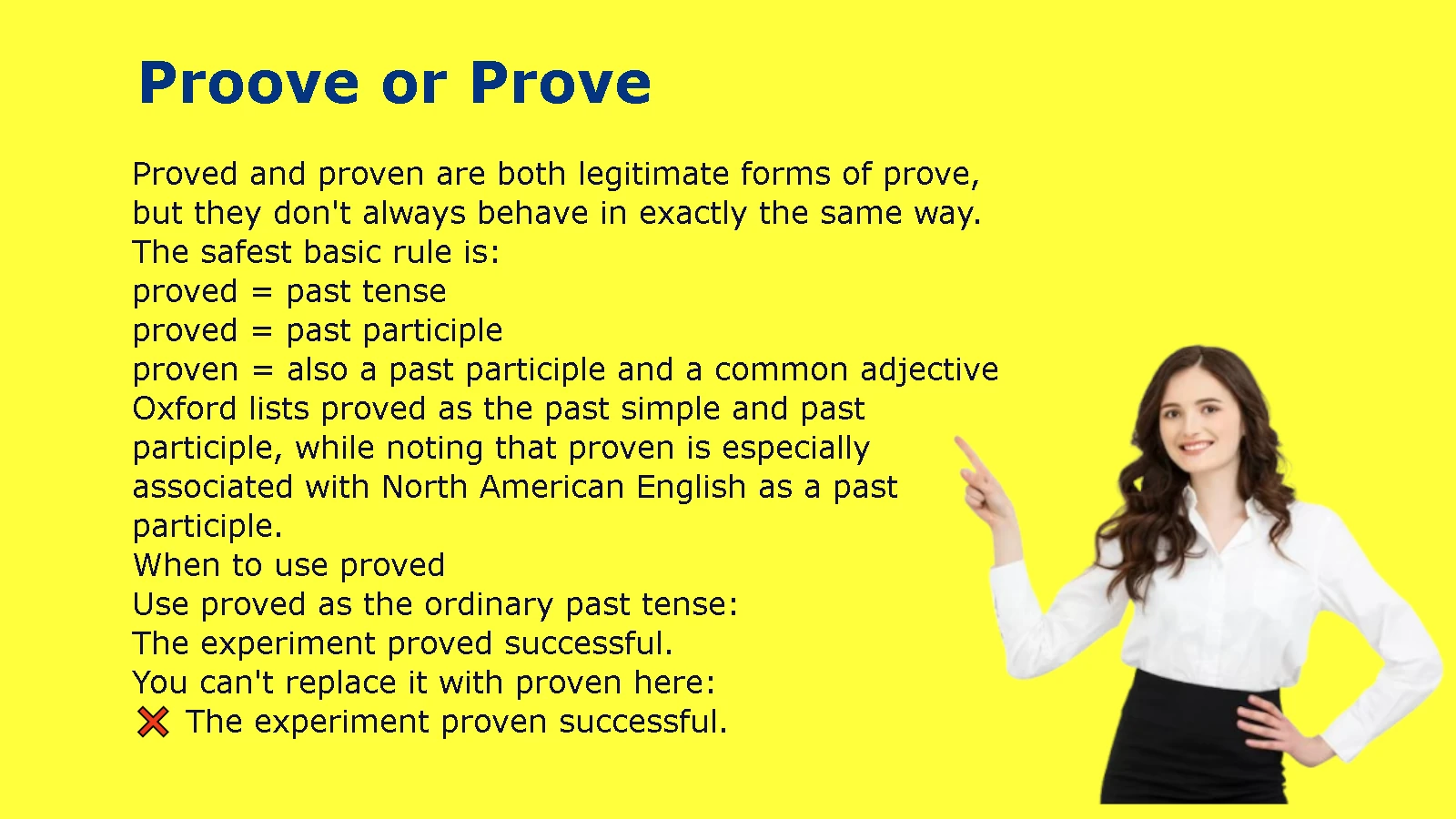
Proved and proven are both legitimate forms of prove, but they don’t always behave in exactly the same way.
The safest basic rule is:
- proved = past tense
- proved = past participle
- proven = also a past participle and a common adjective
Oxford lists proved as the past simple and past participle, while noting that proven is especially associated with North American English as a past participle.
When to use proved
Use proved as the ordinary past tense:
The experiment proved successful.
You can’t replace it with proven here:
❌ The experiment proven successful.
The correct sentence is:
✅ The experiment proved successful.
When to use proven
Proven commonly appears after forms of have or be and can function as an adjective.
For example:
The method has proven effective.
Or:
She has a proven record of success.
Cambridge lists proven as a past participle and as an adjective meaning something has been shown to be true.
Oxford similarly defines proven as something that has been tested and shown to be true.
Quick comparison
| Sentence | Correct? | Why |
| The test proved successful. | ✅ | Simple past |
| The test has proved successful. | ✅ | Past participle |
| The test has proven successful. | ✅ | Past participle |
| She has a proven record. | ✅ | Adjective |
| The test proven successful yesterday. | ❌ | Incorrect simple past construction |
So don’t assume that proven is simply a fancier version of proved. Its grammatical role matters
Proof is primarily a noun.
| Word | Part of speech | Basic meaning | Example |
| prove | Verb | Show that something is true | The evidence can prove the claim. |
| proof | Noun | Evidence showing that something is true | The evidence is proof of the claim. |
Cambridge defines proof as a fact or piece of information that shows something exists or is true.
Oxford likewise defines proof as information, documents, or other material that shows something is true.
Compare these sentences
The photograph can prove that he was there.
Here, prove describes an action.
The photograph is proof that he was there.
Here, proof names the evidence.
A simple way to remember the difference is:
You prove something. You provide proof of something.
Don’t use proof when you need the verb
Incorrect:
❌ We need to proof that the statement is true.
Correct:
✅ We need to prove that the statement is true.
However, proof can also function as a verb in English, but it has different meanings. For example, to proof can mean to protect a material from something or to produce a test copy of printed material. Oxford lists these separate verb uses.
That doesn’t make proof a replacement for prove when you mean “demonstrate that something is true.”
Prove vs. Improve
Prove and improve can sometimes cause spelling confusion because improve contains prove.
But they have completely different meanings.
Prove
Prove means to demonstrate that something is true or to show a particular result or quality.
The evidence helped prove the claim.
Improve
Improve means to make something better or to become better.
Regular practice can improve your writing.
The spelling relationship is straightforward:
improve = im + prove
The word improve does not support the spelling proove.
So if you remove the prefix im- from improve, you get prove, not proove.
Common Phrases With Prove
Certain expressions with prove appear frequently in everyday and formal English.
Prove it
Prove it means “give me evidence that shows your statement is true.”
You say you finished the project. Prove it.
It’s direct and can sound challenging depending on the context.
Prove that
This construction introduces a statement that someone wants to establish as true.
The records prove that the transaction occurred.
The results prove that the process works.
Prove yourself
Prove yourself means to demonstrate your ability or value through your actions.
She worked hard to prove herself in her first year.
Prove to be
Prove to be describes something that eventually shows itself to have a particular quality or result.
The decision proved to be a mistake.
The new system proved to be reliable.
Cambridge gives examples of prove with to be when something turns out to have a particular result or quality.
Prove useful
This construction is common when something turns out to be helpful:
The information proved useful during the investigation.
Prove effective
This means something demonstrates through results that it works well.
The new treatment proved effective in the trial.
Prove difficult
This construction means something turns out to be difficult.
The final stage proved difficult for the team.
These phrases show an important feature of prove: the word doesn’t always mean that someone deliberately presents evidence. Sometimes an event or experience shows what something is really like.
Common Mistakes With Prove
Most errors involving proove or prove are easy to fix once you recognize the pattern.
Mistake: Writing proove
Incorrect:
❌ The evidence will proove his claim.
Correct:
✅ The evidence will prove his claim.
Remember: prove has only one o.
Mistake: Using proven as the simple past
Incorrect:
❌ The experiment proven successful yesterday.
Correct:
✅ The experiment proved successful yesterday.
Proven can work as a past participle, but proved is the simple past form. Oxford lists proved as the past simple.
Mistake: Using proof instead of prove
Incorrect:
❌ Can you proof that statement?
Correct:
✅ Can you prove that statement?
The noun is proof:
Do you have any proof?
The verb is prove:
Can you prove it?
Mistake: Adding an extra syllable
Some learners may read proove as though it were a separate word with a different pronunciation.
It isn’t.
Prove has one syllable and is pronounced /pruːv/.
A Simple Memory Trick for Prove
If you repeatedly forget whether the word contains one o or two, connect it to move.
Both words have a similar spelling pattern:
- move
- prove
You wouldn’t normally write moove in standard English. The same principle applies to prove.
Another useful connection is:
prove → proven → proof
All three words belong to the same word family.
You can also remember the sentence:
I prove it with proof.
That gives you both related forms at once.
Case Study: Choosing Prove in a Real Sentence
Consider this sentence:
The documents helped proove that the company had paid the invoice.
At first glance, the sentence may look fine. The meaning is clear, and the pronunciation of prove doesn’t make the spelling mistake obvious.
But the correct version is:
The documents helped prove that the company had paid the invoice.
Why?
Prove is the base form of the verb after helped in this construction.
The sentence could also be rewritten:
The documents proved that the company had paid the invoice.
Now the verb is in the simple past, so proved is appropriate.
This example shows why spelling and grammar sometimes overlap. Choosing the right word isn’t enough. You also need the correct form of that word for the sentence.
Examples of Prove in Different Types of Writing
Casual conversation
I can prove it if you want.
You don’t have to prove anything to me.
Academic writing
The results prove that the equation is valid.
The researchers used additional evidence to prove their conclusion.
Professional writing
The data proved useful when the team evaluated the new process.
The company must prove that the product meets the required standards.
Legal writing
The prosecution must prove the defendant’s guilt beyond the required standard.
The available evidence did not prove the allegation.
Technical writing
The test results proved that the system could operate under higher temperatures.
Personal writing
She wanted to prove that she could handle the challenge.
These examples show that prove works comfortably across casual, academic, professional, technical, and formal contexts.
Prove, Proved, Proven, and Proof at a Glance
Here’s the whole word family in one place:
| Word | Role | Meaning | Example |
| prove | Verb | Show something is true or demonstrate a result | We need to prove the claim. |
| proves | Verb | Present tense, third person singular | The evidence proves the claim. |
| proved | Verb | Past tense or past participle | The test proved successful. |
| proven | Verb/adjective | Past participle or adjective | The method has proven effective. |
| proving | Verb form | Present participle | The evidence is proving useful. |
| proof | Noun | Evidence showing something is true | We need proof. |
This table is worth remembering because these words are related but serve different grammatical roles.
Is “Proove” Ever Correct?
In standard modern English, no. If you mean the verb prove, use prove.
A search box, spell checker, or informal online text might contain proove, but seeing a spelling doesn’t make it a standard English word.
For formal writing, stick with:
prove
Not:
proove
This is especially important in contexts where spelling affects credibility, such as:
- school assignments
- business emails
- resumes
- reports
- academic papers
- websites
- professional documents
- applications
A one-letter error may seem minor, but repeated spelling mistakes can distract readers from the point you’re trying to make.
Proove or Prove: Quick Answer
Prove is the correct spelling. Proove is a misspelling.
The verb prove means to show that something is true or to demonstrate that someone or something has a particular quality or produces a particular result. Its standard pronunciation is /pruːv/.
For example:
The evidence helped prove that the claim was false.
The main forms are prove, proves, proved, proven, and proving. Oxford lists proved as the past tense and proved and proven as past participles, with proven especially associated with North American English.
Frequently Asked Questions About Proove or Prove
Is “proove” a word?
Proove is not the standard spelling of the English verb prove. If you mean “to show that something is true,” use prove.
Is it prove or proove?
It is prove.
✅ prove
❌ proove
The word has only one o.
What does prove mean?
Prove means to show that something is true, correct, real, or valid. It can also mean to show through experience that someone or something has a particular quality or produces a particular result.
How do you pronounce prove?
Prove is pronounced /pruːv/ in both US and UK English. It has one syllable.
What is the past tense of prove?
The simple past tense is proved.
The experiment proved successful.
Oxford lists proved as the past simple form.
Is proven correct?
Yes. Proven is a correct past participle and is also commonly used as an adjective.
The method has proven effective.
She has a proven record of success.
Cambridge and Oxford both recognize proven as an established form of prove.
Is proved or proven more correct?
Neither is universally “more correct.” Their grammatical use differs.
Proved is the simple past:
The test proved successful.
Both proved and proven can function as past participles:
The test has proved successful.
The test has proven successful.
Oxford notes that proven is especially associated with North American English.
What is the noun form of prove?
The closely related noun is proof.
We need to prove the claim.
We need proof of the claim.
Cambridge defines proof as information or a fact that shows something is true.
What is the difference between prove and proof?
Prove is a verb. Proof is primarily a noun.
Evidence can prove something.
Evidence can provide proof of something.
Can I write “proove” in formal English?
No. If you mean the verb prove, proove should be corrected to prove in formal and standard English writing.
What is the present participle of prove?
The present participle is proving.
She is proving her point.
Cambridge identifies proving as the present participle of prove.
What is the third person singular of prove?
The third person singular present form is proves.
The evidence proves his claim.
Can prove mean demonstrate ability?
Yes. In expressions such as prove yourself, it means to demonstrate your ability, skill, or value.
He worked hard to prove himself in his new role.
Cambridge specifically recognizes this use.
Final Verdict: Proove or Prove?
When choosing between proove or prove, go with prove every time when you mean “to show that something is true” or “to demonstrate a particular result or quality.”
Proove is simply a misspelling.
The key forms to remember are:
- prove — base form
- proves — third person singular
- proved — past tense
- proved / proven — past participle
- proving — present participle
- proof — related noun
If you remember just one thing, make it this:
You prove something. You use proof to support it.
That small distinction clears up most of the confusion around proove vs. prove.