Have you ever wondered why you see both “candor” and “candour” and whether they mean different things? While Candor vs Candour may look confusing, both words have the same meaning. The main difference is the variety of English in which they are used.
Candor is the standard spelling in American English, while candour is the standard spelling in British English and other varieties influenced by British spelling. Both words describe honesty, openness, and a willingness to speak truthfully and directly.
Examples:
- Her candor made it easy to trust her opinion.
- His candour was appreciated during the difficult discussion.
The confusion is understandable. People often search for candor vs candour, candor meaning, candour meaning, is candor or candour correct, or the difference between candor and candour because the spelling changes depending on the type of English being used. And here’s the kicker: neither spelling is more correct. Your choice depends mainly on your audience and the English variety you follow.
In this guide, you’ll learn the complete Candor vs Candour difference, including their meaning, definition, pronunciation, origin, correct usage, and examples in sentences. You’ll also discover when to use candor or candour and how American and British English handle this spelling difference.
Candor vs Candour: The Main Difference
The difference between candor and candour comes down to English spelling conventions.
Candor is the American spelling. Candour is the British spelling. Cambridge lists candor as US English and candour as UK English. Oxford likewise identifies candour as the British form and candor as the US form.
Neither spelling is more correct in every situation. The appropriate choice depends on the variety of English you’re using.
Candor in American English
If you’re writing in the United States, candor is the standard choice.
For example:
- I appreciate your candor.
- She spoke with candor about her experience.
- His candor made the conversation easier.
- The interview revealed his remarkable candor.
You’ll see the same -or pattern in other common American spellings:
- color rather than colour
- honor rather than honour
- labor rather than labour
- favor rather than favour
That doesn’t mean every word ending in -or has a British -our counterpart. English spelling has plenty of exceptions. However, candor/candour follows this familiar regional pattern.
Candour in British English
British English generally uses candour.
For example:
- I appreciate your candour.
- She spoke with candour about the problem.
- His candour surprised everyone.
- The report discusses the issue with unusual candour.
The u doesn’t create a different word. It simply reflects the spelling convention used in British English.
What About Canadian English?
Canadian English sits in an interesting position because it uses features associated with both American and British English.
Oxford’s American dictionary specifically notes that candour is usually used in Canadian English.
Therefore, if you’re writing specifically for Canadian readers, candour is generally the safer choice.
What Does Candor Mean?
Candor means the quality of being open, honest, and sincere when expressing your thoughts or feelings.
It often appears when someone says something that other people might avoid saying because the truth could feel uncomfortable.
Cambridge defines candor as the quality of being honest and telling the truth, particularly about something difficult or embarrassing.
For example:
I appreciate your candor about the problems with my proposal.
The speaker isn’t simply saying, “Thanks for telling me the truth.” The word candor emphasizes the person’s willingness to speak openly, even though the subject may be uncomfortable.
Consider another situation. A friend asks whether you like their new business idea. Instead of giving a polite answer, you explain that you think the idea needs more work and tell them exactly why.
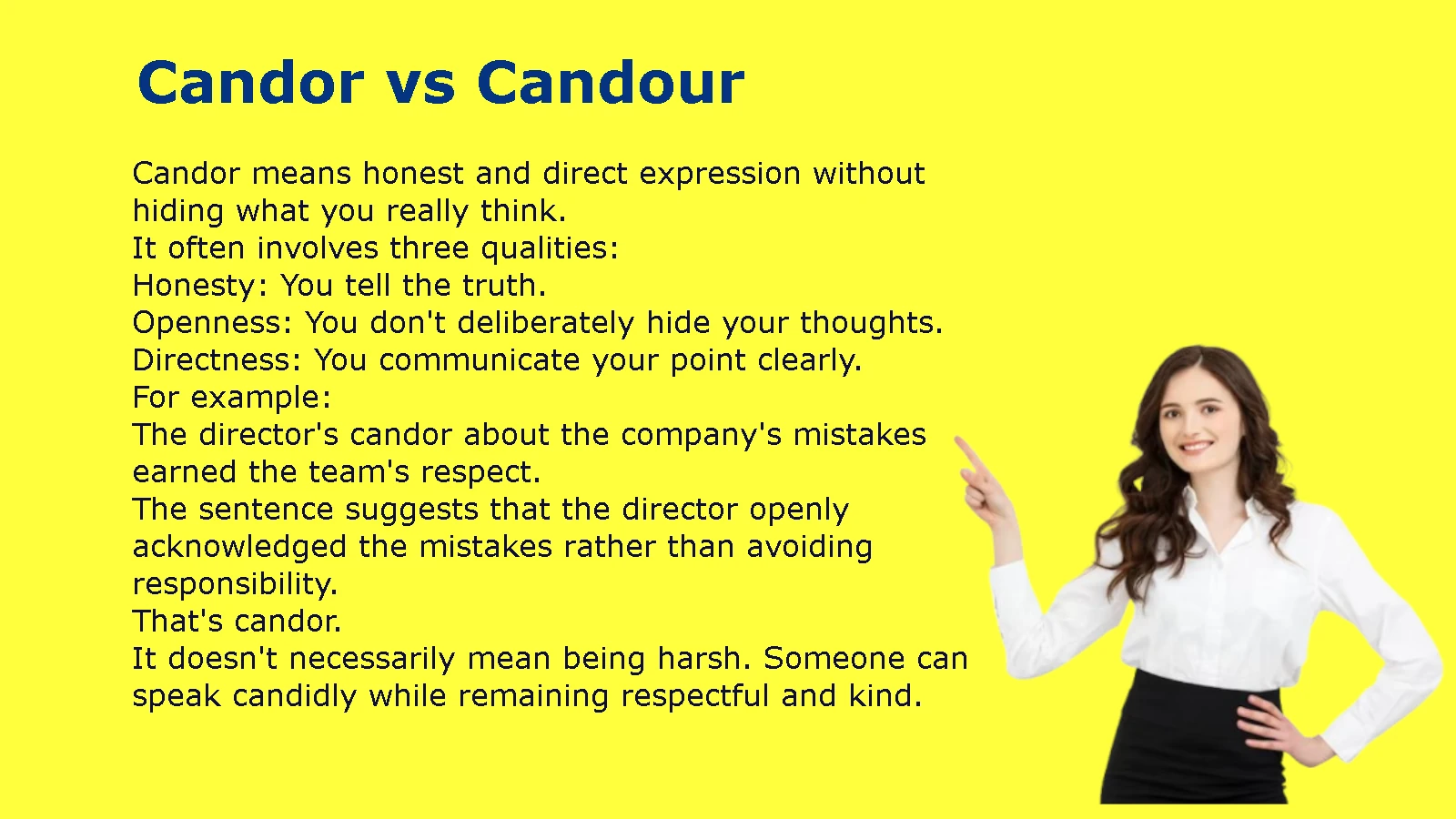
That’s candor.
It doesn’t necessarily mean being harsh. Someone can speak candidly while remaining respectful and kind.
Simple Definition of Candor
In simple terms:
Candor means honest and direct expression without hiding what you really think.
It often involves three qualities:
- Honesty: You tell the truth.
- Openness: You don’t deliberately hide your thoughts.
- Directness: You communicate your point clearly.
For example:
The director’s candor about the company’s mistakes earned the team’s respect.
The sentence suggests that the director openly acknowledged the mistakes rather than avoiding responsibility.
What Does Candour Mean?
Candour has exactly the same basic meaning as candor.
The difference is spelling, not definition.
Cambridge identifies candour as the UK form of candor. Oxford defines it as the quality of saying what you think openly and honestly and lists candor as the US spelling.
For example:
She answered the difficult questions with remarkable candour.
In American English, the same sentence would normally appear as:
She answered the difficult questions with remarkable candor.
Nothing else needs to change.
Is Candor or Candour Correct?
Both are correct.
The choice depends on your target variety of English.
Use this simple rule:
US English → candor
UK English → candour
Quick Decision Guide
| If you’re writing for… | Use |
| United States | candor |
| United Kingdom | candour |
| Canada | candour is usually preferred |
| General international audience | Follow your chosen style consistently |
| American academic writing | candor |
| British academic writing | candour |
The most important thing is consistency. If an article follows US English, don’t switch randomly between candor and candour.
Candor vs Candour in American and British English
The difference reflects a broader history of English spelling.
Many words ending in -or in American English retain -our in British English.
| American English | British English |
| color | colour |
| honor | honour |
| labor | labour |
| favor | favour |
| candor | candour |
This difference became particularly associated with American spelling reforms. The American spelling system favored shorter forms in many words, while British English retained many spellings influenced by French and earlier English usage.
However, don’t turn this into a rigid spelling formula. English contains exceptions.
For instance:
- author stays author in both varieties.
- error stays error.
- horror stays horror.
- senator stays senator.
So the useful lesson isn’t “change every -our ending to -or.” Instead, learn established spelling pairs such as candor/candour.
How Do You Pronounce Candor and Candour?
Although the spelling differs, candor and candour have essentially the same pronunciation within their respective English varieties.
Cambridge gives the US pronunciation as approximately /ˈkæn.dɚ/ and the UK pronunciation as approximately /ˈkæn.də(r)/.
A simple pronunciation guide is:
Candor: KAN-der
Candour: KAN-duh(r)
The first syllable sounds like can in “can do.”
The second syllable is unstressed, so you shouldn’t pronounce the word as though every syllable has equal weight.
Does the Extra U Change the Pronunciation?
No.
The u in candour represents a spelling difference rather than a completely different pronunciation.
That makes this pair similar to:
- color / colour
- honor / honour
- labor / labour
The spelling changes depending on the regional variety, but the underlying word remains the same.
Candor Examples in Sentences
Here are natural examples of candor in American English.
Everyday Examples
- I appreciate your candor about the situation.
- Her candor made it easier to understand what went wrong.
- He answered the question with unusual candor.
- She spoke with candor about her experience.
- His candor caught me off guard, but I respected it.
Workplace Examples
- I appreciate your candor during today’s meeting.
- The manager encouraged employees to speak with candor.
- Her candor helped the team identify the real problem.
- The report addresses the company’s weaknesses with candor.
- His candor during the interview made a strong impression.
Personal Examples
- Thanks for your candor. I needed to hear that.
- Her candor strengthened their friendship.
- I value your candor, even when the truth is difficult to hear.
- He spoke with candor about his mistakes.
Notice something important: candor often appears in situations where honesty carries some risk.
You don’t usually need the word for something trivial.
If someone tells you, “The meeting starts at three,” that’s simply information. If someone tells you, “Your presentation needs serious improvement,” and explains why, that may involve candor.
Candour Examples in Sentences
The British spelling works in exactly the same contexts.
- I appreciate your candour.
- She spoke with candour about her mistakes.
- His candour surprised the committee.
- The journalist was praised for her candour.
- The report deals with the issue with remarkable candour.
- Thank you for your candour during the discussion.
- Her unusual candour made the interview memorable.
Compare these two sentences:
American English:
I appreciate your candor.
British English:
I appreciate your candour.
The meaning is identical.
Common Phrases With Candor and Candour
Some expressions appear frequently with this word.
With Candor or With Candour
With candor means in an open and honest manner.
American example:
She spoke with candor about the company’s challenges.
British version:
She spoke with candour about the company’s challenges.
This phrase works especially well in professional and formal writing.
In All Candor or In All Candour
In all candor introduces a particularly frank statement.
For example:
In all candor, I don’t think the proposal is ready.
A British writer would normally use:
In all candour, I don’t think the proposal is ready.
The expression signals that the speaker intends to be completely direct.
Appreciate Your Candor or Appreciate Your Candour
This phrase commonly appears when someone gives honest feedback.
For example:
I appreciate your candor about the proposal. I’ll revise the weaker sections.
This wording acknowledges that the feedback may not have been easy to give.
Speak With Candor or Speak With Candour
This phrase emphasizes open communication.
The CEO spoke with candor about the company’s disappointing results.
The British version simply changes the spelling:
The CEO spoke with candour about the company’s disappointing results.
Candor vs Honesty: Are They the Same?
Candor and honesty overlap, but they aren’t always interchangeable.
Honesty focuses on truthfulness. It means not lying, cheating, or deliberately misleading someone.
Candor focuses more strongly on openness and direct expression.
Consider this example:
She was honest about the mistake.
This tells you she didn’t lie about what happened.
Now compare:
She discussed the mistake with candor.
This suggests that she openly addressed the issue rather than hiding behind vague explanations or excuses.
Here’s a useful comparison:
| Word | Main idea | Example |
| Honesty | Telling the truth | I value your honesty. |
| Candor | Open, direct honesty | I appreciate your candor. |
| Frankness | Directness, often about uncomfortable matters | His frankness surprised me. |
| Openness | Willingness to share thoughts or information | Her openness encouraged discussion. |
| Sincerity | Genuine thoughts or feelings | I could hear the sincerity in her voice. |
In everyday conversation, honesty is usually the simpler word. Candor can sound more deliberate or formal.
Is Candor a Formal Word?
Candor is moderately formal, but it’s not overly formal or old-fashioned.
You’ll find it in professional conversations, journalism, interviews, business writing, academic discussions, and everyday speech.
For example:
I appreciate your candor.
That’s perfectly natural.
However, depending on the situation, you might choose a simpler alternative:
- I appreciate your honesty.
- Thanks for being honest.
- Thanks for being straightforward.
- I appreciate your openness.
The best choice depends on your tone.
If you’re writing a formal report, candor may fit beautifully. If you’re texting a close friend, honesty or being honest might sound more natural.
Candor vs Frankness
Candor and frankness are close synonyms.
Both describe direct communication that doesn’t hide uncomfortable truths.
However, frankness often emphasizes blunt directness, while candor can emphasize open and sincere disclosure.
Compare:
I appreciate your frankness about the problem.
This can suggest that the person spoke very directly.
I appreciate your candor about the problem.
This emphasizes their willingness to be open and honest.
The distinction isn’t absolute. In many sentences, either word works.
Candor vs Openness
Openness has a broader meaning.
A person can be open about:
- their feelings
- their experiences
- their plans
- their opinions
- their personal life
- their concerns
Candor usually puts more emphasis on honest and direct expression.
For example:
Her openness made people feel comfortable.
This doesn’t necessarily mean she discussed difficult truths.
But:
Her candor made the difficult conversation easier.
Here, the word strongly suggests direct honesty.
Candor vs Candid
One of the easiest mistakes is confusing candor with candid.
They’re related words, but they have different grammatical roles.
Candor is a noun.
Candid is an adjective.
Compare:
- I appreciated her candor.
- I appreciated her candid response.
The first sentence names the quality.
The second sentence describes the response.
Oxford defines candid as saying what you think openly and honestly without hiding your thoughts.
Candor and Candid Examples
| Noun | Adjective |
| Her candor impressed me. | Her answer was candid. |
| I appreciate his candor. | He gave a candid response. |
| Their candor helped the team. | They had a candid discussion. |
A simple trick helps:
Candor = the quality
Candid = describes the person, statement, answer, or conversation
The History and Origin of Candor and Candour
The history of candor is surprisingly bright. Literally.
Oxford traces candour to Latin candor, meaning “whiteness,” and notes that the modern sense developed in the mid 18th century.
Merriam-Webster traces the word through French and Latin and connects it with Latin candēre, meaning “to shine” or “be white.”
The early history explains why the word eventually became associated with qualities such as purity and openness.
Over time, the meaning shifted toward fairness, sincerity, frankness, and honest expression. Today, the sense most people encounter is straightforward honesty.
This same Latin root has influenced several familiar English words, including:
- candid
- candidate
- candle
- incandescent
- candescent
Merriam-Webster notes that candor entered English centuries ago and that its earlier meanings included brightness and purity before the modern sense of honest expression became prominent.
Why Is Candour Spelled With a U?
The -our spelling reflects the historical influence of French and British spelling conventions.
The American spelling candor uses the shorter -or ending.
The British spelling candour retains the u.
This is why the same pattern appears in words such as:
- honor / honour
- color / colour
- favor / favour
- labor / labour
The spelling difference doesn’t indicate a difference in meaning or origin.
Common Mistakes With Candor and Candour
Although the distinction looks simple, several mistakes appear regularly.
Mistake: Thinking Candour Is Incorrect
If you’re writing American English, candour may look unfamiliar. That doesn’t make it incorrect.
It’s the standard British spelling.
Mistake: Thinking Candor Is a Different Word
Candor and candour aren’t two words with different definitions.
They’re regional spellings of the same noun.
Mistake: Mixing Spelling Systems
A document can quickly look inconsistent if it mixes American and British spellings.
For example:
The color of the room was beautiful, and I appreciated her candour.
If the document otherwise follows American English, candour looks out of place.
A consistent American version would be:
The color of the room was beautiful, and I appreciated her candor.
A British version would normally use:
The colour of the room was beautiful, and I appreciated her candour.
Mistake: Confusing Candor With Candid
Don’t write:
She was full of candid during the interview.
Use:
She was full of candor during the interview.
Or:
She gave a candid interview.
Candor is the noun. Candid is the adjective.
When Should You Use Candor?
Use candor when you want to emphasize honest, open, and direct communication.
It works especially well when the truth might be uncomfortable.
Good situations for candor
- Giving constructive feedback
- Discussing a mistake
- Explaining a difficult decision
- Describing a personal experience
- Addressing workplace problems
- Answering sensitive interview questions
- Discussing failures honestly
- Acknowledging weaknesses
- Talking about controversial subjects respectfully
For example:
The executive showed candor by acknowledging that the company had underestimated the project’s cost.
The sentence does more than say the executive was honest. It suggests that the executive openly confronted an uncomfortable fact.
When Candor Can Go Too Far
Candor is valuable, but honesty doesn’t give you permission to be needlessly cruel.
There’s a difference between:
Your presentation is terrible.
and:
The presentation has a strong foundation, but the main argument needs more evidence and the conclusion feels rushed.
Both statements express criticism. The second one shows useful candor because it gives the person something they can act on.
Good candor combines:
- Truth
- Clarity
- Respect
- Context
- Useful feedback
Think of candor as a sharp tool. Used carefully, it solves problems. Used carelessly, it can cause damage.
A Practical Case Study: Candor in the Workplace
Imagine a project team has spent three months developing a new product. During the final review, the team leader notices that the product doesn’t solve the problem customers actually care about.
The easy response would be to stay quiet.
The candid response would be:
We’ve made real progress, but the current version doesn’t address the main customer need. We should fix that before launch.
That statement demonstrates candor because it acknowledges the problem directly.
It also avoids unnecessary harshness.
Now compare the possible responses:
| Response | Honest? | Candid? | Constructive? |
| Everything looks fine. | No | No | No |
| This project is a disaster. | Yes, perhaps | Yes | No |
| We need to rethink the main feature before launch. | Yes | Yes | Yes |
The third response shows why candor matters. The goal isn’t simply to say uncomfortable things. The goal is to communicate the truth clearly enough to help.
Candor in Professional Communication
In business writing, candor can strengthen communication when you use it carefully.
For example, instead of writing:
There may potentially be some issues with the current approach.
You could write:
The current approach has two major problems.
The second sentence is clearer. It doesn’t hide behind vague language.
You can also use the word itself:
I appreciate your candor about the project’s timeline.
or:
The report addresses the financial risks with unusual candor.
These examples sound professional without becoming stiff.
How to Show Candor Without Sounding Rude
When you need to give difficult feedback, try this structure:
Acknowledge → State the issue → Explain why → Suggest a solution
For example:
The research is thorough. However, the introduction doesn’t clearly establish the main argument. Readers may struggle to understand the purpose of the article. Adding a direct thesis statement would make the structure much stronger.
That’s candid. It’s also useful.
Is Candor Always Positive?
Not necessarily.
The word itself often carries a positive or approving tone, especially when people appreciate someone’s willingness to tell the truth. Cambridge’s American definition also connects candor with being honest, sincere, and kind in dealing with others.
However, context matters.
Consider:
His candor was refreshing.
That’s clearly positive.
Now consider:
Her excessive candor offended several colleagues.
Here, the speaker views the person’s directness negatively.
So candor describes the openness of communication, not whether the communication itself is tactful or correct.
Is Candor Countable or Uncountable?
Candor is normally an uncountable noun.
Oxford labels candor/candour as uncountable.
That’s why these constructions sound natural:
- I appreciate your candor.
- She spoke with candor.
- His candor was refreshing.
- The interview was marked by candor.
You generally don’t say:
She showed three candors.
Instead, describe the specific acts or examples:
She gave several candid answers.
or:
She spoke candidly about several issues.
What Is the Opposite of Candor?
There isn’t one perfect opposite in every context, but several words can contrast with candor.
Depending on what you mean, possible opposites include:
- Deception
- Dishonesty
- Evasiveness
- Secrecy
- Concealment
- Deceit
- Insincerity
For example:
His candor made the discussion productive.
The contrasting idea might be:
His evasiveness made the discussion frustrating.
This distinction is useful because someone can avoid lying while still failing to communicate openly. Evasiveness captures that behavior better than simple dishonesty in many situations.
Candor vs Candour: Quick Reference
| Question | Answer |
| Are candor and candour different words? | No. They’re regional spellings of the same word. |
| Is candor American English? | Yes. |
| Is candour British English? | Yes. |
| Is candour correct in the US? | It can be understood, but candor is the standard US spelling. |
| Is candor correct in the UK? | It can be understood, but candour is the standard British spelling. |
| Which spelling does Canada usually use? | Candour is generally preferred. |
| Do they have different meanings? | No. |
| Do they have different pronunciations? | The pronunciation varies slightly by regional accent, not because the spelling represents a different word. |
| What part of speech are they? | Noun. |
| Is candor countable? | Normally no. It is generally used as an uncountable noun. |
| What is the related adjective? | Candid |
| What are common synonyms? | Honesty, frankness, openness, sincerity, forthrightness |
FAQ About Candor vs Candour
Is candor the American spelling?
Yes. Candor is the standard American English spelling. Cambridge and Oxford both identify candor as the US form.
Is candour the British spelling?
Yes. Candour is the standard British English spelling. Cambridge explicitly identifies it as the UK form.
Do candor and candour mean the same thing?
Yes. Both words mean openness, honesty, and frankness, particularly when someone speaks honestly about a difficult subject.
Is candor or candour more correct?
Neither is universally more correct. Use candor for US English and candour for UK English. Canadian English generally favors candour as well.
Do candor and candour sound the same?
They represent the same word and have essentially the same pronunciation within their respective regional varieties. Cambridge lists US /ˈkæn.dɚ/ and UK /ˈkæn.də(r)/.
What is the adjective form of candor?
The related adjective is candid.
For example:
- Her candor impressed me.
- Her answer was candid.
What is a synonym for candor?
Common synonyms include honesty, frankness, openness, sincerity, and forthrightness.
The best choice depends on context. Honesty is the broadest everyday option, while candor often highlights direct and open expression.
Is candor a formal word?
Candor is somewhat formal but remains common in modern English. It works naturally in professional, academic, journalistic, and everyday contexts.
Can candor be negative?
Yes. Although people often praise candor, excessive directness can come across as rude or insensitive. The word describes openness rather than guaranteeing that the speaker communicates tactfully.
Why does candour have a U?
The -our spelling reflects British spelling conventions and historical French influence. American English generally uses the shorter -or form.
Is “in all candor” correct?
Yes. In all candor is a common American English expression meaning that you’re about to speak very frankly.
For British English, write:
In all candour.
For example:
In all candor, I don’t think the plan will work.
Final Takeaway: Candor vs Candour
The candor vs candour question has a simple answer: both spellings are correct.
The difference comes from regional English conventions:
- Candor = standard US English
- Candour = standard UK English
- Candour = generally preferred in Canadian English
Both mean open and honest expression, especially when someone tells the truth about something difficult or uncomfortable.
If you’re writing for an American audience, stick with candor. If you’re following British English, choose candour.
That’s the whole spelling difference. The meaning stays exactly where it belongs: honest, direct, and open communication.