Emphasize vs emphasise is a classic American English versus British English spelling question. The good news is that the answer is straightforward: emphasize and emphasise have the same meaning, the same basic pronunciation, and the same grammatical function. The main difference is the spelling convention.
In American English, emphasize is the standard spelling. In British English, emphasise is commonly used. Cambridge lists emphasise as the usual UK form and gives the same basic pronunciation for the two forms.
So which one should you use?
If you’re writing for a US audience, choose emphasize. If you’re following a British English style that uses -ise spellings, choose emphasise. Most importantly, keep your spelling consistent throughout the same piece of writing.
| Question | Answer |
| Are emphasize and emphasise different words? | No. They are spelling variants of the same verb. |
| Do they have different meanings? | No. |
| Which spelling is standard in American English? | Emphasize |
| Which spelling is common in British English? | Emphasise |
| Do they have different pronunciations? | Generally, no. |
| Is emphasise a misspelling? | No. |
| Is emphasize always wrong in British English? | No. Some British styles use -ize spellings. |
| Should you mix them? | No. Follow the style you’re using consistently. |
Emphasize vs Emphasise at a Glance
The simplest way to understand emphasize vs emphasise is to look at the spelling side by side.
| American English | British English |
| emphasize | emphasise |
| emphasizes | emphasises |
| emphasized | emphasised |
| emphasizing | emphasising |
The difference comes down to z versus s in the verb ending.
Consider these two sentences:
The teacher emphasized the importance of practice.
The teacher emphasised the importance of practice.
The meaning is exactly the same. One follows the American spelling convention. The other follows the common British -ise convention.
Cambridge defines emphasize as showing that something is very important or deserves attention. It also recognizes uses where something is made more obvious or noticeable.
That means you don’t need to learn two separate definitions. Learn one word and recognize its two spelling forms.
What Does Emphasize Mean?
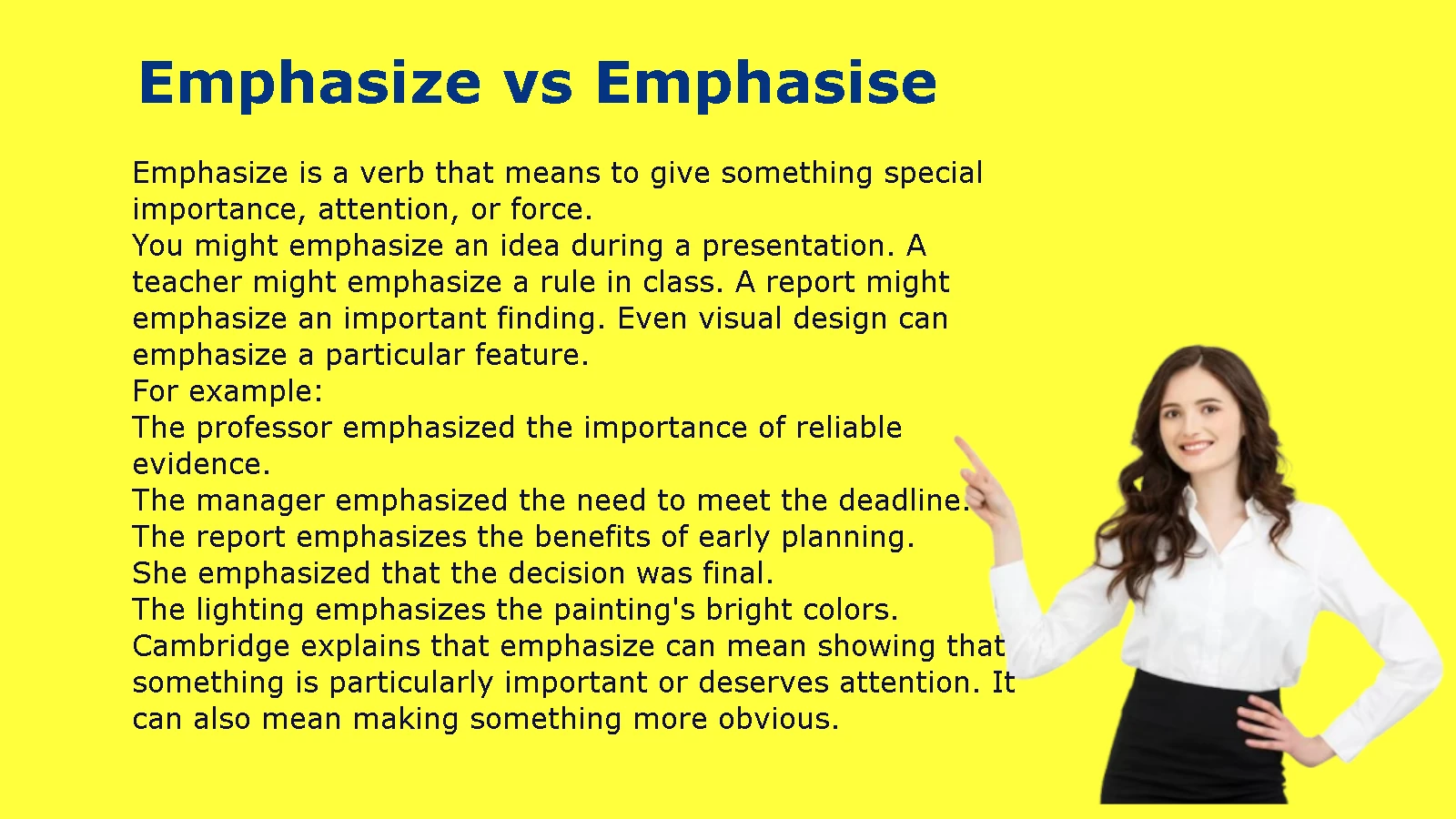
Emphasize is a verb that means to give something special importance, attention, or force.
You might emphasize an idea during a presentation. A teacher might emphasize a rule in class. A report might emphasize an important finding. Even visual design can emphasize a particular feature.
For example:
- The professor emphasized the importance of reliable evidence.
- The manager emphasized the need to meet the deadline.
- The report emphasizes the benefits of early planning.
- She emphasized that the decision was final.
- The lighting emphasizes the painting’s bright colors.
Cambridge explains that emphasize can mean showing that something is particularly important or deserves attention. It can also mean making something more obvious.
Oxford gives the same core idea and also identifies uses involving giving extra force to a word or phrase during speech.
Emphasize Means to Give Importance
The most common use involves an idea or fact that deserves special attention.
That’s the heart of the word.
You can think of emphasize as putting a spotlight on something. The thing was already there, but you deliberately make people notice it.
Emphasize Can Mean Make Something Stand Out
The word also works when something becomes more noticeable.
The dark border emphasizes the photograph.
The lighting emphasizes her facial features.
The contrast emphasizes the difference between the two designs.
In these examples, nobody necessarily says anything aloud. Instead, one feature becomes more prominent.
Oxford includes this meaning as well, describing emphasize as making something easier to notice.
What Does Emphasise Mean?
Emphasise means exactly the same thing as emphasize.
The difference is spelling.
British English commonly uses emphasise, particularly in writing that follows an -ise convention.
For example:
The report emphasises the need for better communication.
The teacher emphasised the importance of careful research.
The campaign emphasises the benefits of recycling.
She emphasised that the figures were only estimates.
Nothing about the underlying meaning changes.
If you replace emphasise with emphasize, you don’t change what the sentence says. You simply switch to the spelling more strongly associated with American English.
Oxford lists emphasise as the British English form of emphasize.
Emphasize vs Emphasise: Why Does the Spelling Change?
The difference between emphasize and emphasise belongs to a larger pattern in English spelling.
American English often uses -ize in verbs such as:
- emphasize
- organize
- recognize
- realize
- apologize
- summarize
- criticize
A common British English convention uses -ise:
- emphasise
- organise
- recognise
- realise
- apologise
- summarise
- criticise
The pattern is easy to spot.
| American spelling | Common British spelling |
| emphasize | emphasise |
| organize | organise |
| recognize | recognise |
| realize | realise |
| apologize | apologise |
| summarize | summarise |
| criticize | criticise |
However, there’s an important detail that often gets lost in simple explanations: British English isn’t limited to -ise spellings.
Some British dictionaries, publishers, and style systems accept or use -ize forms. Oxford, for example, lists emphasise as the British form while also providing an emphasize entry.
Therefore, the statement “American English uses -ize and British English always uses -ise” is too simplistic.
A better rule is:
American English normally uses -ize. British English commonly uses -ise, but some British styles also use -ize.
That distinction matters when you’re editing professional or academic content.
Is Emphasize American or British English?
Emphasize is the standard American English spelling.
If you’re writing for readers in the United States, this is the spelling you will normally want.
Examples include:
The study emphasizes the importance of accurate data.
The manager emphasized the new safety requirements.
The article emphasizes practical solutions.
Researchers are emphasizing the need for further investigation.
Cambridge’s American Dictionary gives emphasize as the US form and provides examples such as “She emphasized the importance of good nutrition.”
Oxford’s American English dictionary likewise lists emphasize, emphasized, and emphasizing as the standard forms.
So, if this article is being written in US English, emphasize is the preferred spelling.
Is Emphasise British Spelling?
Yes. Emphasise is a standard British English spelling.
Cambridge labels emphasise as the usual UK spelling, while Oxford identifies it as the British English form.
For example:
The report emphasises the need for reform.
The teacher emphasised the importance of preparation.
The article emphasises several key findings.
These aren’t errors. They’re normal British spellings.
The confusion often happens because American readers encounter emphasise and assume someone has simply typed the word incorrectly. That’s not the case.
Is Emphasise Ever Wrong?
Not because of the spelling itself.
If you’re writing standard American English, emphasize is the expected choice. If you’re writing British English under a style that uses -ise, emphasise is appropriate.
The important question isn’t:
“Which spelling is universally correct?”
The better question is:
“Which spelling matches the English variety and style I’m using?”
Emphasize vs Emphasise: Do They Mean the Same Thing?
Yes.
Both words mean to give special importance or attention to something.
Compare:
The speaker emphasized the importance of honesty.
The speaker emphasised the importance of honesty.
There is no difference in the speaker’s message.
Both sentences tell you that the speaker gave particular importance to honesty.
This makes emphasize vs emphasise a spelling distinction rather than a vocabulary distinction.
A Simple Example
Imagine a teacher tells a class:
“Always check your sources.”
If the teacher repeats that message, highlights it on the board, and explains why it matters, the teacher emphasizes the importance of checking sources.
A British English writer using the -ise spelling would say that the teacher emphasises the same point.
Same action. Same meaning. Different spelling convention.
Emphasize vs Emphasise: Are They Pronounced the Same?
Yes. Emphasize and emphasise generally have the same pronunciation.
Cambridge gives the pronunciation /ˈem.fə.saɪz/ for both UK and US English.
Oxford also gives /ˈemfəsaɪz/ for emphasize.
That makes this pair different from some English words where spelling changes also produce a pronunciation change.
Here, the s and z difference appears in writing, but the final sound is essentially the same.
So don’t pronounce emphasise as though the ending suddenly becomes a completely different sound. It doesn’t.
Emphasize vs Emphasise Examples
Examples make the distinction much easier to remember.
| American English | British English |
| The teacher emphasized the rule. | The teacher emphasised the rule. |
| The report emphasizes the problem. | The report emphasises the problem. |
| She emphasized the main point. | She emphasised the main point. |
| The article emphasizes accuracy. | The article emphasises accuracy. |
| The manager emphasized the deadline. | The manager emphasised the deadline. |
| We need to emphasize this issue. | We need to emphasise this issue. |
| The design emphasizes the building’s shape. | The design emphasises the building’s shape. |
| The speaker is emphasizing the risks. | The speaker is emphasising the risks. |
Notice a useful pattern: the grammar remains unchanged.
You don’t need a different sentence structure just because you changed the spelling.
How to Use Emphasize in a Sentence
Emphasize works naturally in several common grammatical patterns.
Emphasize a Point
Use emphasize when someone gives special attention to a point or idea.
The speaker emphasized the main point during the meeting.
The editor emphasized the need for accurate information.
This construction is especially common in business, academic, and professional writing.
Emphasize the Importance of Something
One of the most useful structures is:
emphasize + the importance of + noun or gerund
Examples:
The doctor emphasized the importance of sleep.
The coach emphasized the importance of teamwork.
The professor emphasized the importance of checking sources.
The manager emphasized the importance of meeting deadlines.
Oxford gives examples using this structure, including sentences about the importance of attracting industry and the need for economic stability.
Emphasize That Something Is True
You can also use emphasize that…
She emphasized that the figures were estimates.
The researcher emphasized that the results were preliminary.
The manager emphasized that the deadline had not changed.
Cambridge specifically provides examples of emphasize followed by a that clause.
Emphasize How, What, or Why
You can use the verb with question words as well.
He emphasized how important preparation was.
She emphasized what the team needed to accomplish.
The report emphasizes why early planning matters.
This pattern gives the verb plenty of flexibility in both everyday and formal writing.
How to Use Emphasise in a Sentence
If you’re using British English with the -ise convention, the grammatical patterns remain exactly the same.
For example:
The teacher emphasised the importance of practice.
The report emphasises the need for reform.
She emphasised that the decision was final.
The researcher emphasised how important accurate data was.
Only the spelling changes.
That makes this one of the easier British and American spelling differences to handle. Once you know how to use emphasize, you already know how to use emphasise.
Emphasize vs Emphasise Verb Forms
The spelling difference appears in the major forms of the verb.
| Verb form | American English | British English |
| Base form | emphasize | emphasise |
| Third person singular | emphasizes | emphasises |
| Past tense | emphasized | emphasised |
| Past participle | emphasized | emphasised |
| Present participle | emphasizing | emphasising |
Cambridge identifies emphasized as the past tense and past participle and emphasizing as the present participle.
Oxford similarly lists the major forms of emphasize.
Emphasized vs Emphasised
Both forms are correct.
Emphasized is the American spelling:
The professor emphasized the importance of evidence.
Emphasised is the common British spelling:
The professor emphasised the importance of evidence.
Emphasizing vs Emphasising
The same distinction appears in the -ing form.
American English:
The report is emphasizing the need for change.
British English:
The report is emphasising the need for change.
Cambridge identifies emphasizing as the present participle of emphasize.
Emphasize vs Emphasise in Academic Writing
Academic writers frequently use emphasize or emphasise because research papers often need to draw attention to findings, limitations, methods, and conclusions.
For example:
The findings emphasize the importance of sample selection.
A British style might write:
The findings emphasise the importance of sample selection.
Both sentences are correct.
The important issue is style consistency.
Before submitting an academic paper, check whether your university, instructor, journal, or publisher specifies American or British English.
Why Academic Consistency Matters
Imagine reading a paper that uses:
The study emphasizes…
and later:
The research emphasises…
Nothing is technically incomprehensible. Yet the mixed spelling can suggest that the document hasn’t received a final language edit.
A consistent style looks deliberate.
If the paper uses American English, use forms such as:
- emphasize
- organize
- analyze
- recognize
- summarize
If it follows a British -ise convention, use the corresponding forms consistently.
Emphasize vs Emphasise in Business Writing
Professional communication benefits from the same approach.
Suppose an American company writes:
Our proposal emphasizes customer satisfaction and long term value.
That’s natural American English.
A British company following an -ise style might write:
Our proposal emphasises customer satisfaction and long term value.
Neither version has a better meaning.
The right choice depends on the organization’s style.
This applies to:
- Business reports
- Proposals
- Presentations
- Emails
- Company websites
- Marketing materials
- Job applications
- Internal policies
- Press releases
A Useful Business Writing Rule
If your organization has a house style, follow it.
Don’t switch between American and British spellings simply because both forms appear in dictionaries.
A house style exists precisely to keep a company’s communication consistent.
Emphasize vs Emphasise in American English
For American English, use emphasize.
The standard forms are:
- emphasize
- emphasizes
- emphasized
- emphasizing
Examples:
The new policy emphasizes workplace safety.
The manager emphasized the importance of punctuality.
The campaign is emphasizing affordability.
The report emphasizes several key findings.
Cambridge’s American Dictionary and Oxford’s American English dictionary both support these forms.
For a US focused article, essay, report, or website, emphasize is therefore the natural choice.
Emphasize vs Emphasise in British English
British English commonly uses emphasise.
The corresponding forms are:
- emphasise
- emphasises
- emphasised
- emphasising
Examples:
The policy emphasises workplace safety.
The manager emphasised the importance of punctuality.
The campaign is emphasising affordability.
The report emphasises several key findings.
However, British English has more than one spelling tradition for -ize/-ise verbs. Some British publications use -ize. That’s why a blanket rule saying “British English always uses S” isn’t accurate.
When a British publisher or institution gives you a style guide, its style guide wins.
Is Emphasize Incorrect in British English?
No, not automatically.
British English commonly uses emphasise, but -ize spellings also occur in British writing.
Oxford provides an especially useful illustration. Its dictionary lists emphasise as the British English form while also having an emphasize entry with the same core meanings.
Therefore, it would be misleading to tell every British English writer:
“Never use emphasize.”
A better rule is:
Use the spelling required by your British English style guide.
If the style uses -ise, write emphasise. If it uses -ize, write emphasize.
Is Emphasise Incorrect in American English?
For standard American English, emphasize is the normal spelling.
American readers will generally understand emphasise without difficulty. Still, it doesn’t match the standard US spelling convention.
So if you’re writing an American English article, academic paper, resume, or business document, use:
emphasize
rather than:
emphasise
The same principle applies to related forms such as emphasized and emphasised.
Emphasize vs Emphasise and Other -ize/-ise Words
Once you understand this pair, you’ll start noticing the same pattern elsewhere.
| American English | Common British English |
| emphasize | emphasise |
| organize | organise |
| recognize | recognise |
| realize | realise |
| apologize | apologise |
| summarize | summarise |
| criticize | criticise |
| modernize | modernise |
| centralize | centralise |
| specialize | specialise |
These examples explain why emphasize vs emphasise can be confusing at first. The difference isn’t unique to this one word.
Still, don’t apply the rule mechanically to every English word. Some words have different historical spellings, while others don’t follow a simple American versus British pattern.
Emphasis is a noun.
Compare:
The speaker emphasized the importance of safety.
with:
The speaker placed emphasis on safety.
Here’s the distinction in a table:
| Word | Part of speech | Meaning | Example |
| emphasize | Verb | Give special importance or attention | They emphasize safety. |
| emphasise | Verb | Give special importance or attention | They emphasise safety. |
| emphasis | Noun | Special importance or attention | They place emphasis on safety. |
Cambridge defines emphasis as special attention given to something because it matters or because you want it noticed.
Oxford similarly describes emphasis as special importance given to something and provides common structures such as place emphasis on and put emphasis on.
Remember the Grammar
A quick memory trick works well:
Emphasize = do something.
Emphasis = the importance or attention given to something.
For example:
The teacher emphasized grammar.
But:
The teacher placed emphasis on grammar.
Once you see the difference this way, the two forms are much harder to confuse.
Emphasize vs Emphasise vs Stress
Stress is one of the closest synonyms for emphasize.
Consider:
The doctor emphasized the importance of sleep.
The doctor stressed the importance of sleep.
Both sentences communicate the same basic idea.
Oxford explicitly connects emphasize and stress, particularly when discussing giving extra force or importance to a word, phrase, or idea.
However, stress has other meanings that emphasize doesn’t share.
For example:
She experienced a lot of stress before the exam.
Here, stress refers to pressure or strain. You couldn’t replace it with emphasize.
So while stress is often a useful synonym, context still matters.
Synonyms for Emphasize and Emphasise
Depending on the sentence, you can replace emphasize or emphasise with several related verbs.
Common choices include:
- highlight
- stress
- accentuate
- underline
- point out
- draw attention to
- spotlight
- reinforce
- focus on
- feature
Cambridge lists related words such as foreground, highlight, spotlight, and stress.
Oxford also connects emphasize with stress and distinguishes their uses in speech and writing.
Emphasize vs Highlight
Highlight often means to draw attention to something important.
The report highlights three major concerns.
Emphasize vs Stress
Stress often works when someone strongly communicates that something matters.
The manager stressed the importance of meeting the deadline.
Emphasize vs Accentuate
Accentuate often suggests making a feature more noticeable or prominent.
The lighting accentuates the room’s architecture.
The words overlap, but emphasize remains the most flexible choice when you’re simply talking about giving something special importance or attention.
Common Mistakes With Emphasize and Emphasise
Treating Emphasise as a Typo
Emphasise is not a typo.
It’s a recognized British spelling.
If you’re reading British English, seeing emphasise should not raise a red flag.
Treating Emphasize as Always American Only
It’s useful to remember that American English strongly favors -ize, but British English isn’t completely uniform.
Some British styles use -ize spellings.
So the better distinction is common convention, not an absolute geographic rule.
Assuming the Meaning Changes
It doesn’t.
The report emphasizes the problem.
and:
The report emphasises the problem.
Both communicate the same idea.
Mixing the Two Forms
A document that switches between emphasize and emphasise without following a deliberate style can look inconsistent.
The reader may wonder whether the change was intentional.
Usually, it wasn’t.
Choose one spelling system and stick to it.
Confusing Emphasize With Emphasis
Remember:
- emphasize = verb
- emphasise = verb
- emphasis = noun
For example:
The report emphasizes the need for change.
The report places emphasis on the need for change.
Both sentences work, but they use different parts of speech.
A Practical Case Study: Which Spelling Should an Editor Choose?
Imagine an editor receives this sentence:
The new policy emphasizes the importance of workplace safety.
The editor needs to determine whether the spelling is appropriate.
First, the editor checks the audience. The article targets American readers.
Next, the editor checks the publication style. It follows American English.
The answer is easy: emphasizes is appropriate.
Now imagine the same sentence appears in a British publication that uses -ise spellings:
The new policy emphasises the importance of workplace safety.
That version fits the chosen style.
The meaning hasn’t changed. The editorial convention has.
What This Case Study Shows
The real decision isn’t about which word is “better.”
It’s about style, audience, and consistency.
Use this simple decision process:
What English style are you using?
|
+———–+———–+
| |
American English British English
| |
emphasize Check house style
|
+———-+———-+
| |
-ise style -ize style
| |
emphasise emphasize
This approach prevents unnecessary second guessing.
How to Remember Emphasize vs Emphasise
A simple memory trick can help.
American English Uses Z
Remember:
American → emphasize
You can connect it with other common American spellings:
- organize
- recognize
- realize
- apologize
British English Commonly Uses S
Remember:
British -ise style → emphasise
For example:
- organise
- recognise
- realise
- apologise
Just don’t forget the important caveat: some British styles use -ize too.
Why Consistency Matters in Professional Writing
Spelling differences may seem tiny, but consistency gives writing a polished appearance.
Imagine a website that uses organize on one page and organise on another. Then it switches between emphasize and emphasise throughout its articles.
Readers can still understand everything.
But the writing feels less controlled.
Consistency tells readers that the writer has chosen a standard and followed it.
This matters particularly in:
- Academic papers
- Business reports
- Books
- Websites
- Government documents
- Marketing materials
- News articles
- Resumes
- Professional correspondence
The goal isn’t to eliminate every variation in English. English naturally contains regional differences.
The goal is to use one appropriate style consistently within a document.
When Should You Use Emphasize?
Choose emphasize when you’re writing standard American English.
It’s particularly appropriate for:
- US academic assignments
- American business communication
- US websites
- American marketing copy
- US focused publications
- General American English writing
Examples:
The report emphasizes the importance of accuracy.
The teacher emphasized the main point.
The study is emphasizing several important factors.
When Should You Use Emphasise?
Choose emphasise when you’re following a British English style that uses -ise spellings.
It’s common in:
- British publications
- UK business writing
- British educational materials
- UK websites
- British academic writing
- Organizations with an -ise house style
Examples:
The report emphasises the importance of accuracy.
The teacher emphasised the main point.
The study is emphasising several important factors.
Again, if a specific publication uses -ize, follow that publication’s rules instead.
Frequently Asked Questions About Emphasize vs Emphasise
Is emphasize American or British?
Emphasize is the standard American English spelling. British English commonly uses emphasise, although some British style systems also use -ize spellings.
Is emphasise British spelling?
Yes. Emphasise is a standard British English spelling and is commonly used in British writing.
Do emphasize and emphasise mean the same thing?
Yes. Both words mean to give something special importance, attention, force, or prominence.
Which is correct, emphasize or emphasise?
Both are correct. Use emphasize for standard American English and emphasise when following a British -ise convention.
Is emphasize spelled with an S or Z?
In American English, it’s spelled with a Z: emphasize.
Is emphasise spelled with an S or Z?
The common British form is spelled with an S: emphasise.
Can you use emphasize in British English?
Yes. Although emphasise is common in British English, some British style systems use -ize spellings. Oxford documents emphasise as the British form while also listing emphasize.
Can you use emphasise in American English?
American English normally uses emphasize. American readers will understand emphasise, but it doesn’t follow the standard US spelling convention.
Are emphasize and emphasise pronounced differently?
No. They generally have the same pronunciation. Cambridge gives /ˈem.fə.saɪz/ for both UK and US English.
Is emphasized or emphasised correct?
Both are correct.
- emphasized = American English
- emphasised = common British English
Is emphasizing or emphasising correct?
Both are correct.
- emphasizing = American English
- emphasising = common British English
What is the noun form of emphasize?
The noun is emphasis.
For example:
The teacher emphasized the importance of reading.
The teacher placed emphasis on reading.
Cambridge defines emphasis as special attention or importance given to something.
What is the plural of emphasis?
The plural is emphases.
Cambridge gives the American pronunciation of the plural as /ˈem·fəˌsiz/.
For example:
The book explores several different emphases in modern education.
The plural can sound unusual because emphasis and emphases don’t follow the simple “add s” pattern many learners expect.
What is the opposite of emphasize?
Depending on the context, possible opposites include downplay, minimize, and understate.
For example:
The report emphasized the risks.
versus:
The report downplayed the risks.
The exact opposite depends on what you mean by emphasize in the sentence.
Final Answer: Emphasize vs Emphasise
The emphasize vs emphasise difference is mainly a matter of spelling convention.
Emphasize is the standard American English form. Emphasise is the common British English form. Both mean to give something special importance or attention, and both generally have the same pronunciation.
Here’s the rule worth remembering:
| Writing style | Preferred spelling |
| American English | emphasize |
| British English using -ise | emphasise |
| British style using -ize | emphasize |
So, when choosing between emphasize vs emphasise, don’t ask which word is universally correct. Ask which spelling matches the English variety, audience, and style guide you’re using.
For US English, the answer is simple:
Use emphasize.
And if you’re following a British -ise style:
Use emphasise.
The meaning stays the same. Only the spelling changes.