Have you ever written “dreamed” or “dreamt” and wondered which one is correct? While Dreamed vs Dreamt can seem confusing, both forms are correct past tense and past participle forms of the verb dream. The main difference is how they are used and where they are more common.
Dreamed and dreamt both mean experienced dreams while sleeping or imagined or hoped for something. However, dreamed is more common in American English, while dreamt is more common in British English and other varieties of English.
Examples:
- I dreamed about traveling around the world.
- I dreamt about traveling around the world.
The confusion is understandable. People often search for dreamed vs dreamt, is dreamed or dreamt correct, dreamed or dreamt in American English, and what is the difference between dreamed and dreamt because the two words have the same basic meaning but differ in frequency and regional preference.
In this guide, you’ll learn the complete difference between dreamed and dreamt, including their meaning, pronunciation, grammar, usage, examples in sentences, and which form is preferred in American and British English. You’ll also discover whether dreamed or dreamt is better for formal writing and how to choose the right form with confidence.
Fulfill vs Fulfil: Quick Comparison
| Feature | Fulfill | Fulfil |
| English variety | American English | British English |
| Part of speech | Verb | Verb |
| Meaning | Complete, achieve, satisfy, or carry out | Complete, achieve, satisfy, or carry out |
| Pronunciation | /fʊlˈfɪl/ | /fʊlˈfɪl/ |
| Present form | fulfill | fulfil |
| Third person | fulfills | fulfils |
| Past tense | fulfilled | fulfilled |
| Present participle | fulfilling | fulfilling |
| Related noun | fulfillment | fulfilment |
| Example | fulfill a promise | fulfil a promise |
The key point is worth remembering: the difference between fulfill and fulfil is mainly regional spelling, not meaning.
Cambridge labels fulfill as the US spelling of fulfil and identifies fulfil as mainly British, with fulfill usually used in the US.
Is Fulfill American or British?
Fulfill is the standard American English spelling.
If you’re writing for readers in the United States, choose fulfill:
The company must fulfill all legal requirements.
She hopes to fulfill her childhood dream.
The new program will fulfill an important need.
Oxford’s American English dictionary lists fulfill as the North American form and gives related forms such as fulfilled, fulfilling, and fulfillment.
Is Fulfil American or British?
Fulfil is the standard British English spelling.
If you’re following British English conventions, use fulfil:
The company must fulfil all legal requirements.
She hopes to fulfil her childhood dream.
The new program will fulfil an important need.
Oxford lists fulfil as the British English form and fulfill as the North American equivalent.
What Does Fulfill Mean?
Fulfill means to do, achieve, or complete something that someone expected, wanted, promised, or required.
The word has several closely related uses. You can fulfill a promise, fulfill a requirement, fulfill a dream, fulfill a role, or fulfill a need.
Cambridge identifies uses involving expectations, promises, requirements, ambitions, functions, duties, and personal satisfaction.
Fulfill a Promise
When you fulfill a promise, you do what you said you would do.
For example:
He fulfilled his promise to help his friend move.
The idea is straightforward. A promise creates an expectation, and fulfilling it means following through.
You might also see:
- fulfill a commitment
- fulfill an obligation
- fulfill a pledge
- fulfill a duty
- fulfill a responsibility
In formal writing, fulfill an obligation is especially common.
The contractor must fulfill all contractual obligations.
Fulfill a Requirement
You can also fulfill a requirement when you meet a condition or standard.
For example:
Applicants must fulfill all the requirements before they can enroll.
Here, fulfill doesn’t mean “finish” in the simple sense. It means meet what is required.
This distinction matters. A student might complete an application without fulfilling every requirement. Likewise, a business might submit paperwork without meeting all the conditions of a contract.
Fulfill a Dream or Ambition
Another common use describes achieving something you’ve hoped for.
She fulfilled her dream of becoming a teacher.
He finally fulfilled his ambition to run a marathon.
In this sense, fulfill means bringing a long held hope or goal into reality. Cambridge specifically includes ambitions among the things a person can fulfill.
Fulfill a Need
Businesses, organizations, products, and services can fulfill a need.
The new service fulfills a need for affordable transportation.
This usage focuses on satisfying something that people require or want.
You’ll often see the expression in:
- business writing
- marketing
- education
- product descriptions
- policy documents
- academic writing
Fulfill Your Potential
The phrase fulfill your potential means to develop your abilities as fully as possible.
She wants to fulfill her potential as a scientist.
Oxford gives this use alongside examples involving dreams and ambitions.
Here, the word doesn’t mean simply “finish.” Potential isn’t a task sitting on a checklist. Instead, fulfilling your potential means reaching the level of achievement your abilities make possible.
What Does Fulfil Mean?
Fulfil means exactly the same thing as fulfill. The only major difference is the spelling used in different varieties of English.
British English commonly uses fulfil for actions such as:
- fulfilling a promise
- fulfilling a requirement
- fulfilling a duty
- fulfilling an obligation
- fulfilling an ambition
- fulfilling a role
- fulfilling a function
- fulfilling an order
Cambridge lists these uses for British English, including fulfilling contracts, obligations, requirements, needs, roles, and orders.
Consider this sentence:
The supplier must fulfil the terms of the agreement.
In American English, the same sentence would normally appear as:
The supplier must fulfill the terms of the agreement.
Nothing about the meaning changes.
Fulfill vs. Fulfil: What Is the Actual Difference?
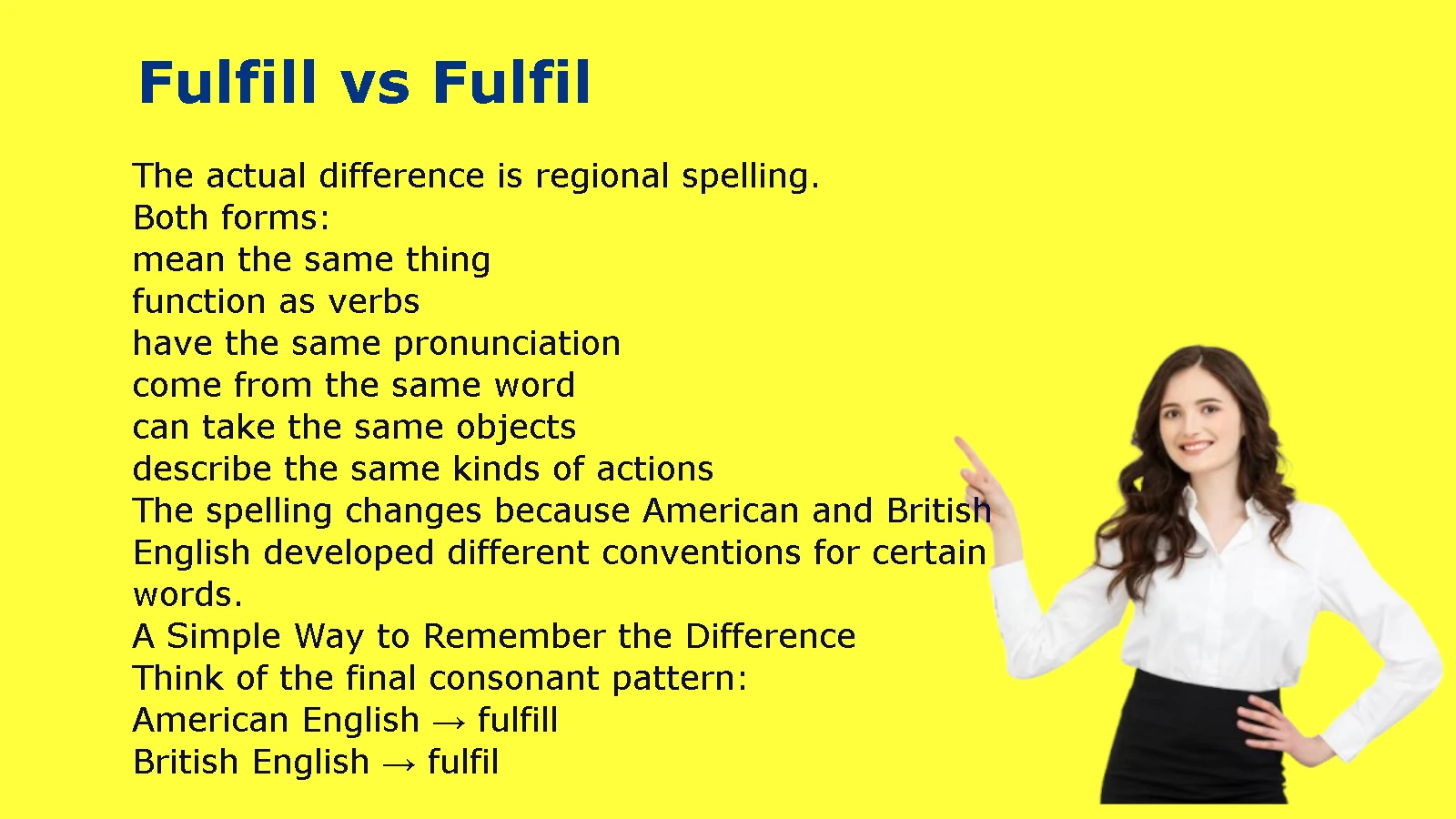
The actual difference is regional spelling.
Both forms:
- mean the same thing
- function as verbs
- have the same pronunciation
- come from the same word
- can take the same objects
- describe the same kinds of actions
The spelling changes because American and British English developed different conventions for certain words.
A Simple Way to Remember the Difference
Think of the final consonant pattern:
American English → fulfill
British English → fulfil
A useful comparison is:
| American English | British English |
| fulfill | fulfil |
| fulfillment | fulfilment |
| fulfills | fulfils |
| fulfillable | fulfilable, where used |
| fulfilled | fulfilled |
| fulfilling | fulfilling |
The last two forms deserve special attention because they do not change between the two varieties.
Fulfill vs. Fulfil in American English
When writing in American English, fulfill is the spelling to choose.
American English commonly uses the double l in the base form:
- fulfill
- fulfills
- fulfilled
- fulfilling
- fulfillment
Oxford’s American English dictionary lists fulfill, fulfilled, fulfilling, and fulfillment as the relevant forms.
American English Examples
Here are natural examples using fulfill:
- The company must fulfill its contractual obligations.
- She hopes to fulfill her dream of becoming a doctor.
- The course helps students fulfill the graduation requirements.
- He promised to fulfill his responsibilities.
- The new product should fulfill an important customer need.
- She worked hard to fulfill her potential.
- The organization must fulfill its legal duties.
- The program was designed to fulfill several important functions.
- They hired another employee to fulfill the role.
- The retailer works quickly to fulfill online orders.
These examples show why the word appears in many types of writing. It can describe a personal goal just as easily as a legal requirement or business process.
Fulfill vs. Fulfil in British English
British English normally uses fulfil.
So a British writer would generally write:
- fulfil
- fulfils
- fulfilled
- fulfilling
- fulfilment
Oxford specifically lists fulfil as the British form and shows fulfilled and fulfilling as the past and -ing forms.
British English Examples
- The company must fulfil its contractual obligations.
- She hopes to fulfil her dream of becoming a doctor.
- The course helps students fulfil the graduation requirements.
- He promised to fulfil his responsibilities.
- The new product should fulfil an important customer need.
- She worked hard to fulfil her potential.
- The organization must fulfil its legal duties.
- The program was designed to fulfil several important functions.
- They hired another employee to fulfil the role.
- The retailer works quickly to fulfil online orders.
Notice something important: the sentences haven’t changed in meaning. Only the regional spelling of the base verb has changed.
Fulfill vs. Fulfil Examples Side by Side
The easiest way to see the distinction is to put the two varieties next to each other.
| American English | British English |
| She wants to fulfill her ambition. | She wants to fulfil her ambition. |
| We must fulfill the requirements. | We must fulfil the requirements. |
| He promised to fulfill his duty. | He promised to fulfil his duty. |
| The company must fulfill the contract. | The company must fulfil the contract. |
| This service will fulfill a customer need. | This service will fulfil a customer need. |
| She hopes to fulfill her potential. | She hopes to fulfil her potential. |
| They need to fulfill their responsibilities. | They need to fulfil their responsibilities. |
| The system must fulfill its intended function. | The system must fulfil its intended function. |
The pattern is almost comically simple once you see it: US English adds the extra l in the base spelling, while UK English doesn’t.
Fulfilled vs. Fulfiled: Which Is Correct?
Here’s where the spelling can trip people up.
The correct past tense and past participle is:
fulfilled
Not:
fulfiled
This form is the same in both American and British English.
Correct Examples
She fulfilled her promise.
They fulfilled all the requirements.
The company fulfilled the terms of the agreement.
He finally fulfilled his ambition.
Oxford lists fulfilled as the past form of both the British verb fulfil and the North American form fulfill.
Why Does Fulfilled Have Two Ls?
The spelling becomes easier to understand when you look at the base word and suffix together.
With fulfill, adding -ed gives:
fulfill + ed → fulfilled
With fulfil, the standard past form is also:
fulfilled
So British English doesn’t normally produce fulfiled.
That makes this a useful rule:
Fulfill → fulfilled
Fulfil → fulfilled
The past form converges even though the base forms differ.
Fulfilling vs. Fulfiling: Which Is Correct?
The correct form is fulfilling in both American and British English.
Fulfiling is not the standard spelling.
Examples:
She has a fulfilling career.
Teaching can be a fulfilling profession.
The project was challenging but fulfilling.
Oxford lists fulfilling as the -ing form associated with both fulfil and fulfill.
Why Is Fulfilling Spelled With Two Ls?
The spelling follows the same basic pattern seen in fulfilled.
Compare:
- fulfill → fulfilling
- fulfil → fulfilling
The result is the same in standard English.
This is useful because writers sometimes assume that British English should produce fulfiling simply because British English spells the base verb fulfil. That’s not the standard form.
Fulfillment vs. Fulfilment
The noun creates another US versus UK spelling difference.
Fulfillment is the standard American form.
Fulfilment is the standard British form.
Cambridge identifies fulfillment as the US spelling of fulfilment, while Oxford lists fulfilment as British English and fulfillment as North American English.
What Does Fulfillment Mean?
Fulfillment can refer to the act of achieving or completing something, or to a feeling of satisfaction.
For example:
Winning the competition brought her a sense of fulfillment.
Owning a home was the fulfillment of his dream.
The word can also describe satisfaction with life, work, or personal achievements. Cambridge gives both the achievement sense and the sense of happiness or satisfaction.
What Does Fulfilment Mean?
Fulfilment carries the same meanings in British English.
For example:
Winning the competition brought her a sense of fulfilment.
Owning a home was the fulfilment of his dream.
Oxford also notes that fulfilment can describe personal satisfaction, the achievement of something hoped for, and the completion of something required.
Fulfillment in Business
There’s another important meaning that appears in commerce.
Order fulfillment refers to the process of processing and sending an order to a customer.
In American English:
The company handles order fulfillment from its Chicago warehouse.
In British English:
The company handles order fulfilment from its Manchester warehouse.
Cambridge’s Business English entry includes the commercial sense of fulfilling an order, including the process of getting a customer’s purchased product to them.
This distinction matters in e-commerce because fulfillment isn’t always about emotions or dreams. It can describe a very practical supply chain process.
Common Phrases With Fulfill and Fulfil
Because the meaning remains unchanged, most common expressions work in exactly the same way.
| US English | UK English |
| fulfill a promise | fulfil a promise |
| fulfill a requirement | fulfil a requirement |
| fulfill an obligation | fulfil an obligation |
| fulfill a duty | fulfil a duty |
| fulfill a contract | fulfil a contract |
| fulfill a dream | fulfil a dream |
| fulfill an ambition | fulfil an ambition |
| fulfill a need | fulfil a need |
| fulfill a role | fulfil a role |
| fulfill a function | fulfil a function |
| fulfill your potential | fulfil your potential |
| fulfill an order | fulfil an order |
| fulfill expectations | fulfil expectations |
These combinations aren’t interchangeable based on meaning. The verb’s meaning stays the same, while the spelling follows the writer’s chosen variety of English.
Fulfill vs. Fulfil: Grammar and Word Forms
The spelling difference becomes clearer when you compare the complete verb forms.
| Form | American English | British English |
| Base verb | fulfill | fulfil |
| Third person singular | fulfills | fulfils |
| Past tense | fulfilled | fulfilled |
| Past participle | fulfilled | fulfilled |
| -ing form | fulfilling | fulfilling |
| Noun | fulfillment | fulfilment |
| Adjective | fulfilled | fulfilled |
| Adjective | fulfilling | fulfilling |
This table reveals an important detail: the regional difference isn’t present in every form.
The main differences appear in the base verb, third person singular, and noun.
The forms fulfilled, fulfilling, and fulfilled remain the same.
Why Does Fulfill Have Two Spellings?
The word has a long history. Oxford traces fulfil to late Old English fullfyllan, meaning roughly “fill up” or “make full.”
Over time, English spelling developed differently in Britain and North America. Some words retained or developed different spellings across the two varieties.
Fulfill vs. fulfil belongs to this larger pattern of regional spelling variation.
You can see similar differences in other common words:
| American English | British English |
| color | colour |
| honor | honour |
| labor | labour |
| center | centre |
| traveled | travelled |
| canceled | cancelled |
| fulfill | fulfil |
The important thing is not to treat these differences as evidence that one form is “real English” and the other is somehow broken. English has multiple established standards.
Case Study: Choosing the Right Spelling for a Global Website
Imagine an online retailer operates in both the United States and the United Kingdom.
Its American website says:
We fulfill orders within two business days.
Its British website says:
We fulfil orders within two working days.
Both sentences communicate the same basic idea.
Now imagine the company publishes a single corporate style guide. It uses fulfil in one section, fulfill in another, and fulfillment somewhere else.
The problem isn’t that readers can’t understand the words. They can.
The problem is inconsistency.
A professional publication should normally select a style and follow it throughout the relevant document or website. If the publication uses American English, fulfill and fulfillment fit naturally. If it uses British English, fulfil and fulfilment fit better.
The Lesson
When choosing between fulfill and fulfil, don’t ask:
“Which spelling looks more correct?”
Ask:
“Which English variety am I using?”
That question solves the problem quickly.
Common Mistakes With Fulfill and Fulfil
A few errors appear repeatedly.
Mistake: Assuming Fulfil Is Wrong
A US English writer might see fulfil and assume someone made a spelling mistake.
That’s not correct.
Fulfil is a standard British English spelling. Cambridge and Oxford both recognize it.
Mistake: Assuming Fulfill Is Wrong
The opposite mistake happens too.
A British English writer might assume fulfill is always incorrect.
It isn’t. Fulfill is the standard American English spelling.
Mistake: Writing Fulfiled
Avoid:
❌ The company fulfiled the order.
Use:
✅ The company fulfilled the order.
The standard past form is fulfilled in both major varieties.
Mistake: Writing Fulfiling
Avoid:
❌ The experience was very fulfiling.
Use:
✅ The experience was very fulfilling.
The standard -ing form is fulfilling.
Mistake: Mixing Regional Spellings
Consider this sentence:
The company will fulfil orders and provide fast fulfillment services.
There’s nothing incomprehensible about it. However, the spelling mixes British fulfil with American fulfillment.
For a polished document, choose one convention and stick with it.
How to Choose Between Fulfill and Fulfil
The decision doesn’t need to be complicated.
Writing for an American Audience?
Use:
- fulfill
- fulfills
- fulfilled
- fulfilling
- fulfillment
Example:
Our team works hard to fulfill every customer request.
Writing for a British Audience?
Use:
- fulfil
- fulfils
- fulfilled
- fulfilling
- fulfilment
Example:
Our team works hard to fulfil every customer request.
Writing for an International Audience?
Choose a consistent English style based on your organization’s audience or editorial guidelines.
For example, if a website primarily targets US readers, use American spelling throughout. If a publication follows British English, use British spelling throughout.
The goal isn’t to make every English speaker use the same spelling. The goal is to make the chosen style consistent and clear.
Fulfill vs. Fulfil in Academic Writing
Academic writers should pay attention to regional spelling because universities, journals, and style guides may follow specific English conventions.
An American academic paper might say:
The study examines whether the intervention can fulfill participants’ needs.
A British academic paper might say:
The study examines whether the intervention can fulfil participants’ needs.
Neither version changes the underlying argument.
However, if an institution specifies a particular style, follow that requirement. Consistency can matter across the entire document.
Fulfill vs. Fulfil in Business Writing
Business writing provides some of the clearest examples of this difference.
Contracts, policies, reports, product pages, and customer communications frequently use fulfill/fulfil in phrases such as:
- fulfill the contract
- fulfil the contract
- fulfill the terms
- fulfil the terms
- fulfill an obligation
- fulfil an obligation
- fulfill an order
- fulfil an order
Cambridge’s Business English definitions specifically include contracts, obligations, requirements, roles, functions, and orders.
A company doesn’t need to change its meaning when it changes markets. It may simply change its spelling conventions to match the local English standard.
Fulfill vs. Fulfil Pronunciation
Despite the different spellings, fulfill and fulfil have the same standard pronunciation.
Both are pronounced approximately:
/fʊlˈfɪl/
The stress falls on the second syllable.
That means the distinction is mainly visible on the page rather than something you hear in ordinary speech. Cambridge and Oxford give the same pronunciation for the two forms.
So if someone says “fulfill” aloud, you usually can’t tell from pronunciation whether the speaker would spell it fulfill or fulfil.
Fulfill vs. Fulfil: What About Fulfilled and Fulfilling?
This is one of the most useful details to remember.
You don’t have to choose between fulfilled and fulfilled. There is only one standard spelling here.
Likewise, the standard form is fulfilling, not fulfiling.
Correct Forms
US English:
fulfill → fulfills → fulfilled → fulfilling → fulfillment
UK English:
fulfil → fulfils → fulfilled → fulfilling → fulfilment
The regional difference largely disappears once you move into the past and -ing forms.
Fulfill vs. Fulfil FAQs
Is fulfill or fulfil correct?
Both are correct. Fulfill is the standard American English spelling, while fulfil is the standard British English spelling.
Is fulfill American or British?
Fulfill is American English. British English usually uses fulfil.
Is fulfil British or American?
Fulfil is mainly British English. American English normally uses fulfill.
Do fulfill and fulfil mean the same thing?
Yes. They have the same meaning and pronunciation. The difference is primarily regional spelling.
Is fulfilled spelled with one L or two?
The correct spelling is fulfilled, with two Ls. This form is used in both American and British English.
Is fulfilling spelled with one L or two?
The standard spelling is fulfilling, with two Ls. Both American and British English use this form.
Is fulfilment the British spelling?
Yes. Fulfilment is the standard British spelling, while American English generally uses fulfillment.
Is fulfillment the American spelling?
Yes. Fulfillment is the standard American spelling. British English generally uses fulfilment.
Can I use fulfill in British English?
British readers will understand fulfill, but fulfil is the standard British spelling. If you’re following British English, fulfil is the better choice.
Can I use fulfil in American English?
American readers will understand fulfil, but fulfill is the standard American spelling. Use fulfill when following American English conventions.
Does fulfill mean “complete”?
Often, yes. Fulfill can mean to complete something that was promised or required. However, it can also mean to achieve an ambition, satisfy a need, perform a function, or develop one’s potential.
Does fulfill mean “satisfy”?
It can. For example:
The new service fulfills customer needs.
It can also describe personal satisfaction:
She found a career that fulfilled her.
Cambridge recognizes both practical and personal uses of the verb.
What is the opposite of fulfill?
Depending on the context, possible opposites include fail to meet, neglect, violate, break, or leave unfulfilled.
For example:
- fulfill a promise ↔ break a promise
- fulfill a requirement ↔ fail to meet a requirement
- fulfill a need ↔ leave a need unmet
- fulfill potential ↔ fail to realize potential
The best opposite depends on what fulfill describes in the sentence.
Final Verdict: Fulfill or Fulfil?
The fulfill vs. fulfil question has a straightforward answer.
Use “fulfill” in American English.
Use “fulfil” in British English.
The words mean the same thing and have the same pronunciation. The difference comes from regional spelling conventions.
The related noun follows the same pattern:
- American English: fulfillment
- British English: fulfilment
But don’t carry the spelling difference into every form. The past tense is fulfilled in both varieties, and the -ing form is fulfilling in both.
The Quick Rule
US English → fulfill
UK English → fulfil
Once that distinction is clear, the choice becomes easy. Match the spelling to your audience, keep the rest of your writing consistent, and you won’t have to second guess the word every time it appears.
In short, neither “fulfill” nor “fulfil” is wrong. The right choice depends on which variety of English you’re writing.