Seam or Seem is a common spelling confusion in English—but have you ever paused mid-sentence wondering which one is correct? You’re not alone. These two words sound similar but have completely different meanings, and mixing them up can change the clarity of your writing.
But here’s the kicker: once you understand the difference, you’ll never confuse them again. And it gets better… knowing when to use seam (related to stitching or joining) and seem (related to appearance or perception) will instantly improve your spelling accuracy and writing confidence. In this guide, you’ll learn seam or seem, their meanings, examples, and simple tricks to remember the difference so you can use both words correctly every time.
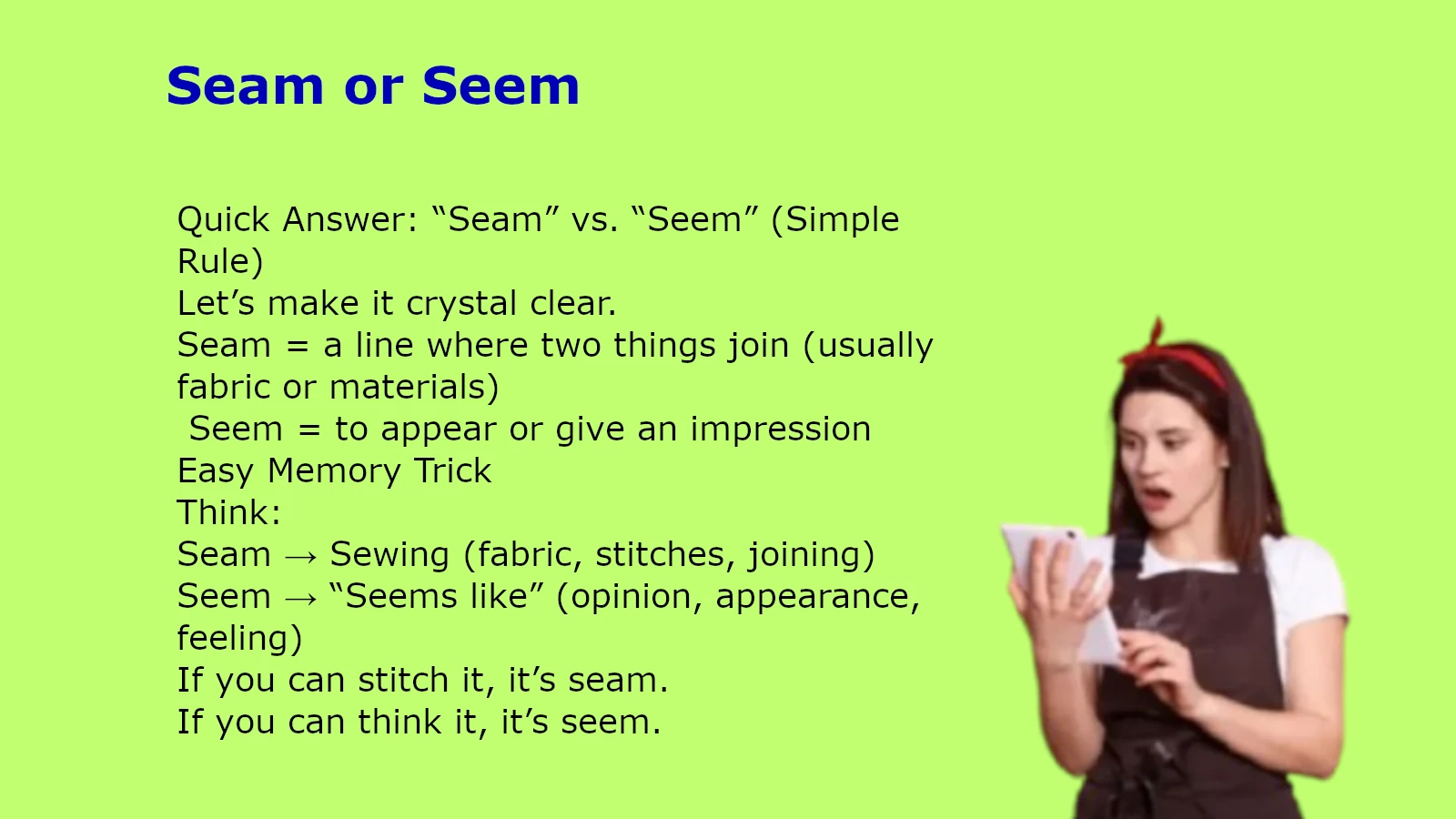
Quick Answer: “Seam” vs. “Seem” (Simple Rule)
Let’s make it crystal clear.
Seam = a line where two things join (usually fabric or materials)
Seem = to appear or give an impression
Easy Memory Trick
Think:
- Seam → Sewing (fabric, stitches, joining)
- Seem → “Seems like” (opinion, appearance, feeling)
If you can stitch it, it’s seam.
If you can think it, it’s seem.
The Core Difference Between “Seam” and “Seem”
Here’s where most confusion starts.
They sound almost identical, but their meanings are completely unrelated.
“Seam” = Physical Connection
Used in clothing, construction, or joining materials.
Example:
- The seam of the shirt is coming apart.
- She stitched the seam carefully.
It always involves something physical being joined.
“Seem” = Perception or Appearance
Used when talking about how something looks or feels.
Example:
- You seem tired today.
- It seems like it will rain.
It is always about opinion, impression, or assumption.
Why People Confuse “Seam” and “Seem”
This is where things get interesting.
The confusion doesn’t come from grammar—it comes from sound + typing habits.
Same Sound Problem
Both words sound identical in speech:
- /siːm/
So when writing quickly, your brain just guesses.
Autocorrect Doesn’t Always Help
- “seem” is more common → gets auto-suggested more often
- “seam” gets ignored unless context is fabric-related
Context Overload
In fast writing, people think:
“It sounds right… so it must be right.”
That’s where mistakes happen.
“Seam” Explained Clearly (With Edge Cases)
Let’s break it down properly.
Standard Meaning
A seam is a line where two materials are joined.
Examples:
- Jeans have strong seams.
- The seam of the bag split open.
Edge Case: Non-Clothing Use
“Seam” isn’t just fashion.
It can also mean:
- Geological seams (rock layers)
- Welding seams (metal joins)
Example:
- The coal seam runs deep underground.
Key Insight
If something is physically connected or stitched, it’s always seam.
“Seem” Explained Clearly (With Edge Cases)
Now the more abstract one.
Standard Meaning
“Seem” means something appears or feels a certain way.
Examples:
- She seems happy.
- This plan seems risky.
Edge Case: Indirect Opinions
Sometimes “seem” softens statements:
- It seems that he is not coming.
- You seem to be correct.
This makes communication less direct and more polite.
Key Insight
If it’s about thoughts, impressions, or assumptions, it’s always seem.
The Biggest Mistake People Make
Here’s the real issue.
People try to decide based on sound instead of meaning.
What Goes Wrong
They write:
- “You seam tired” ❌
- “The plan seam good” ❌
Because both sound correct when spoken.
Real Scenario
A student writes:
“It seam like a good idea.”
Result:
- Teacher correction
- Grammar loss of marks
- Confusion about rule
Lesson
Never trust pronunciation alone. Meaning decides the word.
Side-by-Side Comparison Table
| Word | Meaning | Category | Example | Risk of Confusion |
| Seam | Line where things join | Physical | The seam of the shirt is loose | Medium |
| Seem | Appear or give impression | Abstract | You seem tired | High |
Real-Life Examples of “Seam”
Let’s make it practical.
Common Situations
- The seam of the dress ripped.
- Check the seam before stitching.
- The bag’s seam is weak.
What It Always Means
Something physical, visible, and connected.
Real-Life Examples of “Seem”
Now the abstract side.
Common Situations
- You seem upset today.
- It seems like a bad idea.
- She seems confident.
What It Always Means
Something perceived, not physically touched.
Quick Test to Never Get It Wrong
Ask yourself:
Can I touch it or stitch it?
- Yes → Seam
- No → go next
Am I describing an opinion or feeling?
- Yes → Seem
Simple filter. Works every time.
Why This Confusion Matters More Than You Think
It’s not just spelling.
It affects:
- Professional writing
- Academic scores
- Job communication
- Clarity in emails
A small mistake can change how polished your English looks.
What to Use Instead in Important Writing
If you’re unsure, slow down and check meaning:
For “seam”
Use when writing about:
- clothes
- fabric
- joining materials
For “seem”
Use when writing about:
- opinions
- assumptions
- impressions
Quick Decision Guide
When stuck, use this:
- Stitching or joining → seam
- Thinking or feeling → seem
- Still unsure → rewrite sentence for clarity
FAQ: “Seam” vs. “Seem”
Why do they sound the same?
Because English has many homophones—words that sound identical but mean different things.
Is “seam” ever used figuratively?
Rarely, but mostly it stays physical.
What is the easiest way to remember?
Seam = Sewing
Seem = Sense (opinion)
Which one is more common?
“Seem” is far more common in everyday English.
Final Takeaway: The One Rule That Never Fails
Here’s the truth.
English can be tricky because sound doesn’t always match meaning.
So remember this:
- If it’s about fabric or joining → seam
- If it’s about thought or appearance → seem
And when in doubt, slow down and ask:
“Am I describing something physical or something I think?”
Because when it comes to “seam” vs. “seem,” clarity always wins over guesswork.