Have you ever stopped while writing and wondered whether Who’s vs. Whose is the correct choice? You’re not alone. This common grammar confusion trips up students, professionals, and native English speakers alike because the two words sound identical but serve completely different purposes.
The confusion often starts when people search for who’s meaning, whose meaning, who’s vs whose difference, or how to use who’s and whose correctly. And here’s the kicker: using the wrong word can make an otherwise polished email, essay, or social media post look grammatically incorrect.
But don’t worry—there’s an easy way to tell them apart.
In this guide, you’ll learn the difference between Who’s vs. Whose, discover the correct usage of who’s and whose, and see clear who’s examples and whose examples in real sentences. You’ll also learn when to use who’s, when to use whose, and simple memory tricks that make this common word confusion much easier to remember.
By the end, you’ll know exactly how to use who’s and whose correctly, avoid one of the most common grammar mistakes in English, and write with greater confidence every time these words appear.
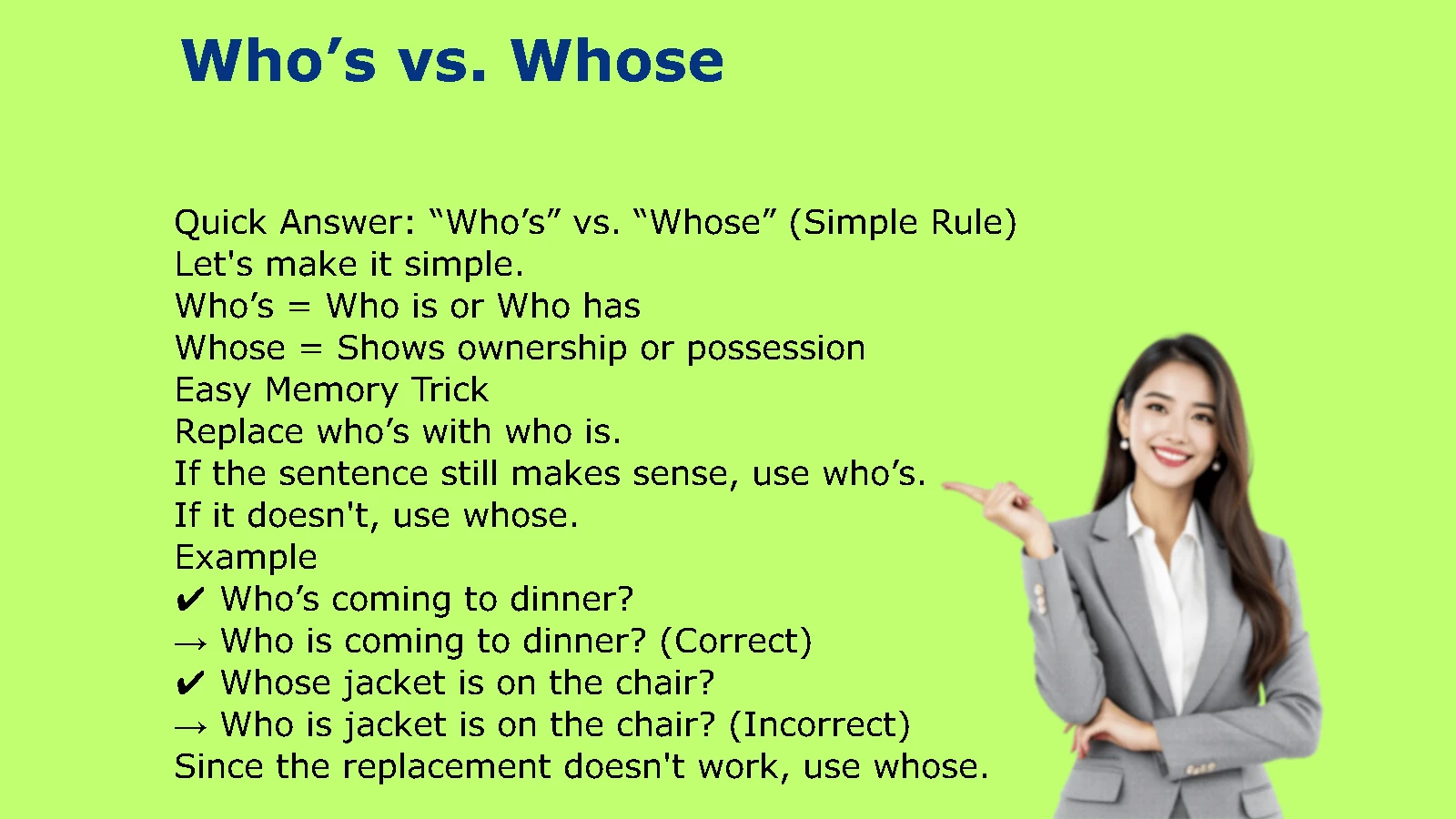
Quick Answer: “Who’s” vs. “Whose” (Simple Rule)
Let’s make it simple.
Who’s = Who is or Who has
Whose = Shows ownership or possession
Easy Memory Trick
Replace who’s with who is.
If the sentence still makes sense, use who’s.
If it doesn’t, use whose.
Example
✔ Who’s coming to dinner?
→ Who is coming to dinner? (Correct)
✔ Whose jacket is on the chair?
→ Who is jacket is on the chair? (Incorrect)
Since the replacement doesn’t work, use whose.
How People Actually Use “Who’s” and “Whose”
This mistake happens because both words sound identical.
In Casual Conversations
People rarely notice the difference when speaking.
The confusion appears mostly in writing.
In Text Messages and Social Media
Fast typing often leads to mistakes.
Many people accidentally type who’s when they mean whose, or vice versa.
At Work and School
Grammar errors can make writing appear less professional.
This is especially important in emails, reports, and academic assignments.
Why This Happens
- The words are pronounced the same.
- Apostrophes confuse many writers.
- English contractions don’t always follow obvious patterns.
The Grammar Logic Behind “Who’s” vs. “Whose”
Understanding the grammar makes everything easier.
Think About Function, Not Spelling
Who’s performs the job of a contraction.
Example:
- Who’s ready?
- Who’s finished the project?
Whose performs the job of showing ownership.
Example:
- Whose phone is ringing?
- Whose idea was this?
Key Insight
Who’s replaces words.
Whose describes ownership.
That single difference solves most confusion.
“Who’s” Explained Clearly (With Edge Cases)
At its core, who’s is simply a contraction.
Standard Meaning
Who’s = Who is
Examples:
- Who’s at the door?
- Who’s responsible for this?
- Who’s your favorite actor?
Second Meaning
Who’s = Who has
Examples:
- Who’s finished their homework?
- Who’s seen my keys?
- Who’s already left?
Edge Case
Sometimes the contraction feels hidden.
Example:
Who’s been using my computer?
Expanded version:
Who has been using my computer?
The contraction still works.
Key Takeaway
If you can replace the word with who is or who has, use who’s.
“Whose” Explained Clearly (With Edge Cases)
Now let’s look at whose.
Standard Meaning
Whose asks about ownership.
Examples:
- Whose bag is this?
- Whose turn is it?
- Whose car is parked outside?
Beyond Questions
Many people don’t realize whose can also connect clauses.
Examples:
- I met a student whose work won an award.
- She’s the author whose book became famous.
Edge Case
The owner doesn’t have to be a person.
Example:
- A company whose products sell worldwide.
Key Insight
Whenever ownership is involved, whose is usually the correct choice.
The Biggest Mistake People Make
Here’s the most common error.
People assume that apostrophes always show possession.
Normally that’s true.
Examples:
- Sarah’s book
- The dog’s leash
But who’s is different.
The apostrophe indicates a contraction, not possession.
What Goes Wrong
Incorrect:
❌ Who’s backpack is this?
Correct:
✔ Whose backpack is this?
Lesson
Don’t let the apostrophe fool you.
For ownership, use whose.
Side-by-Side Comparison Table
| Word | Meaning | Function | Example |
| Who’s | Who is / Who has | Contraction | Who’s calling? |
| Whose | Belonging to whom | Possession | Whose keys are these? |
Real-Life Examples of “Who’s”
Let’s see it in action.
Common Situations
- Who’s coming to the meeting?
- Who’s available tomorrow?
- Who’s been using the printer?
- Who’s interested in joining?
What They Mean
Each example can be expanded:
- Who is coming?
- Who is available?
- Who has been using?
- Who is interested?
Mini Scenario
Manager:
“Who’s available for the presentation?”
Meaning:
“Who is available for the presentation?”
Real-Life Examples of “Whose”
Now compare.
Common Situations
- Whose laptop is this?
- Whose notes are on the desk?
- Whose responsibility is it?
- Whose turn comes next?
What They Mean
Each sentence asks about ownership or association.
Mini Scenario
Teacher:
“Whose notebook did I find?”
Meaning:
The teacher wants to know who owns the notebook.
Common Mistakes and How to Fix Them
Here are mistakes you’ll often see.
Mistake #1
❌ Who’s shoes are these?
✔ Whose shoes are these?
Mistake #2
❌ Whose going to the concert?
✔ Who’s going to the concert?
Mistake #3
❌ Whose been absent all week?
✔ Who’s been absent all week?
Quick Fix
Always test:
Can I replace it with who is or who has?
If yes → who’s
If no → whose
Why Spell Check Often Misses This Error
One reason this mistake survives is that both words are real.
What Happens
Spell check verifies spelling.
It doesn’t always understand context.
Example:
❌ Whose coming over later?
The word whose is spelled correctly.
But the sentence is grammatically wrong.
Result
The mistake remains unnoticed.
Tip
Use the replacement test instead of relying on software.
What to Say Instead (Clear Alternatives)
If you’re unsure, rewrite the sentence.
Instead of
“Who’s responsible?”
You can write:
“Who is responsible?”
Instead of
“Whose jacket is this?”
You can write:
“To whom does this jacket belong?”
Why This Helps
Expanding the sentence reveals the correct choice instantly.
Quick Decision Guide (Use This Instantly)
When you’re unsure, follow this process:
Step 1
Can it become who is?
If yes → who’s
Step 2
Can it become who has?
If yes → who’s
Step 3
Does it show ownership?
If yes → whose
Step 4
Still unsure?
Expand the sentence completely.
The answer usually becomes obvious.
FAQ: “Who’s” vs. “Whose”
Is “who’s” possessive?
No.
Who’s is always a contraction of who is or who has.
Is “whose” always about ownership?
Yes. It indicates possession, ownership, or association.
Why do they sound the same?
English contains many homophones—words that sound alike but have different meanings and spellings.
Which mistake is more common?
Many writers accidentally use who’s when they need whose, especially because apostrophes are often associated with possession.
Case Study: An Embarrassing Email Mistake
A company manager sent an email to the entire department.
The message read:
“Who’s reports are missing?”
What Happened
Several employees noticed the error.
The sentence should have been:
“Whose reports are missing?”
Result
The email’s professionalism suffered.
Fix
The manager corrected the message and used the ownership rule.
Lesson
Small grammar mistakes can create a surprisingly large impression.
Key Facts You Should Remember
- Who’s means who is or who has.
- Whose shows ownership.
- The apostrophe in who’s signals a contraction.
- Possession always points toward whose.
- The replacement test works almost every time.
- Both words sound identical but serve different purposes.
Final Takeaway: The One Rule That Never Fails
Here’s the truth.
The confusion between who’s and whose isn’t about difficult grammar. It’s about recognizing whether you’re dealing with a contraction or ownership.
Keep this simple rule in mind:
Who’s = Who is / Who has
Whose = Belonging to whom
Whenever you’re uncertain, replace who’s with who is.
If the sentence still works, you’ve found the right answer.
If not, use whose.
It’s that simple.
Because when it comes to “who’s” vs. “whose,” one quick test can save you from one of the most common grammar mistakes in English.