Ever wondered why Adopted vs. Adoptive confuses so many English learners, writers, and even native speakers? These two words are closely related to adoption terminology, but they are used in completely different grammatical and contextual ways—one describes a person who has been legally adopted, while the other describes something or someone connected to the act of adoption.
That’s where the confusion starts. You’re not alone if you’ve mixed up phrases like adopted child, adoptive parents, or even adoptive family in writing or conversation. And here’s the kicker: using the wrong form can subtly change the meaning and make your sentence sound unnatural.
But don’t worry—this is easier to fix than it looks.
In this guide, you’ll clearly understand Adopted vs. Adoptive, including their correct grammar usage, real-life examples, and common phrases like adopted child definition, adoptive mother meaning, and adoptive family structure. You’ll also learn simple memory tricks so you never confuse them again.
So if you want to sound more accurate and confident when talking about adoption-related terms, you’re in the right place. Let’s break it down.
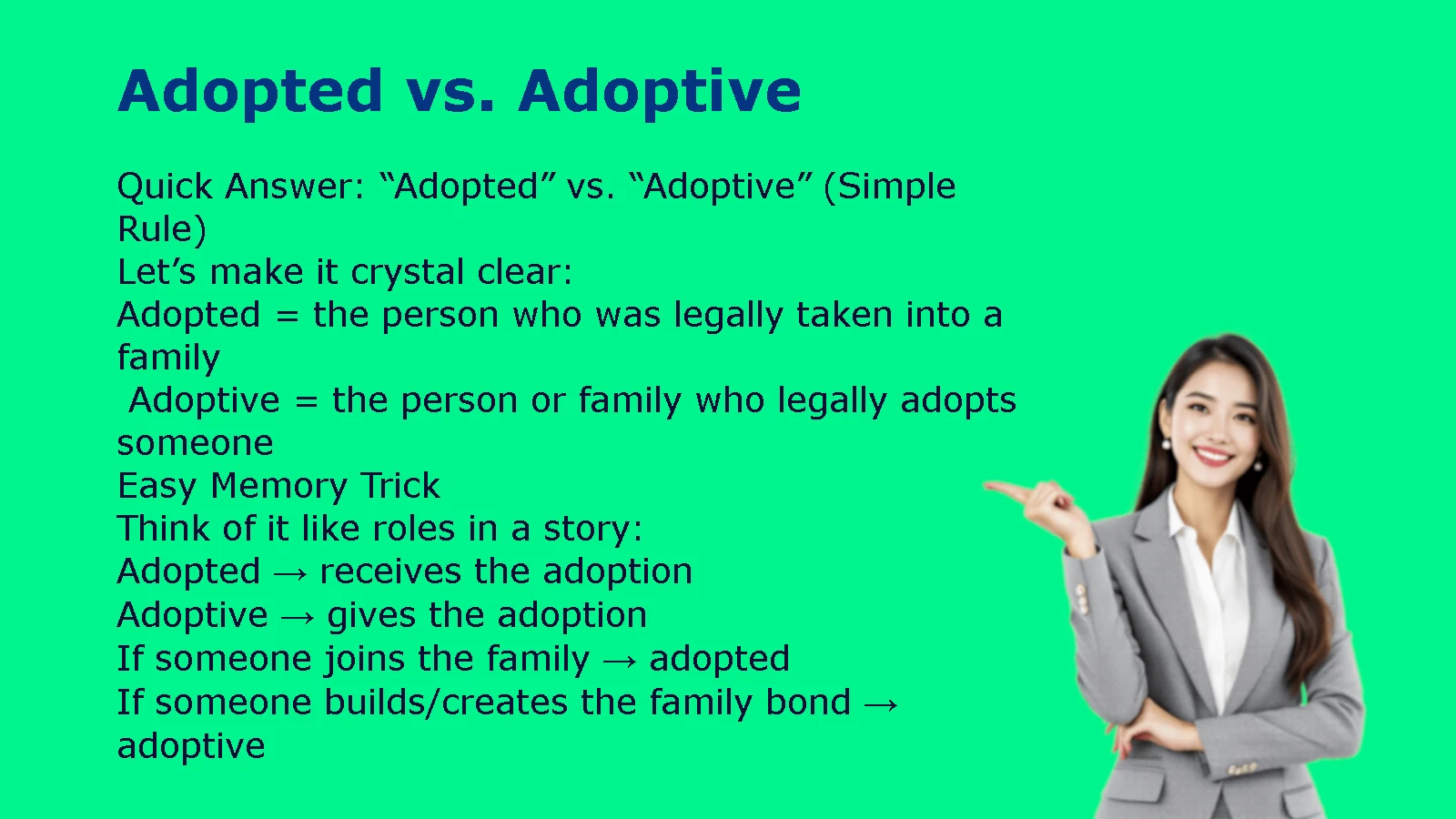
Quick Answer: “Adopted” vs. “Adoptive” (Simple Rule)
Let’s make it crystal clear:
Adopted = the person who was legally taken into a family
Adoptive = the person or family who legally adopts someone
Easy Memory Trick
Think of it like roles in a story:
- Adopted → receives the adoption
- Adoptive → gives the adoption
If someone joins the family → adopted
If someone builds/creates the family bond → adoptive
The Core Difference in Simple Words
The biggest mistake people make is thinking both words describe the same thing.
They don’t.
Adopted (Receiver Side)
Used for the child or person who is adopted into a family.
Adoptive (Giver Side)
Used for parents or family who adopt the child.
This is a relationship-based contrast, not just grammar.
The Grammar Logic Behind “Adopted” vs. “Adoptive”
Let’s break it down simply.
- Adopted = past participle adjective
- Adoptive = descriptive adjective (role-based)
Think in Terms of Direction:
👉 Who is coming into the family? → Adopted
👉 Who is creating the family bond? → Adoptive
This direction-based thinking removes 90% of confusion.
“Adopted” Explained Clearly (With Edge Cases)
At its core, adopted describes someone who has been legally and emotionally taken into a family.
Standard Meaning
- Adopted child
- Adopted son
- Adopted daughter
Real-Life Examples
- “She is their adopted daughter.”
- “He grew up as an adopted child.”
- “They have two adopted kids.”
Important Insight
“Adopted” is always about identity after adoption, not the act itself.
Edge Case: Emotional Usage
Sometimes people say:
- “He is like an adopted brother.”
This is informal and emotional, not legal.
“Adoptive” Explained Clearly (With Edge Cases)
Now let’s flip the perspective.
Adoptive describes the person or family who adopts someone.
Standard Meaning
- Adoptive parents
- Adoptive mother
- Adoptive father
Real-Life Examples
- “Her adoptive parents raised her from infancy.”
- “He met his adoptive father later in life.”
- “They are her adoptive family.”
Key Insight
“Adoptive” always refers to the role of giving care through adoption.
Edge Case: Legal Context
In documents, you may see:
- “Adoptive rights”
- “Adoptive custody”
These refer to legal parental authority.
Side-by-Side Comparison Table
| Word | Meaning | Refers To | Example |
| Adopted | Person who is taken into a family | Child/person | Adopted daughter |
| Adoptive | Person or family who adopts | Parents/family | Adoptive parents |
The Biggest Mistake People Make
Here’s where most confusion happens:
People think both words describe the same family relationship.
What Goes Wrong
- “Adoptive child” ❌ (incorrect in most contexts)
- “Adopted parents” ❌ (incorrect in formal usage)
Why This Happens
Because both words come from the same root: adopt
But grammar assigns them different roles.
Real-Life Examples of “Adopted”
Let’s ground it in everyday usage:
- “He is an adopted child of the Smith family.”
- “She discovered she was adopted at age 10.”
- “They love their adopted son deeply.”
👉 Focus: the person who joins the family
Real-Life Examples of “Adoptive”
Now the opposite side:
- “His adoptive parents supported his education.”
- “She visited her adoptive hometown.”
- “The adoptive family welcomed him warmly.”
👉 Focus: the family who provides the adoption
Quick Rule to Avoid Confusion Every Time
Use this simple system:
👉 If you can replace it with “child” → use adopted
👉 If you can replace it with “parents” → use adoptive
Still unsure? Use this final test:
- Is someone being placed into a family? → adopted
- Is someone receiving a child into their family? → adoptive
What to Say Instead (Clear Alternatives)
If you want zero confusion in formal writing:
- “Adopted child of the family”
- “Adoptive parents of the child”
- “Child adopted by the family”
These remove ambiguity completely.
FAQ: “Adopted” vs. “Adoptive”
Is “adoptive child” correct?
Not usually. The correct term is adopted child.
Can I say “adopted parents”?
No. The correct form is adoptive parents.
Why do both words exist?
To clearly separate roles: the one who adopts and the one who is adopted.
Is this difference important in daily English?
Yes, especially in legal, academic, and formal writing.
Case Study: A Real Communication Mix-Up
A school newsletter wrote:
“We celebrate our adoptive students and their adoptive teachers.”
What Went Wrong
- “Adoptive students” ❌
- “Adoptive teachers” ❌
Correct Version
- “Adopted students and their adoptive parents”
Result
The corrected version clearly defined roles and removed confusion.
Key Facts You Should Remember
- Adopted = the person who joins a family
- Adoptive = the family who takes in the person
- One describes identity, the other describes role
- Context matters, but meaning stays consistent
Final Takeaway: The One Rule That Never Fails
Here’s the simplest way to remember everything:
👉 Adopted = received into a family
👉 Adoptive = gives the family role
Think of it like a story:
One person arrives.
One person welcomes.
And when you use them correctly, your English becomes clearer, more natural, and more precise—especially in important conversations about family and identity.