Ever wondered why Burger vs. Burgher confuses so many people, especially when ordering food or reading restaurant menus? One refers to a popular fast-food item made from a patty in a bun, while the other often describes a person or term historically linked to a citizen or town resident—yet they look almost identical.
That’s where the mix-up happens. You’re not alone if you’ve seen burger restaurant menus, fast food terminology, or even burgher city history and felt unsure which word fits where. And here’s the kicker: using the wrong one can make your writing look confusing or out of context.
But don’t worry—this is actually very easy to fix.
In this guide, you’ll clearly understand the difference between Burger vs. Burgher, including meaning, origin, and real-life usage examples. You’ll also explore related concepts like fast food vocabulary, food terminology confusion, and English homophones that look similar but mean different things.
So whether you’re a student, writer, or just curious about language quirks, this breakdown will make everything crystal clear. Let’s dive in.
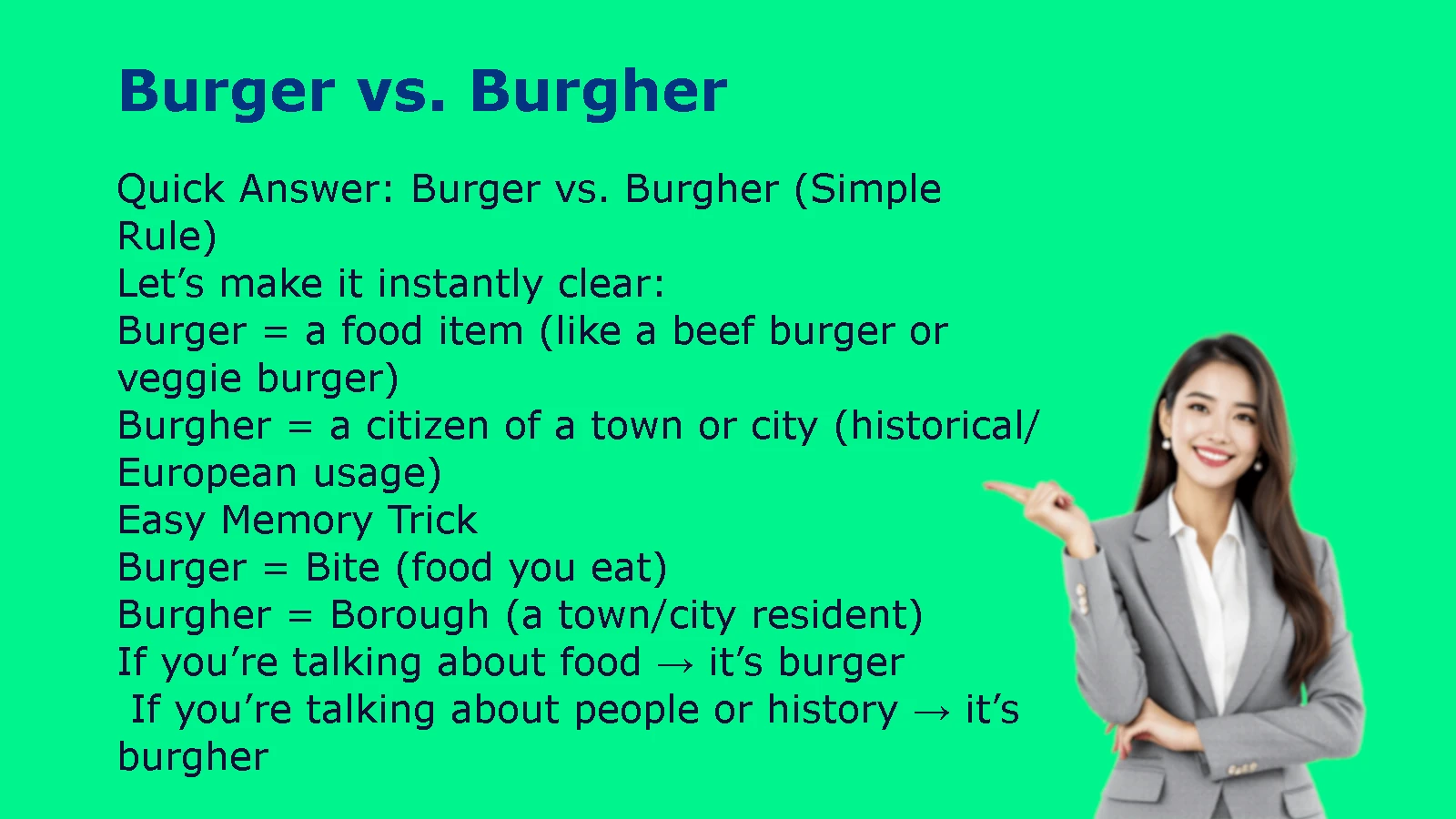
Quick Answer: Burger vs. Burgher (Simple Rule)
Let’s make it instantly clear:
- Burger = a food item (like a beef burger or veggie burger)
- Burgher = a citizen of a town or city (historical/European usage)
Easy Memory Trick
- Burger = Bite (food you eat)
- Burgher = Borough (a town/city resident)
If you’re talking about food → it’s burger
If you’re talking about people or history → it’s burgher
What is a Burger?
A burger is a popular food item made with a patty (usually meat, chicken, or vegetables) placed inside a bun.
Common Types:
- Beef burger
- Chicken burger
- Veggie burger
- Cheeseburger
It is one of the most widely eaten fast foods in the world and is strongly linked with modern fast-food culture.
What is a Burgher?
A burgher is a term used for a citizen of a town or borough, especially in medieval and early modern Europe.
Simple Meaning:
- A respected town resident
- Often a merchant or middle-class citizen
Today, the word is mostly used in:
- Historical texts
- Academic writing
- Certain cultural references
Burger vs Burgher: Key Differences
- Burger → food item
- Burgher → person (historical/civic identity)
One is edible, the other is social status.
Why People Confuse Burger and Burgher
The confusion happens because:
- They sound almost identical
- Spelling differs by only one letter
- “Burger” is extremely common in daily life
- “Burgher” is rare in modern usage
So most people assume they are variations of the same word—but they are not.
Origin of the Word “Burger”
The word burger comes from “hamburger,” which originally referred to something from Hamburg, Germany.
Over time:
- “Hamburger steak” → shortened to “burger”
- Became a global fast-food term
Now it stands alone as a category of food.
Origin of the Word “Burgher”
Burgher comes from the Middle Dutch and German word:
- “Burg” = town or fortress
- “Burgher” = town citizen
It historically referred to someone who lived in a fortified town and had civic rights.
Burger in Fast Food Culture
Today, “burger” is a global food icon.
You’ll find it in:
- Fast food chains
- Street food stalls
- Gourmet restaurants
It represents convenience, flavor, and modern dining.
Burgher in Historical Context
A burgher was typically:
- A merchant or trader
- A member of the middle class
- Someone with property or civic rights
It was not a food-related term at all.
Common Examples of Burger in Sentences
- I ordered a chicken burger for lunch.
- This burger has extra cheese and sauce.
- Let’s grab burgers after school.
Common Examples of Burgher in Sentences
- The burghers of the town held a council meeting.
- In medieval Europe, burghers were influential merchants.
- The rights of burghers were expanded over time.
Burger vs Burgher Table Comparison
| Feature | Burger 🍔 | Burgher 🏛️ |
| Meaning | Food item | Town citizen |
| Usage | Modern everyday | Historical/formal |
| Context | Fast food culture | European history |
| Common today | Very common | Rare |
Real-Life Mistake Example
Someone writes:
- “I had a tasty burgher at lunch.”
This is incorrect unless they’re eating a medieval citizen (which they’re not 😄).
Correct version:
- “I had a tasty burger at lunch.”
Why “Burger” Became So Popular
- Fast food globalization
- McDonald’s and global chains
- Easy pronunciation
- Simple branding
It became one of the most recognizable food words in the world.
Memory Trick to Avoid Confusion
Use this:
- Burger = Eat it (food)
- Burgher = Era (history/citizen)
Or even simpler:
- If you can order it → burger
- If you can read about it in history → burgher
FAQ: Burger vs Burgher
Is burgher a spelling mistake of burger?
No. They are completely different words with different meanings.
Is burgher used today?
Rarely. Mostly in historical or academic contexts.
Can I use burger instead of burgher?
No, it would be incorrect and change the meaning.
Why do they sound the same?
Because English pronunciation evolved differently from spelling origins.
Final Takeaway: The One Rule That Never Fails
Here’s the simplest way to remember it:
- Burger = food you eat 🍔
- Burgher = person from a town (history) 🏛️
If you’re ever unsure, just ask yourself:
“Am I talking about food or people?”
Because in the battle of Burger vs Burgher, one belongs on your plate—and the other belongs in history books.