Fiercesome vs Fearsome: Fearsome is the correct and widely accepted English word, meaning frightening or inspiring fear. Fiercesome is a rare or nonstandard variant that is generally considered incorrect in modern English. Use fearsome in both formal and everyday writing.
The confusion is understandable. People often search for fearsome meaning, fiercesome meaning, fearsome pronunciation, and how to spell fearsome because the two words look similar and sound like they should both be correct. But here’s the kicker: only one of them is recognized as standard English.
In this guide, you’ll learn the difference between Fiercesome vs Fearsome, discover the correct spelling of fearsome, understand is fiercesome a word, and see real fearsome examples in sentences. You’ll also learn when to use fearsome, why fiercesome is considered a common spelling mistake, and how to remember the correct word with a simple trick.
By the end, you’ll know exactly why fearsome is the correct choice, why fiercesome is incorrect, and how to avoid this spelling mistake in your writing.
Fiercesome vs Fearsome: Quick Comparison
| Feature | Fiercesome | Fearsome |
| Standard English word | No | Yes |
| Recognized by major dictionaries | Generally no | Yes |
| Appropriate in formal writing | No | Yes |
| Common in everyday English | Very rare | Very common |
| Meaning | Intended to mean fierce or frightening | Causing fear; frightening or intimidating |
| Recommended spelling | No | Yes |
| Used in professional writing | No | Yes |
Quick takeaway
If you’re deciding between fiercesome vs fearsome, choose fearsome almost every time. Unless you’re intentionally creating fictional dialogue or imitating an old-fashioned style, fiercesome should be avoided.
What Does Fearsome Mean?
The adjective fearsome describes someone or something that inspires fear, respect, or intimidation because of its appearance, power, reputation, or abilities.
Unlike words that merely describe danger, fearsome often carries the idea that people react with caution because they expect something to be difficult to face.
Dictionary-style definition
Fearsome (adjective): Causing fear or great respect because of being powerful, dangerous, or intimidating.
A fearsome object doesn’t have to attack anyone. Sometimes its reputation alone creates fear.
For example:
- A fearsome warrior may intimidate opponents before a battle even begins.
- A fearsome storm warns people to seek shelter.
- A fearsome reputation can discourage competitors before a contest starts.
Pronunciation
Fearsome
Pronunciation: FEER-suhm
Phonetic spelling: /ˈfɪr.səm/
The first syllable rhymes with near, while the second sounds like sum.
Part of Speech
Fearsome functions as an adjective.
It modifies nouns by describing their ability to create fear or intimidation.
Examples include:
- a fearsome tiger
- a fearsome enemy
- a fearsome challenge
- a fearsome reputation
- a fearsome storm
Origin of the Word
The word fearsome combines two older English elements:
- Fear
- -some
The suffix -some creates adjectives that describe possessing or causing a particular quality.
Other familiar examples include:
| Word | Meaning |
| Troublesome | Causing trouble |
| Tiresome | Causing tiredness or annoyance |
| Quarrelsome | Inclined to argue |
| Fearsome | Causing fear |
Because English already had the established adjective fearsome, another form based on fierce never became widely accepted.
Modern Meaning
Today, fearsome usually suggests one or more of these qualities:
- intimidating
- dangerous
- powerful
- impressive
- formidable
- difficult to overcome
Depending on context, it can describe physical appearance, skill, personality, reputation, or natural events.
For example:
The boxer earned a fearsome reputation after winning twelve consecutive championship fights.
Here, the reputation—not necessarily the boxer himself—creates intimidation.
Characteristics of Something Described as Fearsome
A person or thing described as fearsome often has several of these characteristics:
- Inspires fear
- Commands respect
- Appears dangerous
- Has exceptional strength
- Is difficult to defeat
- Creates psychological intimidation
- Possesses an impressive reputation
Notice that actual violence isn’t required.
For instance, a chess champion can have a fearsome reputation simply because opponents know how difficult it is to win against them.
Is Fiercesome a Real Word?
This is the question behind nearly every search for fiercesome vs fearsome.
The answer depends on what someone means by “real.”
People occasionally write fiercesome, and you may encounter it in online discussions, fantasy writing, or older texts. However, that doesn’t make it a standard English word.
In modern English, fiercesome is generally regarded as a nonstandard formation rather than an accepted vocabulary word.
Do Dictionaries Recognize It?
Major English dictionaries recognize fearsome as the correct adjective.
By contrast, fiercesome is generally absent from modern standard dictionaries or appears only as an obsolete, dialectal, or nonstandard form in historical references.
Because professional dictionaries establish modern spelling standards, writers should follow the accepted form.
Why Does It Feel Like It Should Exist?
English learners often think fiercesome sounds logical.
That’s because the language already includes words like:
- awesome
- wholesome
- troublesome
- quarrelsome
It feels natural to combine fierce with -some.
Unfortunately, English isn’t perfectly consistent.
Instead of developing fiercesome, English speakers settled on fearsome, which became standard through centuries of usage.
Historical Appearances
Some historical texts contain spellings that resemble fiercesome, especially before English spelling became standardized.
Older literature often displayed multiple spellings for the same word because dictionaries didn’t yet establish consistent rules.
However, these historical appearances don’t make fiercesome correct in modern English.
Today, publishers, editors, educators, and dictionaries overwhelmingly prefer fearsome.
Should You Ever Use Fiercesome?
For almost every situation, the answer is no.
Avoid it in:
- school assignments
- college essays
- journalism
- business writing
- books
- websites
- academic research
- professional emails
There are only a few exceptions.
You might intentionally use fiercesome if you’re:
- writing historical fiction
- creating dialect dialogue
- inventing fantasy language
- quoting an older source exactly
Even then, readers may assume it’s a spelling mistake unless the context makes your intention clear.
Why People Confuse Fiercesome and Fearsome
The confusion isn’t random. Several language patterns encourage people to create the word fiercesome, even though standard English favors fearsome.
Understanding these patterns makes the distinction much easier to remember.
The Influence of “Fierce”
The biggest reason is the adjective fierce.
Consider these examples:
- fierce lion
- fierce competitor
- fierce battle
- fierce determination
Since fierce is extremely common, many people naturally assume the related adjective should be fiercesome.
Instead, English developed an entirely different word.
Blending Familiar Words
Our brains constantly blend familiar vocabulary.
Someone who already knows these words—
- fierce
- fear
- awesome
- troublesome
—may unconsciously invent fiercesome.
This happens because language users often predict spelling based on patterns they’ve already learned.
Similar Meanings
Another reason involves overlapping meanings.
Both fierce and fearsome can describe dangerous things.
Compare these examples:
- a fierce tiger
- a fearsome tiger
The meanings overlap, although they aren’t identical.
Because they’re so close in meaning, writers sometimes assume the spellings should also be closely related.
Social Media and Informal Writing
Online communication encourages quick typing.
Many people post comments without checking dictionaries, allowing uncommon spellings like fiercesome to circulate.
Once readers encounter the word repeatedly, they begin believing it’s legitimate.
Popularity online, however, doesn’t determine whether a word is standard English.
Autocorrect Doesn’t Catch Everything
Modern spellcheck tools have improved dramatically.
Still, they don’t identify every nonstandard word.
Some software accepts unusual spellings because enough people have typed them.
For that reason, relying only on autocorrect isn’t always enough.
Professional writers still verify uncertain words using trusted dictionaries.
Fearsome Meaning Explained with Examples
Seeing fearsome used in real situations makes its meaning much clearer.
The word works across many different contexts.
Fearsome People
A fearsome person intimidates others because of strength, reputation, skill, or authority.
Examples:
- The general became a fearsome military strategist.
- She was a fearsome courtroom lawyer who rarely lost a case.
- The pirate captain had a fearsome reputation across the seas.
Notice that these examples focus as much on reputation as appearance.
Fearsome Animals
Animals often receive this description because they possess natural power.
Examples include:
- lions
- crocodiles
- wolves
- sharks
- grizzly bears
Example sentence:
The saltwater crocodile is one of the world’s most fearsome predators.
Fearsome Opponents
Sports writers frequently use fearsome to describe dominant competitors.
Examples:
- a fearsome striker
- a fearsome defense
- a fearsome tennis rival
- a fearsome boxing champion
Example:
The undefeated champion remained the division’s most fearsome opponent.
Fearsome Weather
Nature can also inspire fear.
Examples include:
- hurricanes
- tornadoes
- blizzards
- volcanic eruptions
- severe thunderstorms
Example:
The approaching hurricane brought fearsome winds exceeding 150 miles per hour.
Fearsome Weapons
Weapons receive this adjective when they appear exceptionally destructive or intimidating.
Examples:
- ancient siege engines
- naval warships
- advanced fighter aircraft
- heavy artillery
Example:
Medieval armies feared the castle’s fearsome defenses.
Fearsome Reputation
Sometimes reputation alone creates fear.
Examples:
- a fearsome negotiator
- a fearsome investor
- a fearsome prosecutor
- a fearsome chess player
Example:
Although quiet outside the courtroom, she earned a fearsome reputation during trials.
Fearsome Appearance
Physical appearance can also inspire fear.
Examples:
- jagged teeth
- massive size
- scars
- glowing eyes in fiction
- intimidating armor
Example:
The dragon’s fearsome appearance frightened everyone who approached the mountain.
Example Sentences Using Fearsome
Below are examples from different kinds of writing.
Everyday Conversation
- That dog looks fearsome, but it’s actually very friendly.
- Everyone expected the interview to be fearsome, yet it turned out to be relaxed.
- He may seem fearsome, but he’s incredibly kind once you know him.
Academic Writing
- The invading force developed a fearsome reputation among neighboring kingdoms.
- Researchers documented the fearsome effects of the storm on coastal communities.
News Reporting
- Firefighters battled fearsome wildfires throughout the region.
- Authorities warned residents about fearsome flooding after days of heavy rain.
Literature
Writers often use fearsome to create vivid imagery.
Example:
A fearsome beast emerged from the shadows, its roar echoing across the valley.
Business Communication
Although less common, the word can describe strong competition.
Examples:
- The company faces fearsome competition in the global technology market.
- Investors considered the new startup a fearsome rival.
Sports Writing
Sports journalists frequently choose fearsome to emphasize dominance.
Examples:
- The team built a fearsome offense t
- hat led the league in scoring.
- Their goalkeeper earned a fearsome reputation for stopping penalty kicks.
Can You Ever Use Fiercesome?
In modern English, fearsome is almost always the correct choice. Still, there are a handful of situations where a writer might deliberately choose fiercesome for stylistic effect rather than grammatical correctness.
Creative Writing
Fantasy authors sometimes invent or revive unusual words to give dialogue an old-fashioned or mythical tone.
For example, a medieval character might describe a dragon as “a fiercesome beast” to reflect regional speech or an imagined dialect.
Because the choice is intentional, readers understand it as part of the story’s style rather than a spelling standard.
Character Dialogue
Characters don’t always speak with perfect grammar. An author may use fiercesome to reveal a character’s background, education, or accent.
Example:
“That’s the most fiercesome creature I’ve ever laid eyes on,” the old sailor whispered.
In narrative text, however, most editors would still prefer fearsome unless the altered spelling serves a clear purpose.
Poetic or Stylistic License
Poets occasionally bend language to achieve a certain rhythm, rhyme, or emotional effect. Even so, this is an artistic decision rather than evidence that fiercesome is a standard English word.
Outside of fiction, poetry, or highly stylized writing, fearsome remains the correct and recommended choice.
Fearsome vs Fierce
Although these words are related in meaning, they are not interchangeable. Understanding the distinction helps you choose the most precise word for every situation.
| Fearsome | Fierce |
| Causes fear or intimidation | Displays aggression, intensity, or strength |
| Focuses on the reaction it creates | Focuses on the qualities of the subject |
| Often describes reputation, appearance, or power | Often describes behavior, emotions, or competition |
| Usually implies others feel afraid | Doesn’t always involve fear |
Meaning Differences
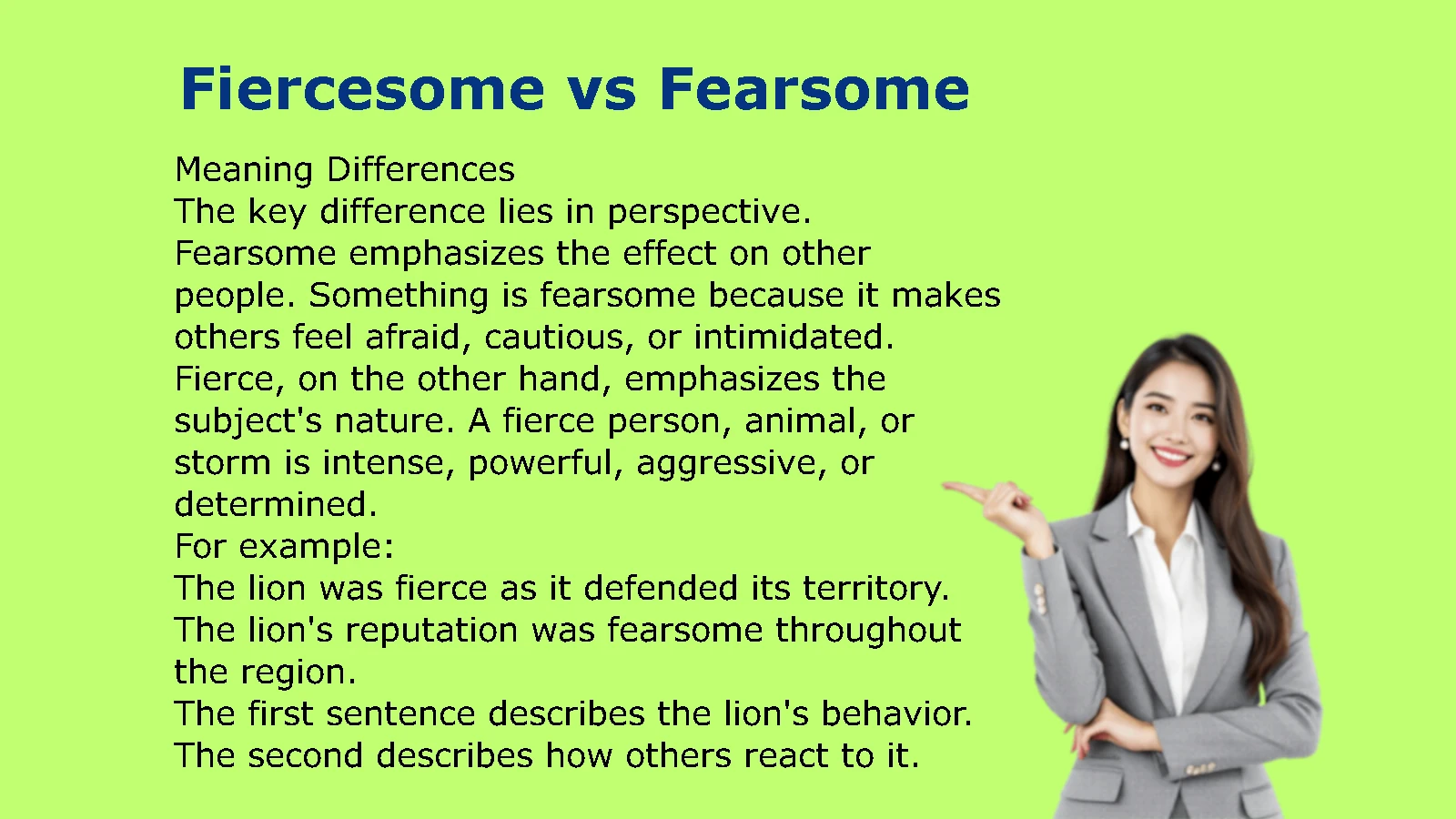
The key difference lies in perspective.
Fearsome emphasizes the effect on other people. Something is fearsome because it makes others feel afraid, cautious, or intimidated.
Fierce, on the other hand, emphasizes the subject’s nature. A fierce person, animal, or storm is intense, powerful, aggressive, or determined.
For example:
- The lion was fierce as it defended its territory.
- The lion’s reputation was fearsome throughout the region.
The first sentence describes the lion’s behavior. The second describes how others react to it.
Side-by-Side Examples
| Sentence with Fierce | Sentence with Fearsome |
| She showed fierce determination. | She developed a fearsome reputation. |
| The competition became fierce. | They faced a fearsome opponent. |
| A fierce wind swept across the valley. | A fearsome storm approached the coast. |
| The tiger looked fierce. | The tiger was a fearsome predator. |
Both words often appear in similar contexts, but each highlights a different aspect of the situation.
Fearsome vs Frightening
Many people also compare fearsome with frightening because both relate to fear. While they’re close in meaning, they aren’t perfect synonyms.
A frightening thing causes fear in the moment. A fearsome thing may cause fear because of its power, reputation, appearance, or long-term threat.
For instance:
- A loud explosion is frightening because it startles people immediately.
- A powerful hurricane is fearsome because of its destructive potential and the respect it commands.
This subtle difference makes fearsome especially useful when describing enduring danger rather than a brief emotional reaction.
Fearsome vs Intimidating
At first glance, fearsome and intimidating seem interchangeable. Both describe people, objects, or situations that make others feel uneasy. However, they differ in intensity and nuance.
Fearsome suggests something that inspires fear, awe, or serious respect because it appears dangerous or exceptionally powerful. Intimidating, on the other hand, usually describes something that makes a person feel nervous, less confident, or hesitant, even if no actual danger exists.
For example, an experienced trial lawyer may be intimidating to a new attorney because of their confidence and reputation. A charging rhinoceros, however, is fearsome because it presents a genuine threat.
Key Differences
| Fearsome | Intimidating |
| Implies real danger or exceptional power | Often involves psychological pressure |
| Creates fear or deep respect | Creates nervousness or self-doubt |
| Common in literature, history, sports, and nature | Common in workplaces, education, and social situations |
| Usually stronger in meaning | Often milder and more subjective |
Example Sentences
- The kingdom relied on its fearsome army to defend its borders.
- The professor seemed intimidating on the first day of class, but students soon discovered she was approachable.
- The champion’s fearsome reputation caused many opponents to change their strategies.
- Speaking before hundreds of people can feel intimidating, especially for beginners.
Which Word Should You Choose?
Use fearsome when emphasizing power, danger, or an imposing reputation.
Use intimidating when focusing on how someone feels in a situation, even if there’s no real threat.
Synonyms of Fearsome
No single synonym works in every situation. The best replacement depends on the context and the level of intensity you want to convey.
Strong Synonyms
| Synonym | Best Used For |
| Formidable | Skilled opponents, challenges |
| Terrifying | Extreme fear |
| Menacing | Threatening appearance |
| Daunting | Difficult tasks or responsibilities |
| Intimidating | Psychological pressure |
| Threatening | Possible danger |
| Ferocious | Wild animals or violent behavior |
| Alarming | Situations that cause concern |
| Frightening | Immediate fear |
| Dreadful | Serious danger or severity |
Near Synonyms
These words share some meaning with fearsome, but they’re not perfect substitutes.
- Fierce
- Powerful
- Dangerous
- Aggressive
- Savage
- Ruthless
- Grim
- Ominous
- Deadly
- Severe
Antonyms
When you need the opposite meaning, consider these words:
- Gentle
- Harmless
- Friendly
- Calm
- Safe
- Comforting
- Reassuring
- Mild
- Peaceful
- Welcoming
Choosing the Right Synonym
Consider these examples:
| Instead of… | You Could Use… |
| Fearsome warrior | Formidable warrior |
| Fearsome storm | Violent storm |
| Fearsome predator | Dangerous predator |
| Fearsome challenge | Daunting challenge |
| Fearsome reputation | Intimidating reputation |
Although these alternatives overlap, fearsome often conveys a unique blend of danger and respect that other words don’t fully capture.
Common Collocations with Fearsome
Certain nouns naturally pair with fearsome. These combinations, known as collocations, appear frequently in books, newspapers, and everyday English.
| Noun | Example |
| Enemy | A fearsome enemy advanced toward the city. |
| Opponent | She defeated a fearsome opponent in the finals. |
| Warrior | The tribe produced fearsome warriors. |
| Predator | The tiger remains a fearsome predator. |
| Beast | Legends spoke of a fearsome beast in the forest. |
| Dragon | The knight confronted a fearsome dragon. |
| Storm | Meteorologists warned of a fearsome storm. |
| Reputation | The company gained a fearsome reputation for innovation. |
| Army | The empire assembled a fearsome army. |
| Weapon | The new technology became a fearsome weapon. |
| Creature | Sailors feared the legendary creature. |
| Fighter | He became one of the division’s most fearsome fighters. |
Other Common Word Partnerships
You’ll also find fearsome paired with abstract nouns.
Examples include:
- fearsome challenge
- fearsome obstacle
- fearsome responsibility
- fearsome force
- fearsome power
- fearsome presence
- fearsome strength
- fearsome sight
These combinations sound natural because they’ve become established through centuries of English usage.
Grammar and Usage Rules
Knowing that fearsome is the correct word is only part of the story. You also need to know how to use it correctly in sentences.
Is Fearsome an Adjective?
Yes.
Fearsome is an adjective, meaning it describes a noun.
Examples:
- a fearsome warrior
- a fearsome animal
- a fearsome reputation
- a fearsome challenge
Can Fearsome Describe Both People and Things?
Absolutely.
It commonly modifies:
People
- a fearsome boxer
- a fearsome general
- a fearsome leader
Animals
- a fearsome shark
- a fearsome bear
- a fearsome wolf
Objects
- a fearsome weapon
- a fearsome fortress
Situations
- a fearsome battle
- a fearsome storm
- a fearsome conflict
Abstract Ideas
- a fearsome responsibility
- a fearsome challenge
- a fearsome reputation
Comparative and Superlative Forms
English generally forms comparisons in two ways.
For fearsome, writers usually prefer:
- more fearsome
- most fearsome
Examples:
- This opponent is more fearsome than last year’s champion.
- That dragon is the most fearsome creature in the kingdom.
Although “fearsomer” occasionally appears in older writing, modern English overwhelmingly favors more fearsome.
Common Sentence Patterns
Here are some natural sentence structures.
Before a noun
- The fearsome lion roared.
After a linking verb
- The opponent looked fearsome.
- The fortress seemed fearsome.
With abstract nouns
- She earned a fearsome reputation.
- The mountain presented a fearsome challenge.
Formal vs Informal Usage
Fearsome works well in both formal and informal writing.
You’ll frequently see it in:
- journalism
- history books
- sports reporting
- novels
- documentaries
- academic discussions
- everyday conversation
Because it’s well established, readers immediately understand its meaning.
Common Mistakes to Avoid
Many writers confuse fearsome, fierce, and fiercesome. Avoiding a few common errors will make your writing more polished.
Mistake: Writing “Fiercesome”
❌ The castle was fiercesome.
✅ The castle was fearsome.
This is the most common mistake.
Mistake: Assuming Fearsome and Fierce Mean Exactly the Same Thing
Consider these examples.
Incorrect thinking:
Fearsome = Fierce
Better understanding:
- Fierce describes behavior or intensity.
- Fearsome describes something that causes fear.
Mistake: Using Fearsome for Every Dangerous Situation
Not every dangerous thing is automatically fearsome.
For example:
- A slippery sidewalk is dangerous.
- A fearsome tornado inspires fear because of its destructive power.
Choose the word that best matches the context.
Mistake: Trusting Spellcheck Completely
Spellcheck tools improve every year, but they aren’t perfect.
Always verify uncertain words using trusted dictionaries, especially when writing professionally.
Mistake: Overusing Fearsome
Repeating fearsome too often weakens your writing.
Instead, vary your vocabulary.
Example:
Instead of writing:
The fearsome warrior carried a fearsome sword into the fearsome battle.
Try:
The formidable warrior carried a deadly sword into the brutal battle.
The revised sentence sounds smoother and avoids repetition.
Dictionary Definitions Compared
Every major English dictionary recognizes fearsome as the standard spelling. Fiercesome, by contrast, is generally absent from modern dictionaries or treated as a nonstandard or obsolete form.
| Dictionary | Fearsome | Fiercesome |
| Merriam-Webster | Standard adjective meaning “causing fear” | Not listed as a standard headword |
| Oxford English Dictionary | Recognized as standard English | Historical or nonstandard references only, if mentioned |
| Cambridge Dictionary | Standard modern English | Not listed as standard |
| Collins Dictionary | Standard adjective | Not recognized as standard modern usage |
| Dictionary.com | Standard entry | Generally not included as a standard word |
What This Means for Writers
When multiple major dictionaries agree, editors and teachers generally follow that standard.
Therefore:
- Use fearsome in professional writing.
- Avoid fiercesome unless you’re intentionally quoting or creating stylized dialogue.
This simple rule will keep your writing consistent with modern English conventions.
Etymology and Word History
The history of fearsome helps explain why it became the accepted form while fiercesome never gained widespread acceptance.
The Origin of Fearsome
The adjective fearsome developed from the noun fear combined with the suffix -some.
The suffix -some has existed in English for centuries. It creates adjectives that indicate possessing or causing a particular quality.
Examples include:
| Word | Meaning |
| Troublesome | Causing trouble |
| Wearisome | Causing weariness |
| Quarrelsome | Inclined to quarrel |
| Awesome | Inspiring awe |
| Fearsome | Causing fear |
Because this pattern already existed, fearsome became the natural choice for describing something that inspires fear.
The History of Fierce
The adjective fierce entered English through Old French, ultimately tracing its roots to the Latin word ferus, meaning wild or untamed.
Over time, fierce came to describe:
- aggressive behavior
- violent conflict
- strong emotions
- intense competition
- determination
Although fierce and fear sometimes describe related ideas, they evolved separately and developed different adjective forms.
Why Fiercesome Never Became Standard
Languages don’t always create every logically possible word.
Even though fiercesome seems like it should fit English spelling patterns, speakers consistently favored fearsome instead.
Several factors contributed to this outcome:
- Fearsome appeared earlier in widespread use.
- Major dictionaries standardized fearsome.
- Publishers, educators, and editors reinforced the accepted spelling.
- Writers rarely needed another adjective because fierce already existed.
As a result, fearsome became firmly established, while fiercesome remained uncommon.
The Evolution of the Suffix “-some”
The suffix -some has survived for hundreds of years, although it’s less productive today than it once was.
Modern English still uses it in many familiar words:
- awesome
- wholesome
- lonesome
- bothersome
- irksome
- cumbersome
- fearsome
Because English speakers recognize these patterns, it’s easy to understand why many people mistakenly create fiercesome. Yet language ultimately depends on accepted usage, not just logical construction.
A Practical Memory Tip
A simple way to remember the correct spelling is this:
Fearsome comes from “fear,” because it causes fear. Fierce already stands on its own.
That single sentence helps many learners avoid confusing fiercesome vs fearsome in the future.
Fearsome in Literature and Popular Culture
The adjective fearsome has appeared in English literature for centuries. Writers often choose it because it instantly creates a vivid image in the reader’s mind. Rather than simply describing something as dangerous, fearsome suggests that the subject commands respect, inspires caution, and leaves a lasting impression.
You’ll encounter the word across many genres, from historical accounts to fantasy novels and modern journalism. Its flexibility has helped it remain a popular choice in both formal and creative writing.
Fearsome in Classic Literature
Classic authors frequently used fearsome to describe formidable enemies, dangerous landscapes, and mythical creatures. In these works, the word often conveyed more than physical strength. It also emphasized the emotional effect a person or creature had on others.
For example, a knight might face a fearsome dragon, or an explorer might venture into a fearsome wilderness. In each case, the adjective adds tension and anticipation before the action even begins.
Fearsome in Fantasy Fiction
Fantasy writers rely heavily on descriptive language, making fearsome one of the genre’s favorite adjectives.
You’ll commonly see phrases such as:
- fearsome dragon
- fearsome sorcerer
- fearsome beast
- fearsome army
- fearsome warrior
- fearsome demon
- fearsome guardian
These descriptions help readers visualize powerful characters and understand their importance within the story.
Fearsome in Historical Writing
Historians also use fearsome when describing influential military leaders, armies, and weapons.
Examples include:
- a fearsome cavalry
- a fearsome naval fleet
- a fearsome fortress
- a fearsome siege weapon
The word doesn’t exaggerate events. Instead, it reflects how contemporaries viewed these people or objects.
Fearsome in Journalism
Modern journalists often use fearsome when reporting on severe weather, natural disasters, sports, and international affairs.
Examples include:
- fearsome tornadoes
- fearsome wildfires
- fearsome flooding
- fearsome competition
- fearsome economic challenges
Because the word conveys seriousness without becoming overly dramatic, it remains a favorite among professional writers.
Fearsome in Sports
Sports commentators regularly describe dominant athletes or teams as fearsome.
Examples include:
- a fearsome striker
- a fearsome defense
- a fearsome batting lineup
- a fearsome competitor
In these situations, fearsome highlights exceptional skill rather than actual danger.
Fearsome in Video Games and Movies
The entertainment industry frequently uses fearsome to introduce memorable characters and adversaries.
Common examples include:
- fearsome monsters
- fearsome bosses
- fearsome villains
- fearsome alien species
- fearsome robots
Game designers and filmmakers often pair the adjective with dramatic visuals to reinforce the sense of power and danger.
Real-World Examples of Fearsome Usage
The following examples show how fearsome naturally appears in different contexts.
Nature
The saltwater crocodile is one of the world’s most fearsome reptiles.
History
The empire built a fearsome navy that controlled major trade routes.
Sports
The championship team developed a fearsome defense that allowed the fewest points in the league.
Business
The startup quickly became a fearsome competitor within the software industry.
Fiction
Travelers avoided the mountain because a fearsome dragon supposedly lived inside the ancient cave.
These examples demonstrate that fearsome isn’t limited to one type of writing. It fits naturally wherever power, danger, or intimidation plays an important role.
Case Study: Why “Fiercesome” Appears So Often Online
If fiercesome isn’t standard English, why do so many people search for it?
The answer lies in how people learn and use language.
Imagine someone who already knows these words:
- fierce
- fear
- awesome
- wholesome
- troublesome
Without checking a dictionary, they may logically combine fierce with -some to form fiercesome. The spelling feels correct because it follows a familiar pattern.
Once that spelling appears in social media posts, online forums, blogs, or comments, other readers begin repeating it. Search engines then record increasing numbers of searches for fiercesome, creating the impression that it’s an accepted word.
However, search popularity doesn’t determine grammatical correctness. Dictionaries, established usage, and editorial standards do.
This explains why the comparison fiercesome vs fearsome remains a common search query despite the clear preference for fearsome in modern English.
Tips to Remember the Difference
Keeping the correct spelling in mind is easier than you might think.
Here are a few simple memory tricks.
Think About the Root Word
Fearsome comes from fear.
If something causes fear, it’s fearsome.
Remember That Fierce Already Exists
English already has the adjective fierce.
Because fierce works perfectly on its own, English never needed fiercesome as a standard alternative.
Use the Dictionary Test
Whenever you’re uncertain, ask yourself:
“Would I expect to find this word in a major dictionary?”
For fearsome, the answer is yes.
For fiercesome, the answer is generally no.
Read Quality Writing
Reading books, newspapers, and professionally edited articles reinforces standard English usage.
Over time, you’ll naturally become familiar with words like fearsome and recognize when a spelling looks unusual.
Quick Summary Table
| Question | Answer |
| Is fearsome a real English word? | Yes |
| Is fiercesome standard English? | No |
| Which spelling should I use in essays? | Fearsome |
| Which spelling appears in major dictionaries? | Fearsome |
| Can fiercesome appear in fiction? | Occasionally, for stylistic purposes |
| Are fearsome and fierce identical? | No |
| Does fearsome describe people, places, and things? | Yes |
Frequently Asked Questions
Is fiercesome a real word?
Fiercesome has appeared occasionally in historical texts and creative writing, but it is not recognized as a standard English word. In modern usage, dictionaries, editors, and educators overwhelmingly recommend fearsome instead.
Which is correct: fiercesome or fearsome?
Fearsome is the correct spelling in standard English.
Whether you’re writing an academic paper, business email, article, or social media post, fearsome is the appropriate choice.
Why do people write fiercesome?
Most people create fiercesome by combining fierce with the suffix -some. The spelling feels logical, even though English established fearsome as the accepted word centuries ago.
Is fiercesome in the dictionary?
Major dictionaries generally do not list fiercesome as a standard headword. Some historical references may mention it as an obsolete, dialectal, or nonstandard form, but it is not accepted for everyday modern English.
Can I use fiercesome in creative writing?
Yes, but only if you have a specific artistic reason.
For example, you might use it to:
- create historical dialogue
- develop a fictional dialect
- give a fantasy world unique vocabulary
- imitate archaic English
Outside these situations, fearsome remains the better choice.
Is fearsome stronger than fierce?
Not necessarily. The two words emphasize different ideas.
- Fierce focuses on aggression, intensity, or determination.
- Fearsome focuses on inspiring fear or commanding respect.
Depending on the context, either word may sound stronger.
What is another word for fearsome?
Some excellent alternatives include:
- formidable
- intimidating
- menacing
- ferocious
- threatening
- terrifying
- daunting
- dangerous
- alarming
- powerful
Choose the synonym that best fits your intended meaning.
How do you pronounce fearsome?
Fearsome is pronounced:
FEER-suhm
The first syllable sounds like fear, while the second rhymes with sum.
Is fearsome positive or negative?
Usually, fearsome has a negative or neutral meaning because it relates to fear.
However, it can also express admiration or respect.
For example:
She became a fearsome competitor.
Here, the word recognizes exceptional ability rather than criticizing the person.
Can fearsome describe a person?
Yes.
It commonly describes:
- athletes
- military leaders
- lawyers
- competitors
- fictional characters
- villains
- heroes
It can also describe someone’s reputation, appearance, or abilities.
Final Verdict: Fiercesome vs Fearsome
When comparing fiercesome vs fearsome, the evidence is clear.
Fearsome is the established and accepted English adjective. It appears in major dictionaries, professional publications, academic writing, journalism, and everyday conversation. It accurately describes people, animals, places, objects, or situations that inspire fear, respect, or intimidation because of their strength, danger, or reputation.
Fiercesome, while occasionally seen in historical works or creative writing, has never become part of standard modern English. Most readers will interpret it as a spelling mistake unless the context clearly indicates otherwise.
If your goal is clear, polished, and grammatically correct writing, choosing fearsome is the safest and most effective option.
Whether you’re preparing a school assignment, publishing a blog post, writing a novel, or communicating in the workplace, using the standard form helps your writing appear professional and credible.
Key Takeaways
- Fearsome is the correct and standard English word.
- Fiercesome is a nonstandard or extremely rare variant and should generally be avoided.
- Fearsome means causing fear, inspiring respect, or appearing powerful and intimidating.
- The word functions as an adjective and can describe people, animals, objects, places, reputations, and challenges.
- Fearsome differs from fierce because it emphasizes the effect on others, while fierce describes the subject’s own qualities or behavior.
- Major English dictionaries recognize fearsome as the accepted spelling.
- In professional, academic, and everyday writing, fearsome is the recommended choice.
- Remember the simple rule: If it causes fear, it’s fearsome. If it shows aggression or intensity, it’s fierce.