Ever wondered why Farther vs. Further confuses even confident writers? One is usually linked to physical distance, while the other is used for figurative or abstract ideas—yet in real writing, the line between them often feels blurry.
That’s the problem. You’re not alone if you’ve hesitated while writing sentences like “How far/farther/further should I go?” And here’s the kicker: using the wrong one can make your sentence sound unnatural or grammatically off in formal writing.
But don’t worry—this is easier to fix than it seems.
In this guide, you’ll clearly understand Farther vs. Further, including their key differences, correct usage rules, and simple examples that make everything easy to remember. You’ll also learn related concepts like distance vs. extent, physical vs. abstract comparison, and common grammar mistakes that often confuse learners.
So whether you’re writing essays, emails, or improving your grammar skills, this breakdown will help you use both words correctly and confidently. Let’s clear up the confusion once and for all.
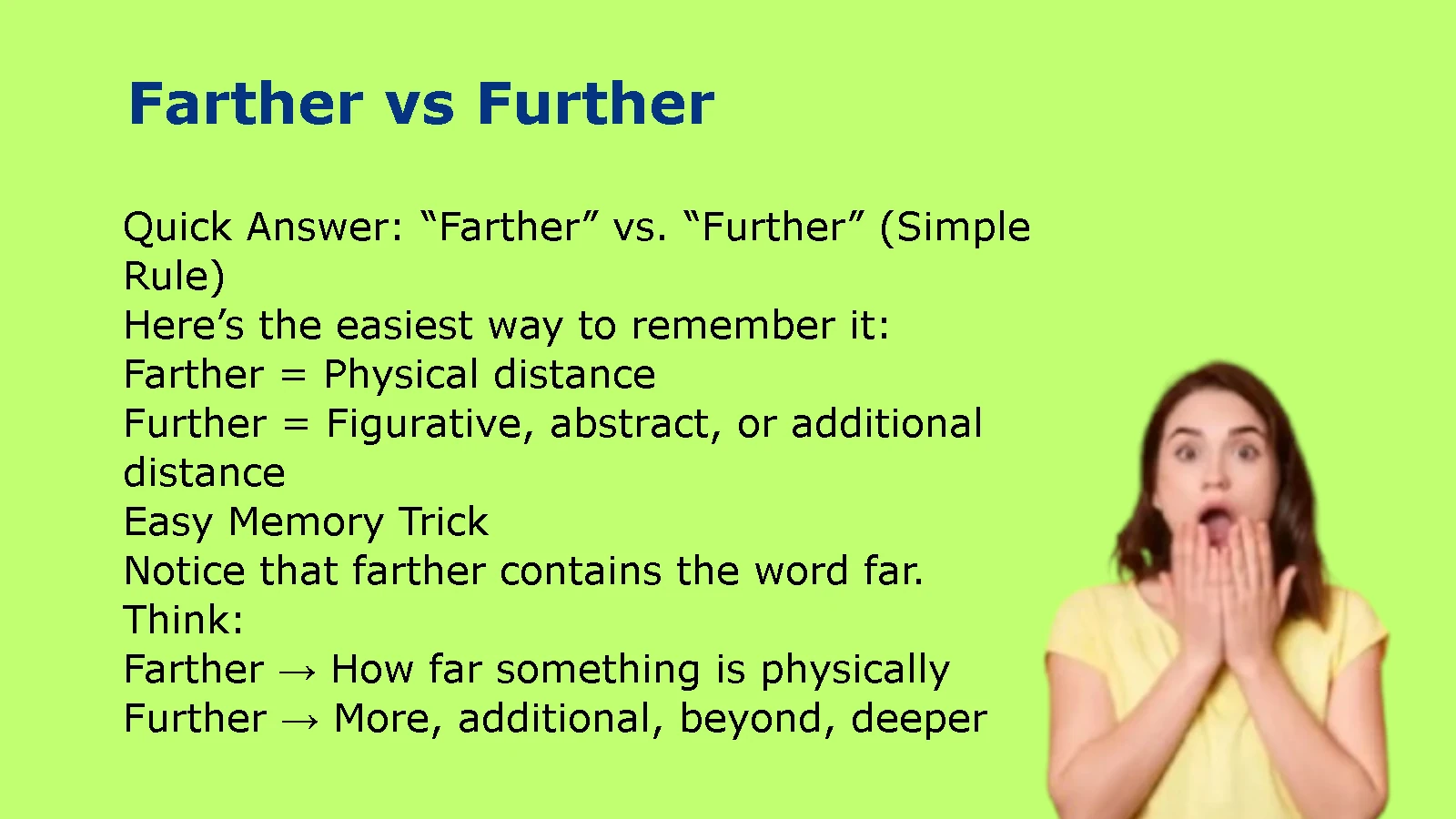
Quick Answer: “Farther” vs. “Further” (Simple Rule)
Here’s the easiest way to remember it:
Farther = Physical distance
Further = Figurative, abstract, or additional distance
Easy Memory Trick
Notice that farther contains the word far.
Think:
- Farther → How far something is physically
- Further → More, additional, beyond, deeper
Quick Examples
✅ We walked farther down the road.
✅ We need further discussion before deciding.
If you can measure the distance, use farther. If you can’t measure it, use further.
How People Actually Use “Farther” and “Further”
Here’s where things become interesting.
Many people use further for almost everything.
In modern English, especially in casual speech, further often replaces farther, even when talking about physical distance.
In Everyday Conversations
You may hear:
- “Can you drive further?”
- “Let’s go further down the beach.”
Technically, many style guides prefer farther for physical distance.
In Professional Writing
Editors usually follow the traditional distinction:
- Physical distance → farther
- Abstract distance → further
Why This Happens
Language evolves.
Over time, further has become more flexible, while farther remains tied mainly to measurable distance.
The Core Difference Between “Farther” and “Further”
The simplest way to understand these words is to think about whether the distance is real or figurative.
Physical Distance = Farther
Use farther when talking about actual measurable space.
Examples:
- The gas station is farther than I expected.
- She threw the ball farther than anyone else.
- We traveled farther north this year.
Figurative Distance = Further
Use further when discussing ideas, progress, time, or degree.
Examples:
- We need further information.
- The investigation went further than expected.
- Further improvements are necessary.
Key Insight
Ask yourself:
Can I measure it with a ruler, map, or odometer?
If yes → farther
If no → further
“Farther” Explained Clearly (With Examples)
At its core, farther relates to physical distance.
Standard Meaning
It refers to something being at a greater physical distance.
Examples:
- The store is farther away than the mall.
- Their house is farther down the street.
- We walked farther than planned.
Common Uses
- Travel
- Geography
- Sports
- Navigation
Example Scenario
Imagine you’re hiking.
You ask:
“How much farther do we need to walk?”
Because you’re discussing an actual measurable distance, farther is the correct choice.
Key Takeaway
When distance can be physically measured, farther is usually the better option.
“Further” Explained Clearly (With Examples)
Now let’s look at further.
Standard Meaning
Further means:
- Additional
- More
- To a greater extent
- Beyond the current point
Examples
- We need further evidence.
- She offered further assistance.
- The discussion moved further into the topic.
Common Uses
- Education
- Business
- Research
- Personal development
Example Scenario
A manager says:
“We need further analysis before approving the project.”
No physical distance exists here.
The manager means more analysis, not distance.
Key Takeaway
Use further whenever you’re discussing ideas, progress, time, or additional amounts.
The Biggest Mistake People Make
The most common mistake is assuming the words are completely interchangeable.
What Goes Wrong
People learn that both words relate to distance and begin using them randomly.
Example:
❌ We walked further down the trail.
While many people say this, some style guides prefer:
✅ We walked farther down the trail.
Why It Matters
In casual conversation, the distinction rarely causes problems.
In professional or academic writing, using the traditional rule improves clarity and credibility.
Side-by-Side Comparison Table
| Word | Standard Meaning | Best Used For | Example |
|---|---|---|---|
| Farther | Physical distance | Measurable space | We drove farther west. |
| Further | Additional or figurative distance | Ideas, progress, degree | We need further details. |
Real-Life Examples of “Farther”
Let’s see how farther appears in everyday situations.
Travel
“The hotel is farther from the airport than I thought.”
Sports
“He kicked the ball farther than everyone else.”
Walking
“We couldn’t walk any farther.”
Navigation
“The next town is much farther away.”
What They Have in Common
Every example involves actual physical distance.
Real-Life Examples of “Further”
Now compare them with further.
Business
“We need further approval from management.”
Education
“Further study may improve your results.”
Research
“Scientists conducted further experiments.”
Personal Growth
“She wants to take her career further.”
What They Have in Common
None involve measurable physical distance.
Instead, they describe additional progress, development, or information.
Common Expressions That Use “Further”
Some phrases almost always use further.
Examples
- Further information
- Further research
- Further education
- Until further notice
- Further discussion
- Further assistance
- Further action
These are standard English expressions.
Using farther in these phrases would sound unnatural.
Why “Further” Is Becoming More Common
Language trends have changed over time.
Many dictionaries now recognize further as acceptable for both physical and figurative distance.
Modern Usage
You’ll frequently hear:
- Go further down the road.
- Move further away.
Even though traditional grammar favors farther, modern speakers often choose further.
What Most Style Guides Recommend
For the clearest writing:
- Physical distance → farther
- Everything else → further
This distinction keeps your writing precise.
How to Avoid Confusion Every Time
Want a foolproof method?
Step 1
Ask:
“Am I talking about actual distance?”
If yes → farther
Step 2
Ask:
“Am I talking about more, additional, or deeper?”
If yes → further
Step 3
When unsure
Use further.
Modern English generally accepts it in most contexts.
Why This Works
It follows both traditional grammar and modern usage patterns.
What to Say Instead (Clear Alternatives)
Sometimes you can avoid the choice entirely.
Alternatives to “Farther”
- More distant
- A greater distance away
- Beyond
Alternatives to “Further”
- Additional
- More
- Extra
- Continued
- Extended
Example
Instead of:
“We need further details.”
You can say:
“We need additional details.”
Quick Decision Guide (Use This Instantly)
Use this simple checklist:
Talking About Physical Distance?
✅ Farther
Talking About More Information?
✅ Further
Talking About Progress or Development?
✅ Further
Talking About Travel Distance?
✅ Farther
Still Unsure?
✅ Further is generally accepted in modern English.
Simple. Reliable. Done.
FAQ: “Farther” vs. “Further”
Can “further” refer to physical distance?
Yes. Modern English often allows this usage.
However, traditional grammar prefers farther for measurable distance.
Is “farther” becoming less common?
Yes. Many speakers use further in situations where farther was traditionally expected.
Which word should I use in formal writing?
Follow the classic distinction:
- Farther = physical distance
- Further = figurative or additional distance
Which is more versatile?
Further is more flexible and works in more contexts.
Case Study: A Writing Improvement Example
A student wrote:
“We traveled further than any previous group.”
The teacher suggested:
“We traveled farther than any previous group.”
Why?
The sentence describes actual travel distance.
Using farther makes the meaning more precise.
Later in the essay, the student wrote:
“We conducted further research.”
This usage was correct because it refers to additional research rather than physical distance.
Lesson
Choosing the right word helps readers understand exactly what you mean.
Key Facts You Should Remember
- Farther usually refers to physical distance.
- Further usually refers to additional, figurative, or abstract distance.
- Modern English often uses further for both meanings.
- Formal writing typically preserves the distinction.
- When discussing ideas, progress, or information, use further.
- When discussing measurable distance, use farther.
Final Takeaway: The One Rule That Never Fails
The difference between farther vs. further is simpler than it first appears.
Think of farther as something you can physically measure.
Think of further as something that goes beyond distance—ideas, progress, information, and development.
So remember:
Physical distance → Farther
Additional or figurative meaning → Further
And when clarity matters, especially in professional or academic writing, following this rule will keep your English accurate and easy to understand.