Have you ever paused while writing and wondered whether “Board vs Bored” is just a spelling mistake or two completely different English words? This is one of the most common areas of confusion in English vocabulary, especially for learners who often come across similar-looking words in reading, writing, and everyday communication. Even though only a single vowel separates them, their meanings belong to entirely different contexts and uses in the English language.
In simple terms, board refers to a flat surface, plank, or piece of material used in construction, writing, teaching, or even games like a chess board. It can also mean to get on or enter a vehicle, such as boarding a bus or airplane. On the other hand, bored describes a feeling of lack of interest, excitement, or mental stimulation. When someone says they are bored, it means they are tired, uninterested, or looking for something engaging to do.
This confusion often appears in searches like board meaning, bored meaning, difference between board and bored, and how to use board vs bored in a sentence, especially among students improving their grammar, spelling accuracy, and communication skills. Because both words are commonly used in academic writing, conversations, and professional English, understanding their difference is essential for clear expression.
If you’ve ever written a sentence like “I am bored on the board meeting” and felt unsure, you’re not alone—this is exactly where learners mix up spelling and meaning. In this guide, you’ll learn the clear difference between board and bored, their definitions, real-life examples, and simple memory tricks to help you use them correctly every time.
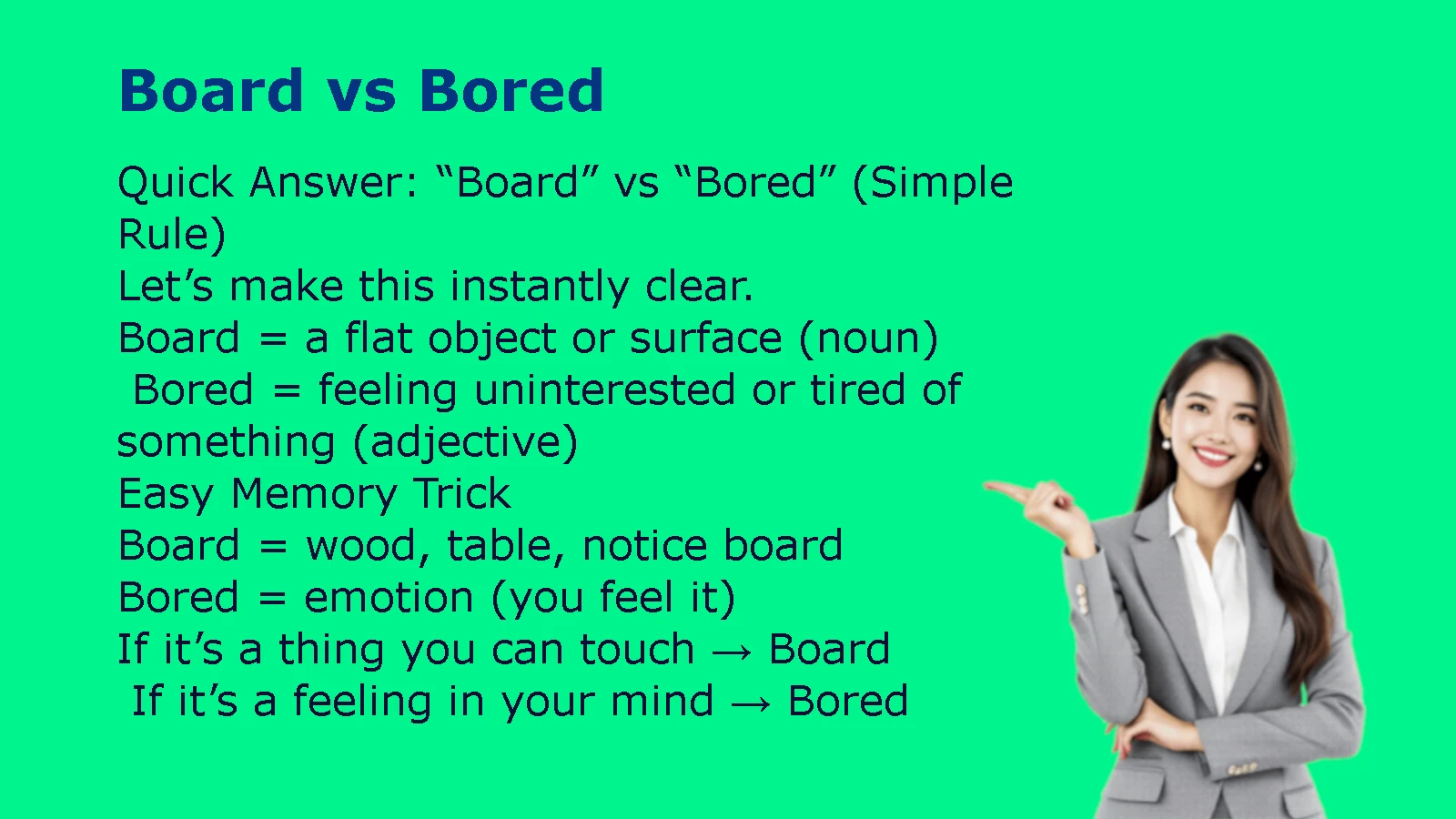
Quick Answer: “Board” vs “Bored” (Simple Rule)
Let’s make this instantly clear.
Board = a flat object or surface (noun)
Bored = feeling uninterested or tired of something (adjective)
Easy Memory Trick
- Board = wood, table, notice board
- Bored = emotion (you feel it)
If it’s a thing you can touch → Board
If it’s a feeling in your mind → Bored
Why People Confuse “Board” and “Bored”
The confusion happens for one simple reason: they sound almost identical when spoken.
But in writing, they carry completely different meanings.
Common Causes of Mistakes
- Fast typing (auto-correct fails)
- Speaking influence on writing
- Not knowing “bored” is an emotion word
- Assuming spelling is interchangeable
The result? Sentences like:
- “I’m so board at home.” ❌
- “The wooden bored is broken.” ❌
The Meaning of “Board” (Clear Explanation)
Board is a noun most of the time. It refers to something solid, flat, or used as a surface.
Common Uses of “Board”
- A wooden board
- A chalkboard / whiteboard
- A notice board
- A surfboard
- A board of directors
Real Examples
- “He nailed the poster to the board.”
- “The teacher wrote on the whiteboard.”
- “They sat on a wooden board bench.”
Key Insight
If you can see it, touch it, or use it physically, it’s probably board.
The Meaning of “Bored” (Clear Explanation)
Now here’s the emotional one.
Bored is an adjective. It describes a feeling of lack of interest or excitement.
What “Bored” Means
- Feeling uninterested
- Feeling tired of something repetitive
- Wanting something more engaging
Real Examples
- “I’m so bored in this class.”
- “She got bored during the long meeting.”
- “They were bored at home all weekend.”
Key Insight
If it’s something you feel inside, it’s bored.
Side-by-Side Comparison Table
| Word | Type | Meaning | Example |
| Board | Noun | Flat surface or group | Wooden board, whiteboard |
| Bored | Adjective | Feeling uninterested | I am bored at school |
The Easiest Memory Trick Ever
Here’s a simple trick you’ll never forget:
Think: “Board = Object, Bored = Emotion”
Or even simpler:
- Board has “a” → like table, surface, thing
- Bored has “e” → emotion, energy loss
Another trick:
- If you’re bored, you feel like falling asleep
- If you see a board, you can lean on it
Real-Life Examples of “Board”
Let’s make it practical.
Common Situations
- “The announcement is on the board.”
- “He bought a cutting board for the kitchen.”
- “The company appointed a new board member.”
Mini Scenario
You walk into a classroom and see:
- A white writing surface → whiteboard
Not a feeling, not an emotion.
Real-Life Examples of “Bored”
Now compare.
Common Situations
- “I’m bored, let’s go somewhere.”
- “He looked bored during the lecture.”
- “They were bored waiting for the bus.”
Mini Scenario
You’re sitting at home doing nothing:
- No excitement
- No interest
- Just waiting for something fun → bored
The Biggest Mistake People Make
Here’s the real issue.
People rely only on sound, not meaning.
What Goes Wrong
- “Board” and “bored” sound similar
- People type what they hear
- Context is ignored
Real Example
“I was so board yesterday.”
This changes the entire meaning of the sentence into nonsense.
Quick Fix Rule (Never Fail Again)
Use this simple test:
- Can I touch it or use it physically? → Board
- Am I describing a feeling? → Bored
Still unsure? Replace the word in your mind:
- “Wooden board” → makes sense ✔
- “Wooden bored” → nonsense ❌
Common Sentences You Should Remember
With “Board”
- Notice board
- Surfboard
- Cutting board
- Blackboard
With “Bored”
- I’m bored
- Feeling bored
- Get bored easily
- So bored right now
FAQ: Board vs Bored
Is “bored” always about sadness?
No. It’s about lack of interest, not necessarily sadness.
Can “board” ever mean a verb?
Yes, but rarely in this context. Example: “to board a train.”
Why do people confuse them so often?
Because they are homophones—words that sound the same but have different meanings.
Final Takeaway: The One Rule That Never Fails
Here’s the truth.
English mistakes like “board vs bored” don’t come from difficulty—they come from mixing sound with meaning.
So remember this:
- Board = something physical you can use or see
- Bored = something you feel inside
And if you’re ever unsure, just ask yourself:
👉 “Am I talking about a thing or a feeling?”
Because in English, clarity always wins over guessing.