Have you ever come across the words “Dim” vs “Dull” and wondered whether they mean the same thing or describe completely different ideas? This is a common confusion in English vocabulary, especially for learners who often encounter similar descriptive words in reading, writing, and everyday communication. Although both words are used to describe something that is not bright or not sharp, their usage, tone, and context are quite different.
In simple terms, dim usually refers to low light, weak visibility, or something that is not clearly illuminated. For example, a dim light in a room, a dim streetlamp, or even a dim memory that is not fully clear. It often suggests a gentle or reduced level of brightness rather than something completely absent.
On the other hand, dull describes something that lacks sharpness, energy, brightness, or interest. It can refer to a dull knife, a dull sound, a dull color, or even a dull experience that feels boring or lifeless. Unlike “dim,” which is mostly connected to light or clarity, “dull” has a broader emotional and physical usage in English.
This confusion between dim vs dull often appears in searches like dim meaning, dull meaning, difference between dim and dull, and commonly confused English words. Understanding their distinction helps improve grammar accuracy, descriptive writing skills, and overall vocabulary strength.
In this guide, you’ll learn the clear difference between dim and dull, their meanings, real-life examples, and easy memory tricks so you never mix them up again in writing or speech.
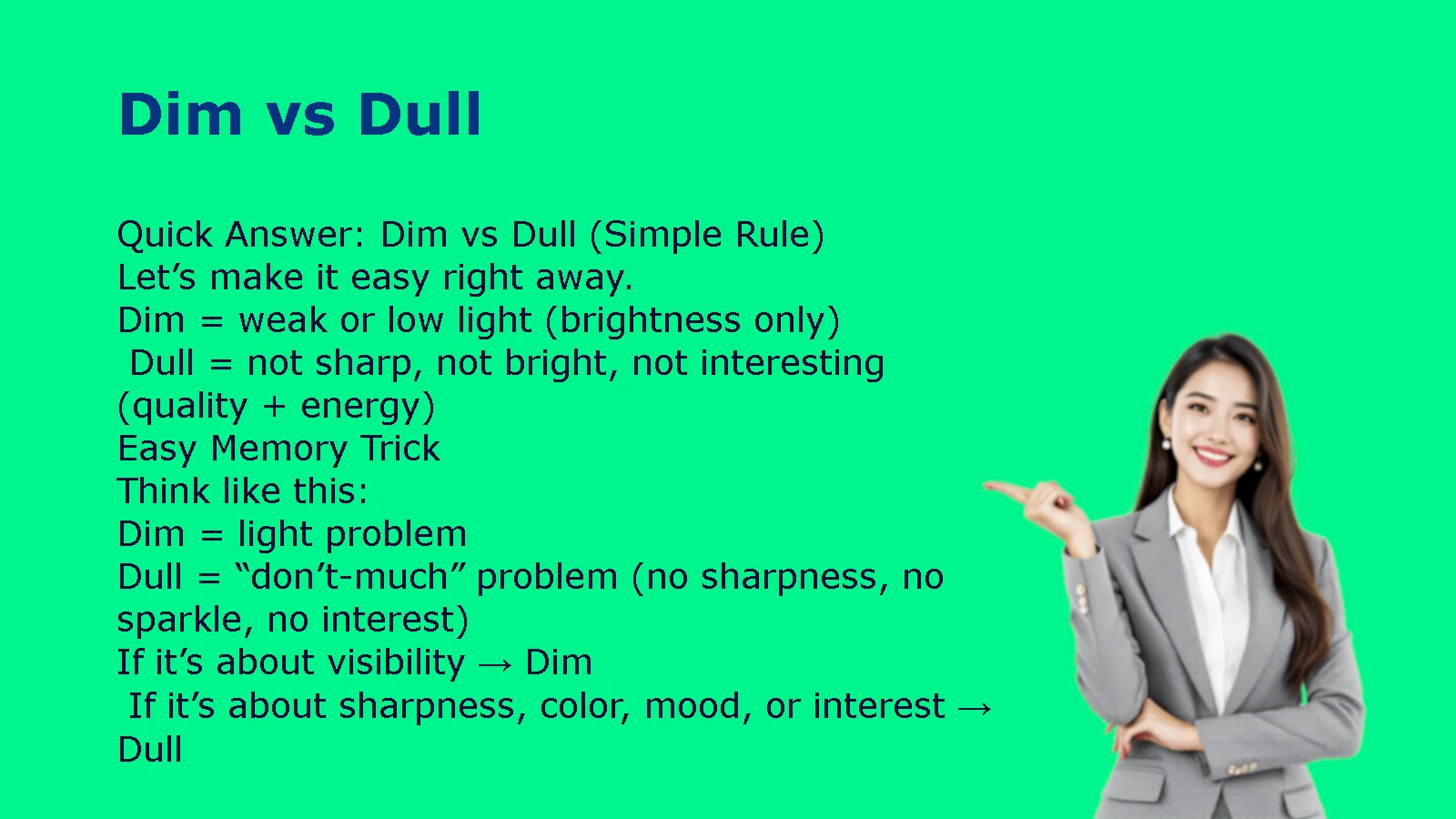
Quick Answer: Dim vs Dull (Simple Rule)
Let’s make it easy right away.
Dim = weak or low light (brightness only)
Dull = not sharp, not bright, not interesting (quality + energy)
Easy Memory Trick
Think like this:
- Dim = light problem
- Dull = “don’t-much” problem (no sharpness, no sparkle, no interest)
If it’s about visibility → Dim
If it’s about sharpness, color, mood, or interest → Dull
How People Actually Use “Dim” and “Dull”
Here’s where things start to blur (ironically).
People often mix them in casual speech because both can feel “low energy.” But their usage depends heavily on context.
In Everyday Conversation
- “Dim” is used for lights, screens, rooms
- “Dull” is used for knives, weather, colors, emotions, and experiences
In Writing and Exams
- “Dim” is strictly about brightness
- “Dull” has a wider emotional and physical meaning
Why Confusion Happens
- Both sound negative
- Both suggest “reduced quality”
- But they operate in completely different categories
The Core Meaning Behind “Dim” (Clear Understanding)
Dim refers to low brightness or weak visibility.
Standard Meaning
- Dim light → not bright enough
- Dim room → poorly lit space
- Dim screen → low display brightness
Examples
- “The hallway was dim at night.”
- “Turn the lights down; it’s too dim.”
- “Her phone screen looked dim in sunlight.”
Key Insight
Dim is always connected to light intensity.
You cannot use it for sharpness, taste, sound, or personality.
The Core Meaning Behind “Dull” (Deeper Understanding)
Now let’s decode the more flexible word.
Dull means lacking sharpness, brightness, energy, or interest.
Standard Meanings
- Physical: not sharp
- Visual: not bright or vivid
- Emotional: boring or lifeless
- Sensory: muted or flat
Examples
- “The knife is dull.” (not sharp)
- “The colors look dull.” (not bright)
- “The lecture was dull.” (boring)
- “The sky looks dull today.” (cloudy, lifeless)
Key Insight
Dull is a multi-purpose negative word. It describes quality, not just light.
Dim vs Dull: The Core Difference
Here’s the simplest breakdown:
| Word | Main Meaning | Used For | Example |
| Dim | Low brightness | Light, rooms, screens | Dim lamp |
| Dull | Lack of sharpness or energy | Objects, mood, color, events | Dull knife |
One-Line Rule
Dim = light level problem
Dull = quality or energy problem
Real-Life Examples of “Dim”
Let’s make it practical.
Common Situations
- “The theater lights are dim.”
- “It’s hard to read in dim lighting.”
- “The street is dim at night.”
What It Always Means
Low visibility or weak lighting conditions.
Mini Scenario
You walk into a café at night:
“The lights are dim, creating a cozy atmosphere.”
No confusion here—this is purely about brightness.
Real-Life Examples of “Dull”
Now compare.
Common Situations
- “The blade is dull; it won’t cut.”
- “The weather is dull and cloudy.”
- “The meeting was dull and long.”
What It Can Mean
- Not sharp (objects)
- Not bright (colors, sky)
- Not interesting (events, people, experiences)
Mini Scenario
You attend a lecture:
“The content was accurate but dull.”
Here, it has nothing to do with light—it’s about interest.
The Biggest Mistake People Make
Here’s the real confusion trap:
People think:
“Dim and dull both mean something weak, so they must be interchangeable.”
That’s incorrect.
What Goes Wrong
- “Dull light” ❌ (wrong in most cases)
- “Dim knife” ❌ (completely wrong)
- Mixing emotional and physical meanings
Why It Happens
English words often overlap in feeling, not function.
Side-by-Side Comparison Table
Here’s a quick reference you can reuse anytime:
| Feature | Dim | Dull |
| Category | Light/brightness | Quality/energy/sharpness |
| Physical use | Yes (light, room, screen) | Yes (knife, color) |
| Emotional use | No | Yes (boring, lifeless) |
| Sound correct? | “Dim light” ✔ | “Dull light” (rare/awkward) |
| Core idea | Low brightness | Low sharpness or interest |
Edge Cases That Confuse Learners
1. “Dull sky” vs “Dim sky”
- “Dull sky” = correct (cloudy, lifeless)
- “Dim sky” = incorrect in most cases
2. “Dim colors”
- Rare but can mean weak lighting affecting perception
3. “Dull light”
- Usually incorrect unless describing emotional tone (very poetic usage)
How to Never Confuse Dim and Dull Again
Use this simple decision rule:
Step 1: Is it about light?
→ Use Dim
Step 2: Is it about sharpness, color, mood, or interest?
→ Use Dull
Step 3: Still unsure?
→ Replace the word and check meaning:
- “Low light” = Dim
- “Boring / not sharp” = Dull
Better Alternatives You Can Use
Instead of “Dim”
- Low light
- Poorly lit
- Faint light
Instead of “Dull”
- Boring (for events)
- Blunt (for knives)
- Lifeless (for mood)
- Faded (for colors)
Quick Decision Guide
When in doubt:
- Light-related → Dim
- Everything else → Dull
- Professional writing → describe instead of guessing
FAQ: Dim vs Dull
Can “dull” describe light?
Rarely. Only in poetic or descriptive writing. In normal usage, avoid it.
Is “dim” used for emotions?
No. It stays with brightness only.
Can a person be “dull”?
Yes. It means boring, uninteresting, or low-energy.
What is the safest choice in exams?
- Light → dim
- Everything else → dull
Key Facts You Should Remember
- Dim = brightness only
- Dull = quality, sharpness, interest, or color
- They are not interchangeable
- Context decides everything
Final Takeaway: The One Rule That Never Fails
Here’s the simplest way to lock it in:
If you can turn it brighter → it’s Dim
If you can sharpen it, spice it up, or make it interesting → it’s Dull
Think of it like this:
- Dim is a light switch problem
- Dull is a life/energy problem
Once you see that difference, you’ll never mix them up again.