Ever wondered why Lamb vs Lam confuses so many readers, especially when both words look almost identical at first glance? In reality, they belong to completely different meanings—one refers to young sheep used in food or farming contexts, while the other is often a misspelling or abbreviation that creates confusion in writing.
This is where the problem starts. You’re not alone if you’ve mixed them up in spelling, grammar checks, or everyday reading. And here’s the kicker: using the wrong term can hurt clarity in both casual writing and professional communication.
But don’t worry—this is easier to fix than it looks.
In this guide, you will clearly understand Lamb vs Lam, including their meanings, correct usage, and key differences so you never confuse them again. You’ll also learn related LSI keywords like lamb meaning in food, difference between lamb and lam, common spelling mistakes, and grammar confusion words to strengthen your understanding and improve SEO relevance.
So if you want a quick, simple breakdown that clears up the confusion once and for all, you’re in the right place. Let’s get started.
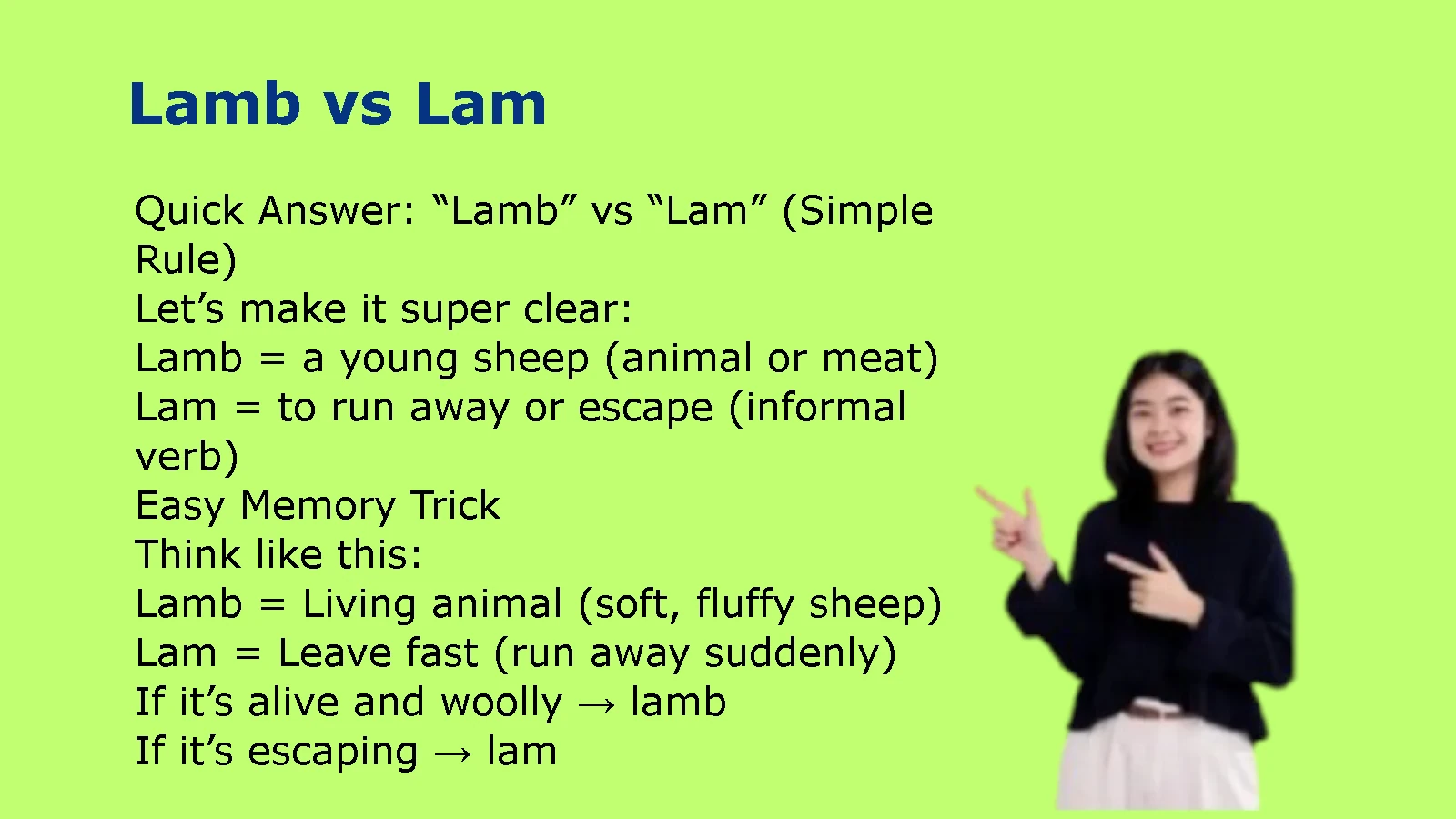
Quick Answer: “Lamb” vs “Lam” (Simple Rule)
Let’s make it super clear:
- Lamb = a young sheep (animal or meat)
- Lam = to run away or escape (informal verb)
Easy Memory Trick
Think like this:
- Lamb = Living animal (soft, fluffy sheep)
- Lam = Leave fast (run away suddenly)
If it’s alive and woolly → lamb
If it’s escaping → lam
“Lamb” vs “Lam”: Quick Overview
People confuse these because:
- They sound similar in quick speech
- Both are short words
- Context is often missing in informal writing
But their meanings are completely unrelated.
What Does “Lamb” Mean? (Simple Explanation)
At its core, lamb refers to a young sheep.
Primary Meaning
A baby sheep, usually under one year old.
In Food Context
“Lamb” also refers to meat from a young sheep.
Examples
- The lamb was grazing in the field.
- We had roast lamb for dinner.
- The farmer raised several lambs this season.
Key Insight
“Lamb” is always about animals or food—never action.
What Does “Lam” Mean? (Simple Explanation)
Now here’s the tricky one.
Primary Meaning
To run away quickly or escape, especially from danger or police (informal usage).
Examples
- The thief went on the lam after the robbery.
- He had to lam it before anyone noticed.
- The suspect is still on the lam.
Key Insight
“Lam” is about escaping or fleeing, not animals.
Biggest Difference Between Lamb and Lam
Here’s the simplest breakdown:
| Word | Meaning | Category | Example |
| Lamb | Young sheep / meat | Noun | Roast lamb |
| Lam | To escape or run away | Verb (informal) | On the lam |
Why People Confuse “Lamb” and “Lam”
This confusion happens because:
- They are near-homophones in casual speech
- Auto-correct sometimes changes one into the other
- Context is often missing in short messages
But meaning-wise, they live in completely different worlds.
“Lamb” Explained Clearly (With Edge Cases)
Let’s go deeper.
Standard Meaning
Always refers to a young sheep or its meat.
Edge Case: Religious or Symbolic Use
- “Sacrificial lamb” = symbol of innocence or sacrifice
Mini Example
- The shepherd cared for the newborn lamb carefully.
“Lam” Explained Clearly (With Edge Cases)
Now the action word.
Standard Meaning
Running away to avoid capture or trouble.
Edge Case: Informal Speech
- Mostly used in phrases like “on the lam”
Mini Example
- After the incident, he stayed on the lam for weeks.
Real-Life Examples of “Lamb”
- The restaurant serves grilled lamb chops.
- The shepherd counted every lamb in the flock.
- A mother sheep protects her lamb.
👉 Always animal or food-related.
Real-Life Examples of “Lam”
- The criminals went on the lam.
- He’s been on the lam since last month.
- The suspect decided to lam it across the border.
👉 Always about escape or running away.
The Biggest Mistake People Make
People assume the words are interchangeable.
What Goes Wrong
- “Lam chops” (incorrect → should be lamb chops)
- “On the lamb” (incorrect → should be lam)
Result
- Miscommunication
- Funny but wrong sentences
- SEO keyword confusion
Side-by-Side Comparison Table
| Feature | Lamb | Lam |
| Type | Noun | Verb (informal) |
| Meaning | Young sheep | To escape |
| Usage | Food / animal context | Crime / slang context |
| Tone | Neutral | Informal/slang |
| Confusion risk | Medium | High |
Common Mistakes in Writing
❌ Wrong
- “He went on the lamb”
- “I love lam curry”
✅ Correct
- “He went on the lam”
- “I love lamb curry”
Quick Decision Guide
Use this when you’re stuck:
- Animal or food → Lamb
- Escape or running away → Lam
- Still unsure → Check dictionary context
FAQ: Lamb vs Lam
Is “lam” a common word?
No, it’s informal slang and not used in formal writing.
Is “lamb” always food?
No, it also means a young sheep.
Why do they sound similar?
Because of natural English pronunciation overlap in fast speech.
Can they be used interchangeably?
Never. They have completely different meanings.
Key Facts You Should Remember
- Lamb = animal or meat
- Lam = escape or run away
- They are not related in meaning
- Context decides everything
Final Takeaway: The One Rule That Never Fails
Here’s the simplest way to never confuse them again:
If it bleats → lamb
If it flees → lam
One is soft, natural, and edible. The other is fast, secretive, and slang.
So next time you see “lamb vs lam,” remember:
👉 One lives on a farm.
👉 The other runs from trouble.
And that difference is everything.