Neurosis vs Neuroses: What’s the Difference?
Neurosis is the singular form and refers to a mental or emotional condition involving distress or anxiety. Neuroses is the plural form, referring to multiple cases or types of neurosis.
Examples:
- The patient was diagnosed with neurosis.
- Different neuroses can affect people in various ways.
The confusion comes from understanding neurosis meaning, neuroses meaning, and knowing when to use the singular and plural forms correctly. But here’s the kicker: using the wrong word can make your writing inaccurate, especially in academic, medical, or psychology-related discussions.
In this guide, you’ll learn the difference between Neurosis vs Neuroses, discover neurosis definition, neuroses definition, and understand when to use neurosis or neuroses in different contexts. You’ll also find neurosis vs neuroses examples, correct usage, and simple memory tips to help you choose the right term with confidence.
Neurosis vs Neuroses: Quick Difference Between the Two Words
The easiest way to remember the difference is to look at the number of things being discussed.
| Word | Meaning | Form | Example Sentence |
| Neurosis | A single emotional or psychological pattern involving distress, anxiety, or inner conflict | Singular | “His fear of failure developed into a neurosis.” |
| Neuroses | Multiple emotional or psychological patterns involving distress or conflict | Plural | “Researchers studied different neuroses throughout history.” |
Think of it like this:
- One diagnosis → diagnosis
- More than one diagnosis → diagnoses
The same spelling pattern applies:
- One neurosis → several neuroses
- One crisis → several crises
- One analysis → several analyses
The ending changes because these words come from Greek based terms that follow a traditional plural pattern.
What Does Neurosis Mean?
Neurosis Definition and Meaning
Neurosis traditionally refers to a psychological condition involving emotional distress, anxiety, fear, or internal conflict while a person still understands reality.
Historically, psychologists used the term to describe struggles such as:
- Excessive worry
- Unreasonable fears
- Emotional tension
- Obsessive thoughts
- Difficulty managing stress
- Persistent insecurity
A person experiencing neurosis might recognize that their fears or reactions are excessive but still find them difficult to control.
For example:
Someone might constantly worry about making mistakes at work. They understand that a small error will not ruin their career, yet the fear feels overwhelming. Older psychological theories might have described this pattern as a neurosis.
Today, professionals would likely use more specific terms depending on the symptoms.
The History and Origin of Neurosis
The word neurosis comes from the Greek word neuron, meaning “nerve.”
During the 18th and 19th centuries, some doctors believed emotional problems were connected to disturbances in the nervous system. The term originally described conditions that were thought to involve the nerves rather than physical damage to organs.
Over time, psychologists began using neurosis to describe emotional and mental struggles.
The meaning expanded to include:
- Anxiety based behaviors
- Emotional conflicts
- Repetitive thoughts
- Fear driven reactions
The concept became especially important during the development of psychoanalysis.
Neurosis in Traditional Psychology
One of the most influential figures connected with the concept of neurosis was Sigmund Freud.
Freud believed neuroses developed from unconscious conflicts between desires, fears, and social expectations. In psychoanalytic theory, symptoms such as anxiety or compulsive behavior could represent hidden emotional struggles.
For example:
A person might avoid social situations because of deep fears of rejection. A psychoanalytic approach might explore childhood experiences, relationships, and unconscious beliefs to understand the behavior.
However, modern psychology has moved away from this broad definition.
The Diagnostic and Statistical Manual of Mental Disorders no longer lists neurosis as a formal mental health diagnosis.
Instead, professionals use specific diagnostic categories based on symptoms and research.
What Does Neuroses Mean?
Neuroses Definition and Meaning
Neuroses is simply the plural form of neurosis.
When you talk about multiple psychological patterns, conditions, or examples of neurosis, you use the word neuroses.
Examples:
- “Different neuroses were discussed in early psychological research.”
- “The author examined the neuroses of several fictional characters.”
- “Historical psychologists classified various neuroses differently.”
The meaning does not change completely. The only major difference is quantity.
One neurosis = one pattern.
Many neuroses = multiple patterns.
Examples of Different Neuroses
In older psychological literature, researchers often described several types of neuroses.
Common historical categories included:
| Type of Neurosis | General Description |
| Anxiety neurosis | Excessive worry, fear, and nervous tension |
| Phobic neurosis | Strong irrational fears connected to specific objects or situations |
| Obsessive neurosis | Repetitive thoughts or behaviors that feel difficult to control |
| Hysterical neurosis | Emotional symptoms once linked to psychological conflict |
| Depressive neurosis | Persistent sadness and emotional struggles |
It is important to understand that these categories are mostly historical. Modern psychology uses more precise diagnostic terms.
For example:
A condition once called “phobic neurosis” may now be described as a specific phobia.
An “obsessive neurosis” may relate to obsessive compulsive disorder.
Neurosis vs. Neuroses: Key Differences Explained
Singular vs. Plural Difference
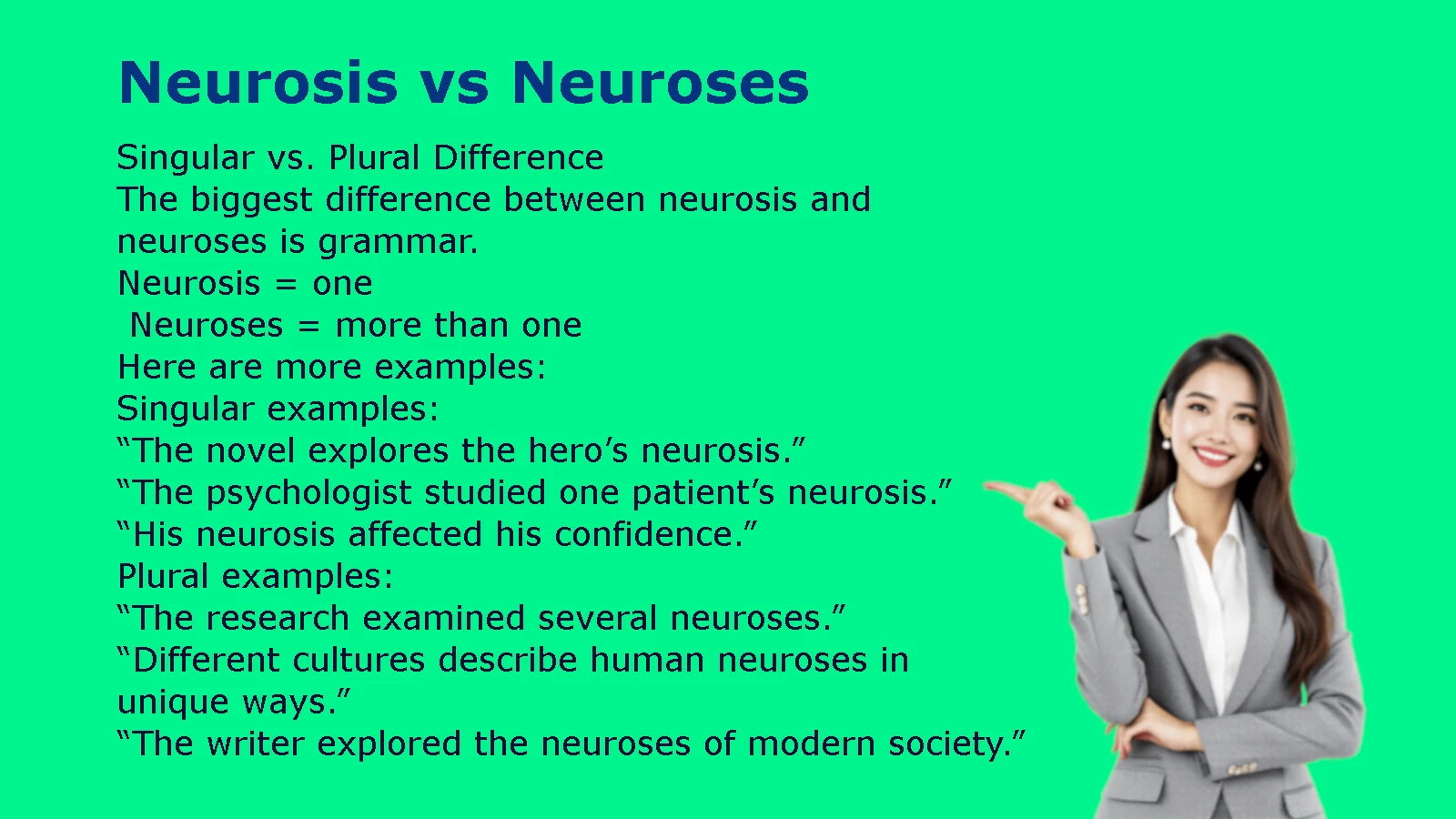
The biggest difference between neurosis and neuroses is grammar.
Neurosis = one
Neuroses = more than one
Here are more examples:
Singular examples:
- “The novel explores the hero’s neurosis.”
- “The psychologist studied one patient’s neurosis.”
- “His neurosis affected his confidence.”
Plural examples:
- “The research examined several neuroses.”
- “Different cultures describe human neuroses in unique ways.”
- “The writer explored the neuroses of modern society.”
A simple memory trick:
If you are talking about one emotional pattern, use neurosis. If you are talking about several patterns, use neuroses.
Why Does Neurosis Become Neuroses?
The change follows an old Greek based plural pattern.
Many English words ending in -sis change to -ses when they become plural.
Examples:
| Singular | Plural |
| Neurosis | Neuroses |
| Diagnosis | Diagnoses |
| Analysis | Analyses |
| Crisis | Crises |
| Thesis | Theses |
These words can feel tricky because English usually adds “s” or “es” for plurals. However, words borrowed from other languages often keep their original patterns.
Is Neurosis Still a Medical Term Today?
Modern Psychology’s View of Neurosis
Today, neurosis is not an official medical diagnosis in major diagnostic systems.
Mental health professionals now use more specific categories that describe symptoms more accurately.
Conditions that were once grouped under neurosis may now include:
- Anxiety disorders
- Obsessive compulsive disorder
- Post traumatic stress disorder
- Specific phobias
- Some depressive disorders
This change happened because researchers wanted clearer definitions.
Instead of placing many different experiences under one broad label, modern psychology focuses on:
- Specific symptoms
- Duration of symptoms
- Severity
- Impact on daily life
Why People Still Use the Word Neurosis
Even though neurosis is no longer a formal diagnosis, people still use the word in certain situations.
Historical discussions
Books about early psychology often mention neurosis because it played an important role in psychological theories.
Everyday language
People sometimes use neurosis to describe excessive worry or unusual behavior.
Example:
“She has a cleaning neurosis.”
This usually means someone has an extreme concern about cleanliness, not that they have a clinical diagnosis.
Literature and culture
Writers often use neurosis to describe complex characters.
A fictional character may have:
- Fear of failure
- Constant self doubt
- Social anxiety
- Emotional conflicts
These traits can create interesting character development.
Common Confusions Between Neurosis and Neuroses
Many people mix up neurosis vs. neuroses because the two words look almost the same. The difference is not about meaning, history, or severity. It is mainly about grammar and number.
However, several other misunderstandings can make these terms confusing.
Confusing Neurosis and Neuroses in Sentences
A common mistake happens when someone uses neuroses while talking about only one situation.
Incorrect:
“His neuroses caused him to avoid social events.”
If the sentence describes one pattern of behavior, neurosis is the better choice.
Correct:
“His neurosis caused him to avoid social events.”
On the other hand, if someone discusses multiple patterns, neuroses works correctly.
Example:
“The psychologist studied the neuroses found in different characters throughout the novel.”
The sentence refers to several emotional patterns, so the plural form fits.
Neurosis vs. Neuroses: A Simple Memory Trick
Remember this simple rule:
One problem = neurosis
Multiple problems = neuroses
You can compare it with familiar words:
- One diagnosis → two diagnoses
- One crisis → several crises
- One analysis → multiple analyses
- One neurosis → many neuroses
The ending may look unusual, but the pattern stays consistent.
Neurosis vs. Psychosis: Understanding the Difference
People sometimes confuse neurosis with psychosis because both terms appear in discussions about mental health.
Historically, psychologists used these words to describe different types of psychological experiences.
| Term | Traditional Meaning | Main Difference |
| Neurosis | Emotional distress, anxiety, fears, and internal conflicts | A person generally remains connected with reality |
| Psychosis | A condition involving hallucinations, delusions, or altered perception of reality | A person may lose touch with reality |
For example:
Someone with intense anxiety may know their fear is excessive but still feel unable to control it. Older psychology might describe this as a neurotic experience.
Someone experiencing psychosis may hear voices or believe something that others cannot confirm as real.
Modern psychology no longer uses neurosis as a formal diagnosis. However, the distinction remains useful when studying the history of mental health.
How to Use Neurosis and Neuroses Correctly in Writing
Choosing between neurosis and neuroses becomes easier when you identify whether you are describing one example or several.
When to Use Neurosis
Use neurosis when referring to:
- One emotional pattern
- One person’s psychological struggle
- One historical concept
- One example in literature or discussion
Examples:
“The author explored the character’s neurosis through his fear of rejection.”
“Freud’s theories included discussions of neurosis and unconscious conflict.”
“Her perfectionism became a neurosis that affected her daily routine.”
When to Use Neuroses
Use neuroses when discussing:
- Multiple psychological patterns
- Several historical examples
- Different characters or case studies
Examples:
“The study examined various neuroses described in early psychology.”
“The novel presents the neuroses of several characters dealing with fear and insecurity.”
“Researchers once classified different neuroses based on emotional symptoms.”
Neurosis and Neuroses Pronunciation Guide
Pronunciation can also create confusion because the endings sound different.
How to Pronounce Neurosis
Neurosis is pronounced:
noo-ROH-sis
Break it into parts:
- Noo
- Roh
- Sis
Example:
“The doctor discussed neurosis in historical psychology.”
How to Pronounce Neuroses
Neuroses is pronounced:
noo-ROH-seez
The final sound changes from “sis” to “seez.”
Example:
“Different neuroses appeared in early psychological studies.”
A helpful reminder:
- Neurosis → ends with sis
- Neuroses → ends with sees
Neurosis vs. Neurotic: What Is the Difference?
Another common confusion involves neurosis and neurotic.
Although they share the same root, they serve different purposes.
| Word | Type | Meaning |
| Neurosis | Noun | A psychological pattern or condition |
| Neurotic | Adjective or noun | Describes someone showing anxious or emotionally unstable traits |
Examples:
Neurosis:
“The story explores his neurosis and fear of failure.”
Neurotic:
“The character is neurotic because he constantly worries about small mistakes.”
A person can show neurotic behavior without having a clinical condition.
For example, someone who checks their email repeatedly before sending a message may be described casually as neurotic. That does not mean they have a mental disorder.
Neurosis vs. Anxiety: Are They the Same?
Although people sometimes use neurosis and anxiety interchangeably, they are not exactly the same.
Anxiety
Anxiety is a current psychological term used to describe feelings such as:
- Nervousness
- Fear
- Worry
- Stress about future events
For example, feeling nervous before an interview is a common human experience.
However, anxiety becomes a concern when it:
- Feels overwhelming
- Continues for long periods
- Interferes with daily life
Neurosis
Neurosis is a broader historical concept.
It once included many emotional struggles, including anxiety.
The relationship looks like this:
Historical concept:
Neurosis → included anxiety, fears, and emotional conflicts
Modern approach:
Specific symptoms → placed into clearer categories
For example:
A person with repeated panic attacks would not usually receive a diagnosis of “neurosis” today. Instead, professionals would evaluate whether the person meets criteria for a specific anxiety disorder.
Neurosis vs. Neuroses vs. Diagnosis and Diagnoses
Many learners understand neurosis vs. neuroses better when they compare it with another familiar word pair.
| Singular Word | Plural Word |
| Diagnosis | Diagnoses |
| Analysis | Analyses |
| Crisis | Crises |
| Thesis | Theses |
| Neurosis | Neuroses |
These words follow a Greek plural pattern.
Instead of adding a simple “s,” the ending changes.
For example:
- A doctor makes one diagnosis.
- Doctors make several diagnoses.
Likewise:
- A psychologist discusses one neurosis.
- Researchers discuss multiple neuroses.
Real World Examples of Neurosis and Neuroses
Understanding examples makes the difference easier to remember.
Example 1: A Single Neurosis
Imagine a person who constantly fears disappointing others.
They understand that their fear may be stronger than necessary. Still, they spend hours worrying about making mistakes.
A writer might say:
“The character’s neurosis comes from his constant need for approval.”
The sentence focuses on one emotional pattern.
Example 2: Multiple Neuroses
Imagine a novel featuring several characters:
- One character fears failure.
- Another avoids relationships because of insecurity.
- A third constantly worries about health.
A reviewer might write:
“The novel explores the neuroses that shape each character’s choices.”
The plural form works because multiple patterns appear.
Case Study: How the Meaning of Neurosis Changed Over Time
Early Psychology
In early psychological writing, neurosis served as a broad category.
Doctors and researchers used it to describe emotional problems that did not appear to have obvious physical causes.
Common descriptions included:
- Anxiety
- Emotional conflict
- Fear responses
- Compulsive behaviors
Modern Psychology
Today, mental health research focuses on clearer definitions.
Instead of one broad category, professionals examine:
- Specific symptoms
- Biological factors
- Environmental influences
- Personal experiences
For example:
A person experiencing obsessive thoughts and repetitive behaviors may now be evaluated for obsessive compulsive disorder rather than being described as having a neurosis.
This shift helped psychology become more precise and research based.
Frequently Asked Questions About Neurosis and Neuroses
Is neuroses the plural of neurosis?
Yes. Neuroses is the plural form of neurosis.
Use:
- One neurosis
- Two or more neuroses
Example:
“The therapist studied one neurosis.”
“The researchers studied several neuroses.”
How many neuroses are there?
There is no official number of neuroses today because neurosis is not a current formal diagnosis.
Historically, psychologists described different forms, including:
- Anxiety neuroses
- Phobic neuroses
- Obsessive neuroses
- Hysterical neuroses
Modern psychology uses more specific diagnostic categories.
Is neurosis a mental illness?
Historically, neurosis described certain types of psychological distress.
Today, it is not considered an official mental health diagnosis.
Many experiences once described as neurosis are now understood through specific conditions such as anxiety disorders or obsessive compulsive disorder.
What is the difference between neurosis and neuroses?
The difference is simple:
- Neurosis = singular
- Neuroses = plural
The meaning stays connected, but the number changes.
Is neurosis still used today?
Yes, but mostly in:
- Historical psychology discussions
- Literature analysis
- Everyday conversations
Mental health professionals usually use more specific terms.
Final Thoughts: Remember the Difference Between Neurosis and Neuroses
The difference between neurosis vs. neuroses comes down to one important detail: singular versus plural.
A neurosis refers to one emotional or psychological pattern.
Neuroses refers to multiple patterns.
Although these terms have deep roots in psychology, their meanings have changed over time. Modern mental health professionals rarely use neurosis as a formal diagnosis. Instead, they focus on specific conditions with clearer definitions.
Still, these words remain valuable when reading older psychology books, studying literature, or writing about human behavior.
A quick way to remember:
One neurosis. Many neuroses.
Neurosis vs. Neuroses: Additional Examples, Writing Tips, and Language Guide
Understanding the difference between neurosis and neuroses is not only useful for psychology students. It also helps writers, readers, and anyone interested in language use these terms accurately.
Because these words come from older psychological discussions, they often appear in books, research articles, movies, and everyday conversations. Knowing when to use each form prevents confusion and makes your writing clearer.
Common Mistakes When Using Neurosis and Neuroses
Even experienced writers sometimes misuse these words. Most mistakes happen because people focus on the meaning but forget the grammar.
Mistake 1: Using Neuroses for a Single Example
Incorrect:
“His neuroses made him afraid of public speaking.”
The sentence describes one emotional pattern, so neurosis is the correct choice.
Correct:
“His neurosis made him afraid of public speaking.”
Mistake 2: Using Neurosis for Multiple Examples
Incorrect:
“The researcher examined several neurosis in different cultures.”
Because the sentence refers to multiple examples, the plural form is needed.
Correct:
“The researcher examined several neuroses in different cultures.”
Mistake 3: Treating Neurosis as a Current Diagnosis
Incorrect:
“The doctor diagnosed her with neurosis.”
This wording may sound outdated because modern psychology does not typically use neurosis as an official diagnosis.
A more accurate modern sentence would be:
“The doctor evaluated her symptoms for a specific anxiety related condition.”
However, if you are discussing historical psychology, the word can still be appropriate.
Example:
“Freud’s writings explored the concept of neurosis in depth.”
Neurosis vs. Neuroses in Academic Writing
Academic writing requires careful word choice. Since neurosis has a historical meaning, writers should explain the context when using it.
Historical Psychology Writing
When discussing older theories, neurosis is appropriate.
Example:
“Early psychoanalytic theories viewed neurosis as a result of unresolved internal conflicts.”
In this context, the word refers to a historical concept.
Modern Psychology Writing
For current research, more specific terms are usually better.
Instead of:
“The patient suffered from neurosis.”
Modern writing might say:
“The patient experienced symptoms consistent with an anxiety disorder.”
This approach avoids confusion and reflects current terminology.
Neurosis and Neuroses in Literature and Popular Culture
The idea of neurosis appears frequently in novels, films, and television because it helps writers create realistic characters.
Many memorable characters struggle with:
- Self doubt
- Fear of failure
- Perfectionism
- Social anxiety
- Emotional conflict
These struggles create tension and make characters feel human.
For example, a fictional character who repeatedly questions every decision may be described as having a neurosis. A story with several characters facing different emotional conflicts may explore their neuroses.
Why Writers Use the Concept of Neurosis
The idea of neurosis gives writers a way to explore the hidden battles people face.
A character might appear successful on the outside but struggle internally.
For example:
A successful business owner may constantly worry about losing everything despite having financial security. A writer could use the character’s neurosis to show the difference between external success and internal fear.
This creates a deeper and more realistic personality.
How Neurosis and Neuroses Relate to Human Behavior
Although neurosis is no longer a formal diagnosis, the concept still describes something familiar: the way people sometimes become trapped in unhealthy thought patterns.
Many people experience moments of:
- Overthinking
- Excessive worry
- Fear of rejection
- Perfectionism
- Self criticism
These experiences do not automatically indicate a mental health disorder.
Human emotions exist on a wide spectrum.
For example:
| Everyday Experience | Possible Healthy Response | When It May Become Concerning |
| Worry before an exam | Studying and preparing | Constant panic that prevents daily activities |
| Concern about mistakes | Learning from errors | Extreme fear that stops action |
| Wanting approval | Building relationships | Changing everything to avoid criticism |
The historical idea of neurosis attempted to describe situations where emotional patterns became disruptive.
Why the Word Neurosis Still Matters Today
Even though psychology has moved beyond the term, neurosis remains culturally important.
The word appears in:
- Classic psychology books
- Philosophy discussions
- Literature criticism
- Movies and television reviews
- Everyday speech
It also helps people understand how ideas about mental health have evolved.
Psychology has changed from broad labels toward more detailed explanations based on research.
The journey from neurosis to modern diagnostic categories shows how scientific understanding develops over time.
Quick Comparison: Neurosis, Neuroses, Neurotic, and Anxiety
| Term | Meaning | Example |
| Neurosis | One historical psychological pattern involving distress or conflict | “The character’s neurosis affected his choices.” |
| Neuroses | Multiple neurosis patterns | “The study discussed several neuroses.” |
| Neurotic | Describes anxious or overly worried behavior | “He has a neurotic habit of checking everything twice.” |
| Anxiety | A modern psychological term involving worry or fear | “She experiences anxiety before major events.” |
This table shows why these terms should not be used interchangeably.
Tips for Remembering Neurosis vs. Neuroses
If you struggle to remember which word to use, try these simple tricks.
Trick 1: Count the Examples
Ask yourself:
Am I talking about one or many?
- One → neurosis
- Many → neuroses
Example:
“One person’s emotional struggle” = neurosis
“Several people’s emotional struggles” = neuroses
Trick 2: Compare It With Diagnosis
Think:
- Diagnosis → diagnoses
- Neurosis → neuroses
Both words follow the same spelling pattern.
Trick 3: Listen to the Ending
The pronunciation gives a clue:
- Neurosis ends with “sis”
- Neuroses ends with “seez”
If you hear the “seez” ending, you are probably using the plural form.
Examples of Neurosis and Neuroses in Sentences
Neurosis Examples
- “His neurosis caused him to constantly seek reassurance.”
- “The author examined the character’s neurosis throughout the novel.”
- “Early psychologists studied neurosis as a broad category of emotional distress.”
- “Her fear of failure developed into a neurosis that affected her decisions.”
Neuroses Examples
- “Different neuroses were discussed in early psychological research.”
- “The book explores the neuroses of modern society.”
- “Researchers compared various neuroses described in historical theories.”
- “The characters represent different neuroses and emotional struggles.”
A Simple Guide for Editors and Content Writers
Writers should consider the context before using these words.
Use Neurosis When:
✅ Discussing one psychological pattern
✅ Describing one character’s behavior
✅ Writing about historical psychology
✅ Referring to one example
Use Neuroses When:
✅ Discussing multiple patterns
✅ Comparing several examples
✅ Writing about groups of characters
✅ Referring to several historical categories
Avoid Using Neurosis as a Casual Label
Although people sometimes say things like:
“He has a cleaning neurosis.”
Casual language can oversimplify complex emotional experiences.
A person’s behavior may come from many factors, including:
- Personality
- Habits
- Stress
- Environment
- Mental health conditions
Using respectful and accurate language helps avoid misunderstanding.
Frequently Asked Questions About Neurosis vs. Neuroses
Are neurosis and neuroses the same word?
They are related but not identical.
Neurosis is singular.
Neuroses is plural.
They describe the same general concept but refer to different quantities.
Why does neurosis change to neuroses?
The change happens because the word follows a Greek based plural pattern.
Similar examples include:
- Crisis → crises
- Diagnosis → diagnoses
- Analysis → analyses
Is neurosis an outdated word?
It depends on the context.
In modern clinical psychology, it is outdated as a diagnosis.
However, it remains useful in:
- Historical discussions
- Literature
- General descriptions of behavior
Can someone have multiple neuroses?
Historically, psychologists used the term to describe different patterns of emotional conflict.
Today, professionals usually describe multiple symptoms using specific diagnostic categories rather than the broad term neuroses.
What is the easiest way to remember neurosis vs. neuroses?
Remember:
Neurosis = one
Neuroses = many
The spelling difference works the same way as:
Diagnosis → Diagnoses
Conclusion: Neurosis vs. Neuroses Explained Clearly
The difference between neurosis and neuroses is straightforward once you understand the grammar.
A neurosis refers to one psychological pattern or historical concept involving emotional distress, anxiety, or inner conflict.
Neuroses refers to multiple examples of these patterns.
While psychology no longer uses neurosis as a formal diagnosis, the term continues to appear in historical texts, literature, and everyday discussions. Understanding its meaning helps you read older works and communicate more accurately.
The easiest rule to remember is:
One neurosis. More than one neuroses.
With that simple distinction, you can confidently choose the right word every time.