Estrogen and oestrogen are two spellings of the same word and refer to the same group of hormones. The main difference is regional spelling: estrogen is the standard spelling in American English, while oestrogen is the standard spelling in British English and many other varieties of English.
If you’re searching for “estrogen vs oestrogen,” “estrogen or oestrogen,” or “oestrogen vs estrogen,” you’re likely wondering which spelling is correct. Both are correct, but the choice depends mainly on the type of English you are using.
| Question | Answer |
|---|---|
| What is the difference between estrogen and oestrogen? | They are different spellings of the same hormone term. |
| Is estrogen or oestrogen correct? | Both are correct; the spelling depends on regional English. |
| Which spelling is American? | Estrogen is the standard American spelling. |
| Which spelling is British? | Oestrogen is the standard British spelling. |
| Do estrogen and oestrogen mean the same thing? | Yes. They refer to the same group of hormones. |
Estrogen vs Oestrogen: Quick Answer
| Spelling | Main variety of English | Meaning |
| Estrogen | American English | A group of steroid hormones |
| Oestrogen | British English | The same group of hormones |
| Estrogen | Common in US medical writing | Same biological meaning |
| Oestrogen | Common in UK medical writing | Same biological meaning |
Oxford lists oestrogen as the British English form and estrogen as the North American form. Cambridge likewise identifies estrogen as the US spelling of oestrogen.
So, if you’re writing for an American audience, estrogen is usually the better choice. If you’re writing for a British audience, oestrogen fits the standard spelling convention.
The simplest rule
American English: estrogen
British English: oestrogen
Neither spelling is more biologically correct.
The choice is primarily a matter of regional spelling and editorial style, not a difference in hormones.
What Does Estrogen Mean?
Estrogen is a collective term for a group of hormones that play major roles in reproductive development and function. These hormones aren’t limited to one part of the body, either. They influence several systems and processes throughout the body.
MedlinePlus describes estrogens as a group of hormones involved in female reproductive health, including puberty, menstruation, pregnancy, and menopause. Estrogens also contribute to functions such as bone and muscle strength, cholesterol and blood sugar regulation, and brain function.
Although people often call estrogen a “female hormone,” that description is incomplete.
Both females and males produce estrogens. The amounts and patterns differ, but estrogen has biological functions in both sexes.
What does estrogen do?
Estrogens have several important roles, including:
- Supporting sexual development during puberty
- Helping regulate the menstrual cycle
- Supporting ovulation and reproductive function
- Helping maintain the uterine lining
- Contributing to pregnancy-related changes
- Supporting bone health
- Contributing to muscle health
- Playing a role in brain function
- Influencing cholesterol and blood sugar regulation
The exact effects depend on the specific estrogen, the person’s age, sex, reproductive status, and other biological factors.
That broader picture matters because the word estrogen doesn’t refer to one single chemical in every context.
What Is Oestrogen?
Oestrogen is the British English spelling of estrogen.
There is no separate class of hormones called “oestrogen” that differs biologically from “estrogen.” The extra o belongs to the spelling.
Oxford gives oestrogen as the British form and estrogen as the North American form. Cambridge makes the relationship equally clear by labeling oestrogen as the UK form and estrogen as the US form.
For example:
- American English: Estrogen levels can change during the menstrual cycle.
- British English: Oestrogen levels can change during the menstrual cycle.
The medical idea remains the same.
Why does British English use “oe”?
The spelling reflects an older oe pattern found in some words derived from Greek or Latin through European languages. American English often simplified these spellings by removing the o.
That gives us pairs such as:
| British English | American English |
| oestrogen | estrogen |
| anaemia | anemia |
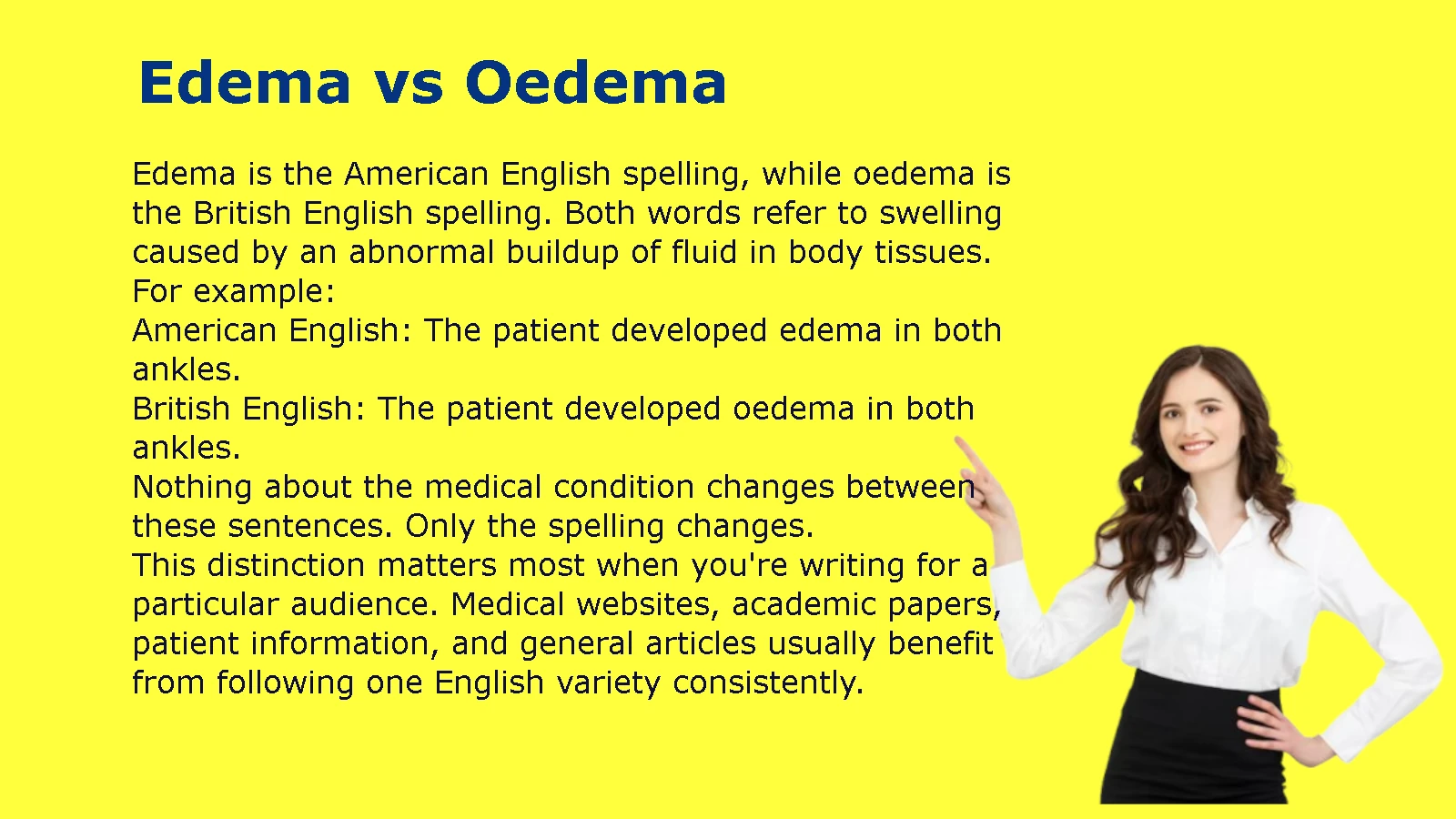
| oedema | edema |
| foetus | fetus |
These aren’t absolute rules for every word containing oe. English spelling has plenty of exceptions. Still, the pattern helps explain why oestrogen and estrogen look different.
A University of the Arts London spelling guide, for example, lists oestrogen/estrogen among British and American examples involving the -oe-/-e- spelling pattern.
Estrogen vs Oestrogen: Are They the Same Hormone?
Yes, but there’s an important detail to understand.
Estrogen and oestrogen are the same term, but estrogen itself refers to a group of hormones rather than one single hormone.
This distinction becomes important when you encounter names such as estradiol, estrone, and estriol.
Think of “estrogen” as the category and several specific hormones as members of that category.
The main types of estrogen
Three forms commonly appear in medical testing:
| Type | Common abbreviation | General role |
| Estradiol | E2 | Main estrogen in nonpregnant females of reproductive age |
| Estrone | E1 | Becomes the main estrogen after menopause |
| Estriol | E3 | Rises substantially during pregnancy |
MedlinePlus identifies estrone, estradiol, and estriol as the three types commonly tested.
Estradiol
Estradiol, also called E2, is the main estrogen in nonpregnant females during the reproductive years.
The ovaries produce much of it. Estradiol contributes to the menstrual cycle and ovulation and also supports bone and brain health. Males produce smaller amounts as well.
This is why you may see estradiol discussed separately from estrogen in medical information.
Estradiol is an estrogen. It isn’t an alternative spelling of estrogen.
Estrone
Estrone, or E1, is another type of estrogen.
MedlinePlus notes that estrone is produced by body fat and the adrenal glands in both males and females. In females, the ovaries also produce it. After menopause, estrone becomes the only type of estrogen that females continue to produce in significant amounts.
Estriol
Estriol, or E3, is particularly associated with pregnancy.
Its levels increase during pregnancy because the placenta produces it. Estriol has a much smaller presence in nonpregnant females and males.
This distinction prevents a common misunderstanding:
Estrogen is the broader category. Estradiol, estrone, and estriol are specific forms of estrogen.
Estrogen vs Oestrogen Spelling Difference
At first glance, the difference looks tiny:
estrogen
oestrogen
Only one letter changes. Yet that small difference can reveal which variety of English a writer is using.
Is “estrogen” American English?
Yes.
Estrogen is the standard American English spelling. Oxford labels it as the North American form and gives oestrogen as the British equivalent.
American medical sources also routinely use estrogen.
For example, the US National Library of Medicine’s MedlinePlus uses estrogen in its information about estrogen testing and estrogen medications.
So an American article might say:
Estrogen plays an important role in bone health.
A US medical source may also refer to estrogen therapy, estrogen levels, or an estrogen test.
Is “oestrogen” British English?
Yes.
Oestrogen is the standard British spelling.
The UK’s National Health Service consistently uses oestrogen in its information about hormone replacement therapy. For example, NHS pages discuss oestrogen-only HRT, oestrogen tablets, oestrogen patches, and vaginal oestrogen.
A British sentence might therefore read:
Oestrogen levels fall during and after menopause.
The spelling reflects British English. It doesn’t indicate a different substance.
Estrogen or Oestrogen: Which Spelling Should You Use?
The best spelling depends on your audience and the style of English you’re using.
If you’re writing an American English article, use estrogen.
If you’re writing a British English article, use oestrogen.
Use “estrogen” when:
- Your content targets readers in the United States.
- You’re following American English conventions.
- You’re writing for a US medical or educational publication.
- Your organization’s style guide specifies American English.
- You’re maintaining consistency with US terminology.
Use “oestrogen” when:
- Your content targets readers in the United Kingdom.
- You’re following British English conventions.
- You’re writing for a UK publication.
- You’re following a British organization’s style guide.
- Your source material consistently uses British spelling.
What if the audience is international?
That’s where consistency becomes especially useful.
An international publication may choose one spelling based on its house style. If the publication uses American English throughout, estrogen makes sense. If it follows British English, oestrogen is appropriate.
The important thing is not to switch randomly.
For example, an article that uses estrogen in one section and oestrogen in another without a reason can look poorly edited. The reader may even wonder whether the two forms describe different things.
They don’t.
Estrogen vs Oestrogen in Medical Writing
Medical writing provides some of the clearest real world evidence of the difference.
US and UK health authorities use different spellings while discussing the same hormone group.
US example: estrogen
MedlinePlus uses estrogen in its information about estrogen testing. It explains that an estrogen test can measure estrogens in blood, urine, or saliva.
Its medication information also uses estrogen when discussing medicines prescribed for conditions such as menopause symptoms and certain other conditions.
UK example: oestrogen
The NHS uses oestrogen throughout its hormone replacement therapy information.
Its guidance explains that HRT can contain oestrogen, progestogen, or both. It also describes oestrogen tablets, patches, gels, sprays, and vaginal preparations.
That gives us a useful real world comparison:
| US source | UK source |
| Estrogen | Oestrogen |
| MedlinePlus | NHS |
| Estrogen test | Oestrogen HRT |
| Estrogen medication | Oestrogen medication |
The terminology changes with the spelling system. The biology does not.
Estrogen vs Oestrogen and Hormone Replacement Therapy
The two spellings also appear frequently in discussions about hormone replacement therapy (HRT).
In the United States, medical information generally refers to estrogen therapy or estrogen medication.
In the United Kingdom, the NHS uses oestrogen.
The NHS explains that HRT can replace hormones that decline around menopause. It may contain oestrogen alone or combine oestrogen with a progestogen, depending on the person’s circumstances.
The distinction is useful because it shows that spelling differences don’t disappear in technical language. They continue into professional medical communication.
Why might estradiol appear in an HRT discussion?
Here’s another point worth clearing up.
The NHS notes that the type of oestrogen most commonly used in HRT is estradiol.
So these terms can appear together:
oestrogen → the hormone group
estradiol → a specific estrogen
In American English, the same relationship would normally be written:
estrogen → the hormone group
estradiol → a specific estrogen
That difference is about terminology and biology rather than British versus American spelling.
Estrogen vs Oestrogen Pronunciation
The spelling changes, but the pronunciation is broadly similar.
Oxford gives pronunciation information for both forms and identifies the regional spelling difference directly.
A simplified pronunciation guide is:
Estrogen: ES-truh-jen or EE-struh-jen, depending on pronunciation system and accent.
Oestrogen: generally pronounced similarly, although British pronunciation can differ from American pronunciation.
The important point is that the extra o doesn’t create a completely different word.
Why can pronunciation guides look different?
Dictionaries sometimes provide more than one pronunciation because English pronunciation varies by region.
For instance, Oxford lists both British and North American pronunciation forms for the word.
That means spelling, pronunciation, and regional variety can all interact. A British speaker and an American speaker may use slightly different sounds while still referring to exactly the same hormone group.
Estrogen vs Oestrogen in Sentences
Seeing the words in context makes the distinction much easier.
| American English | British English |
| Estrogen levels can change throughout the menstrual cycle. | Oestrogen levels can change throughout the menstrual cycle. |
| Estrogen plays a role in bone health. | Oestrogen plays a role in bone health. |
| The doctor ordered an estrogen test. | The doctor ordered an oestrogen test. |
| Estrogen therapy may be used for certain symptoms. | Oestrogen therapy may be used for certain symptoms. |
| Estradiol is a major type of estrogen. | Estradiol is a major type of oestrogen. |
| Low estrogen levels can occur during menopause. | Low oestrogen levels can occur during menopause. |
Notice what doesn’t change: the meaning of the sentence.
Only the regional spelling changes.
Estrogen vs Oestrogen: Common Mistakes
The spelling itself is rarely the real problem. Most mistakes happen when readers confuse spelling differences with biological differences.
Mistake: Thinking they are different hormones
Incorrect idea: Estrogen and oestrogen are two different hormones.
Correct: They are two spellings of the same term.
The spelling depends mainly on the variety of English.
Mistake: Thinking estradiol and estrogen are identical terms
Incorrect idea: Estradiol is simply another spelling of estrogen.
Correct: Estradiol is one specific type of estrogen.
MedlinePlus identifies estradiol as E2 and describes it as one of the main estrogens.
Mistake: Assuming British spelling is always more formal
British spelling isn’t automatically more formal or more scientific.
Oestrogen is simply the standard British form.
Likewise, estrogen isn’t an informal American shortcut. It is the standard US spelling used by major medical sources.
Mistake: Mixing the spellings without a reason
If an article targets American readers, consistently using estrogen usually makes more sense.
If it targets British readers, use oestrogen.
Consistency helps the article feel deliberate rather than stitched together from different sources.
Estrogen vs Oestrogen and Other British American Spelling Differences
The estrogen/oestrogen distinction belongs to a larger pattern of spelling differences between American and British English.
Consider these examples:
| American English | British English |
| estrogen | oestrogen |
| anemia | anaemia |
| edema | oedema |
| fetus | foetus |
| pediatric | paediatric |
These examples often involve words with historical ae or oe spellings that American English simplified in many cases.
However, don’t treat this as a perfect mathematical formula. English spelling has exceptions, and some forms are accepted in more than one variety of English.
The safest approach is simple: follow the spelling convention required by the publication, audience, or style guide.
A Real World Comparison: MedlinePlus vs NHS
A quick comparison of authoritative sources makes the distinction especially clear.
MedlinePlus
The US National Library of Medicine uses estrogen in its medical information.
Its estrogen testing information explains that estrogens are a group of hormones with roles extending beyond reproductive health, including bone and muscle strength and aspects of brain function.
Its medication information also uses estrogen when discussing estrogen medicines.
NHS
The UK’s National Health Service uses oestrogen.
Its HRT information discusses oestrogen as one of the hormones used in hormone replacement therapy and provides information about different forms, including tablets, patches, gels, sprays, and vaginal preparations.
What does this comparison prove?
It demonstrates something important for writers:
Both spellings are fully established in professional medical communication.
The difference isn’t about one being medically correct and the other being wrong.
It’s about regional English conventions.
Is Estrogen the American Spelling?
Yes.
Estrogen is the standard American English spelling.
Oxford labels estrogen as North American English and gives oestrogen as the British form.
Cambridge similarly defines estrogen as the US spelling of oestrogen.
If you’re writing an article for a US audience, estrogen is therefore the natural choice.
Is Oestrogen the British Spelling?
Yes.
Oestrogen is the standard British English spelling.
Oxford identifies it as British English and lists estrogen as the North American equivalent.
The NHS’s use of oestrogen provides a practical example of how the spelling appears in UK medical writing.
Can You Use Estrogen in British English?
People in the UK will understand estrogen, and the spelling clearly refers to the same hormone group.
However, if the goal is to follow standard British English spelling, oestrogen is the better choice.
This is especially relevant for formal writing, educational content, medical publications, and websites that consistently follow British English.
The same principle works in reverse.
Can You Use Oestrogen in American English?
American readers will generally recognize oestrogen, especially because the term appears in international medical and scientific material.
Still, estrogen is the normal American spelling.
For a US focused article, using estrogen keeps the terminology consistent with American dictionaries and major US medical sources.
Is Estrogen or Oestrogen More Correct?
Neither is universally “more correct.”
The better question is:
Which variety of English are you writing?
If the answer is American English, choose estrogen.
If the answer is British English, choose oestrogen.
Both spellings are legitimate. The mistake is treating one as though it represents a different biological substance.
Quick decision guide
| If you’re writing for… | Use |
| United States | estrogen |
| United Kingdom | oestrogen |
| American medical audience | estrogen |
| British medical audience | oestrogen |
| US educational material | estrogen |
| UK educational material | oestrogen |
| An international publication | Follow its style guide |
Frequently Asked Questions About Estrogen vs Oestrogen
Are estrogen and oestrogen the same thing?
Yes. Estrogen and oestrogen are regional spellings of the same term. Estrogen is the standard American spelling, while oestrogen is the standard British spelling.
Is estrogen American or British?
Estrogen is the standard American English spelling. British English generally uses oestrogen.
Is oestrogen British or American?
Oestrogen is the standard British English spelling. American English normally uses estrogen.
Which is correct, estrogen or oestrogen?
Both are correct. The correct choice depends on the variety of English you’re using.
Use estrogen for American English and oestrogen for British English.
Does oestrogen mean something different from estrogen?
No. The additional o does not create a different hormone. It reflects the British spelling convention.
Is estradiol the same as estrogen?
Not exactly.
Estradiol is one type of estrogen. Other commonly tested forms include estrone and estriol.
Why does British English spell it oestrogen?
British English has retained the oe spelling in this word, while American English uses the simplified e spelling. Similar patterns appear in words such as oedema/edema and anaemia/anemia.
Which spelling should a US writer use?
A US writer should normally use estrogen.
It matches standard American English and the terminology used by major US medical resources such as MedlinePlus.
Which spelling should a UK writer use?
A UK writer should normally use oestrogen.
It follows standard British spelling and matches terminology used by organizations such as the NHS.
Is estrogen only found in women?
No.
Estrogens play major roles in female reproductive health, but males also produce estrogens. MedlinePlus notes that males produce estradiol and estrone as well.
Is estrogen one hormone or several hormones?
The term estrogen generally refers to a group of hormones.
Commonly discussed forms include estradiol, estrone, and estriol.
Estrogen vs Oestrogen: Final Verdict
The difference between estrogen vs oestrogen is mainly a matter of spelling, not biology.
Estrogen is the standard American English form.
Oestrogen is the standard British English form.
Both refer to a group of hormones that play important roles in reproductive health and also contribute to functions involving bones, muscles, the brain, metabolism, and other parts of the body.
The distinction can be summed up in one line:
Estrogen = American English; oestrogen = British English.
So, if you’re deciding which form to use, don’t ask which hormone is correct. Ask which English spelling matches your audience and style guide.
For American English content, choose estrogen. For British English content, choose oestrogen. Once that choice is made, keep it consistent throughout the piece.
And remember one final distinction: estradiol is not another spelling of estrogen. It is one specific type of estrogen. That small bit of biological context makes the spelling comparison much easier to understand.