Compare is the correct spelling, while compair is a common misspelling. If you’re unsure whether to write compare or compair, always choose compare when you mean to examine two or more things for similarities or differences. Understanding the compare meaning, the correct verb forms, and the difference between compare to vs compare with will help you write clearer English.
Whether you’re writing an email, completing a school assignment, comparing products, or preparing a professional report, using the right spelling matters. This guide explains the correct spelling, definition, compare meaning in Urdu, grammar rules, synonyms, and practical examples to help you use the word confidently.
Compare vs Compair: Which Spelling Is Correct?
Compare is the correct spelling in standard English. Compair is a misspelling and should not appear in formal writing, academic assignments, business emails, or published content when you intend to use the verb compare.
The confusion often comes from pronunciation. In many English accents, compare sounds similar to how someone might imagine the spelling compair. However, English spelling doesn’t always follow pronunciation exactly.
| Word | Correct or Incorrect | Meaning |
| Compare | Correct | To examine things for similarities or differences |
| Compair | Incorrect | A common misspelling of compare |
Correct: Compare the prices of these three laptops before buying one.
Incorrect: Compair the prices of these three laptops before buying one.
The correct spelling remains compare regardless of whether you’re comparing prices, people, ideas, products, or experiences.
Compare vs Compair at a Glance
Here’s a quick reference for the difference between compare and compair.
| Feature | Compare | Compair |
| Spelling | Correct | Incorrect |
| Part of speech | Verb | Not a standard spelling of this verb |
| Pronunciation | Commonly /kəmˈper/ | Intended to represent the sound of compare |
| Formal writing | Recommended | Avoid |
| Example | Compare both reports. | Incorrect: Compair both reports. |
The verb compare can describe a simple everyday action or a detailed analytical process.
For example:
- A shopper compares prices before purchasing a phone.
- A teacher compares two characters in a novel.
- An analyst compares quarterly revenue figures.
- A student compares different explanations of a historical event.
In every example, compare is the correct word.
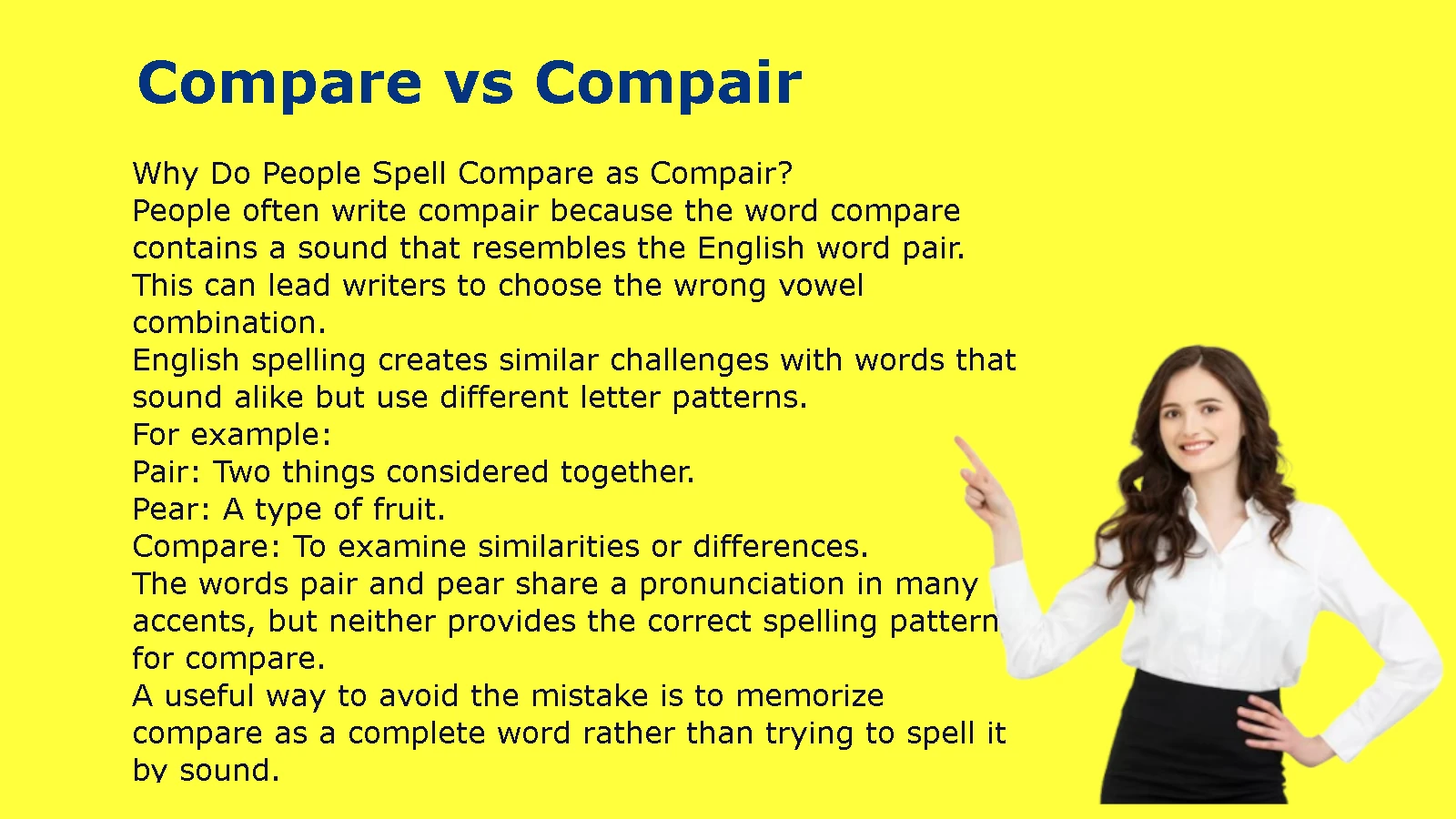
Why Do People Spell Compare as Compair?
People often write compair because the word compare contains a sound that resembles the English word pair. This can lead writers to choose the wrong vowel combination.
English spelling creates similar challenges with words that sound alike but use different letter patterns.
For example:
- Pair: Two things considered together.
- Pear: A type of fruit.
- Compare: To examine similarities or differences.
The words pair and pear share a pronunciation in many accents, but neither provides the correct spelling pattern for compare.
A useful way to avoid the mistake is to memorize compare as a complete word rather than trying to spell it by sound.
You can also remember a familiar sentence:
Compare the two options before making a choice.
Reading and writing this sentence regularly can reinforce the correct spelling.
Compare Meaning and Definition
Compare means to examine two or more people, objects, ideas, or situations to identify their similarities, differences, or both. The word appears in everyday conversations, academic writing, business analysis, shopping decisions, and many other contexts.
For example, when you compare two smartphones, you might examine their prices, battery life, cameras, storage, and performance.
The goal isn’t always to find a winner. Sometimes, comparison simply helps you understand how two things relate to each other.
What Does Compare Mean in English?
The verb compare describes the process of considering things together.
Depending on the context, it can emphasize similarities, differences, or a combination of both.
Consider these examples:
Comparing similarities:
The teacher compared the two poems because both explore the theme of friendship.
Here, the comparison highlights a shared characteristic.
Comparing differences:
We compared the two internet plans to find out which offered better value.
This sentence focuses on differences that may influence a decision.
Comparing for general understanding:
The researcher compared the survey results from two different years.
The comparison may reveal both similarities and changes.
In practical use, compare often involves several steps:
- Identify the things you want to compare.
- Choose relevant features or criteria.
- Examine the similarities and differences.
- Explain what the comparison reveals.
For instance, comparing two job offers becomes more useful when you consider salary, benefits, commute, flexibility, and opportunities for growth instead of focusing only on the job titles.
Compare Meaning in Urdu
The common Urdu meaning of compare is موازنہ کرنا. Depending on the context, it may also be translated as مقابلہ کرنا, although the latter can suggest competition or facing someone or something.
| English | Urdu |
| Compare | موازنہ کرنا |
| Compare two things | دو چیزوں کا موازنہ کرنا |
| Compare prices | قیمتوں کا موازنہ کرنا |
| Compare results | نتائج کا موازنہ کرنا |
| Comparison | موازنہ |
Example in English: Compare the prices of these two phones.
Urdu translation: ان دونوں فونز کی قیمتوں کا موازنہ کریں۔
Another example:
English: We compared the examination results.
Urdu: ہم نے امتحان کے نتائج کا موازنہ کیا۔
The best translation depends on the sentence. When someone compares two products, موازنہ کرنا usually communicates the intended meaning clearly.
Compare as a Verb: Word Forms and Grammar
Compare is a regular verb. It follows the standard pattern for many English verbs when forming its past tense and past participle.
However, the spelling changes slightly when you add certain endings.
| Word form | Grammatical role | Example |
| Compare | Base form | I compare the prices. |
| Compares | Third-person singular present | She compares the results. |
| Compared | Simple past | We compared both options. |
| Compared | Past participle | They have compared the figures. |
| Comparing | Present participle/gerund | Comparing prices saves money. |
| Comparison | Noun | The comparison was helpful. |
| Comparable | Adjective | Both products offer comparable performance. |
| Comparative | Adjective/noun | The report includes a comparative analysis. |
Spelling tip: When adding -ed, the final silent e remains part of the spelling, so compare becomes compared, not compareed.
When adding -ing, the final e drops:
- Compare → Comparing
- Create → Creating
- Evaluate → Evaluating
These spelling patterns help you avoid errors when using related forms.
Compare To or With: Which One Should You Use?
Both compare to and compare with are grammatically correct. Traditionally, compare to often highlights a resemblance or analogy, while compare with often emphasizes examining similarities and differences. Modern English allows considerable overlap, so context matters more than a strict rule.
Choosing the right phrase depends on what you want readers to understand.
When to Use Compare To
Use compare to when you want to describe one thing as resembling another or draw an analogy between two different things.
This construction often appears in figurative language, creative writing, speeches, and everyday conversation.
Examples:
- The poet compared her smile to sunshine.
- The coach compared the team’s progress to a growing tree.
- My grandfather compared life to a long journey.
- The author compared the city lights to stars scattered across the sky.
In these sentences, the writer isn’t necessarily conducting a detailed analysis. The comparison helps readers imagine a quality, feeling, or idea.
For example, when someone writes, Her voice was compared to music, the statement highlights a perceived resemblance.
Practical tip: Use compare to when an analogy or resemblance is the main point.
However, don’t assume that every comparison involving similarity must use to. English speakers also use compare with in many contexts involving similarities.
When to Use Compare With
Use compare with when you want to examine two or more things, especially to evaluate their similarities and differences.
This construction often appears in research, education, business, product reviews, and analytical writing.
Examples:
- Compare this year’s sales figures with last year’s results.
- The researcher compared the new treatment with the existing approach.
- We compared the two insurance policies with each other.
- The editor compared the revised draft with the original version.
In these examples, the comparison involves examining specific details.
For example, comparing sales figures may involve revenue, customer numbers, seasonal changes, and conversion rates.
Similarly, comparing insurance policies may require checking premiums, deductibles, exclusions, and coverage limits.
Practical tip: Use compare with when you’re asking readers to examine two or more things systematically.
This preference is a helpful guideline rather than an unbreakable rule. Writers sometimes use compare to for analytical comparisons, too.
Compare To vs Compare With: Key Differences
The difference between compare to vs compare with is mainly about emphasis.
| Feature | Compare to | Compare with |
| Traditional emphasis | Resemblance or analogy | Examination and evaluation |
| Common context | Figurative comparisons | Analytical comparisons |
| Example | She compared his patience to a mountain. | She compared his results with the team’s results. |
| Is it always exclusive? | No | No |
The expressions can overlap.
For example:
The manager compared our current performance to last year’s performance.
This sentence is understandable and acceptable. It can describe an analytical comparison despite using to.
Likewise:
The poet compared the moon with a silver coin.
Although to might feel more natural to many writers in this analogy, with can still appear in English usage.
The best choice often depends on conventional phrasing, sentence rhythm, and the type of comparison you’re making.
Compare To and Compare With in Everyday English
Both constructions appear in ordinary speech and writing.
The following examples show how the phrases work in different situations.
Academic writing
The student compared the two theories with each other.
This sentence suggests a structured examination of the theories.
Business communication
We compared the new campaign’s performance with the previous campaign’s results.
The comparison evaluates measurable outcomes.
Creative writing
She compared the sound of rain to a gentle song.
This sentence creates an image through resemblance.
Everyday conversation
You should compare this phone to the one you already own.
The speaker recommends evaluating the two products. Many speakers might also say compare this phone with the one you already own.
When you aren’t sure which preposition to use, focus on clarity.
If both expressions sound natural and communicate your meaning, either may work.
Compare vs Compair Examples in Sentences
Examples make the difference between compare vs compair easier to remember. The following sentences demonstrate the correct spelling across everyday, academic, and professional contexts.
Correct Sentences Using Compare
Use compare whenever you mean to examine similarities or differences.
Everyday examples
- Compare the prices before you buy the shoes.
- I want to compare these two restaurants.
- We compared our travel experiences.
- You can compare the available options online.
Academic examples
- The assignment asks students to compare two historical events.
- The researcher compared the survey responses from different age groups.
- Our teacher asked us to compare the main characters in the novel.
Business examples
- The marketing team compared conversion rates across campaigns.
- We compared the supplier’s quotation with the approved budget.
- Management compares monthly revenue to identify changes in performance.
Technology examples
- I compared the specifications of two laptops.
- The developer compared the application’s performance before and after the update.
- Consumers often compare camera quality before choosing a smartphone.
Notice that compare works naturally with many different subjects and objects.
You can compare products, opinions, outcomes, documents, methods, and experiences.
Incorrect Compair Examples and Their Corrections
The spelling compair is incorrect when you intend the standard verb compare.
Use these corrections as a quick reference.
| Incorrect sentence | Correct sentence |
| Compair these two products. | Compare these two products. |
| I want to compair the results. | I want to compare the results. |
| We compaired both reports. | We compared both reports. |
| She is compairing the prices. | She is comparing the prices. |
| He compairs every option. | He compares every option. |
Remember that correcting the base word also helps you correct its related forms.
- Compairing → Comparing
- Compaired → Compared
- Compairs → Compares
If you find compair in a draft, replace it with the correct form when the context calls for the verb compare.
However, check the context before using automated replacement in technical documents or proper names, where an unusual spelling might serve another purpose.
Compare in Questions and Professional Writing
The word compare works well in direct questions, instructions, reports, and professional discussions.
Examples include:
- How do you compare these two options?
- Can you compare the latest results with last quarter’s figures?
- Which features should we compare before selecting a vendor?
- How does this year’s performance compare with last year’s?
- Could you compare the revised contract with the original version?
For clearer professional writing, specify what readers should examine.
Instead of writing:
Please compare the products.
Try:
Please compare the products’ prices, warranty periods, and delivery times.
The second instruction identifies the criteria and makes the task easier to complete.
This principle also improves reports. A comparison becomes more useful when readers know the measures, time periods, and conditions involved.
Common Mistakes When Using Compare
Writers can spell compare correctly and still use it awkwardly. Common issues include confusing related words, creating unclear comparisons, and repeating the same construction.
Understanding these mistakes helps improve both grammar and readability.
Confusing Compare With Comparison
Compare is a verb, while comparison is a noun.
The verb describes an action. The noun names the process or result of that action.
| Word | Part of speech | Example |
| Compare | Verb | Compare the two proposals. |
| Comparison | Noun | The comparison revealed several differences. |
| Comparable | Adjective | The two products have comparable features. |
| Comparative | Adjective | The report provides a comparative analysis. |
Incorrect: We made a compare of the two products.
Better: We made a comparison of the two products.
Also correct: We compared the two products.
The most natural choice depends on the sentence.
For example, compare often produces shorter, more direct sentences:
We compared both proposals.
This version sounds more concise than:
We conducted a comparison of both proposals.
Both sentences are grammatical, but the first often works better in straightforward writing.
Using Compare Without a Clear Reference
A comparison needs a clear point of reference.
Consider this sentence:
This laptop is better when compared.
The sentence leaves readers wondering: Compared with what?
A clearer version is:
This laptop offers longer battery life than the previous model.
Another example:
Unclear: Our results improved compared with before.
Clearer: Our conversion rate increased from 2.4% to 3.1% compared with the previous quarter.
The revised sentence identifies the measure and reference period.
When writing a comparison, check three things:
- Subject: What are you comparing?
- Reference: What are you comparing it with or to?
- Criteria: Which features or results matter?
This simple framework works especially well for product reviews, business reports, and academic writing.
Overusing Compare To and Compare With
Repeating compare to or compare with throughout a paragraph can make the writing sound mechanical.
For example:
We compared the price with the competitor’s price. We compared the features with the competitor’s features.
A smoother version would be:
We compared both products’ prices, features, and warranty coverage.
This revision removes repetition while keeping the meaning clear.
Other useful alternatives include:
- Evaluate: Focus on judging quality or value.
- Assess: Focus on examining a situation.
- Contrast: Focus on differences.
- Examine: Focus on studying details.
- Analyze: Focus on detailed investigation.
Choose an alternative only when it preserves your intended meaning.
Compare Synonyms and Related Words
Several words share meanings with compare, but they don’t always work in the same situations.
Choosing the right synonym can make your writing more precise.
Synonyms for Compare
| Synonym | Meaning or emphasis | Example |
| Contrast | Highlight differences | Contrast the two writing styles. |
| Evaluate | Judge quality or value | Evaluate both proposals. |
| Examine | Inspect carefully | Examine the two documents. |
| Assess | Estimate or judge | Assess the risks of both options. |
| Analyze | Study components or patterns | Analyze the sales figures. |
| Match | Check whether things correspond | Match the invoice against the purchase order. |
Compare is a broad term. It can include identifying similarities, differences, or both.
By contrast, evaluate usually involves a judgment, while analyze often requires closer examination.
For example:
Compare the two phones.
This instruction could involve many features.
Evaluate the two phones.
This instruction more strongly suggests deciding which one offers better value or performance.
Analyze the two phones’ battery test results.
This sentence calls for detailed examination of specific data.
Compare vs Contrast
Both are related verbs, but their emphasis differs.
Contrast generally highlights differences.
| Word | Main emphasis | Example |
| Compare | Similarities, differences, or both | Compare the two business models. |
| Contrast | Differences | Contrast their pricing strategies. |
For example:
Compare online shopping with traditional shopping.
This request may involve convenience, costs, delivery, customer service, and shopping experience.
Contrast online shopping with traditional shopping.
This request more strongly directs attention toward differences, such as physical inspection and delivery time.
In school assignments, a prompt may ask students to compare and contrast two subjects. That phrase encourages them to discuss both shared features and distinguishing characteristics.
How to Remember the Correct Spelling of Compare
The easiest way to remember compare is to learn its spelling as a complete word and practice using it in meaningful sentences.
Since compair sounds plausible to some writers, relying on pronunciation alone may not prevent the mistake.
A visual memory technique can help.
A Simple Spelling Trick
Remember this spelling:
C-O-M-P-A-R-E = COMPARE
Focus on the ending -pare, not -pair.
You can also connect the word with a familiar action:
Compare two prices before you purchase something.
The repeated use of the correct spelling helps reinforce the word in your memory.
Try these short exercises:
Fill in the blank:
- Please ______ the two reports.
- We ______ the available plans yesterday.
- She is ______ the prices now.
Answers:
- Compare
- Compared
- Comparing
Another helpful practice is to write the word in three forms:
Compare → Compared → Comparing
This reinforces both the spelling and the grammar.
Quick Proofreading Tips
Use these techniques to catch compair and other spelling mistakes.
Search your document
Use the find function in your writing software to look for compair. Review each result and correct it if you intended compare.
Check related forms
Look for common errors such as compairs, compaired, and compairing.
Use spellcheck
Most standard English spellcheckers should flag compair when you intend the ordinary verb. Still, don’t rely on spellcheck alone because proper names and unusual terms may complicate its suggestions.
Read the sentence aloud
Reading helps you spot awkward grammar and unclear comparisons, although it won’t always reveal spelling errors because compare and compair may sound similar.
Proofread in context
Check the full sentence rather than replacing every unusual spelling automatically.
For articles, reports, and assignments, a final proofreading pass can prevent small errors from weakening otherwise strong writing.
A Practical Example: Comparing Two Products Correctly
A useful way to understand compare is to see how the word works in a realistic decision.
Imagine you’re choosing between two laptops.
Laptop A costs $700, while Laptop B costs $850.
You might compare their prices, battery life, weight, memory, and warranty terms.
| Feature | Laptop A | Laptop B |
| Price | $700 | $850 |
| Battery life | 8 hours | 11 hours |
| Weight | 1.5 kg | 1.4 kg |
| RAM | 16 GB | 16 GB |
Illustrative example figures.
A clear comparison could read:
We compared the two laptops’ prices, battery life, weight, and memory. Laptop A costs less, while Laptop B offers longer battery life and weighs slightly less.
This example demonstrates three useful writing principles:
- Use compared when describing a completed comparison.
- Identify the criteria instead of making a vague statement.
- Explain the findings without declaring a winner automatically.
Laptop A may suit a budget-conscious student, while Laptop B may appeal to someone who travels frequently and values battery life.
The better choice depends on the user’s needs.
This example also shows why comparison and evaluation aren’t exactly the same. First, you compare the products. Then, you evaluate which one fits your priorities.
Frequently Asked Questions
Is it compare or compair?
Compare is the correct spelling in standard English. Compair is a common misspelling when someone intends to write the verb meaning to examine similarities or differences.
Example: Compare the two options before deciding.
What does compare mean?
Compare means to examine two or more things to identify similarities, differences, or both.
Example: We compared the two proposals to understand their advantages and disadvantages.
Is it compare to or compare with?
Both compare to and compare with are correct. Traditionally, compare to often emphasizes resemblance, while compare with often suggests analytical examination. The distinction isn’t absolute.
Example: She compared his voice to thunder.
Example: We compared the results with last month’s figures.
What is the meaning of compare in Urdu?
The common Urdu meaning of compare is موازنہ کرنا.
Example: Compare the prices of both products.
Urdu: دونوں مصنوعات کی قیمتوں کا موازنہ کریں۔
Is comparison the noun form of compare?
Yes. Comparison is the related noun, while compare is a verb.
Example: We compared the documents.
Example: Our comparison revealed several differences.
How do you use compare in a sentence?
Use compare when you want to examine things together.
Example: Compare the two prices before you buy the product.
You can also use related forms, such as compared, compares, and comparing, depending on the sentence.
Conclusion: Choose Compare, Not Compair
When deciding between compare vs compair, remember that compare is the correct spelling. The word means to examine two or more things for similarities, differences, or both.
Use compare to when expressing resemblance or drawing an analogy, and consider compare with when discussing analytical comparisons. Both constructions are correct, and their meanings can overlap.
Keep these key points in mind:
- Compare is the correct spelling.
- Compair is a common spelling mistake.
- Comparison is the related noun.
- Compare to and compare with can both be correct.
- Clear comparisons identify the subjects and relevant criteria.