Have you ever written memorandums or memoranda and wondered which form is correct? While both Memorandums vs Memoranda are accepted plural forms of memorandum, they can differ in usage, style, and context.
Memorandum is a formal written message, note, or document used to communicate information, instructions, or decisions. Its traditional Latin plural is memoranda, while the English plural memorandums is also widely accepted and commonly used today.
Examples:
- The company issued several memorandums about the new policy.
- The committee reviewed the memoranda before making a decision.
The confusion is understandable. People often search for memorandums vs memoranda, memorandum plural, plural of memorandum, or is memoranda correct because both forms appear in formal writing. And here’s the kicker: although memoranda may sound more formal or traditional, memorandums is perfectly acceptable in modern English.
In this guide, you’ll learn the complete difference between Memorandums vs Memoranda, including their meaning, plural forms, usage, pronunciation, and examples in sentences. You’ll also discover when to use memoranda or memorandums and which form is more appropriate for formal and everyday writing.
What Does Memorandum Mean?
A memorandum is a written communication or record that deals with a particular subject. In business settings, it can be a formal report prepared for a person, team, company, or organization. It can also refer to a written reminder or a document that records an agreement.
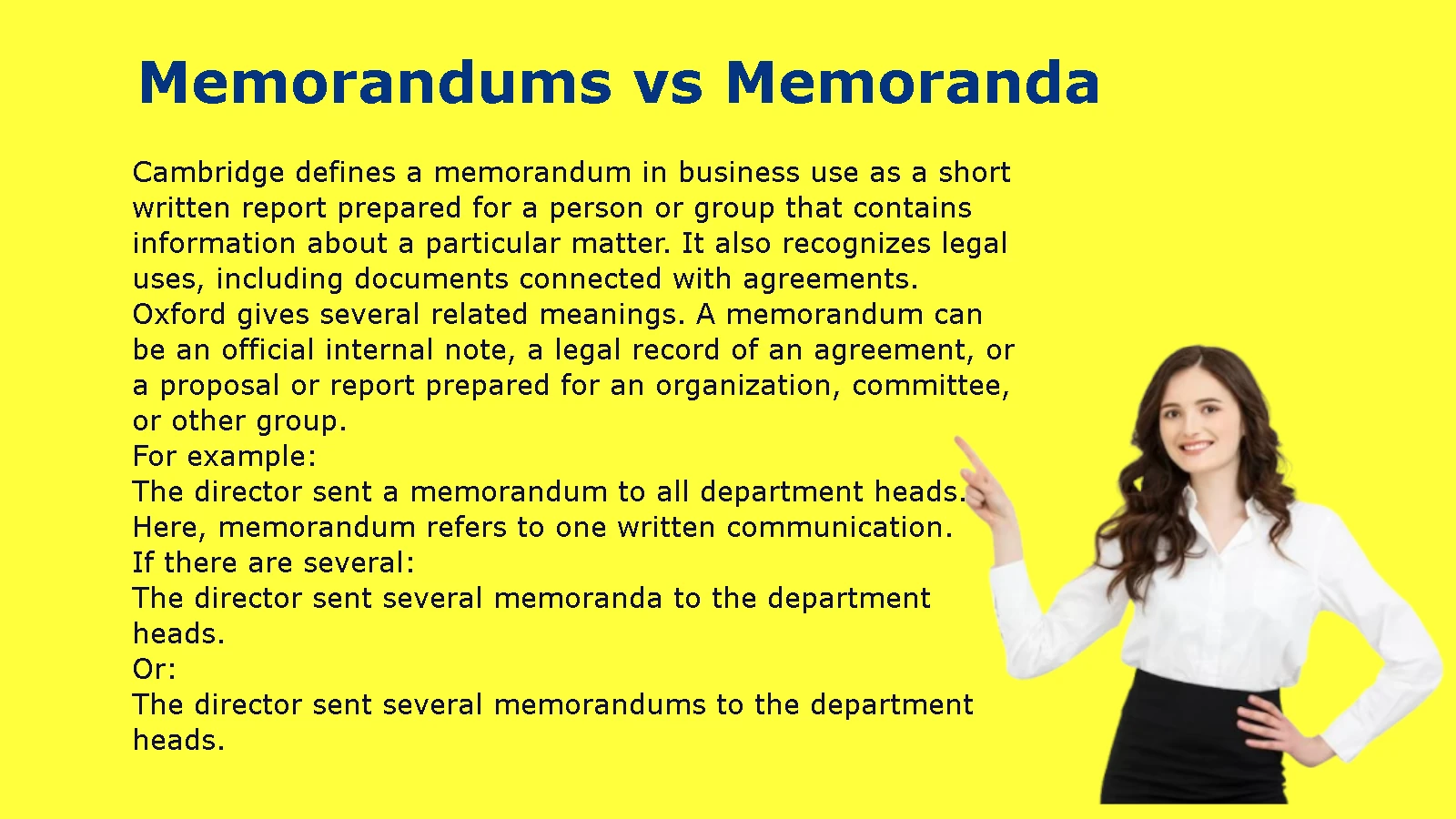
Cambridge defines a memorandum in business use as a short written report prepared for a person or group that contains information about a particular matter. It also recognizes legal uses, including documents connected with agreements.
Oxford gives several related meanings. A memorandum can be an official internal note, a legal record of an agreement, or a proposal or report prepared for an organization, committee, or other group.
For example:
The director sent a memorandum to all department heads.
Here, memorandum refers to one written communication.
If there are several:
The director sent several memoranda to the department heads.
Or:
The director sent several memorandums to the department heads.
Both plural versions work.
Common Uses of Memorandum
You’ll most often see memorandum in formal or professional contexts, including:
- Business communication
- Government documents
- Legal writing
- Academic administration
- Corporate policies
- Diplomatic communication
- Internal organizational notices
- Reports and proposals
- Records of agreements
- Official instructions
The word can therefore cover more ground than the everyday word memo.
What Does Memoranda Mean?
Memoranda is a plural form of memorandum.
If one document is a memorandum, two or more documents can be called memoranda.
For example:
- One memorandum
- Two memoranda
- Several memoranda
- The memoranda were reviewed
- The committee received three memoranda
Cambridge’s dedicated entry identifies memoranda as the plural of memorandum. Its corpus examples include uses such as legal memoranda, committee memoranda, and research memoranda.
The form can sound formal because it preserves the traditional plural pattern associated with the word’s Latin origin.
Memoranda in a Sentence
Consider these examples:
- The attorneys prepared several legal memoranda.
- The committee reviewed the memoranda before making its decision.
- Several government memoranda were released to the public.
- The researchers compared the memoranda from different departments.
- The board received three memoranda on the proposed policy.
Notice that memoranda takes a plural verb:
The memoranda were important.
Not:
The memoranda was important.
That’s an important grammatical point. The ending -a doesn’t make memoranda singular in modern English. In standard usage, it functions as a plural noun.
What Does Memorandums Mean?
Memorandums is the other accepted plural form of memorandum.
It follows a familiar English pattern:
memorandum → memorandums
Instead of preserving the traditional Latin plural ending, English simply adds -s.
Merriam Webster explicitly lists memorandums or memoranda as the plural forms of memorandum.
Cambridge also lists memorandums alongside memoranda. Its Business English entry uses memorandums in examples involving draft documents.
Memorandums in a Sentence
Here are natural examples:
- The company issued several memorandums about the new policy.
- Employees received three memorandums during the month.
- The department keeps copies of old memorandums.
- The lawyers reviewed the memorandums before the meeting.
- The agency published several memorandums concerning the new regulations.
These sentences are grammatically sound.
So if someone tells you that memorandums is always wrong, that claim goes too far. Major dictionaries recognize the form.
Memorandums vs Memoranda: What’s the Difference?
The most important point is simple: there is no major difference in basic meaning.
Both words refer to more than one memorandum.
The main distinction involves form, history, and style rather than meaning.
| Feature | Memoranda | Memorandums |
| Singular | memorandum | memorandum |
| Plural | memoranda | memorandums |
| Meaning | More than one memorandum | More than one memorandum |
| Formation | Traditional Latin pattern | Regular English plural |
| Grammatically accepted | Yes | Yes |
| Can appear in formal writing | Yes | Yes |
| Can appear in business writing | Yes | Yes |
| May sound traditional | Often | Less so |
| Easy for general readers | Usually understandable | Very straightforward |
Think of the two forms as two roads leading to the same destination. One road follows the word’s historical Latin route. The other follows English’s regular plural system.
Memoranda Is the Traditional Form
The word memorandum comes from Latin. Oxford traces it to a Latin form meaning roughly “something to be brought to mind” and explains that the word originally appeared as an adjective at the head of a record intended for future reference.
That history helps explain memoranda.
The traditional Latin plural is formed by changing the ending from -um to -a.
So:
memorandum → memoranda
English has retained this pattern in a number of borrowed words.
Memorandums Follows English Grammar
English also has a strong tendency to make nouns plural by adding -s or -es.
That produces:
memorandum → memorandums
There’s nothing unusual about English adapting borrowed words to its own grammatical patterns. In fact, this process happens frequently.
Merriam Webster’s usage information supports the coexistence of both plural forms rather than treating the English plural as an error.
Why Does Memorandum Have Two Plurals?
The answer lies in the relationship between borrowed words and English grammar.
That is exactly what happened with memorandum.
The Latin Pattern
The traditional form is:
memorandum → memoranda
This pattern is inherited from Latin grammar.
You can see similar historical patterns in other English words of Latin origin, although each word has its own established usage.
For example:
- curriculum → curricula
- datum → data
- bacterium → bacteria
However, you shouldn’t assume that every noun ending in -um must form its plural with -a. English usage doesn’t work like a mathematical formula.
Some words have regular English plurals. Others have both traditional and English forms. Still others have developed specialized modern meanings and plural conventions.
That’s why dictionaries matter more than a blanket rule.
Is Memoranda or Memorandums More Common?
There isn’t a useful universal rule saying that one form always wins.
Memoranda has a strong presence in formal English, particularly in legal, academic, governmental, and institutional contexts. Cambridge’s examples include legal and committee uses of memoranda.
At the same time, memorandums is well established in English. Cambridge’s Business English material uses the form in professional contexts, and Merriam Webster explicitly recognizes it as a plural.
The better question isn’t simply:
Which one is correct?
It’s:
Which one fits the context and style of this document?
That’s a much more useful way to approach the choice.
When Should You Use Memoranda?
Memoranda can be a good choice when you’re writing in a formal, legal, academic, or institutional setting.
For example:
- The court reviewed the legal memoranda.
- The committee considered several memoranda.
- The agency published its policy memoranda.
- The archive contains memoranda from previous administrations.
- The researchers examined historical memoranda.
The form can give the writing a traditional formal tone.
That’s especially noticeable in legal writing. Phrases such as legal memoranda and memoranda of law are familiar in legal contexts.
When Memoranda Makes Sense
Choose memoranda when:
- Your organization traditionally uses it.
- You’re writing formal legal material.
- Your academic or professional style guide prefers it.
- You’re writing for an audience accustomed to formal terminology.
- You want to maintain a traditional register.
- You’re using established terminology such as legal memoranda.
However, don’t choose it merely because you think the Latin form is automatically “more correct.” Memorandums is also accepted.
When Should You Use Memorandums?
Memorandums works well when you want a straightforward English plural.
For example:
- The manager distributed several memorandums.
- Employees must read all company memorandums.
- The office keeps copies of previous memorandums.
- The department issued two memorandums this week.
This form can feel especially natural in general business writing.
It also has one practical advantage: readers who aren’t familiar with Latin plurals can immediately recognize the -s ending as plural.
When Memorandums Makes Sense
Use memorandums when:
- Your workplace uses regular English plurals.
- You’re writing for a broad general audience.
- Your organization’s style guide prefers it.
- You want a plain, modern tone.
- You’re writing ordinary business prose.
- Consistency with other regular English plurals matters more than traditional style.
Again, the key is consistency.
If a company uses memorandums throughout its internal documentation, suddenly switching to memoranda doesn’t make the writing better. It may simply make the terminology less consistent.
Memoranda vs. Memorandums in Formal Writing
Here’s where the distinction gets interesting.
Memoranda often sounds more formal or traditional than memorandums. That doesn’t mean it has greater grammatical authority. It reflects the historical form and the contexts in which writers often use it.
Compare:
The legal team prepared several memoranda for the court.
with:
The legal team prepared several memorandums for the court.
Both are grammatically acceptable.
The first may sound more traditionally legal. The second sounds more like a regular English plural.
That’s a difference in register, not correctness.
Style Matters More Than People Think
Imagine two companies.
Company A uses memoranda in every official document.
Company B uses memorandums in its internal communications.
Neither company has made a grammatical mistake.
The smartest approach is to follow the established style of the organization, publication, profession, or document.
When a style guide specifies one form, consistency usually matters more than personal preference.
Memorandums vs Memoranda in American English
In American English, both forms are recognized.
Cambridge’s American Dictionary gives memoranda and memorandums as plural forms. It also identifies memo as the short form.
Merriam Webster, an American dictionary, similarly lists memorandums or memoranda.
Oxford’s American English entry, however, presents memoranda as the plural.
That difference is useful because it prevents an overly simple conclusion. Dictionary entries can emphasize different forms while still describing the same underlying usage.
Which Form Should American Writers Choose?
For most American writers, either form can work.
Use memoranda if:
- The document is highly formal.
- You’re writing legal material.
- The surrounding terminology is traditional.
- Your institution already uses memoranda.
Use memorandums if:
- You’re writing straightforward business English.
- Your audience prefers familiar English forms.
- Your company style uses memorandums.
- You want to avoid unnecessarily formal wording.
And if you’re simply talking about everyday workplace documents, memos will often sound much more natural.
Memorandum vs. Memo
A memo is the shorter form of memorandum.
Oxford identifies memo as an abbreviation of memorandum and gives memos as its plural.
That gives you three useful levels:
| Formality | Singular | Plural |
| Formal | memorandum | memoranda / memorandums |
| Less formal | memo | memos |
For example:
Formal:
The director issued a memorandum regarding the new policy.
Everyday workplace English:
The director sent a memo about the new policy.
Both sentences communicate essentially the same basic idea.
The second simply sounds more natural in many everyday office conversations.
Common Mistakes With Memorandum
The two accepted plurals cause a few predictable errors.
Using Memoranda as a Singular
Incorrect:
The memoranda was sent yesterday.
Correct:
The memorandum was sent yesterday.
Correct:
The memoranda were sent yesterday.
The key is number. Memorandum is singular. Memoranda is plural.
Using Memorandums as a Singular
Incorrect:
This memorandums explains the new rule.
Correct:
This memorandum explains the new rule.
Correct:
These memorandums explain the new rule.
The same principle applies to both plural forms.
Writing Memorandas
Memorandas is not the standard plural form.
Use:
- memoranda
- memorandums
Don’t combine the traditional -a ending with another plural ending.
Treating Memorandum as a Plural
Another common mistake is using memorandum after a plural determiner.
For example:
Several memorandum were discussed.
The correct version is:
Several memoranda were discussed.
Or:
Several memorandums were discussed.
The noun must agree with the plural quantity.
Memorandums vs Memoranda Examples
Seeing the forms side by side makes the distinction much easier.
| Singular | Plural with memoranda | Plural with memorandums |
| The memorandum was confidential. | The memoranda were confidential. | The memorandums were confidential. |
| The lawyer prepared a memorandum. | The lawyer prepared several memoranda. | The lawyer prepared several memorandums. |
| The committee received one memorandum. | The committee received several memoranda. | The committee received several memorandums. |
| This memorandum contains the recommendation. | These memoranda contain the recommendations. | These memorandums contain the recommendations. |
| The memorandum was filed yesterday. | The memoranda were filed yesterday. | The memorandums were filed yesterday. |
The meaning remains essentially the same. What changes is the plural form.
Memorandums or Memoranda in Legal Writing?
Legal writing is one area where memoranda appears particularly naturally.
A legal memorandum can present legal research, analysis, arguments, or information about a specific legal issue. Oxford also recognizes the legal sense of memorandum as a record of an agreement that has not yet been formally prepared and signed.
For example:
The attorneys prepared three legal memoranda.
That sounds entirely natural in formal legal English.
But:
The attorneys prepared three legal memorandums.
is also grammatically valid.
The choice may depend on the legal organization’s established conventions.
Legal Memorandum vs. Memorandum of Law
Don’t confuse these related expressions.
A legal memorandum can refer broadly to a formal written analysis or legal communication.
A memorandum of law is a more specific type of legal document that generally presents legal reasoning, authorities, and arguments concerning an issue.
The plural can be:
- legal memoranda
- legal memorandums
- memoranda of law
- memorandums of law
The important grammatical point is that memorandum is the noun being pluralized.
Memoranda of Understanding vs. Memorandums of Understanding
The phrase memorandum of understanding, commonly abbreviated MOU, creates another question.
The singular is:
memorandum of understanding
The plural can be:
memoranda of understanding
or:
memorandums of understanding
Cambridge specifically gives examples of memorandums of understanding, demonstrating that this plural construction is used in established English.
How Does the Plural Work?
The plural changes memorandum, not understanding.
So:
One:
a memorandum of understanding
More than one:
memoranda of understanding
or:
memorandums of understanding
You don’t need to turn understanding into a plural because it functions as part of the fixed noun phrase.
Examples
- The two organizations signed a memorandum of understanding.
- The organizations signed several memoranda of understanding.
- The organizations signed several memorandums of understanding.
- The government entered into three memoranda of understanding with partner agencies.
All of these constructions follow the same basic pluralization principle.
A Practical Case Study: Choosing the Right Form
Consider a company that has three internal documents about a new employee benefits policy.
The legal department might write:
The legal team reviewed the memoranda before approving the policy.
The human resources department might write:
The HR team reviewed the memorandums before approving the policy.
An employee might say:
I read the memos about the new benefits.
These sentences don’t describe three different kinds of documents simply because they use different plural nouns.
They illustrate three levels of register:
memoranda → formal/traditional
memorandums → regular/formal English
memos → everyday workplace English
The underlying concept stays the same.
What Do Major Dictionaries Say About Memorandums vs Memoranda?
Reliable dictionaries are especially useful here because this is one of those questions where common grammar myths can spread quickly.
| Dictionary | Plural information |
| Cambridge Dictionary | memoranda, memorandums |
| Merriam Webster | memorandums or memoranda |
| Oxford Advanced Learner’s Dictionary | memoranda |
| Oxford Advanced American Dictionary | memoranda |
| Collins | memoranda or memorandums |
Cambridge explicitly lists both plural forms. Merriam Webster also lists both and explains that memorandum can refer to a written reminder, an agreement record, diplomatic communication, or an interoffice communication. Oxford lists memoranda in its American English entry and uses it in examples involving confidential and legal documents.
The evidence points in the same general direction: both forms have a legitimate place in English usage.
Memoranda vs. Memorandums: What About Grammar Rules?
You may have learned a rule that Latin words must keep their original Latin plurals.
That’s too broad.
English doesn’t operate as a museum for every historical grammatical rule it inherits.
Borrowed words often change over time. Some retain traditional plural forms. Others adopt English endings. Some accept both.
That’s why a rule such as:
“Words ending in -um must become -a in the plural”
doesn’t work as a universal English rule.
Instead, check the established form of the individual word.
For memorandum, the established forms are:
memoranda
and
memorandums
The dictionary evidence makes that clear.
Quick Grammar Test
If you’re still unsure which form to use, try replacing the word with documents.
For example:
The committee reviewed several documents.
Now substitute the plural:
The committee reviewed several memoranda.
Or:
The committee reviewed several memorandums.
Both work.
For the singular:
The committee reviewed one document.
Therefore:
The committee reviewed one memorandum.
This simple substitution test helps you keep subject and verb agreement straight.
Memorandums vs Memoranda: Which One Should You Use?
If you need a practical answer, use this guide:
Memoranda When:
- You’re writing formal legal material.
- You’re working in an academic or institutional setting.
- Your organization traditionally uses the Latin plural.
- The surrounding language has a formal register.
- You want to match established terminology such as legal memoranda.
Memorandums When:
- You’re writing general business English.
- Your organization uses regular English plurals.
- Your audience is broad.
- You want a straightforward plural form.
- Your style guide prefers it.
Choose Memos When:
- You’re writing an everyday workplace message.
- The context is informal or conversational.
- There’s no reason to use the longer formal word.
Oxford identifies memo as the abbreviation of memorandum and gives memos as its plural.
Is Memorandums Correct?
Yes. Memorandums is correct.
Major dictionaries recognize it as an accepted plural of memorandum.
Cambridge lists memorandums alongside memoranda, while Merriam Webster gives memorandums or memoranda.
So this sentence is correct:
The company issued several memorandums.
You don’t need to change it to memoranda unless your preferred style calls for that form.
Is Memoranda Correct?
Yes. Memoranda is correct.
It is the traditional plural of memorandum and remains common in formal English. Cambridge identifies it as a plural form, and Oxford uses it as the principal plural in its dictionary entries.
For example:
The attorneys reviewed several memoranda.
That’s perfectly standard.
Is Memorandas Correct?
No. Avoid memorandas in standard English.
The accepted plural choices are:
- memoranda
- memorandums
The form memorandas mixes the traditional plural ending with an additional English plural ending. It isn’t the standard form.
Merriam Webster’s usage discussion also notes that commentators have criticized memorandas and that evidence for such confused forms is rare in print.
Is Memoranda Singular or Plural?
Memoranda is plural.
The singular is:
memorandum
The plural is:
memoranda
For example:
The memorandum was confidential.
But:
The memoranda were confidential.
The verb changes from was to were because memoranda refers to more than one document.
What Is the Plural of Memorandum?
The plural of memorandum can be:
memoranda
or
memorandums
Both are accepted.
If you’re writing a formal document and want the traditional form, memoranda is a safe choice. If you prefer the regular English plural, memorandums is also correct.
What Is the Plural of Memo?
The plural of memo is:
memos
Oxford lists memos as the plural of memo.
So the three forms are:
| Singular | Plural |
| memorandum | memoranda / memorandums |
| memo | memos |
Don’t write memoes. The standard plural is simply memos.
Memorandums vs Memoranda: Final
Frequently Asked Questions
Is memoranda the plural of memorandum?
Yes. Memoranda is an established plural of memorandum. It follows the traditional Latin plural pattern.
Is memorandums grammatically correct?
Yes. Memorandums is also an accepted plural form. Cambridge and Merriam Webster both recognize it.
Which is correct, memoranda or memorandums?
Both are correct. Choose based on context, style, and your audience.
Is memoranda more formal than memorandums?
It can sound more formal or traditional, particularly in legal, academic, and institutional writing. However, that doesn’t make memorandums less grammatical.
What is the singular of memoranda?
The singular is memorandum.
Can you say memorandums in formal writing?
Yes. Memorandums is an accepted plural and can appear in formal writing.
Is memorandas correct?
No. The standard plural forms are memoranda and memorandums.
What is the plural of memorandum of understanding?
You can write memoranda of understanding or memorandums of understanding. Cambridge provides examples using the latter form.
What is the plural of memo?
The plural of memo is memos.
Should legal writers use memoranda?
Memoranda is especially well established in formal legal writing, but memorandums is not grammatically wrong. Follow the conventions of the relevant court, firm, publication, or style guide.
Does memoranda mean something different from memorandums?
No. In ordinary usage, both are plural forms of memorandum and carry the same basic meaning.
Verdict
Memorandums and memoranda are both correct plural forms of memorandum.
The distinction is mainly historical and stylistic:
- Memoranda is the traditional Latin derived plural.
- Memorandums follows the regular English plural pattern.
- Both refer to more than one memorandum.
- Memoranda often fits formal, legal, academic, and institutional writing.
- Memorandums works naturally in general and professional English.
- Memos is the common everyday plural of the shorter form memo.
If you remember only one thing, remember this:
memorandum = one
memoranda = more than one
memorandums = more than one
memo = short form
memos = plural of memo
There’s no need to treat memorandums as a grammatical mistake. Major dictionaries recognize it. Likewise, there’s no reason to avoid memoranda simply because it sounds more traditional. Both forms have a legitimate place in modern English.