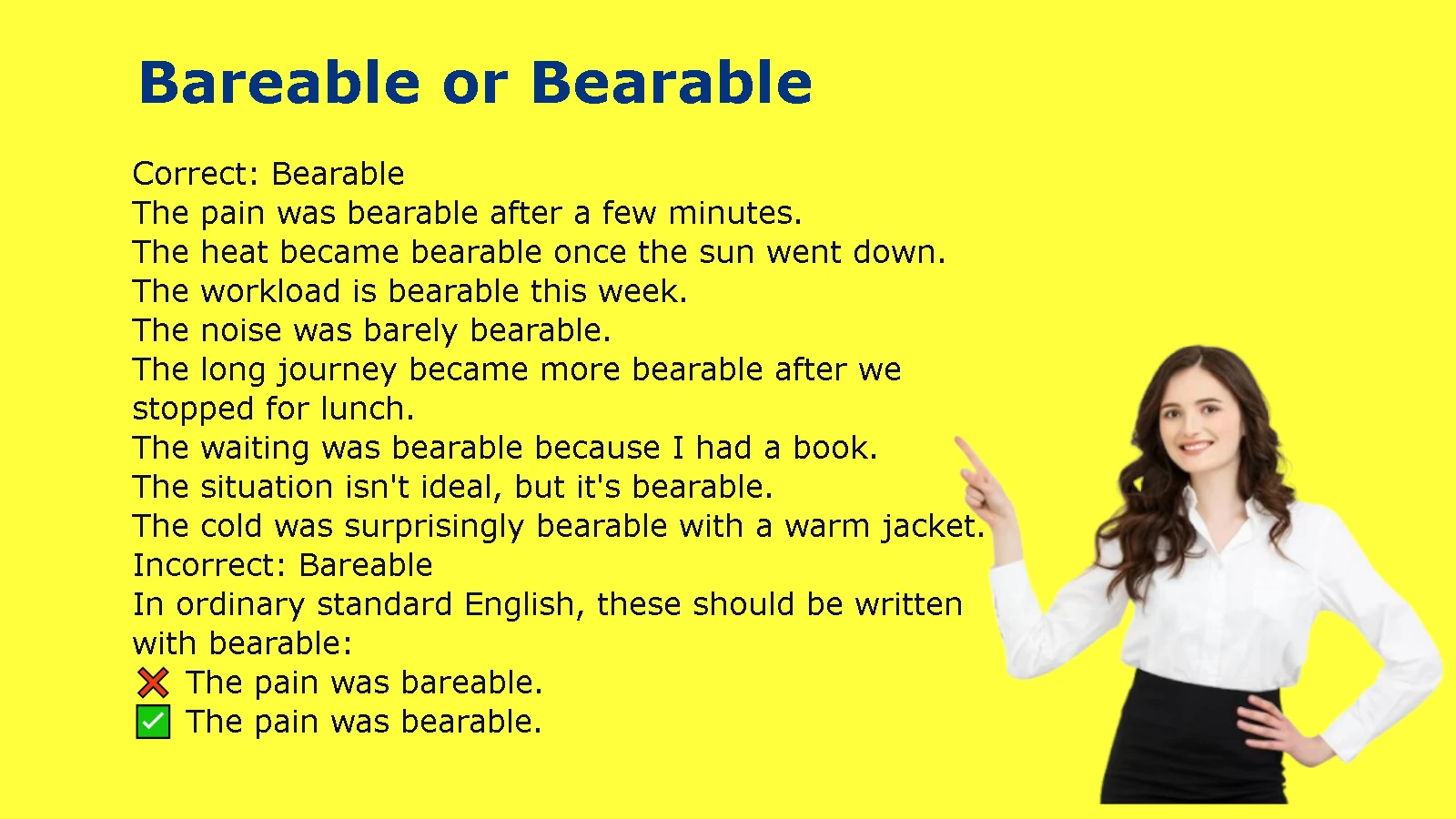
Have you ever wondered whether the correct spelling is “Bareable” or “Bearable”? These two spellings look almost identical, but only one is correct in standard English. If you’ve ever hesitated before writing the word, you’re not alone.
Bearable is the correct spelling. It means something that can be endured, tolerated, or dealt with without becoming too difficult. The word often describes pain, discomfort, stress, heat, noise, or other unpleasant experiences that you can still manage.
Examples:
- The pain was bearable after taking some rest.
- The heat was uncomfortable but still bearable.
The confusion is understandable. People often search for bareable or bearable, is it bareable or bearable, bareable meaning, or bearable meaning because the word sounds like it starts with “bare.” And here’s the kicker: although bareable may look like a logical spelling, it is not the standard form of the word.
In this guide, you’ll learn whether bareable or bearable is correct, the meaning and definition of bearable, its pronunciation, correct usage, and examples in sentences. You’ll also discover why bearable is spelled with “bear”, along with simple tips to help you remember the correct spelling.
Is It Bareable or Bearable?
Bearable is the standard spelling.
| Spelling | Standard English? | Meaning |
| bearable | Yes | Able to be endured, tolerated, accepted, or dealt with |
| bareable | No, when intended to mean bearable | Usually a spelling mistake |
The easiest way to remember the difference is to connect bearable with the verb bear.
If you can bear something, that thing is bearable.
For example:
- I can bear the noise. → The noise is bearable.
- She couldn’t bear the heat. → The heat was unbearable.
- We can bear the delay. → The delay is bearable.
This relationship explains the spelling better than simply memorizing six letters.
Why Do People Spell It “Bareable”?
The mistake usually comes from the pronunciation.
In American English, bearable is pronounced approximately BAIR uh buhl. Cambridge gives the US pronunciation as /ˈber.ə.bəl/.
Because bear and bare are pronounced alike in standard English, it’s easy to confuse them when writing.
There’s another reason, too. English frequently forms adjectives with the suffix -able, which means roughly “able to be” or “capable of.” Oxford specifically gives bearable as an example of an adjective formed with -able.
That can lead someone to reason incorrectly:
bare + able = bareable
But English doesn’t work that way here.
The established word is:
bear + able = bearable
So the spelling depends on the meaning of bear, not bare.
What Does Bearable Mean?
Bearable is an adjective that describes something you can endure, tolerate, accept, or deal with even though it may be unpleasant.
Cambridge explains the word in terms of an unpleasant situation that you can “accept or deal with.”
Oxford gives a similar definition, describing a person or thing as bearable when it can be accepted or dealt with.
In everyday English, bearable often describes something that isn’t pleasant but isn’t impossible to handle either.
Think of it as a middle point:
pleasant → uncomfortable → bearable → unbearable
For example, imagine sitting outside on a hot afternoon. The temperature isn’t comfortable, but you can still sit there for a while.
You might say:
The heat is bearable.
If the temperature becomes so extreme that you can’t reasonably tolerate it, you could say:
The heat is unbearable.
That contrast is one of the most useful ways to understand the word.
Bearable Definition in Simple English
A simple definition is:
Bearable means possible to endure or tolerate.
It doesn’t necessarily mean good.
That’s an important distinction.
If something is bearable, you aren’t saying you enjoy it. You’re saying you can put up with it.
Consider these examples:
- The noise was bearable.
The noise was unpleasant, but I could tolerate it. - The workload was bearable.
The workload was difficult, but I could handle it. - The wait was bearable.
Waiting wasn’t fun, but it wasn’t impossible. - The pain was bearable.
The pain was uncomfortable, but I could endure it.
This is why bearable often appears with words such as barely, almost, more, less, quite, and somewhat. Oxford lists several of these adverb combinations in its usage information.
Bearable vs. Bare: What’s the Difference?
The spelling confusion becomes much easier once you separate bear from bare.
They sound alike in standard English, but they have completely different meanings.
| Word | Part of speech | Main meaning | Example |
| bear | Verb | To endure, tolerate, carry, or withstand | I can’t bear the noise. |
| bare | Adjective/verb | Uncovered, empty, exposed, or lacking something | The walls were bare. |
What Does “Bear” Mean?
One meaning of bear is to endure or tolerate something.
For example:
- I can’t bear this noise.
- She could barely bear the pain.
- He couldn’t bear waiting any longer.
That meaning gives us bearable.
What Does “Bare” Mean?
Bare usually describes something uncovered, exposed, empty, or without its usual contents or covering.
For example:
- The floor was bare.
- The walls were bare.
- He walked outside with bare feet.
- They gave us the bare facts.
Notice that none of these meanings involves endurance.
That’s why bareable doesn’t replace bearable.
Why “Bearable” Uses “Bear” Instead of “Bare”
The spelling makes sense when you look at the base verb.
Bear has several meanings in English, including the sense of enduring or tolerating something. The adjective bearable comes from that idea.
The suffix -able commonly creates adjectives that describe something as capable of being done or experienced.
For example:
- read + able → readable
- understand + able → understandable
- accept + able → acceptable
- bear + able → bearable
Oxford explains that -able can form adjectives meaning “that can or must be” and specifically lists bearable as an example.
So you can think of bearable as meaning:
able to be borne
In modern everyday English, however, borne isn’t necessary for understanding the word. The simpler idea is:
bear it → bearable
That’s the spelling trick worth remembering.
Bearable vs. Bareable Examples
Seeing the words in context makes the distinction much clearer.
Correct: Bearable
- The pain was bearable after a few minutes.
- The heat became bearable once the sun went down.
- The workload is bearable this week.
- The noise was barely bearable.
- The long journey became more bearable after we stopped for lunch.
- The waiting was bearable because I had a book.
- The situation isn’t ideal, but it’s bearable.
- The cold was surprisingly bearable with a warm jacket.
Incorrect: Bareable
In ordinary standard English, these should be written with bearable:
- ❌ The pain was bareable.
- ✅ The pain was bearable.
- ❌ The heat is barely bareable.
- ✅ The heat is barely bearable.
- ❌ The workload became more bareable.
- ✅ The workload became more bearable.
- ❌ The delay was not bareable.
- ✅ The delay was not bearable.
The pattern stays the same regardless of the context.
How to Use “Bearable” in a Sentence
Bearable usually appears after a linking verb such as be, become, or seem.
“Be”
- The temperature is bearable.
- The pain was bearable.
- The noise wasn’t bearable.
“Become”
- The weather became bearable.
- The workload became more bearable.
- The situation eventually became bearable.
“Make”
Another common structure is make something bearable.
- Music made the long drive bearable.
- Her support made the difficult period more bearable.
- Air conditioning made the heat more bearable.
Oxford lists make something among the common verb patterns used with bearable.
This construction is especially useful because it shows that something can change from difficult to tolerate without becoming pleasant.
Common Phrases With Bearable
Certain combinations sound especially natural in everyday English.
Barely Bearable
Barely bearable means something is just within the limits of what you can tolerate.
- The heat was barely bearable.
- The noise became barely bearable.
- The pain was barely bearable.
There’s a subtle difference between bearable and barely bearable.
If something is bearable, you can tolerate it without necessarily struggling badly.
If something is barely bearable, you’re close to your limit.
More Bearable
More bearable means something has become easier to tolerate.
- The cooler weather made the afternoon more bearable.
- A shorter workday would make the schedule more bearable.
- Having someone to talk to made the situation more bearable.
Less Bearable
Less bearable describes something becoming harder to tolerate.
- The noise became less bearable as the day went on.
- The delay was even less bearable without an explanation.
Quite Bearable
Quite bearable means reasonably easy to tolerate.
- The temperature was quite bearable in the shade.
The exact force of quite can depend on context, but the phrase generally suggests that something is acceptable rather than terrible.
Bearable vs. Unbearable
The clearest opposite of bearable is unbearable.
The difference is straightforward:
| Word | Meaning | Example |
| bearable | Possible to tolerate | The heat is bearable. |
| unbearable | Too difficult or unpleasant to tolerate | The heat is unbearable. |
Oxford identifies unbearable as the opposite of bearable. It defines unbearable as something too painful, annoying, or unpleasant to deal with or accept.
Cambridge likewise lists unbearable as the opposite of bearable.
The prefix un- changes the meaning from possible to impossible or extremely difficult.
Compare These Sentences
Bearable:
The noise was bearable for an hour.
This means the speaker could tolerate it.
Unbearable:
The noise became unbearable after an hour.
Now the speaker can no longer reasonably tolerate it.
That small prefix creates a big difference.
Bearable vs. Tolerable
Tolerable is one of the closest synonyms for bearable.
Both words can describe something unpleasant that remains possible to endure.
| Word | Basic idea | Tone |
| bearable | Able to be endured | Natural and common |
| tolerable | Acceptable despite being unpleasant | Often slightly more formal |
| endurable | Capable of being endured | Less common in everyday conversation |
Cambridge lists tolerable as a synonym of bearable. Oxford also gives bearable as a synonym for the relevant sense of tolerable.
However, the words aren’t always interchangeable in every sentence.
Bearable
The pain was bearable.
This sounds natural and conversational.
Tolerable
The pain was tolerable.
This is also correct, but it can sound slightly more clinical or formal depending on the context.
Endurable
The hardship was endurable.
This is grammatical, but it sounds less natural in ordinary conversation.
For most everyday writing, bearable is the straightforward choice when you mean “able to be endured.”
Bearable vs. Tolerable vs. Unbearable
These words can be placed on a useful scale:
Bearable
↓
Tolerable
↓
Unbearable / Intolerable
The first two describe something that can still be endured. The last two describe something that has crossed the line.
For example:
The heat was bearable in the morning.
Later:
By afternoon, the heat was barely tolerable.
Finally:
By evening, the heat was unbearable.
This progression shows how speakers use these words to communicate degrees of discomfort.
How to Pronounce Bearable
In American English, bearable is pronounced approximately:
BAIR uh buhl
The Cambridge pronunciation is /ˈber.ə.bəl/ for US English.
Oxford gives the American pronunciation as /ˈbɛrəbl/ in its American dictionary.
The first syllable sounds like bear or bare.
That’s exactly why spelling the word can be tricky.
You hear something close to:
BAIR uh buhl
But you write:
BEARABLE
Not:
BAREABLE
Does “Bareable” Sound Different?
In most standard English pronunciation, bear and bare are homophones. That means they have the same pronunciation but different spellings and meanings.
This creates a classic spelling trap.
English contains many homophones:
- there / their / they’re
- to / too / two
- right / write
- bare / bear
The solution isn’t to rely on sound alone. You have to connect the spelling to the word’s meaning and origin.
A Simple Memory Trick for Bearable
Here’s the easiest rule:
If you can bear it, it’s bearable.
Think of these two sentences together:
I can bear the pain.
The pain is bearable.
Or:
I can’t bear the noise.
The noise is unbearable.
This trick works because it connects the adjective directly to its base verb.
Bear → Bearable
- bear
- bearable
- unbearably
- bearability
Bare → Bare
- bare feet
- bare walls
- bare facts
- bare hands
When you see bearable, think endure.
When you see bare, think uncovered.
Is “Bareable” a Word?
For the spelling question bareable or bearable, the safe answer is that bearable is the standard word for the meaning “able to be endured.”
Major English dictionaries list bearable as the established adjective. Cambridge, Oxford, and other major reference works recognize it with this meaning.
So if you’re writing an essay, email, article, report, school assignment, or professional document, use bearable.
For example:
❌ The working conditions were barely bareable.
✅ The working conditions were barely bearable.
The second sentence is the standard form.
Is Bearable an Adjective?
Yes. Bearable is an adjective.
An adjective describes a person, place, thing, condition, or situation.
In these examples, bearable describes the noun:
- bearable pain
- bearable heat
- bearable noise
- bearable conditions
- bearable workload
- bearable delay
It can also appear after linking verbs:
- The pain is bearable.
- The situation became bearable.
- The conditions seem bearable.
Oxford categorizes bearable as an adjective.
Related Forms of Bearable
Once you understand bearable, several related words become easier to recognize.
| Word | Part of speech | Meaning |
| bear | Verb | To endure, tolerate, carry, or withstand |
| bearable | Adjective | Able to be endured or tolerated |
| unbearable | Adjective | Too difficult or unpleasant to endure |
| bearably | Adverb | In a bearable manner |
| bearability | Noun | The quality or degree of being bearable |
Bear
The base verb can describe endurance:
I can’t bear this heat.
Bearable
The adjective describes something that can be endured:
The heat is bearable.
Unbearable
The opposite describes something that can’t reasonably be endured:
The heat is unbearable.
Bearably
The adverb describes the manner in which something is experienced:
The room was bearably cool.
Bearability
The noun refers to the quality or degree of being bearable.
These related forms reinforce the central spelling pattern: bear, not bare.
Case Study: Choosing the Right Word in Context
Consider a simple workplace situation.
An employee has a heavy workload. The job is stressful, but the employee can still manage it.
The natural sentence is:
The workload is bearable.
Now imagine the company adds several more tasks without extending the deadline.
The employee might say:
The workload is becoming less bearable.
If the situation gets extreme:
The workload has become unbearable.
Notice how the vocabulary changes with intensity.
| Situation | Natural expression |
| Difficult but manageable | bearable |
| Becoming harder to handle | less bearable |
| Almost impossible to tolerate | barely bearable |
| Impossible or extremely unpleasant to tolerate | unbearable |
This is more precise than simply calling every unpleasant situation “bad.”
Bearable in Everyday Writing
Bearable works across many subjects because people constantly talk about things they can or cannot tolerate.
Weather
- The temperature was bearable in the shade.
- The humidity made the heat less bearable.
Work
- The workload is bearable when the team shares it.
- The schedule became more bearable after the deadline changed.
Travel
- The eight-hour flight was bearable because I had plenty to read.
- The delay was barely bearable.
Noise
- The construction noise was bearable during the day.
- By midnight, it was no longer bearable.
Waiting
- The wait was bearable because the line moved quickly.
- Two hours without any explanation was barely bearable.
Difficult Situations
- Her support made the difficult situation more bearable.
- The financial pressure became more bearable after expenses were reduced.
These examples show an important feature of bearable: it often describes something that becomes easier because circumstances change.
Common Mistakes With Bearable
Mistake: Writing “Bareable”
❌ The heat was bareable.
Correct:
✅ The heat was bearable.
Mistake: Confusing Bear With Bare
❌ I can’t bare the noise.
Correct:
✅ I can’t bear the noise.
Here, the problem starts before bearable. The verb itself must be bear when you mean “tolerate.”
Mistake: Assuming “Bareable” Comes From “Bare”
The fact that bare exists doesn’t mean bareable is the correct formation.
Bare refers to being uncovered or lacking something:
- bare feet
- bare walls
- bare hands
- bare facts
Bear can mean endure or tolerate:
- bear the pain
- bear the pressure
- bear the noise
- bear the responsibility
That second meaning produces bearable.
Bare vs. Bear: A Quick Comparison
| Example | Correct word | Why |
| The walls were ___. | bare | The walls were uncovered or empty |
| I can’t ___ this noise. | bear | The speaker can’t tolerate it |
| The noise is ___. | bearable | The noise can be tolerated |
| The noise is ___.* | unbearable | The noise can’t be tolerated |
| She walked with ___ feet. | bare | Her feet had no shoes |
| He could barely ___ the pain. | bear | He could barely tolerate it |
One letter can change the meaning completely.
Bearable Synonyms
Depending on the context, you can replace bearable with several related words.
Tolerable
Tolerable means acceptable despite being unpleasant or less than ideal.
The heat was tolerable.
Cambridge defines tolerable as acceptable, although not necessarily good, and also uses it for things that can be accepted or endured despite being unpleasant.
Endurable
Endurable emphasizes the ability to endure something.
The discomfort was endurable.
This word is correct, but it appears less often in casual conversation than bearable.
Supportable
Cambridge lists supportable as a formal synonym of bearable.
In many everyday contexts, however, bearable or tolerable will sound more natural.
Acceptable
Acceptable can overlap with bearable, but the meaning is broader.
Something can be acceptable because it meets a standard. Something is bearable because you can endure it.
For example:
The quality is acceptable.
doesn’t necessarily mean:
The quality is bearable.
The words overlap in some contexts, but they’re not perfect substitutes.
Bearable Antonyms
The strongest common opposite is unbearable.
Other related opposites include:
- intolerable
- unendurable
- insufferable
Cambridge lists intolerable and unendurable as synonyms related to unbearable.
However, the best direct opposite for bearable is usually unbearable.
Bearable vs. Intolerable
Bearable means you can tolerate something.
Intolerable means you cannot accept or tolerate it.
Compare:
The noise was bearable.
The noise was intolerable.
The second sentence is much stronger.
Frequently Asked Questions About Bareable or Bearable
Is “bareable” or “bearable” correct?
Bearable is correct when you mean “able to be endured or tolerated.” Bareable is generally a misspelling of this word.
Is “bareable” a word?
If you intend to describe something that can be endured, use bearable. Major dictionaries recognize bearable as the standard adjective for this meaning.
What does bearable mean?
Bearable means able to be endured, tolerated, accepted, or dealt with. It usually describes something unpleasant that remains possible to handle.
What is the correct spelling of bearable?
The correct spelling is:
B-E-A-R-A-B-L-E
A useful memory aid is bear + able = bearable.
What is the difference between bare and bear?
Bare generally means uncovered, exposed, empty, or lacking something.
Bear can mean to endure or tolerate something.
For example:
- The walls are bare.
- I can’t bear the noise.
What is the opposite of bearable?
The direct opposite is unbearable.
For example:
- The heat was bearable.
- The heat became unbearable.
Oxford and Cambridge both identify unbearable as the opposite of bearable.
What is a synonym for bearable?
Common synonyms include tolerable and endurable. Cambridge also lists supportable as a formal synonym.
Is bearable an adjective?
Yes. Bearable is an adjective.
It can describe things such as:
- bearable pain
- bearable heat
- bearable conditions
- bearable noise
- a bearable workload
How do you pronounce bearable?
In US English, bearable is pronounced approximately BAIR uh buhl, with the IPA pronunciation /ˈber.ə.bəl/.
Why is bearable spelled with “bear”?
Because the adjective relates to the verb bear in the sense of endure or tolerate.
Think:
I can bear it → It is bearable.
Can you say “barely bearable”?
Yes. Barely bearable is a natural phrase meaning that something is only just tolerable.
For example:
The heat was barely bearable.
This means the speaker could tolerate the heat, but only with difficulty.
Bareable or Bearable: The Final Verdict
When you’re choosing between bareable or bearable, use bearable.
The reason is simple once you connect the adjective to its base verb:
bear → bearable
The verb bear can mean to endure or tolerate. Therefore, something that can be endured is bearable.
Bare has a different meaning. It usually describes something uncovered, exposed, empty, or lacking something. That’s why it doesn’t give us the standard spelling bareable for this meaning.
Keep this quick rule in mind:
If you can bear it, it’s bearable.
So write:
✅ The pain was bearable.
Not:
❌ The pain was bareable.
When the situation crosses the line and you can no longer tolerate it, the correct opposite is unbearable.
Bearable. Unbearable. Never bareable when you mean “able to be endured.”