Have you ever wondered whether “griefing” or “grieving” is the right word to use? These two words look almost identical, but they have very different meanings. Understanding the difference between Griefing or Grieving can help you choose the right word when talking about loss, emotions, or online behavior.
Grieving is the correct word when you mean experiencing or expressing grief, especially after the death of someone or another significant loss. Griefing, on the other hand, usually refers to deliberately annoying, upsetting, or disrupting other players in an online game or community.
Examples:
- She is grieving the loss of her father.
- The player was griefing others by repeatedly destroying their builds.
The confusion is understandable. People often search for griefing vs grieving, grieving meaning, griefing meaning, or is it grieving or griefing because both words come from “grief” but are used in completely different contexts. And here’s the kicker: using the wrong one can completely change what you mean.
In this guide, you’ll learn the complete difference between Griefing or Grieving, including their meanings, definitions, pronunciation, correct usage, and examples in sentences. You’ll also discover when to use grieving, what griefing means in gaming and online communities, and how to easily remember the difference.
Griefing or Grieving: Quick Answer
If you’re wondering whether to write griefing or grieving, use this simple rule:
Use “grieving” when someone is experiencing grief. Use “griefing” when someone is deliberately causing problems for other players, especially in an online game.
| Word | Meaning | Common context | Example |
| Grieving | Experiencing or expressing sorrow | Death, loss, mourning | The family is grieving after her death. |
| Griefing | Deliberately disrupting or annoying others | Online gaming and communities | The player was griefing the team. |
Grieving is the present participle of grieve. Merriam-Webster defines grieve as feeling or showing grief and also uses grieving for the experience of sorrow after a loss.
Griefing has a different modern meaning. In gaming, it describes behavior intended to spoil another person’s enjoyment rather than simply trying to win. Collins records the term in connection with multiplayer online games.
So, if a person has lost someone they love, they’re grieving.
If a player repeatedly destroys another player’s virtual property just to ruin the experience, they’re griefing.
That one distinction solves most cases.
What Does “Grieving” Mean?
Grieving is the present participle of the verb grieve. It describes the experience of feeling or expressing deep sorrow.
The word most often appears when someone has lost a loved one. However, grief isn’t limited to death. People can also grieve after other major losses, such as the end of a relationship, the loss of a home, or another life changing event.
Cambridge lists grieving as the present participle of grieve and gives the familiar context of feeling very sad because someone has died. Merriam-Webster gives the broader meaning of feeling or showing grief.
Definition of Grieving
In simple terms:
Grieving means feeling or expressing deep sadness because of a loss.
It can describe an internal emotional experience or the outward expression of that experience.
For example:
- She is grieving after her mother’s death.
- The children are still grieving.
- He spent months grieving the loss of his wife.
- The entire community is grieving.
- Everyone grieves differently.
The word doesn’t necessarily describe crying or visible sadness. Someone can be grieving while appearing calm, going to work, talking with friends, or handling everyday responsibilities.
Grief can look different from person to person.
How “Grieving” Works Grammatically
The base verb is grieve.
Its main forms are:
| Form | Example |
| Base form | People grieve after a major loss. |
| Third person | She grieves quietly. |
| Past tense | He grieved for his brother. |
| Present participle | She is grieving. |
| Past participle | They have grieved for years. |
The spelling grieving follows the normal spelling pattern of grieve. The final e drops before -ing, producing grieving, not grieveing.
So:
grieve → grieving
Not:
grieve → grieveing
Examples of “Grieving”
Here are several natural examples:
- She is grieving the death of her husband.
- His family is still grieving.
- The community gathered to support the grieving parents.
- She needed time to grieve after losing her dog.
- He was grieving for his closest friend.
- People don’t always grieve in the same way.
- The children are grieving the loss of their home.
- Her friends stayed close while she was grieving.
- The nation mourned as grieving families gathered together.
- He had little time to grieve before returning to work.
Notice that grieving can describe an individual, a family, or an entire community.
Common Collocations With “Grieving”
Certain words naturally appear alongside grieving.
Common examples include:
- grieving family
- grieving parents
- grieving spouse
- grieving relatives
- grieving community
- grieving children
- grieving loved ones
- grieving after a loss
- grieving the loss of someone
- grieving for someone
These combinations are useful because they show how native speakers commonly use the word.
For instance, “grieving family” sounds natural because it identifies a family experiencing sorrow. “Griefing family” would normally suggest something completely different and would be inappropriate in that context.
What Does “Griefing” Mean?
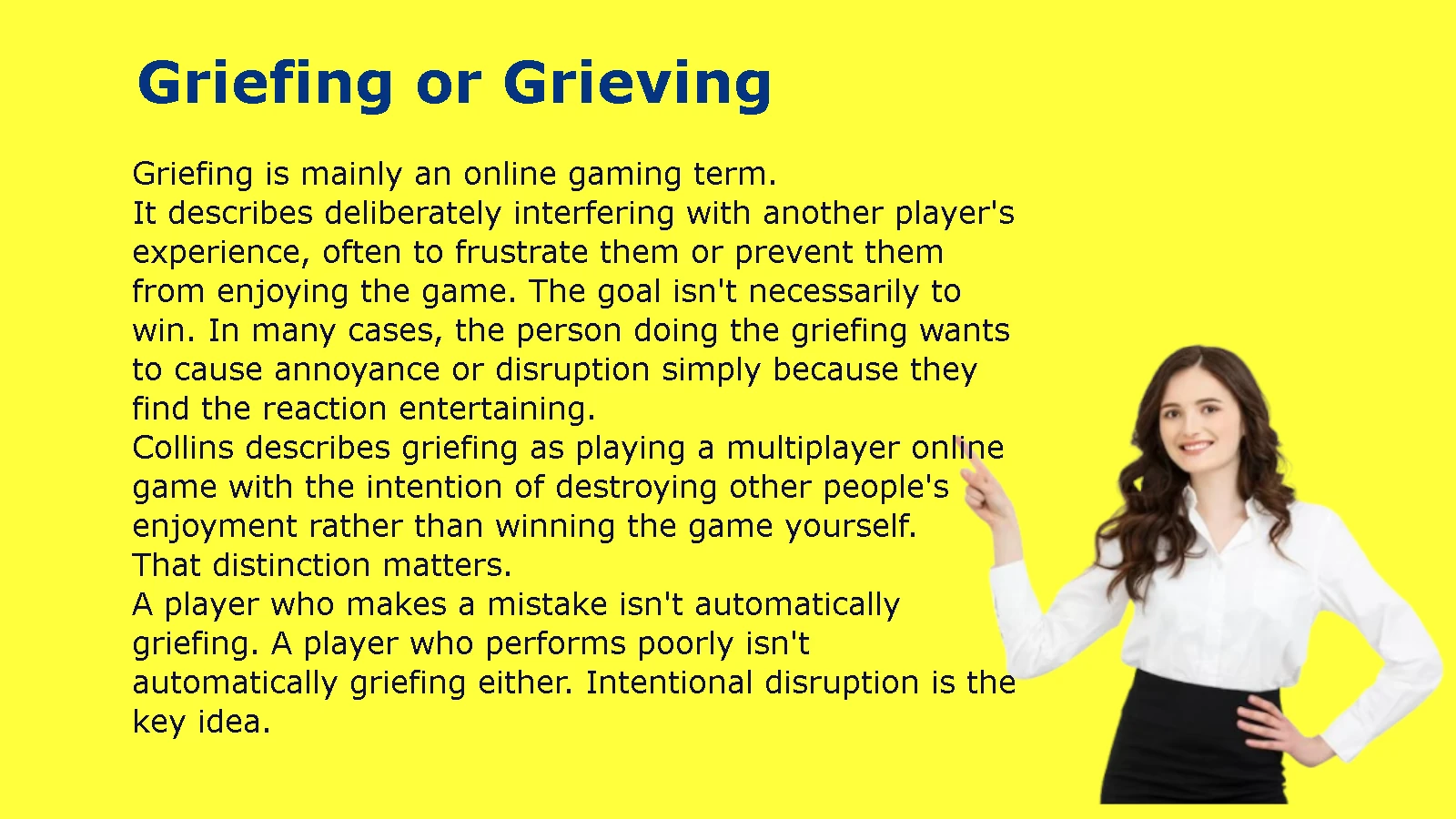
Griefing is mainly an online gaming term.
It describes deliberately interfering with another player’s experience, often to frustrate them or prevent them from enjoying the game. The goal isn’t necessarily to win. In many cases, the person doing the griefing wants to cause annoyance or disruption simply because they find the reaction entertaining.
Collins describes griefing as playing a multiplayer online game with the intention of destroying other people’s enjoyment rather than winning the game yourself.
That distinction matters.
A player who makes a mistake isn’t automatically griefing. A player who performs poorly isn’t automatically griefing either. Intentional disruption is the key idea.
Examples of Griefing
Imagine a multiplayer game where players build bases.
One player repeatedly destroys another player’s carefully built structure even though doing so provides no meaningful advantage. If the purpose is simply to frustrate the other player, that behavior can be described as griefing.
Other examples include:
- The player was griefing everyone on the server.
- We reported him for griefing.
- The moderators banned the account for repeated griefing.
- Someone kept griefing our team during the match.
- The server rules prohibit griefing.
- The player spent the entire game griefing his teammates.
- They added stronger rules to prevent griefing.
- The new player quit after repeated griefing.
What Is a “Griefer”?
A griefer is a person who engages in griefing.
The relationship looks like this:
grief → griefing → griefer
In gaming terminology:
- griefing = the behavior
- griefer = the person doing it
For example:
The griefer kept destroying other players’ builds.
That sentence has nothing to do with mourning or bereavement.
Griefing Isn’t the Same as Playing Badly
This distinction is important in gaming discussions.
A player who misses an easy shot, makes a poor decision, or doesn’t understand the game isn’t necessarily a griefer.
Bad gameplay and griefing aren’t synonyms.
Griefing generally involves intentional behavior designed to interfere with someone else’s experience.
| Behavior | Usually griefing? |
| Accidentally making a mistake | No |
| Losing a match | No |
| Being inexperienced | No |
| Choosing an unpopular strategy | Not necessarily |
| Deliberately sabotaging teammates | Yes |
| Destroying another player’s work for amusement | Yes |
| Repeatedly disrupting gameplay to frustrate others | Yes |
The exact definition can vary between games and communities, but intentional disruption remains the central idea.
Griefing vs. Grieving: The Key Difference
The easiest way to distinguish the words is to look at what the person is doing.
Grieving describes someone experiencing grief.
Griefing describes someone causing grief or disruption, especially in an online game.
| Feature | Grieving | Griefing |
| Meaning | Experiencing or expressing sorrow | Deliberately disrupting others |
| Root word | Grieve | Grief |
| Main context | Loss and mourning | Gaming and online communities |
| Typical subject | A grieving person or family | A player or online user |
| Related noun | Griever | Griefer |
| Common phrase | grieving family | griefing player |
| Example | She is grieving her mother’s death. | He was griefing the other players. |
A useful test is to ask:
Is the sentence about feeling grief or causing trouble?
If it’s about feeling grief, choose grieving.
If it’s about intentionally causing trouble in a game, choose griefing.
Why Are “Griefing” and “Grieving” So Easy to Confuse?
The two words look almost identical.
That makes the spelling easy to mix up, especially when you’re writing quickly.
There’s also an interesting historical connection behind the family of words.
The noun grief dates to the early 13th century and originally referred to hardship, suffering, pain, or affliction. Its history traces through Old French to Latin gravare, meaning roughly “to make heavy” or “to burden.”
The verb grieve is similarly old. Merriam-Webster dates its first known use to the 13th century.
The modern gaming sense of griefing is much newer.
So although the words look like close spelling variants, they developed into distinct uses.
When to Use “Grieving”
Use grieving when your sentence concerns emotional sorrow caused by loss.
Common situations include:
- Someone has died.
- Someone has lost a loved one.
- A person has lost a pet.
- Someone is dealing with a major personal loss.
- A family is mourning.
- A community has experienced a tragedy.
- Someone is going through a period of deep sadness.
Examples
Death:
She is grieving after her father’s death.
Family loss:
The grieving family asked for privacy.
Pet loss:
He was still grieving after losing his dog.
Community tragedy:
The entire town was grieving after the accident.
Personal loss:
She needed time to grieve after the relationship ended.
The word can also appear with for and over:
- She is grieving for her husband.
- He is grieving over the loss of his friend.
It can also take a direct object:
- She is grieving the death of her mother.
- They are grieving the loss of their home.
Merriam-Webster and Collins both provide examples of grieve used with a death or loss.
When to Use “Griefing”
Use griefing when you’re talking about deliberate disruption, particularly in online gaming.
Common situations include:
- Multiplayer games
- Online servers
- Team based games
- Virtual worlds
- Player versus player environments
- Online communities
- Deliberate sabotage
- Destroying another player’s progress
- Repeatedly annoying another player
Examples
- He’s griefing the entire team.
- The moderators warned the player about griefing.
- Griefing isn’t allowed on this server.
- They reported him for griefing.
- The player was accused of griefing.
- The game introduced new tools to reduce griefing.
The word often appears alongside terms such as server, player, team, game, match, online, and multiplayer.
That vocabulary provides a strong contextual clue.
If you see a sentence filled with gaming terms, griefing is probably the intended word.
Grieving vs. Mourning vs. Bereavement
These three terms are related, but they aren’t interchangeable.
Grieving
Grieving describes the emotional experience of dealing with loss.
She is grieving after her husband’s death.
Mourning
Mourning often refers to the outward expression of grief or the cultural and social practices surrounding a death.
The family was in mourning.
Bereavement
Bereavement refers to the state or experience of having lost someone through death.
She received support during her bereavement.
A simple way to remember the distinction is:
Bereavement is the loss. Grief is the emotional response. Mourning is often the outward or social expression of that grief.
These concepts overlap, but they emphasize different parts of the experience.
Common Mistakes With “Griefing” and “Grieving”
Because the words differ by only one letter, spelling mistakes are common.
Here are some of the most important ones to avoid.
| Incorrect sentence | Correct sentence | Reason |
| She is griefing after her father’s death. | She is grieving after her father’s death. | The sentence describes sorrow. |
| The family is griefing their loss. | The family is grieving their loss. | The family is experiencing grief. |
| He was grieving the other players. | He was griefing the other players. | The sentence describes deliberate disruption. |
| The player got banned for grieving. | The player got banned for griefing. | The behavior is gaming disruption. |
| The grieving player destroyed everyone’s base on purpose. | The griefing player destroyed everyone’s base on purpose. | The intended meaning is deliberate disruption. |
Mistake: “She Is Griefing After a Death”
This is one of the clearest cases.
If someone has lost a parent, spouse, friend, or another loved one, write:
She is grieving.
Not:
She is griefing.
The extra f changes the meaning completely.
Mistake: “He Is Grieving Other Players”
If a player intentionally ruins another player’s experience, write:
He is griefing other players.
If you write grieving, readers may interpret the sentence as saying that he feels sorrow for those players.
Context matters, but spelling makes the intended meaning much clearer.
Grieving or Griefing in Different Contexts
Context is your best shortcut when you’re unsure.
Talking About Death
Use grieving.
The family is grieving after the death of their grandfather.
Talking About a Personal Loss
Use grieving.
She is grieving the loss of her job.
Although grieve is especially common with death, the verb can describe sorrow over other losses as well. Merriam-Webster gives examples involving both death and non-death losses.
Talking About a Funeral
Use grieving when describing someone’s emotional state.
The grieving family gathered for the funeral.
You can also use mourning when the focus is on the ceremony, customs, or outward expression of sorrow.
Talking About Online Games
Use griefing.
The player was banned for griefing.
Talking About Minecraft and Similar Games
Griefing is particularly useful when someone intentionally damages another player’s creations or progress.
For example:
Someone kept griefing our base while we were offline.
The word fits because the behavior involves deliberate interference with gameplay.
Talking About Online Communities
Griefing can also appear outside traditional competitive matches when an online community uses the term for intentional disruption.
However, don’t automatically label every rude or unpleasant online action as griefing. Trolling, harassment, cheating, and griefing can overlap, but they aren’t identical concepts.
Griefing or Grieving in American English
There is no American versus British spelling difference here.
American English uses:
- grieving
- griefing
British English uses the same spellings.
The real issue isn’t regional spelling. It’s meaning.
That makes this different from pairs such as color/colour or favorite/favourite.
If you’re writing for an American audience, you don’t need to change either word because of regional spelling.
The Word “Grieve” Has More Than One Meaning
There’s another reason the word family can be interesting.
In addition to meaning “to feel or show grief,” grieve can have other established senses.
Merriam-Webster also lists grieve as a verb meaning to cause distress and, in a legal or formal context, to submit a grievance through a grievance procedure.
For example:
It grieves me to see him suffer.
Here, grieves means causes emotional distress.
There is also a formal labor or legal use:
The employee decided to grieve the dismissal.
In that context, grieve means to submit a formal grievance.
These meanings don’t change the answer to the griefing or grieving question, but they show why context matters when dealing with older words that have developed several uses.
How to Remember the Difference
You don’t need a complicated mnemonic.
Use the meaning as your memory trick.
Grieving = Grief
Think:
loss → grief → grieving
If someone is dealing with sorrow, they’re grieving.
Griefing = Gaming
Think:
gaming → disruption → griefing
If someone is deliberately ruining another player’s experience, they’re griefing.
Here’s an even simpler question:
Is the person feeling grief or causing grief?
If they’re feeling grief, use grieving.
If they’re deliberately causing grief in a gaming context, use griefing.
That distinction is far more useful than trying to memorize the letters in isolation.
Griefing and Grieving Example Sentences
Seeing the words in complete sentences makes the distinction much easier to remember.
Grieving Examples
- She is grieving the loss of her mother.
- The family is still grieving.
- He spent months grieving after his brother died.
- The grieving parents asked for privacy.
- She was grieving for her closest friend.
- Everyone grieves differently.
- The community came together to support the grieving family.
- He needed time to grieve.
- She is still grieving over the loss.
- The children were grieving after their grandfather died.
Griefing Examples
- The player was griefing everyone on the server.
- We reported the account for griefing.
- The moderators banned him for repeated griefing.
- Someone keeps griefing our team.
- The server rules prohibit griefing.
- The player was accused of griefing his teammates.
- They created new rules to reduce griefing.
- The griefer destroyed another player’s base.
- He wasn’t trying to win; he was griefing.
- The community has a strict policy against griefing.
The contrast becomes obvious when the sentences sit side by side.
Grieving: She is grieving the loss of her brother.
Griefing: He is griefing the other players.
One describes sorrow.
The other describes intentional disruption.
A Practical Case Study: One Letter, Two Completely Different Meanings
Consider these two sentences:
The player is grieving after the death of his teammate.
Here, grieving is correct because the player is experiencing sorrow after a death.
Now change one letter:
The player is griefing his teammates.
The meaning flips.
Now the player is deliberately disrupting or annoying his teammates.
This is why proofreading matters with words that differ by only one letter. A spell checker may not catch the mistake because both words can be legitimate English words.
The problem isn’t spelling alone.
It’s semantic accuracy.
Griefing vs. Trolling vs. Harassment
These terms sometimes appear together in gaming discussions, but they aren’t exact synonyms.
Griefing
Usually focuses on deliberately disrupting another person’s gameplay or online experience.
Trolling
Usually involves provoking someone, often for amusement or attention.
Harassment
Generally involves abusive, threatening, or unwanted behavior directed toward another person.
One action can involve more than one category.
For example, a player might repeatedly destroy someone’s virtual base while insulting them in chat. That behavior could involve griefing and harassment at the same time.
Still, the terms describe different aspects of the behavior.
Griefing or Grieving: Side by Side
Here’s the complete comparison at a glance:
| Question | Grieving | Griefing |
| What does it mean? | Feeling or expressing sorrow | Deliberately disrupting others |
| Is it connected to loss? | Yes | Usually no |
| Is it associated with death? | Very commonly | No |
| Is it associated with gaming? | No | Yes |
| Is it standard English? | Yes | Modern gaming/internet term |
| Base verb | Grieve | Grief |
| Person | Griever | Griefer |
| Example | She is grieving her father. | He is griefing the team. |
| Memory clue | Grief and loss | Gaming and disruption |
The quickest rule remains:
Grieving is about sorrow. Griefing is about deliberate disruption.
Frequently Asked Questions About Griefing and Grieving
Is “griefing” a real word?
Yes. Griefing is an established term used especially in online gaming to describe deliberate behavior intended to disrupt or ruin another player’s experience. Collins lists the gaming sense online.
It is not simply a misspelling of grieving.
What is the difference between griefing and grieving?
Grieving means experiencing or expressing sorrow after a loss.
Griefing means deliberately disrupting or annoying other people, especially in an online game.
For example:
- She is grieving her father’s death.
- He is griefing the other players.
Is “grieving” the correct word for someone who lost a loved one?
Yes.
She is grieving after losing her husband.
Grieving is the appropriate word for someone experiencing sorrow because of a death or other significant loss.
Can “griefing” mean being sad?
No.
Griefing does not mean experiencing sadness after a loss. In its common modern gaming sense, it refers to deliberate disruption or interference.
Use grieving for sorrow.
Is griefing only used in gaming?
Gaming is the main context in which the term is used and understood. It can appear more broadly in online communities, but the meaning generally remains connected to deliberately disrupting another person’s experience.
What is a person who griefs called?
In modern gaming terminology, a person who engages in griefing is commonly called a griefer.
For example:
The griefer kept destroying other players’ builds.
Is grieving only used when someone dies?
No.
Death is one of the most common contexts, but people can grieve other major losses as well. Merriam-Webster provides examples of grieve being used for losses beyond death.
Are griefing and grieving spelled differently in American and British English?
No.
Both forms are spelled the same in American and British English. The difference is meaning, not regional spelling.
Which word should I use after a death?
Use grieving.
The family is grieving after the death of their father.
Which word should I use when someone ruins another player’s game?
Use griefing.
The player was banned for griefing.
Is “griefing” the same as cheating?
Not necessarily.
Cheating usually means gaining an unfair advantage by violating game rules or using prohibited methods. Griefing focuses on deliberately disrupting another player’s experience.
A person could potentially cheat and grief at the same time, but the concepts aren’t identical.
Is “grieving” the same as mourning?
They’re closely related, but not exactly the same.
Grieving generally emphasizes the emotional experience of loss. Mourning can emphasize the outward expression or social practices associated with grief.
Final Verdict: Griefing or Grieving?
The difference between griefing and grieving is simple once you focus on meaning.
Grieving means experiencing or expressing deep sorrow, especially after a loss.
Griefing means deliberately disrupting, annoying, or ruining another person’s experience, particularly in online gaming.
Remember it this way:
If someone feels grief, they’re grieving. If someone deliberately causes grief in a game, they’re griefing.
So write:
- “She is grieving after her father’s death.”
- “The player was banned for griefing.”
Don’t swap the two.
Although they differ by only one letter, grieving and griefing live in two very different parts of the English language. One describes the heavy emotional experience of loss. The other describes a modern form of deliberate disruption in digital spaces.
When in doubt, look at the context. Loss points to grieving. Gaming disruption points to griefing.