Have you ever wondered whether you should use “While” or “Whilst” in a sentence? Both words have the same basic meaning, but their usage, tone, and regional preference can make one sound more natural than the other.
While and whilst are conjunctions that can mean “during the time that” or “although.” For example, you can use while to describe two actions happening at the same time or to introduce a contrast.
Examples:
- While I was cooking, my brother watched TV.
- Whilst I was cooking, my brother watched TV.
The confusion is understandable. People often search for while vs whilst, while or whilst, difference between while and whilst, and when to use while or whilst because both words can often fit in the same sentence. And here’s the kicker: the main difference isn’t usually meaning. It’s more about style, formality, and regional usage.
In this guide, you’ll learn the complete difference between While and Whilst, including their meanings, definitions, pronunciation, correct usage, and examples in sentences. You’ll also discover whether while or whilst is more common in American and British English, when to use each word, and which one sounds more natural in everyday writing.
While or Whilst: Quick Answer
While and whilst can mean the same thing when they are used as conjunctions. Both can introduce an action happening during the same period as another action. Both can also introduce a contrast or concession.
For example:
- I listened to music while I worked.
- I listened to music whilst I worked.
The meaning is essentially the same.
However, while is much more common, while whilst has a more formal or traditional feel and is particularly associated with British English. Cambridge Dictionary describes whilst as a UK formal conjunction and notes that while is much more common.
| Feature | While | Whilst |
| Means “during the time that” | Yes | Yes |
| Can express contrast | Yes | Yes |
| Can express concession | Yes | Yes |
| Common in American English | Yes | Less common |
| Common in British English | Yes | Yes |
| Often sounds formal | No | Yes |
| Can be a noun | Yes | No |
| Can be used in “while away” | Yes | No |
| Best general choice | Yes | Sometimes |
If you’re writing for a broad audience and aren’t sure which word to choose, use while.
It is natural, widely understood, and versatile.
What Does While Mean?
The word while has several grammatical functions. Most people first learn it as a conjunction, but it can also function as a noun and appear in established expressions.
Understanding those different roles is the key to knowing why while and whilst aren’t always interchangeable.
While Meaning “During the Time That”
The most common use of while is to connect two actions or situations that occur during the same period.
For example:
- I read while I waited for the train.
- She cooked while her husband set the table.
- He listened to a podcast while driving.
- We talked while we walked through the park.
In these examples, while establishes a time relationship. One action takes place during the period in which another action happens.
Cambridge describes this use as meaning “during the time that” or “at the same time as.”
The two clauses don’t necessarily begin or end at exactly the same moment. The important point is that their time periods overlap.
Consider:
I was reading while my sister was watching television.
The reading and television watching happen during overlapping periods. Neither activity needs to last for exactly the same length of time.
While Meaning “Although”
While can also introduce a concession. In this construction, it means something close to although or despite the fact that.
For example:
- While I understand your concern, I disagree with the decision.
- While the idea sounds promising, it could be expensive.
- While I appreciate your help, I need to finish this myself.
- While the restaurant is popular, the service can be slow.
Here, while isn’t talking about time.
Instead, it acknowledges one fact before introducing another fact that creates tension or contrast.
The pattern is often:
While + fact or concession, + main point.
For example:
While the plan has some advantages, it also creates several problems.
The sentence essentially says, “I recognize that the plan has advantages, but I want you to consider these problems too.”
While Meaning “But” or “Whereas”
Another common use of while is to compare two different facts or situations.
For example:
- My brother loves winter, while I prefer summer.
- Sarah works from home, while David goes to the office.
- This phone is cheaper, while that model has a better camera.
- The north receives more rain, while the south has a drier climate.
In these sentences, while functions as a contrast marker.
It doesn’t necessarily mean “although.” Instead, it places two facts side by side.
Cambridge identifies this use as a comparison meaning similar to but.
While as a Noun
Here’s where the difference between while and whilst becomes especially important.
While can be a noun meaning a period or length of time.
You see this in expressions such as:
- for a while
- a long while
- a short while
- quite a while
- a while ago
- in a while
For example:
- I’ll stay here for a while.
- We haven’t spoken in a while.
- She waited for quite a while.
- That happened a while ago.
- I’ll be ready in a little while.
Cambridge lists while as a noun meaning a length or period of time.
You cannot simply replace while with whilst in these constructions.
Correct:
I haven’t seen him for a while.
Incorrect:
I haven’t seen him for a whilst.
This is one of the clearest reasons why saying “while and whilst are exactly the same” goes too far.
They can share meaning in their conjunction uses, but while has additional grammatical functions.
While in “While Away”
While also appears in the expression while away, meaning to spend time in a relaxed or unproductive way.
For example:
- We whiled away the afternoon by the lake.
- She whiled away the evening reading old magazines.
- They whiled away the weekend playing board games.
The verb is while, with the past tense whiled.
You can’t substitute whilst here.
So:
We whiled away the afternoon.
is correct, while:
We whilst away the afternoon.
is not standard English.
What Does Whilst Mean?
Whilst is a conjunction. It can be used in situations where while expresses time, contrast, or concession.
Cambridge labels whilst as a UK formal conjunction and gives examples of its use for time, concession, and contrast.
Whilst Meaning “During the Time That”
The first major use is temporal.
For example:
- I listened to music whilst I worked.
- She read whilst waiting for the bus.
- He learned Spanish whilst living in Madrid.
- They talked quietly whilst walking home.
In each case, whilst means something close to during the time that.
Compare:
I listened to music while I worked.
and:
I listened to music whilst I worked.
The meaning doesn’t materially change.
The second version simply has a different stylistic flavor.
Whilst Meaning “Although”
Whilst can also introduce a concession.
For example:
Whilst I understand your concerns, I think the project is worth continuing.
This is essentially equivalent to:
While I understand your concerns, I think the project is worth continuing.
Both acknowledge the first idea before presenting the main point.
Whilst Meaning “But” or “Whereas”
Whilst can also connect two contrasting situations.
For example:
James prefers coffee, whilst Maria prefers tea.
This means roughly:
James prefers coffee, while Maria prefers tea.
Cambridge’s dictionary entries explicitly recognize whilst in contrastive constructions with a meaning similar to but.
Is There a Difference Between While and Whilst?
Yes, but the difference isn’t primarily about basic meaning.
When the words function as conjunctions, their meanings overlap heavily. The more useful distinctions involve frequency, regional usage, style, and grammatical range.
The Meaning Is Usually the Same
If while and whilst introduce the same type of subordinate clause, replacing one with the other usually doesn’t change the basic meaning.
Compare:
She called me while I was driving.
She called me whilst I was driving.
Both sentences describe an action that happened during the period when the speaker was driving.
Likewise:
While I agree with you, I have some concerns.
Whilst I agree with you, I have some concerns.
Both sentences introduce a concession.
So if someone tells you that while always means one thing and whilst always means another, be cautious. The distinction isn’t that neat.
While Is Much More Common
This is one of the most practical differences.
While is the more common word.
Cambridge explicitly states that while is much more common than whilst. It also describes whilst as more formal.
That frequency difference matters because common words tend to feel more natural in everyday writing and conversation.
For example:
Call me while you’re on your way.
sounds completely ordinary.
Call me whilst you’re on your way.
is grammatically possible, but it may sound noticeably more formal or British to many readers.
The second sentence isn’t automatically wrong. It simply has a different register.
Whilst Often Sounds More Formal
Whilst can give a sentence a formal, traditional, or distinctly British flavor.
That doesn’t mean whilst is inherently better for formal writing.
In fact, choosing a less common word merely because it sounds sophisticated can make writing feel less natural.
Compare:
While the results are encouraging, more research is needed.
with:
Whilst the results are encouraging, more research is needed.
Both work. The first is more neutral. The second may sound more formal or traditional.
As a general rule, clarity beats ceremony.
While Has Greater Grammatical Range
This is perhaps the most important technical distinction.
While can work as:
- a conjunction
- a noun
- part of the verb phrase while away
Whilst is primarily used as a conjunction.
That means while has a much broader grammatical range.
| Construction | While | Whilst |
| While I worked | ✓ | ✓ |
| While I was there | ✓ | ✓ |
| While I agree | ✓ | ✓ |
| While she prefers tea | ✓ | ✓ |
| for a while | ✓ | ✗ |
| a while ago | ✓ | ✗ |
| quite a while | ✓ | ✗ |
| while away the afternoon | ✓ | ✗ |
This distinction prevents a common mistake: treating whilst as nothing more than a longer spelling of while.
It isn’t.
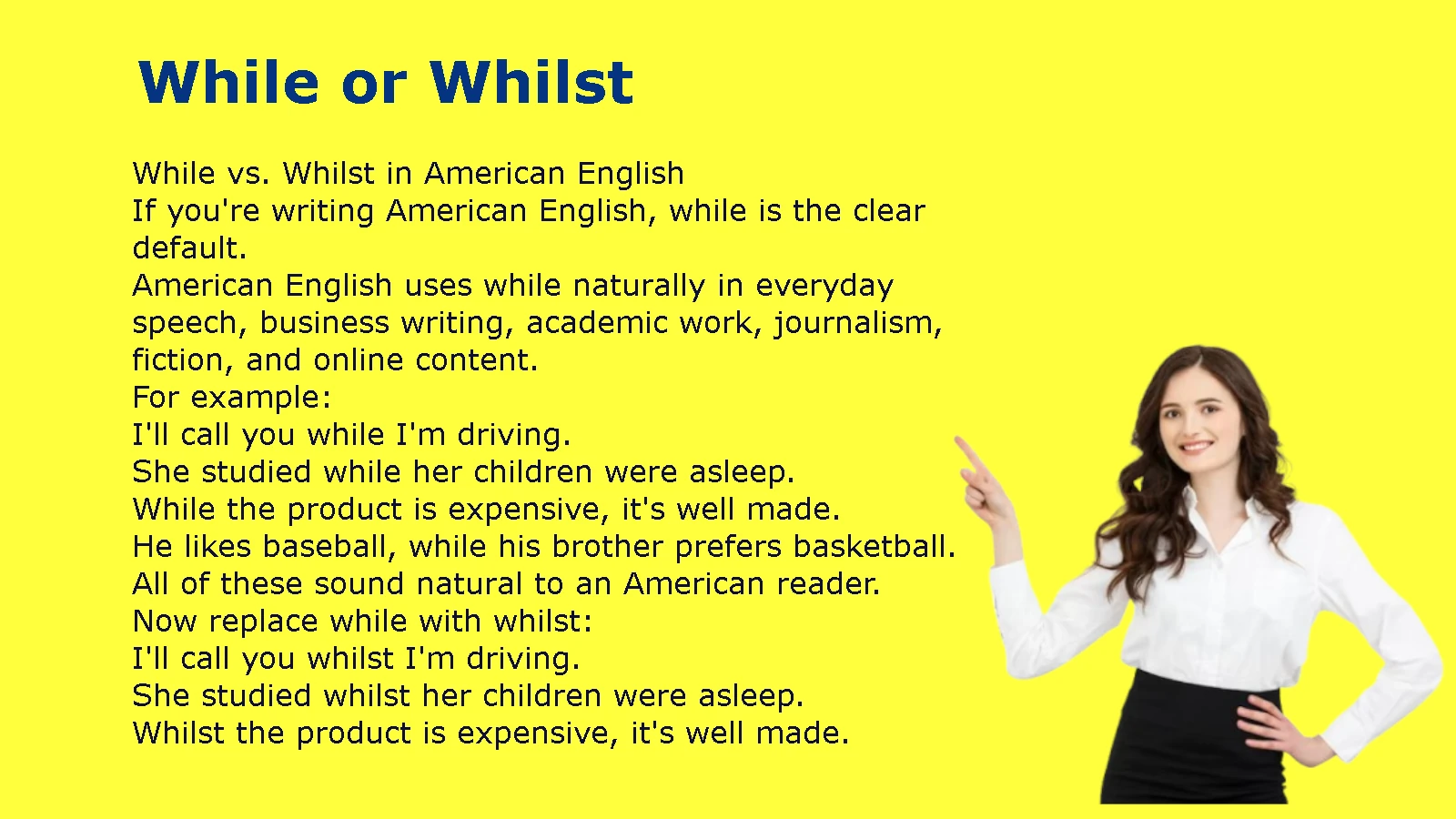
While vs. Whilst in American English
If you’re writing American English, while is the clear default.
American English uses while naturally in everyday speech, business writing, academic work, journalism, fiction, and online content.
For example:
- I’ll call you while I’m driving.
- She studied while her children were asleep.
- While the product is expensive, it’s well made.
- He likes baseball, while his brother prefers basketball.
All of these sound natural to an American reader.
Now replace while with whilst:
- I’ll call you whilst I’m driving.
- She studied whilst her children were asleep.
- Whilst the product is expensive, it’s well made.
These sentences aren’t necessarily grammatically unacceptable. However, whilst can sound unusual or conspicuously British in American English.
That’s an important distinction.
Uncommon does not mean incorrect.
If your audience is American, though, there’s usually little reason to choose the less common form.
Should Americans Use Whilst?
They can, but most don’t need to.
Use while when you want your writing to sound natural and neutral in American English.
Choose whilst only if you have a deliberate stylistic reason.
For example, a writer might use it in dialogue to give a character a particular voice. A writer might also use it when preserving a distinctly British style.
For ordinary American communication, while wins easily.
While vs. Whilst in British English
British English gives you more freedom.
Both while and whilst are used in British English. However, whilst can sound more formal or traditional.
For example:
She listened while he explained the problem.
and:
She listened whilst he explained the problem.
Both are possible.
The important point is that British English doesn’t require whilst.
You don’t need to use whilst simply because you’re writing for a British audience. While remains completely standard British English.
Cambridge’s grammar guidance makes this clear by describing both as conjunctions with the same meanings while noting that while is much more common.
So the practical British English rule is:
Use either when the conjunction fits. Choose based on tone and preference rather than a supposed grammatical requirement.
When Can You Use While and Whilst Interchangeably?
The two words are interchangeable in many conjunction constructions.
For Simultaneous Actions
Both work when two activities happen during overlapping periods.
While:
I listened to an audiobook while I cleaned the house.
Whilst:
I listened to an audiobook whilst I cleaned the house.
The meaning remains the same.
For “Although”
Both can introduce a concession.
While:
While the plan is ambitious, it could work.
Whilst:
Whilst the plan is ambitious, it could work.
Again, the meaning is essentially unchanged.
For Contrast
Both can compare two different facts.
While:
Emma enjoys hiking, while Daniel prefers cycling.
Whilst:
Emma enjoys hiking, whilst Daniel prefers cycling.
The contrast remains the same.
For Reduced Clauses
While and whilst can appear before an -ing form when the subject is understood from context.
For example:
She listened to music while walking home.
The full version could be:
She listened to music while she was walking home.
A similar construction works with whilst:
She listened to music whilst walking home.
Cambridge notes that while can be used without an explicit subject and verb in constructions such as while waiting for the bus, where the fuller form is understood from context.
When Can’t You Replace While With Whilst?
This is where the simple “they mean the same thing” explanation breaks down.
You Can’t Use Whilst in “For a While”
The noun while appears in common expressions describing a period of time.
Correct:
I’ll stay for a while.
Not standard:
I’ll stay for a whilst.
Correct:
We talked for a while.
Not standard:
We talked for a whilst.
The reason is straightforward: while is functioning as a noun in these examples.
You Can’t Replace While in “A While Ago”
Correct:
I saw him a while ago.
Not:
I saw him a whilst ago.
The phrase a while ago is an established expression.
You Can’t Replace While in “Quite a While”
Correct:
It took quite a while to finish.
Not:
It took quite a whilst to finish.
Again, while is acting as a noun meaning a period of time.
You Can’t Replace While in “While Away”
Correct:
We whiled away the afternoon.
Not:
We whilsted away the afternoon.
The verb while away is separate from the conjunction use.
These examples show why grammar matters more than spelling.
While vs. Whilst Examples
The fastest way to understand the distinction is to see both words in real sentence patterns.
| Meaning | While | Whilst |
| During an activity | She called while I was working. | She called whilst I was working. |
| Two simultaneous actions | He listened while she spoke. | He listened whilst she spoke. |
| Concession | While I agree, I have concerns. | Whilst I agree, I have concerns. |
| Contrast | I like tea, while he prefers coffee. | I like tea, whilst he prefers coffee. |
| Period of time | We waited for a while. | ✗ |
| A period ago | I saw her a while ago. | ✗ |
| Spending time | We whiled away the afternoon. | ✗ |
Everyday Conversation
Text me while you’re on the bus.
This sounds natural and relaxed.
Whilst would sound more formal than most everyday conversation requires.
Professional Writing
While the proposal has several strengths, it also presents some risks.
This is clear and professional.
You don’t need whilst to make it sound more polished.
Academic Writing
While the study provides useful evidence, its sample size is limited.
This construction is concise and conventional.
British Formal Writing
Whilst the proposal has merit, further evidence is required.
This can work when a more formal British register fits the publication or writer’s style.
The important thing is consistency. Don’t switch between while and whilst randomly simply to make the prose sound varied.
Is “Whilst” More Formal Than “While”?
Often, yes. But “more formal” doesn’t mean “more correct.”
Cambridge specifically describes whilst as formal and says that while is much more common.
Think of the difference as one of register.
Register is the level or style of language appropriate to a particular situation.
For example:
- Hey, can you wait while I grab my keys? — casual
- Please wait while I retrieve the documents. — professional
- Whilst the evidence is limited, the findings remain significant. — more formal or traditional
The second and third sentences aren’t automatically better than the first.
They’re simply suited to different contexts.
Does Formal Mean Better?
No.
A common writing trap is assuming that a longer or less familiar word sounds smarter.
It often doesn’t.
If your audience expects plain American English, while will usually communicate more naturally than whilst.
The best word isn’t the one wearing the fanciest suit.
It’s the one that fits the occasion.
Which Is Better for Formal Writing?
For most formal writing, while is an excellent choice.
There’s no grammatical requirement to replace it with whilst when you want to sound professional.
American Business Writing
Use while.
While we appreciate your proposal, we need additional information before making a decision.
This sounds professional without being stiff.
Academic Writing
Use while when it clearly expresses the relationship you want.
While previous studies focused on short-term effects, this study examines long-term outcomes.
It’s concise and precise.
General Professional Writing
Again, while is usually the best choice.
While the current system works well, we recommend upgrading the software.
The sentence is direct and easy to understand.
British Formal Writing
Both can work.
While the results are encouraging, further research is needed.
Whilst the results are encouraging, further research is needed.
The second version may sound more formal or traditional, but it isn’t inherently more professional.
Common Mistakes With While and Whilst
Knowing what not to do can save you from several unnecessary grammar problems.
Assuming Whilst Is More Correct
This is probably the most common misconception.
Whilst is not a superior form of while.
It is a legitimate conjunction, but while is also completely standard.
If anything, while is the more flexible and widely used choice.
Assuming They Are Always Interchangeable
They’re not.
You can often replace one with the other when they function as conjunctions.
You cannot replace while with whilst when while is being used as a noun.
For example:
I’ve been here for a while.
The noun while cannot simply become whilst.
Thinking Whilst Is Wrong
Calling whilst “incorrect English” is inaccurate.
Major dictionaries recognize it as a conjunction. Cambridge lists it as a formal UK conjunction and gives examples for time, concession, and contrast.
The more accurate description is:
Whilst is correct, but it is less common and more formal or traditionally British in tone.
Thinking While Is Informal
While can appear in casual conversation, but that doesn’t make it an informal-only word.
It is also completely normal in:
- academic writing
- business documents
- journalism
- technical writing
- legal writing
- professional communication
Its broad range is one of its strengths.
Inventing a Difference in Length of Time
You may encounter claims that while refers to a shorter period and whilst refers to a longer period.
That’s not a dependable rule.
The words don’t have a fixed difference in duration when they function as conjunctions.
For example:
I worked while she slept.
and:
I worked whilst she slept.
Neither sentence tells you whether the activity lasted ten minutes or ten hours.
The context determines the duration.
While vs. Whilst vs. Although vs. Whereas
These words overlap, but they aren’t identical.
Understanding the differences helps you choose the right connector instead of treating every contrast word as interchangeable.
| Word | Main function | Example |
| while | Time, contrast, concession | While I agree, I have concerns. |
| whilst | Time, contrast, concession | Whilst I agree, I have concerns. |
| although | Concession | Although I agree, I have concerns. |
| whereas | Contrast | I prefer tea, whereas she prefers coffee. |
While vs. Although
Compare:
While I understand your point, I disagree.
Although I understand your point, I disagree.
These can have nearly the same meaning.
However, while can also describe simultaneous time or direct comparison. Although is primarily a concession marker.
While vs. Whereas
These overlap when expressing contrast.
I like working early, while my colleague prefers working late.
I like working early, whereas my colleague prefers working late.
Whereas is especially clear when the purpose is to contrast two facts.
Cambridge notes that whereas can mean the same as while in sentences expressing contrast, but it cannot replace while when while refers to time.
For example:
I read while I waited.
You cannot change this to:
I read whereas I waited.
That doesn’t work because the original while expresses time rather than contrast.
While or Whilst: Punctuation Rules
The choice between while and whilst doesn’t fundamentally change the punctuation.
When a subordinate clause beginning with while or whilst comes first, a comma commonly separates it from the main clause.
For example:
While I was cooking, the phone rang.
Whilst I was cooking, the phone rang.
When the subordinate clause comes after the main clause, a comma is generally not necessary:
The phone rang while I was cooking.
The phone rang whilst I was cooking.
This pattern follows the broader punctuation behavior of introductory subordinate clauses.
Cambridge’s grammar guidance similarly shows a comma when a time clause with while comes before the main clause.
Don’t Add a Comma Automatically
Avoid treating while as a signal that a comma must follow it.
Incorrect:
I listened to music, while I worked.
A comma may sometimes be justified for a particular rhetorical reason, but it isn’t automatically required simply because while appears.
For straightforward time relationships, this is cleaner:
I listened to music while I worked.
While and Whilst With -ing Forms
Both words can introduce an -ing clause when the subject is understood.
For example:
She listened to music while studying.
This means:
She listened to music while she was studying.
Likewise:
She listened to music whilst studying.
The reduced construction is useful because it removes repetition.
However, make sure the implied subject makes sense.
Clear Example
While walking to work, Maria called her sister.
Maria is the person walking.
Problematic Example
While walking to work, the rain started.
Grammatically, the sentence appears to say that the rain was walking to work.
That’s a dangling modifier.
A clearer version would be:
While Maria was walking to work, it started to rain.
This isn’t a special rule about while or whilst. It’s a broader issue with reduced clauses and implied subjects.
While vs. When: Are They the Same?
Not always.
While and when can overlap when they describe events happening during the same period, but they don’t always communicate the same time relationship.
Cambridge explains that while generally emphasizes a period during which something happens, whereas when can also refer to a specific point in time.
Compare:
I was cooking when the phone rang.
The phone ringing is a particular event that happened during the cooking.
Now:
I cooked while my sister cleaned.
The two activities occupy overlapping periods.
This distinction becomes especially useful when choosing among while, when, and as.
While vs. During
These two words are easy to confuse because they both relate to time.
The grammatical difference is important.
While is commonly followed by a clause containing a subject and verb:
I listened to music while I worked.
During is a preposition and is followed by a noun phrase:
I listened to music during the meeting.
You wouldn’t normally say:
I listened to music during I worked.
That construction doesn’t work because during doesn’t introduce a full clause in the same way while does. Cambridge specifically warns against using during instead of while before a clause.
A useful shortcut is:
- while + clause
- during + noun phrase
For example:
while I was traveling
but:
during my trip
Case Study: Choosing Between While and Whilst
Imagine an American company publishing a customer guide.
The writer has two options:
While your order is being processed, you can track its status online.
or:
Whilst your order is being processed, you can track its status online.
Both communicate the intended time relationship.
However, while is the stronger choice for a general American audience because it is more common and neutral.
Now imagine a British historical journal discussing an archival document:
Whilst the evidence is incomplete, the surviving records provide useful insight.
Here, whilst can fit a more formal British register.
The lesson isn’t that one sentence is grammatically correct and the other is wrong.
The lesson is that audience and register influence word choice.
While or Whilst: Which One Should You Use?
The easiest way to decide is to start with your audience.
Choose While If:
- You’re writing in American English.
- You want a neutral tone.
- You’re writing for a broad international audience.
- You’re writing everyday messages.
- You’re creating business content.
- You’re writing academic material.
- You want the most common option.
- You need while as a noun.
- You’re using the expression while away.
Choose Whilst If:
- You’re deliberately using British English.
- The surrounding style is formal or traditional.
- You want a distinctly British register.
- You’re writing dialogue where the word choice suits the speaker.
- You have a consistent stylistic reason for using it.
When in Doubt
Use while.
It’s difficult to go wrong with it.
The word works naturally in American English and British English. It handles time, contrast, and concession. It can also function as a noun and appear in other grammatical constructions.
That’s a lot of work for one small word.
While or Whilst in Different Types of Writing
The best choice can become clearer when you look at specific contexts.
| Type of writing | Best default |
| American English | While |
| Everyday conversation | While |
| Text messages | While |
| Business email | While |
| Academic writing | While |
| Website content | While |
| General professional writing | While |
| British English | While or whilst |
| Traditional British style | Whilst can fit |
| Historical dialogue | Depends on voice and period |
This isn’t a rigid rulebook.
A British writer can absolutely use while in formal writing. An American writer can occasionally use whilst. Context still matters.
However, if you’re making a choice without a strong reason to prefer one, while is the practical default.
Frequently Asked Questions About While or Whilst
Is “whilst” correct English?
Yes. Whilst is a standard English conjunction. Cambridge lists it as a formal UK conjunction and gives examples of its use for time, concession, and contrast.
It isn’t an incorrect or made-up version of while.
Is “whilst” more formal than “while”?
Often, yes.
Cambridge specifically describes whilst as more formal and notes that while is much more common.
However, formal doesn’t mean superior.
Which is more common: while or whilst?
While is much more common.
This is true enough that while is usually the better default when you aren’t intentionally aiming for a particular regional or stylistic effect.
Is whilst British English?
Whilst is strongly associated with British English and is labeled UK formal by Cambridge. However, British English also uses while extensively.
So British English doesn’t mean “always use whilst.”
Is whilst used in American English?
It can appear in American English, but it is much less common than while.
For most American writing, while sounds more natural.
Can while and whilst be used interchangeably?
They can often be substituted when they function as conjunctions expressing time, contrast, or concession.
They cannot be substituted in every grammatical construction because while also functions as a noun and appears in expressions such as while away.
Can whilst mean “although”?
Yes.
For example:
Whilst I understand your concerns, I think the plan is worth trying.
Here, whilst introduces a concession similar to although.
Can whilst mean “whereas”?
Yes, in contrastive constructions.
For example:
He prefers tea, whilst I prefer coffee.
Here, whilst expresses a contrast between two preferences.
Can you say “for a whilst”?
No.
Use:
for a while
not:
for a whilst
That’s because while is functioning as a noun in the expression a while.
Is “whilst” outdated?
Not exactly.
It remains a standard word, but it can sound formal, traditional, or distinctly British depending on the context.
Calling it simply “outdated” misses the point.
Should I use while or whilst in an essay?
If you’re writing in American English, while is generally the better choice.
In British English, either can work. Choose whilst only if its tone fits the style of the essay.
Is while informal?
No.
While works across casual, professional, academic, and formal writing.
Its broad use is one reason it’s usually the safest option.
Can while mean “although”?
Yes.
For example:
While the proposal has strengths, it also has weaknesses.
Here, while means something close to although.
Can while mean “whereas”?
Yes.
For example:
The first option is inexpensive, while the second offers more features.
Here, while introduces a contrast.
Final Verdict: While or Whilst?
The difference between while or whilst is easier to understand once you separate meaning from usage.
When they function as conjunctions, they can mean essentially the same thing:
- during the time that
- at the same time as
- although
- but
- in contrast with
The main difference is how and where people use them.
While is much more common and works naturally across American and British English. It also has grammatical functions that whilst doesn’t share, including its use as a noun in phrases such as for a while and a while ago.
Whilst is a legitimate conjunction, but it is particularly associated with formal British English. It can be a good choice when that regional or stylistic tone is intentional.
So, if you’re staring at a sentence and wondering which word belongs there, here’s the simplest rule:
When in doubt, use “while.”
It’s common, flexible, clear, and grammatically versatile.
If whilst fits your audience and style, there’s nothing wrong with using it. Just don’t choose it because you think the extra two letters somehow make the sentence more intelligent.
Good writing doesn’t need a tuxedo when a clean shirt will do.
Key Takeaways
- While and whilst can have the same meaning when used as conjunctions.
- While is much more common than whilst.
- Whilst is especially associated with formal British English.
- American English strongly favors while.
- British English accepts both while and whilst.
- While can function as a noun.
- Whilst cannot replace noun phrases such as “for a while” or “a while ago.”
- While can also appear in the verb phrase “while away.”
- Neither word has a fixed meaning based on the length of time involved.
- Formal doesn’t automatically mean better.
- For most general writing, while is the safest choice.