Have you ever wondered what itch means and how to use it correctly in a sentence? The word itch is common in everyday English, but its meaning can change slightly depending on whether you use it as a noun or a verb. Understanding these uses can help you recognize the word in conversations, writing, and different contexts.
Itch means an uncomfortable feeling on your skin that makes you want to scratch. As a verb, itch means to have this feeling or to want to scratch a particular part of your body. The word can also have a figurative meaning, especially when you strongly want to do something.
Examples:
- I have an itch on my arm.
- My mosquito bite itches badly.
The confusion is understandable. People often search for itch meaning, itch definition, what does itch mean, or itch meaning in English because the word can describe both a physical sensation and a strong desire to do something. For example, someone might say they “have an itch to travel” when they strongly want to go somewhere.
In this guide, you’ll learn the complete meaning of itch, including its definition, pronunciation, origin, part of speech, and usage. You’ll also discover its noun and verb forms, figurative meaning, common expressions, and clear examples to help you understand how to use itch correctly.
What Does Itch Mean?
Itch means an uncomfortable sensation on the skin that creates an urge to rub or scratch the affected area. As a verb, itch means to have or cause this uncomfortable sensation.
The word also has a figurative meaning: a strong desire or urge to do something.
Cambridge Dictionary defines the physical sense as an uncomfortable skin feeling that makes you want to rub the area with your nails. It also recognizes the figurative construction itch to do something, which expresses a strong desire.
Itch Meaning at a Glance
| Word | Part of speech | Meaning | Example |
| itch | Noun | An uncomfortable skin sensation | “I have an itch on my neck.” |
| itch | Verb | To have an irritating skin sensation | “My arm itches.” |
| itch | Noun | A strong desire or urge | “I have an itch to travel.” |
| itch | Verb | To strongly want to do something | “She’s itching to leave.” |
| itchy | Adjective | Causing or having an itch | “This sweater is itchy.” |
| itching | Noun | The experience of having an itch | “The cream reduced the itching.” |
The easiest way to remember the core idea is this:
An itch creates an urge to scratch, while a figurative itch creates an urge to act.
That connection explains why English speakers use the same word for both physical irritation and strong desire.
Itch as a Noun
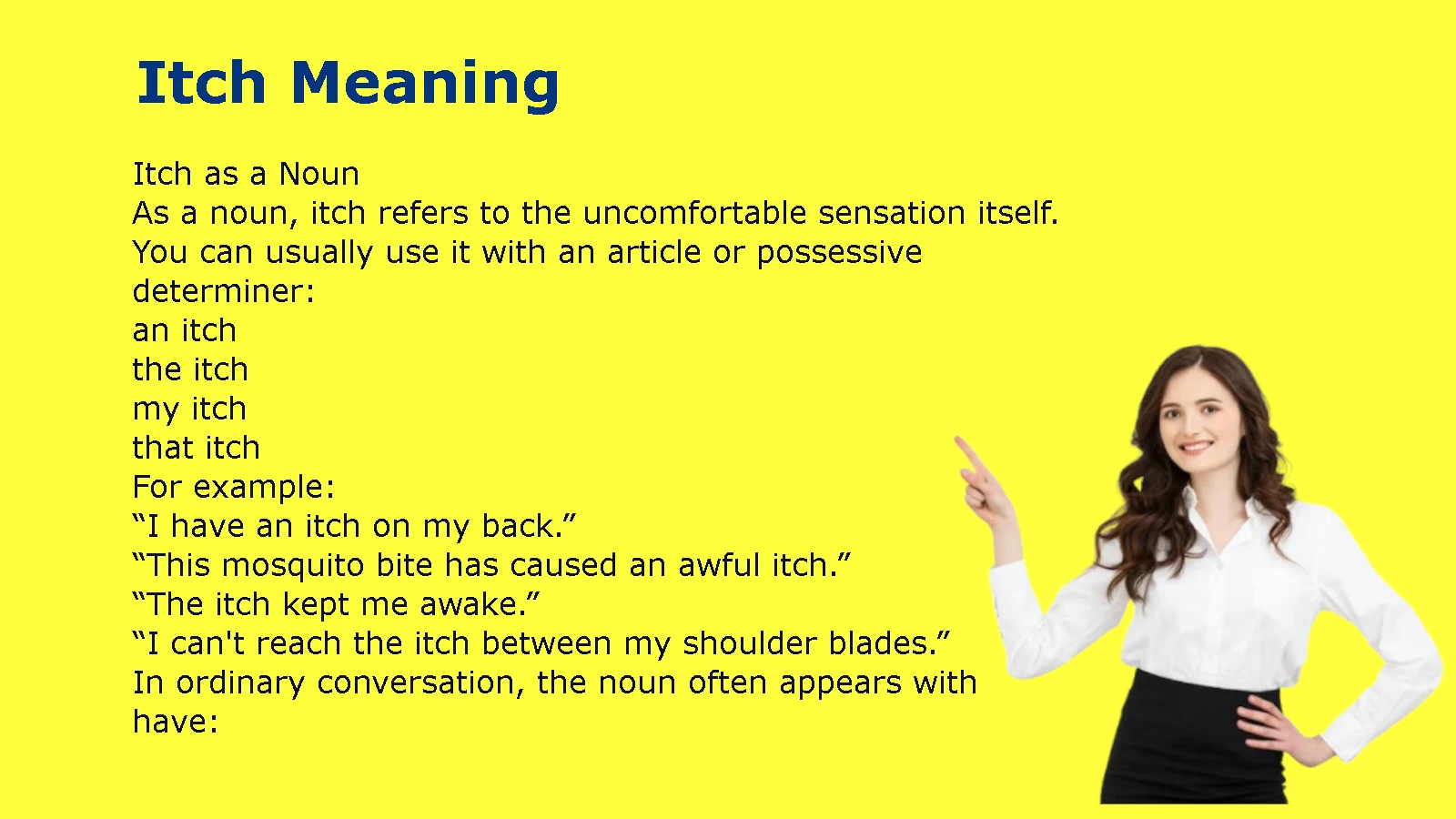
As a noun, itch refers to the uncomfortable sensation itself.
You can usually use it with an article or possessive determiner:
- an itch
- the itch
- my itch
- that itch
For example:
- “I have an itch on my back.”
- “This mosquito bite has caused an awful itch.”
- “The itch kept me awake.”
- “I can’t reach the itch between my shoulder blades.”
In ordinary conversation, the noun often appears with have:
have + an itch
This construction focuses on the sensation you are experiencing rather than the action of scratching.
Examples of Itch as a Noun
- “I have an itch on my ankle.”
- “There’s an annoying itch on my neck.”
- “The rash gave me a terrible itch.”
- “He couldn’t ignore the itch.”
- “A mosquito bite left me with a persistent itch.”
The noun can also describe a figurative desire.
- “I have an itch to travel.”
- “She has an itch for adventure.”
- “He developed an itch to start something new.”
In these sentences, nobody has a literal skin problem. Itch means a strong desire or restlessness.
Itch as a Verb
As a verb, itch describes the experience of feeling an irritating sensation on the skin.
For example:
- “My hand itches.”
- “My eyes itch.”
- “This sweater makes me itch.”
- “The mosquito bite is itching.”
- “My back started itching.”
The verb can describe something that causes the sensation as well.
“Wool makes my skin itch.”
Here, wool causes the uncomfortable sensation.
Cambridge gives similar examples involving wool, insect bites, and irritated skin.
Common Verb Patterns
Several sentence patterns are especially common:
Body part + itch
- “My arm itches.”
- “Her eyes itch.”
- “His back started itching.”
Something + makes + person + itch
- “That fabric makes me itch.”
- “The detergent makes my skin itch.”
Something + itches
- “The rash itches.”
- “The bite still itches.”
These patterns make itch a useful everyday verb because you don’t always need to say feel an itch. You can simply describe the affected area as itching.
Figurative Itch Meaning
The word itch isn’t limited to skin sensations. English speakers also use it figuratively to describe a strong desire, urge, or restlessness.
Consider this sentence:
“I have an itch to travel.”
The speaker doesn’t mean that their skin feels irritated. Instead, they feel a powerful desire to travel.
This figurative meaning comes from the idea that an itch creates an urge that demands attention. Just as a physical itch makes you want to scratch, a figurative itch makes you want to do something.
Examples of the Figurative Meaning
- “I have an itch to explore somewhere new.”
- “She has an itch to start her own business.”
- “He developed an itch for adventure.”
- “After years at the same job, she felt an itch for change.”
- “That conversation gave me an itch to learn more.”
The construction an itch to + verb is especially useful when talking about a strong personal desire.
What Does Itching to Do Something Mean?
Itching to do something means wanting to do something very much.
It is an informal expression that often suggests excitement, impatience, eagerness, or pent-up energy.
For example:
- “I’m itching to go home.”
- “She’s itching to tell everyone the news.”
- “The players are itching to get back on the field.”
- “We’re itching to start the project.”
Cambridge lists be itching to do something as an informal expression meaning to want to do something very much.
The expression works particularly well when someone has been waiting for an opportunity.
Itch to Do Something vs. Itching to Do Something
These structures are closely related:
| Expression | Meaning | Example |
| have an itch to do something | Have a strong desire | “I have an itch to travel.” |
| itch to do something | Strongly want to do something | “I itch to explore new places.” |
| be itching to do something | Be very eager or impatient | “I’m itching to get started.” |
In everyday American English, be itching to do something often sounds more natural than the bare verb itch in this figurative sense.
Itch Examples in Sentences
Seeing itch in different contexts makes the meaning much easier to understand.
Physical Itch Examples
- “I have an itch on my left arm.”
- “The mosquito bite still itches.”
- “This wool sweater makes my neck itch.”
- “My eyes itch whenever the pollen gets bad.”
- “The rash started to itch during the night.”
- “He woke up with an itch on his back.”
- “That insect bite gave me an unbearable itch.”
- “My skin feels dry and itchy after the shower.”
Figurative Itch Examples
- “I have an itch to visit another country.”
- “She has an itch for adventure.”
- “After years in the office, he developed an itch for a change.”
- “I’m itching to see the finished house.”
- “The team is itching to play again.”
- “She’s itching to share her big announcement.”
- “He has an itch to learn a new language.”
- “That book gave me an itch to explore the subject further.”
Notice the difference. Physical examples involve the skin or body. Figurative examples involve desire, action, or ambition.
Common Phrases With Itch
Several everyday expressions contain the word itch. Some describe literal sensations, while others use the word figuratively.
Have an Itch
Have an itch means to experience an irritating sensation on your skin.
- “I have an itch on my shoulder.”
- “She has an itch on her back.”
The phrase can also describe a strong desire:
- “I have an itch to travel.”
- “He has an itch to try something different.”
Context tells you which meaning the speaker intends.
Scratch an Itch
Scratch an itch literally means to scratch an area of skin to relieve an irritating sensation.
- “I need to scratch this itch.”
- “He scratched the itch on his arm.”
The phrase also has a figurative use. It can mean to satisfy a desire, curiosity, need, or interest.
For example:
- “Buying that camera scratched my photography itch.”
- “The trip scratched my itch for adventure.”
- “That documentary scratched my curiosity itch.”
The figurative version is especially common in informal English.
Itch to Do Something
Itch to do something means to strongly want to do something.
- “I itch to get back on the road.”
- “She has an itch to start a new project.”
The more common conversational form is often itching to do something:
- “I’m itching to get started.”
- “He’s itching to tell you what happened.”
Itching to Do Something
This phrase communicates strong eagerness.
Someone who says, “I’m itching to leave,” isn’t necessarily uncomfortable. They probably really want to leave and may be growing impatient.
The expression can carry a sense of anticipation:
“The students were itching to get out of the classroom.”
Here, itching suggests that the students were eager and restless.
The Seven-Year Itch
The seven-year itch is a well-established expression associated with the idea that romantic relationships may experience dissatisfaction or restlessness after several years.
The phrase became especially familiar through popular culture and the 1955 film The Seven Year Itch. It should not be confused with the ordinary physical meaning of itch.
The important point for vocabulary learners is that itch can represent psychological restlessness as well as physical irritation.
Itch vs. Scratch
One of the most common sources of confusion is the difference between itch and scratch.
They describe two related but different things.
An itch is the sensation. A scratch is the action used to relieve it.
For example:
- “I have an itch.”
- “I scratched the itch.”
You can have an itch without scratching it. Likewise, you can scratch something that isn’t itchy.
Simple Comparison
| Word | What it means | Example |
| itch | An uncomfortable sensation | “I have an itch.” |
| itch as a verb | To experience that sensation | “My arm itches.” |
| scratch | To rub or scrape with nails or another rough surface | “I scratched my arm.” |
| scratch an itch | Scratch to relieve an itch | “I scratched the itch.” |
Think of it this way:
Itch = the problem.
Scratch = the response.
That distinction makes the words much easier to use correctly.
Itch vs. Irritation
Itch and irritation overlap, but they aren’t exact synonyms.
An itch specifically describes a sensation that creates an urge to scratch or rub the skin.
Irritation has a broader meaning. It can describe physical discomfort, inflammation, annoyance, or emotional frustration.
For example:
- “The lotion caused an itch.”
- “The lotion caused skin irritation.”
- “The loud noise caused irritation.”
The first sentence points specifically to an itchy sensation. The second is broader and could involve redness, burning, discomfort, or another reaction.
Therefore, itch is more specific than irritation when you’re talking about the urge to scratch.
Itch Synonyms
The best synonym depends on which meaning of itch you want to express.
Synonyms for the Physical Meaning
Possible related words include:
- irritation
- tingling
- prickling
- discomfort
- tickling sensation
These aren’t perfect replacements in every sentence. For instance, tingling can describe a sensation that doesn’t make you want to scratch.
Synonyms for the Figurative Meaning
When itch means a strong desire, useful alternatives include:
- urge
- desire
- craving
- longing
- impulse
- eagerness
- restlessness
Consider these examples:
- “I have an itch to travel.”
- “I have an urge to travel.”
- “I have a desire to travel.”
All three communicate desire, but the emotional tone differs. Itch often sounds more informal and energetic.
Is Itch a Noun or a Verb?
Itch is both a noun and a verb.
As a noun, it describes the sensation:
“I have an itch.”
As a verb, it describes experiencing or causing the sensation:
“My hand itches.”
The word can also function figuratively in both roles:
Noun:
“I have an itch to travel.”
Verb:
“I’m itching to travel.”
This flexibility makes itch a useful word in everyday English.
How to Use Itch Correctly
The easiest way to use itch correctly is to identify whether you’re describing a sensation, an action, or a desire.
Use Itch as a Noun for the Sensation
- “I have an itch.”
- “There’s an itch on my neck.”
- “The rash caused a terrible itch.”
Itch as a Verb for the Sensation
- “My leg itches.”
- “My eyes itch.”
- “The bite is itching.”
Itch for Strong Desire
- “I’m itching to travel.”
- “She’s itching to start.”
- “They’re itching to get back on the field.”
This figurative structure is generally informal and works especially well in conversation.
Itch Word Forms
The word also appears in several related forms.
| Word form | Part of speech | Example |
| itch | Noun/verb | “I have an itch.” / “My arm itches.” |
| itches | Verb | “Her skin itches.” |
| itched | Past tense | “My arm itched all night.” |
| itching | Present participle/noun | “My skin is itching.” |
| itchy | Adjective | “This shirt is itchy.” |
| itchiness | Noun | “The cream reduced the itchiness.” |
What Does Itchy Mean?
Itchy means having or causing an itch.
For example:
- “This sweater is itchy.”
- “My skin feels itchy.”
- “The mosquito bite is red and itchy.”
Cambridge defines itchy as having or causing an itch.
The distinction is simple:
Itch names the sensation or describes the action.
Itchy describes something that has or causes that sensation.
What Does Itching Mean?
Itching can describe the ongoing experience of having an itch.
- “The itching lasted all night.”
- “The cream reduced the itching.”
- “She complained about constant itching.”
It can also form the figurative expression itching to do something.
Cambridge uses itching as a noun for the uncomfortable skin sensation and separately recognizes the idiomatic use involving strong desire.
Itch Meaning in Different Contexts
Context can completely change what itch means.
| Context | Meaning | Example |
| Skin | Uncomfortable sensation | “I have an itch.” |
| Clothing | Something causes skin irritation | “This shirt makes me itch.” |
| Insect bite | Irritating skin sensation | “The bite itches.” |
| Allergy | Skin or body feels irritated | “My eyes itch during allergy season.” |
| Desire | Strong urge | “I have an itch to travel.” |
| Eagerness | Strong desire to act | “She’s itching to begin.” |
| Idiom | Restlessness in a relationship | “the seven-year itch” |
This range explains why simply memorizing one dictionary definition isn’t enough. The surrounding words tell you which sense applies.
The History and Origin of Itch
The history of itch reaches back to Old English.
The noun comes from Old English gicce, while the verb traces back to Old English giccan, meaning “to itch.” Etymological records connect these forms to the West Germanic root jukkjan.
The figurative idea of an itch as a restless desire is also quite old. Etymological evidence records the figurative verbal sense of feeling a provoking desire in the early 13th century. The noun sense meaning a restless desire appears by the 1530s.
That history makes the modern expression itching to do something less mysterious. English speakers have long connected physical irritation with an internal urge that demands attention.
The adjective itchy also has Old English roots, appearing as giccig.
Common Mistakes With Itch
Although itch looks simple, several usage mistakes appear frequently.
Confusing Itch With Scratch
Incorrect idea:
“An itch means scratching.”
itch isn’t the act of scratching. An itch is the sensation that makes you want to scratch.
Correct:
“I have an itch, so I scratched it.”
Assuming Itch Only Refers to Skin
The physical meaning is the most obvious one, but itch also expresses desire or eagerness.
Compare:
- “My arm itches.” → physical sensation
- “I’m itching to leave.” → strong desire
Ignoring the figurative meaning can make expressions such as itching to get started seem confusing.
Using Itchy and Itch Interchangeably
These words have different grammatical jobs.
- “My skin itches.”
- “My skin is itchy.”
- “I have an itch.”
All three are natural, but the structure changes.
Missing the Informal Tone of Itching to
Itching to do something is generally informal.
It works naturally in conversations, emails between familiar colleagues, social posts, and casual writing:
“We’re itching to get started.”
In a highly formal document, eager to, keen to, or strongly motivated to may fit better.
A Quick Case Study: Understanding Itch From Context
Consider these three sentences:
“My arm itches.”
Here, itch describes a physical sensation.
“I have an itch on my arm.”
The noun itch names the same physical sensation.
“I have an itch to leave.”
Now the meaning changes. The speaker isn’t describing their skin. They mean they have a strong desire to leave.
One small change, “to leave,” shifts the meaning from a physical sensation to a figurative urge.
That’s why context matters so much when interpreting the itch meaning.
Itch Meaning: Key Facts
Here are the most important points to remember:
- Itch can be a noun or a verb.
- As a noun, it commonly means an uncomfortable skin sensation.
- As a verb, it means to have or cause an irritating skin sensation.
- An itch can also mean a strong desire or urge.
- Itch to do something expresses a strong desire to act.
- Be itching to do something means to be very eager to do it.
- Scratch an itch can have both literal and figurative meanings.
- Itchy is the adjective related to itch.
- Itching can describe the physical sensation or form part of the figurative expression itching to do something.
- Itch and scratch aren’t synonyms. An itch is the sensation, while a scratch is an action.
- The word has roots in Old English and has been used figuratively for desire for many centuries.
Frequently Asked Questions About Itch Meaning
What does itch mean?
Itch means an uncomfortable sensation on the skin that makes you want to scratch or rub it. It can also mean a strong desire or urge to do something.
What does itch mean as a verb?
As a verb, itch means to have or cause an uncomfortable skin sensation.
For example:
“My hand itches.”
It can also have a figurative meaning:
“I’m itching to leave.”
Here, it means I really want to leave.
What does itch mean as a noun?
As a noun, itch usually means an uncomfortable skin sensation.
“I have an itch on my neck.”
It can also mean a strong desire:
“I have an itch to travel.”
What does itching to do something mean?
Itching to do something means wanting to do something very much. It often suggests eagerness or impatience.
“She’s itching to open the gift.”
This means she is very eager to open it.
What does scratch an itch mean?
Literally, scratch an itch means to rub an itchy area to relieve the sensation.
Figuratively, it can mean satisfying a desire, curiosity, interest, or need.
“The weekend trip scratched my itch for adventure.”
Is itch a noun or a verb?
Itch is both a noun and a verb.
- Noun: “I have an itch.”
- Verb: “My arm itches.”
What is another word for itch?
For the physical meaning, related words include irritation, prickling, tingling, and discomfort. For the figurative meaning, related words include urge, desire, craving, impulse, and longing.
However, these aren’t exact substitutes in every sentence.
What is the difference between itch and scratch?
An itch is an uncomfortable sensation that makes you want to scratch. A scratch is the action of rubbing or scraping the skin, often to relieve an itch.
What does have an itch mean?
Have an itch usually means to experience an uncomfortable skin sensation.
“I have an itch on my back.”
In a figurative context, have an itch to do something means to have a strong desire to do it.
What does the seven-year itch mean?
The seven-year itch is an expression associated with restlessness or dissatisfaction in a romantic relationship after several years. It is a figurative use of itch rather than a reference to a literal skin sensation.
Final Takeaway on Itch Meaning
The word itch has two central ideas: a physical sensation and a strong urge.
In its literal sense, an itch is the uncomfortable feeling that makes you want to scratch. As a verb, itch describes experiencing that sensation, as in “My arm itches.”
In its figurative sense, itch describes a strong desire or restlessness. Expressions such as itch to do something, itching to do something, and scratch an itch show how naturally English connects physical urges with emotional ones.
Once you understand that basic connection, the word becomes easy to recognize in almost any context. An itch makes you want to scratch; a figurative itch makes you want to act.